
Table of Contents
- Introduction
- What is Respiration?
- Difference Between Breathing and Respiration
- Why Do Living Organisms Need Respiration?
- Process of Breathing in Humans
- Human Respiratory System
- Breathing Rate
- Aerobic Respiration
- Anaerobic Respiration
- Respiration in Different Organisms
- Respiration in Plants
- Important Terms
- NCERT Important Points
- MCQs
- Fill in the Blanks
- Short Answer Questions
- Long Answer Questions
- Chapter Summary
- Conclusion
Introduction
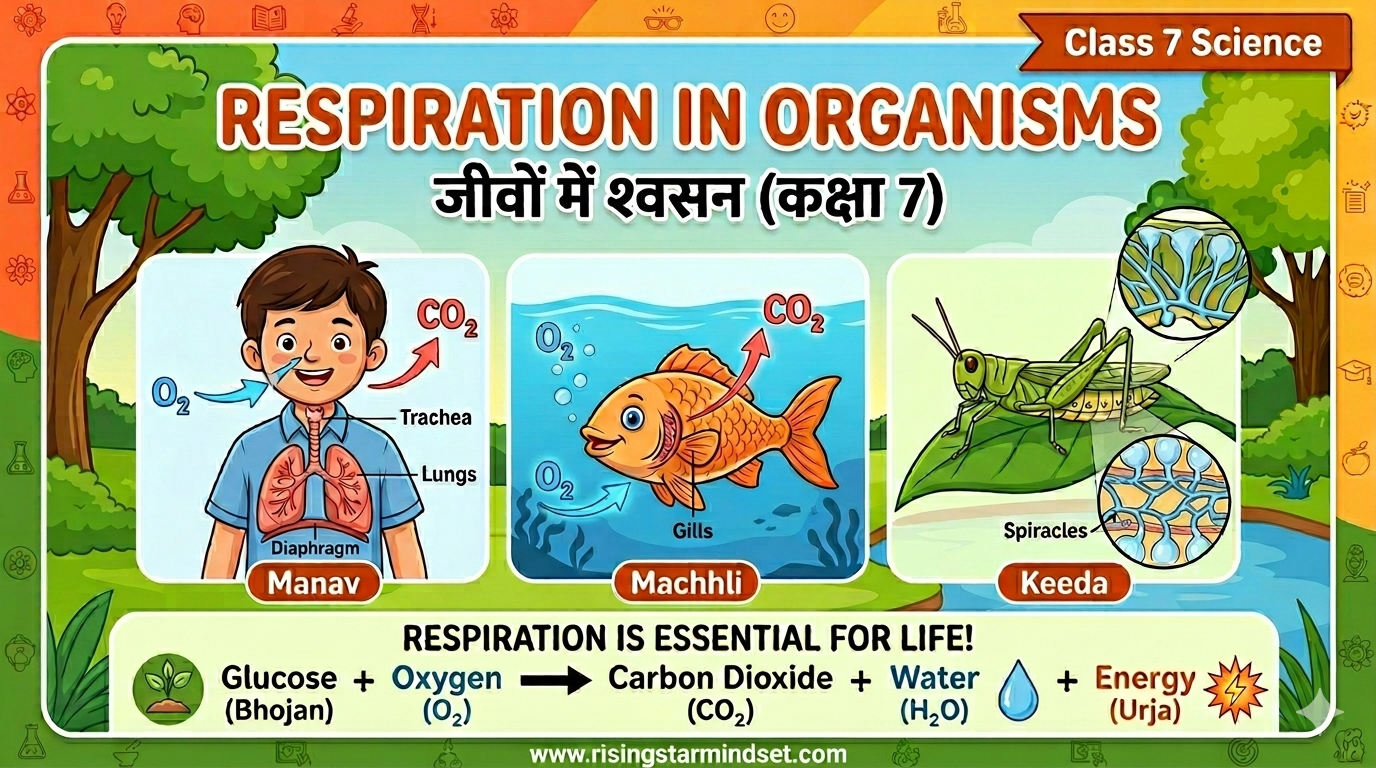
Every living organism requires energy to perform various activities such as walking, running, studying, growing, reproducing, and even sleeping. This energy is obtained from food through a process called respiration. ( Respiration in Organisms )
Respiration is one of the most important life processes. Without respiration, no living organism can survive.
What is Respiration?
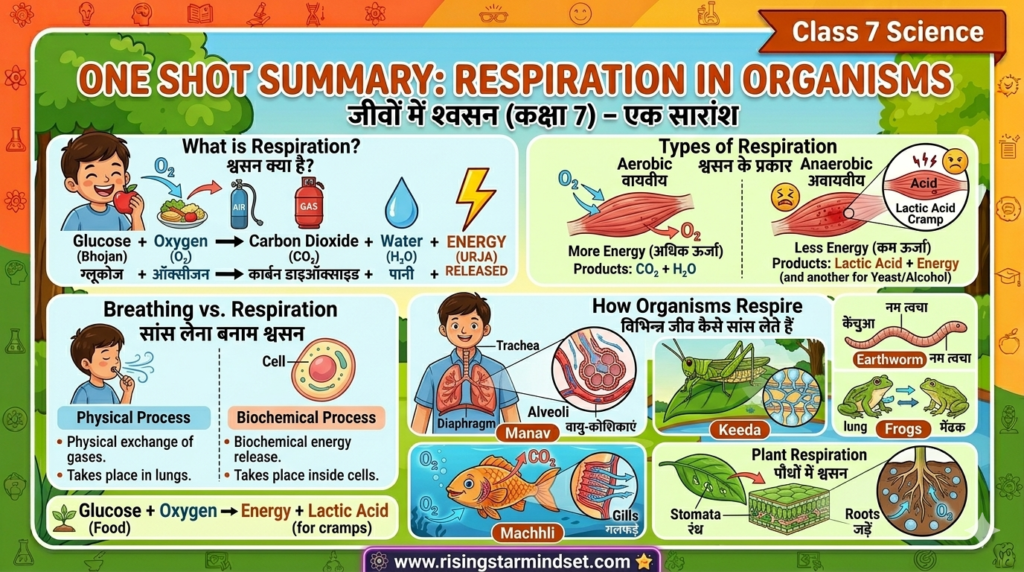
Respiration is the process by which food is broken down in the cells of the body to release energy.
Word Equation:
Glucose+Oxygen→Carbon Dioxide+Water+Energy
The released energy is used for all body activities.
Difference Between Breathing and Respiration
| Breathing | Respiration |
|---|---|
| Physical process | Chemical process |
| Occurs in lungs | Occurs in cells |
| Involves inhaling and exhaling air | Involves breakdown of food |
| Does not release energy directly | Releases energy |
| Visible process | Microscopic process |
Important Exam Point
Breathing is a part of respiration, but respiration is not just breathing.
Why Do Living Organisms Need Respiration?
Respiration provides energy for:
Growth
Movement
Digestion
Blood circulation
Thinking and learning
Repair of body tissues
Reproduction
Process of Breathing in Humans ( Respiration in Organisms )
Breathing occurs in two stages:
1. Inhalation
- Air enters through nostrils.
- Oxygen-rich air reaches lungs.
- Chest cavity expands.
2. Exhalation
- Carbon dioxide-rich air leaves the body.
- Chest cavity contracts.
Human Respiratory System ( Respiration in Organisms )

Main Parts
- Nostrils
- Nasal Cavity
- Windpipe (Trachea)
- Bronchi
- Lungs
- Diaphragm
Functions
| Organ | Function |
|---|---|
| Nostrils | Air enters body |
| Trachea | Passage for air |
| Lungs | Exchange of gases |
| Diaphragm | Helps breathing |
Breathing Rate
The number of breaths taken in one minute is called the breathing rate.
Average Breathing Rate
| Activity | Breaths per Minute |
|---|---|
| Resting Adult | 15–18 |
| Running | 25–30 or more |
| Infant | 30–60 |
Activity
Count your breathing rate:
- Sit quietly.
- Count breaths for one minute.
- Record the result.
Aerobic Respiration
Respiration that occurs in the presence of oxygen is called aerobic respiration.
Equation
C6H12O6+6O2→6CO2+6H2O+Energy
Characteristics
✔ Requires oxygen
✔ Produces large amount of energy
✔ Occurs in humans and most animals
Anaerobic Respiration
Respiration that occurs without oxygen is called anaerobic respiration.
In Yeast
Glucose→Alcohol+Carbon Dioxide+Energy
Characteristics
✔ No oxygen required
✔ Less energy produced
✔ Occurs in yeast and some bacteria
Muscle Cramps and Anaerobic Respiration
When we perform heavy exercise:
- Muscles may not receive enough oxygen.
- Anaerobic respiration begins.
- Lactic acid is produced.
- Muscle cramps occur.
Prevention
Take rest
Deep breathing
Proper hydration
Respiration in Different Organisms
Earthworm
- Breathes through moist skin.
Cockroach
- Breathes through spiracles.

Fish
- Breathes through gills.
Plants also respire continuously.
Respiration in Plants (Respiration in Organisms )
How Plants Respire?
Plants exchange gases through:
- Stomata (Leaves)
- Lenticels (Stems)
- Root Hairs (Roots)
Important Fact
Photosynthesis occurs only in sunlight, but respiration occurs day and night.
Important Terms
| Term | Meaning |
|---|---|
| Respiration | Release of energy from food |
| Breathing | Taking in oxygen and giving out carbon dioxide |
| Inhalation | Breathing in |
| Exhalation | Breathing out |
| Trachea | Windpipe |
| Diaphragm | Muscle below lungs |
| Spiracles | Breathing openings in insects |
| Gills | Respiratory organs in fish |
| Stomata | Tiny pores in leaves |
NCERT Important Points
Respiration releases energy from food.
Oxygen is essential for aerobic respiration.
Carbon dioxide is produced during respiration.
Fish breathe through gills.
Earthworms breathe through skin.
Cockroaches breathe through spiracles.
Plants also respire.
Heavy exercise may cause muscle cramps.
MCQs
1. Energy is released during:
A. Digestion
B. Respiration
C. Photosynthesis
D. Growth
Answer: B
2. Fish breathe through:
A. Skin
B. Lungs
C. Gills
D. Spiracles
Answer: C
3. Cockroach breathes through:
A. Gills
B. Spiracles
C. Skin
D. Lungs
Answer: B
4. Anaerobic respiration occurs in:
A. Yeast
B. Human lungs
C. Fish
D. Frog
Answer: A
5. Respiration occurs:
A. Only during day
B. Only during night
C. Continuously
D. During exercise only
Answer: C
Fill in the Blanks
- Respiration releases ________.
Energy - Fish breathe through ________.
Gills - Earthworms breathe through ________.
Skin - Plants exchange gases through ________.
Stomata - Cockroach breathes through ________.
Spiracles
Short Answer Questions
Q1. What is respiration?
Respiration is the process of breaking down food to release energy.
Q2. What is breathing?
Breathing is the process of inhaling oxygen and exhaling carbon dioxide.
Q3. Why do we need oxygen?
Oxygen helps in releasing energy from food.
Q4. Why do muscle cramps occur?
Muscle cramps occur due to lactic acid accumulation during anaerobic respiration.
Q5. Name respiratory organs of fish.
Fish breathe through gills.
Long Answer Questions
Q1. Explain aerobic and anaerobic respiration.
Aerobic respiration occurs in the presence of oxygen and releases a large amount of energy. Anaerobic respiration occurs without oxygen and releases less energy.
Q2. Describe the human respiratory system.
The human respiratory system consists of nostrils, nasal cavity, trachea, bronchi, lungs, and diaphragm. Oxygen enters the lungs through inhalation, and carbon dioxide leaves during exhalation.
Q3. Explain respiration in plants.
Plants respire through stomata, lenticels, and root hairs. Respiration occurs continuously during both day and night.
Chapter Summary (Quick Revision)
Respiration releases energy from food.
Breathing is different from respiration.
Oxygen is required for aerobic respiration.
Anaerobic respiration occurs without oxygen.
Fish breathe through gills.
Earthworms breathe through skin.
Cockroaches breathe through spiracles.
Plants also respire continuously.
Muscle cramps are caused by lactic acid accumulation.
Conclusion ( Respiration in Organisms )
Respiration in Organisms is an important chapter of Class 7 Science that explains how living organisms obtain energy from food. Understanding respiration helps students learn about breathing, respiratory organs, aerobic and anaerobic respiration, and the survival mechanisms of various organisms.
📚 For more NCERT Notes, MCQs, One-Shot Revision Notes, BPSC, UPSC, SSC, Railway, Current Affairs, Motivation, and Educational Content, regularly visit:
🌐 www.risingstarmindset.com
Keep Learning, Keep Growing! 🚀