
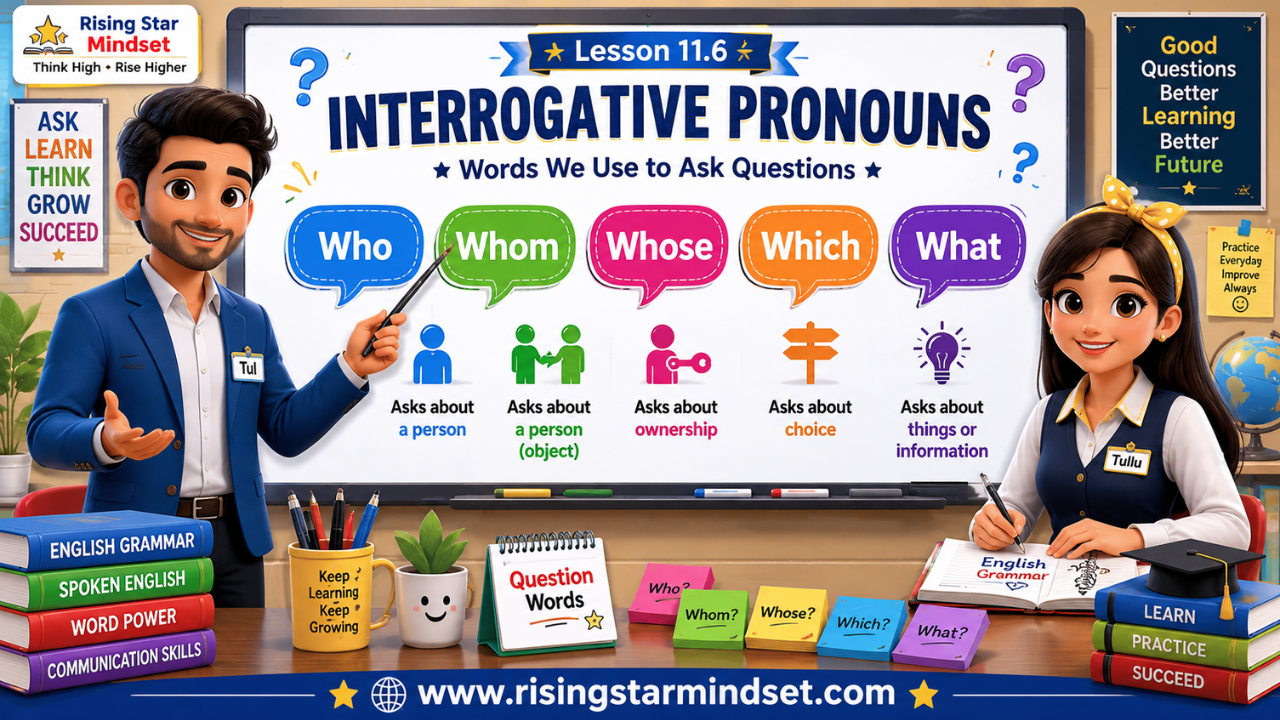
Lesson 11.6 – Interrogative Pronouns in English | Complete Beginner Guide
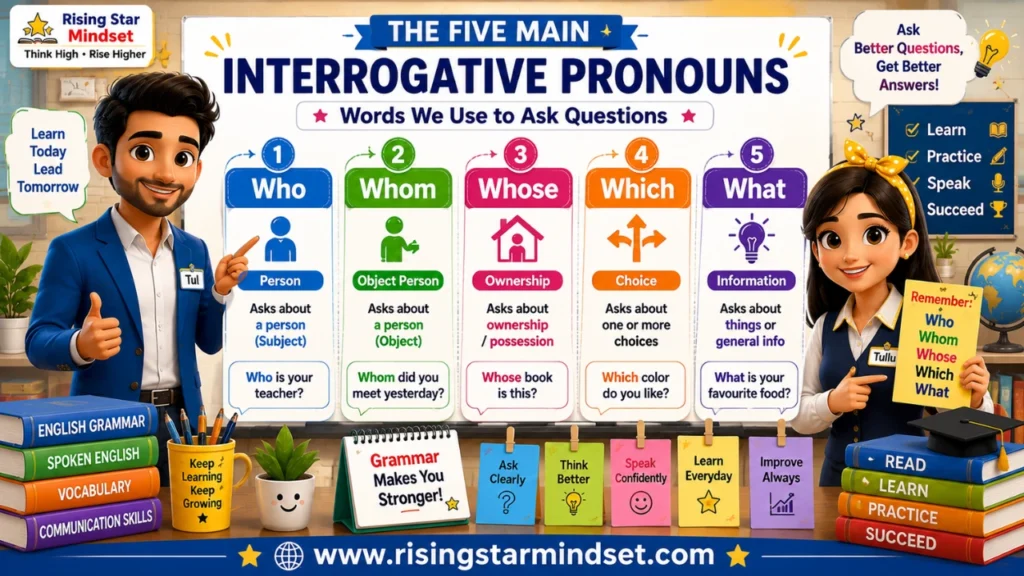
Table of Contents
- What are Interrogative Pronouns?
- Definition
- Hindi Meaning
- Why are Interrogative Pronouns Important?
- Types of Interrogative Pronouns
- Who (Subject Pronoun)
- Using Whom Correctly
- Whose (Showing Ownership)
- Which (Making a Choice)
- What (Asking for Information)
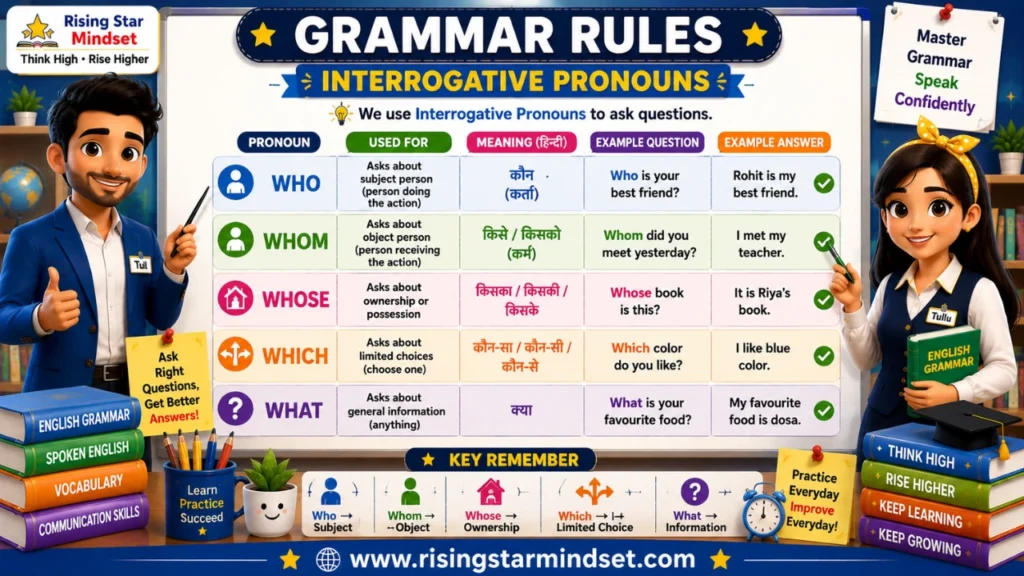
- Grammar Rules
- Sentence Structure
- Daily Conversation
- Common Mistakes
- Practice Worksheet
- Fill in the Blanks
- Match the Following
- MCQs
- HOTS Questions
- FAQs
- Conclusion
- Previous Lesson : Lesson 11.5 – How to Use Demonstrative Pronouns in English
- Next Lesson : Lesson 11.7 – Relative Pronouns in English
Quick Abbreviation ( Use Interrogative Pronouns )
| Short Form | Full Form |
| IP | Interrogative Pronoun |
| QW | Question Word |
| Eng | English |
| Hin | Hindi |
| Ex. | Example |
| MCQ | Multiple Choice Question |
| FAQ | Frequently Asked Questions |
| HOTS | Higher Order Thinking Skills |
Introduction ( Use Interrogative Pronouns )
Whenever we ask a question in English, we often begin with words like Who, Whom, Whose, Which, and What. These words help us ask about people, things, ownership, or choices. Therefore, learning Interrogative Pronouns is essential for speaking correct English and asking meaningful questions in daily conversations. ( Use Interrogative Pronouns )
परिचय ( Use Interrogative Pronouns )
जब भी हम अंग्रेज़ी में कोई प्रश्न पूछते हैं, तो अक्सर Who, Whom, Whose, Which और What जैसे शब्दों का प्रयोग करते हैं। ये शब्द व्यक्ति, वस्तु, स्वामित्व तथा विकल्प के बारे में प्रश्न पूछने में सहायता करते हैं। इसलिए Interrogative Pronouns सीखना सही अंग्रेज़ी बोलने और प्रभावी प्रश्न पूछने के लिए अत्यंत आवश्यक है।
What are Interrogative Pronouns?
English Definition
An Interrogative Pronoun is a pronoun used to ask questions about a person, thing, ownership, or choice.
These pronouns replace nouns while asking questions.
हिन्दी परिभाषा ( Use Interrogative Pronouns )
Interrogative Pronoun वह Pronoun होता है जिसका प्रयोग किसी व्यक्ति, वस्तु, स्वामित्व या विकल्प के बारे में प्रश्न पूछने के लिए किया जाता है।
यह प्रश्न पूछते समय Noun के स्थान पर प्रयोग होता है।
The Five Main Interrogative Pronouns
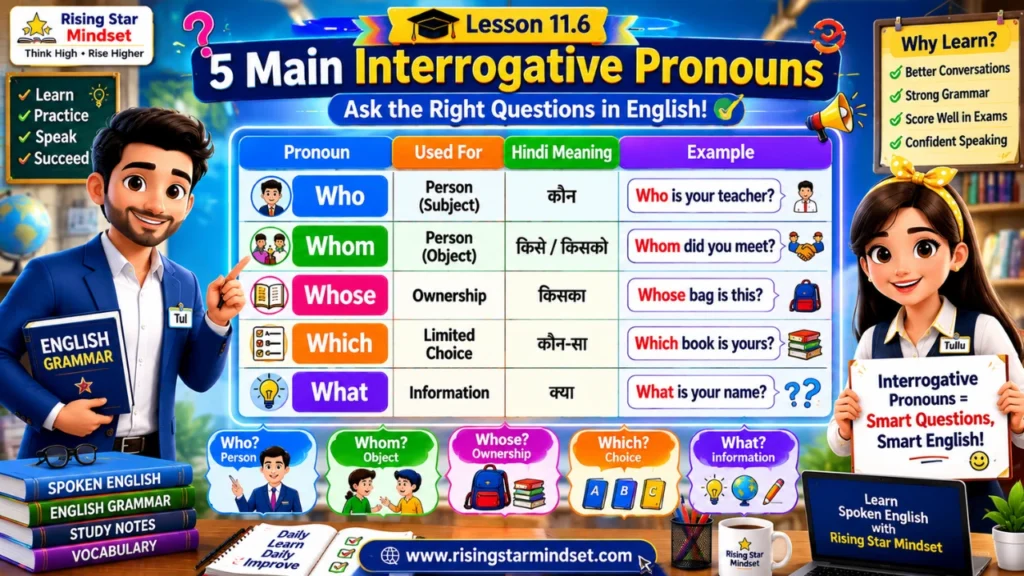
| Pronoun | Used For | Hindi Meaning |
| Who | Person | कौन |
| Whom | Object Person | किसे / किसको |
| Whose | Ownership | किसका |
| Which | Choice | कौन-सा |
| What | Thing / Information | क्या |
Why Should We Learn Interrogative Pronouns?
English
Interrogative Pronouns help us:
- Ask correct questions.
- Improve spoken English.
- Communicate confidently.
- Write grammatically correct sentences.
- Perform well in school exams.
- Crack competitive examinations.
- Speak naturally in interviews.
हिन्दी ( Use Interrogative Pronouns )
Interrogative Pronouns सीखने से—
- सही प्रश्न पूछना आसान होता है।
- Spoken English बेहतर होती है।
- Grammar मजबूत होती है।
- स्कूल परीक्षाओं में अच्छे अंक मिलते हैं।
- Competitive Exams में सहायता मिलती है।
- Interview में आत्मविश्वास बढ़ता है।
- दैनिक बातचीत आसान हो जाती है।
Types of Interrogative Pronouns
There are five main Interrogative Pronouns in English.
| Type | Example |
| Who | Who is your teacher? |
| Whom | Whom did you meet? |
| Whose | Whose book is this? |
| Which | Which is your bag? |
| What | What is your name? |
Easy Memory Trick ( Use Interrogative Pronouns )
English
Remember this order:
Who → Whom → Whose → Which → What
Think of it like this:
- Person
- Person (Object)
- Ownership
- Choice
- Thing
हिन्दी ( Use Interrogative Pronouns )
याद रखने की आसान ट्रिक—
Who → Whom → Whose → Which → What
क्रम याद रखें—
- व्यक्ति
- व्यक्ति (Object)
- स्वामित्व
- विकल्प
- वस्तु
Real-Life Examples ( Use Interrogative Pronouns )
English
- Who is she?
- What is your name?
- Which is your book?
- Whose pen is this?
- Whom did you call?
हिन्दी
- वह कौन है?
- तुम्हारा नाम क्या है?
- तुम्हारी किताब कौन-सी है?
- यह पेन किसका है?
- तुमने किसे फोन किया?
1. Who ( Use Interrogative Pronouns )
English Explanation
Who is used to ask about a person who performs an action (Subject).
It always refers to people.
Formula
Who + Verb + Object?
Examples
- Who is your teacher?
- Who opened the door?
हिन्दी व्याख्या ( Use Interrogative Pronouns )
Who का प्रयोग किसी व्यक्ति के बारे में प्रश्न पूछने के लिए किया जाता है जो कार्य करता है।
यह हमेशा Subject के लिए प्रयोग होता है।
उदाहरण
- तुम्हारे शिक्षक कौन हैं?
- दरवाज़ा किसने खोला?
- यहाँ कौन रहता है?
- मैच किसने जीता?
- तुम्हें किसने फोन किया?
Spoken English Examples
- Who are you?
- Who is she?
More examples
- Who is your best friend?
- Who is coming today?
Rule
✅ Use Who for the person doing the action.
Common Mistake
❌ Who did the work by him?
✅ Who did the work?
2. Whom ( Use Interrogative Pronouns )
English Explanation
Whom is used for the person receiving the action (Object).
It is more common in formal English.
Formula
Whom + Helping Verb + Subject + Verb?
Examples
- Whom did you meet?
- Whom were they talking about?
हिन्दी व्याख्या
Whom का प्रयोग उस व्यक्ति के लिए किया जाता है जिस पर कार्य होता है।
यह Object के लिए प्रयोग किया जाता है।
उदाहरण
- तुम किससे मिले?
- तुम किसे फोन कर रहे हो?
- मुझे किस पर भरोसा करना चाहिए?
- उसने किसे बुलाया?
- वे किसके बारे में बात कर रहे थे?
Spoken English Tip
Daily English में लोग अक्सर Who का प्रयोग Whom की जगह कर देते हैं।
Formal English में Whom सही माना जाता है।
Common Mistake
❌ Whom is your teacher?
✅ Who is your teacher?
3. Who vs Whom ( Use Interrogative Pronouns )
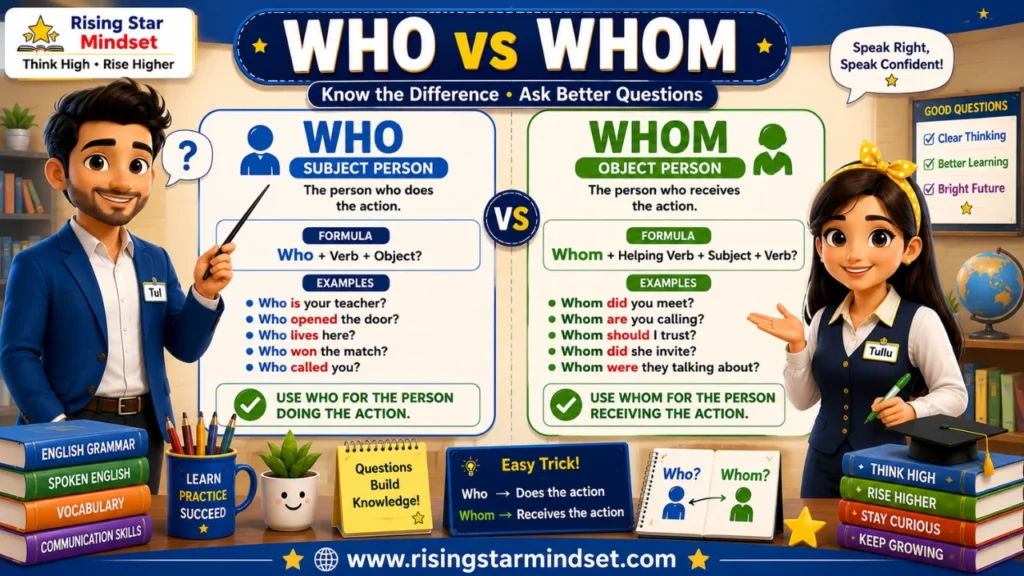
| Who | Whom |
| Subject | Object |
| Performs action | Receives action |
| Informal + Formal | Mostly Formal |
Easy Trick
Ask yourself—
Who is doing the action?
➡ Use Who
Who is receiving the action?
➡ Use Whom
Examples
Who called you?
You called whom?
4. Whose ( Use Interrogative Pronouns )
English Explanation
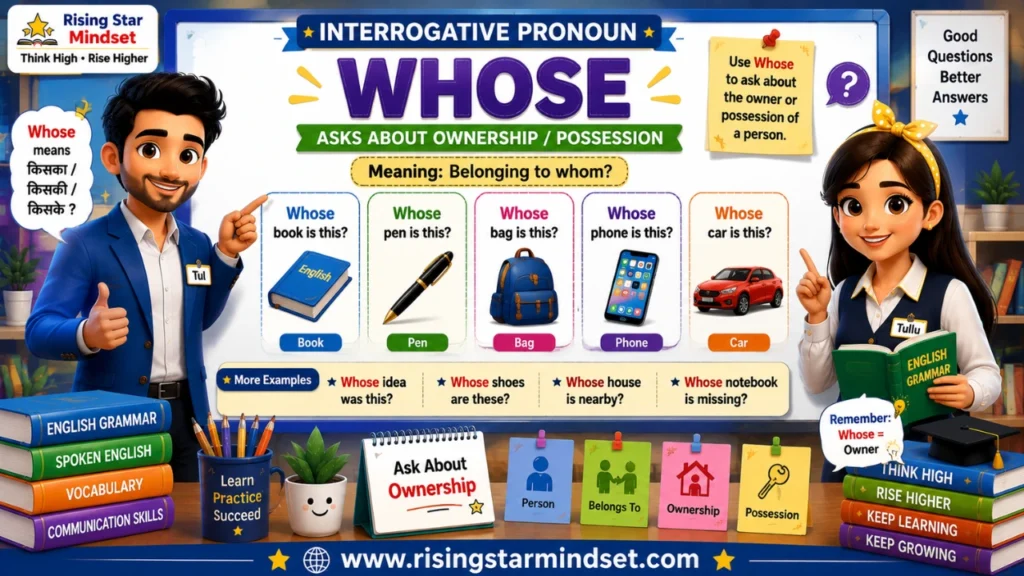
Whose is used to ask about ownership or possession.
It means “belonging to whom?”
Formula
Whose + Noun + Verb?
Examples
- Whose bag is this?
- Whose car is outside?
हिन्दी व्याख्या
Whose का प्रयोग स्वामित्व (Ownership) पूछने के लिए किया जाता है।
अर्थ—
किसका / किसकी / किसके
उदाहरण
- यह बैग किसका है?
- यह पेन किसका है?
- बाहर खड़ी कार किसकी है?
- यह मोबाइल किसका है?
- यह कॉपी किसकी है?
Spoken English Examples
- Whose idea was this?
- Whose house is nearby?
Common Mistake
❌ Who bag is this?
✅ Whose bag is this?
Quick Revision Table ( Use Interrogative Pronouns )
| Pronoun | Used For | Hindi |
| Who | Subject Person | कौन |
| Whom | Object Person | किसे |
| Whose | Ownership | किसका |
Practice Questions ( Use Interrogative Pronouns )
Choose the correct answer.
- ______ is your English teacher?
- ______ did you invite?
- ______ notebook is this?
- ______ called me yesterday?
- ______ are you waiting for?
Answers
- Who
- Whom
- Whose
- Who
- Whom
4. Which ( Use Interrogative Pronouns )
English Explanation
Which is used when we choose one or more people or things from a limited number of options.
It is used when the choices are already known.
Formula
Which + Noun + Verb?
OR
Which + Helping Verb + Subject + Verb?
Examples
- Which book is yours?
- Which color do you like?
हिन्दी व्याख्या
Which का प्रयोग तब किया जाता है जब हमें सीमित विकल्पों (Limited Choices) में से किसी एक का चुनाव करना होता है।
उदाहरण
- तुम्हारी किताब कौन-सी है?
- तुम्हें कौन-सा रंग पसंद है?
- दिल्ली कौन-सी बस जाती है?
- किस विद्यार्थी ने सही उत्तर दिया?
- हमें कौन-सा रास्ता लेना चाहिए?
Daily Spoken English ( Use Interrogative Pronouns )
- Which movie do you want to watch?
- Which pen is yours?
Grammar Rule ( Use Interrogative Pronouns )
Use Which only when choices are limited.
Example
There are five books.
Which book is yours?
Common Mistake
❌ What book is yours? (when choices are limited)
✅ Which book is yours?
5. What ( Use Interrogative Pronouns )
English Explanation
What is used to ask about things, ideas, information, professions, or general facts.
Unlike Which, What is used when there are unlimited possibilities.
Formula
What + Verb + Subject?
OR
What + Noun + Verb?
Examples
- What is your name?
- What is this?
हिन्दी व्याख्या
What का प्रयोग वस्तुओं, जानकारी, विचार, व्यवसाय तथा सामान्य प्रश्न पूछने के लिए किया जाता है।
जब विकल्प सीमित न हों, तब What का प्रयोग किया जाता है।
उदाहरण
- तुम्हारा नाम क्या है?
- यह क्या है?
- तुम क्या करते हो?
- कल क्या हुआ?
- तुम्हें किस बात से खुशी मिलती है?
Daily Spoken English ( Use Interrogative Pronouns )
- What is your hobby?
- What are you doing?
Grammar Rule
Use What for general questions.
Common Mistake
❌ Which is your name?
✅ What is your name?
Which vs What
| Which | What |
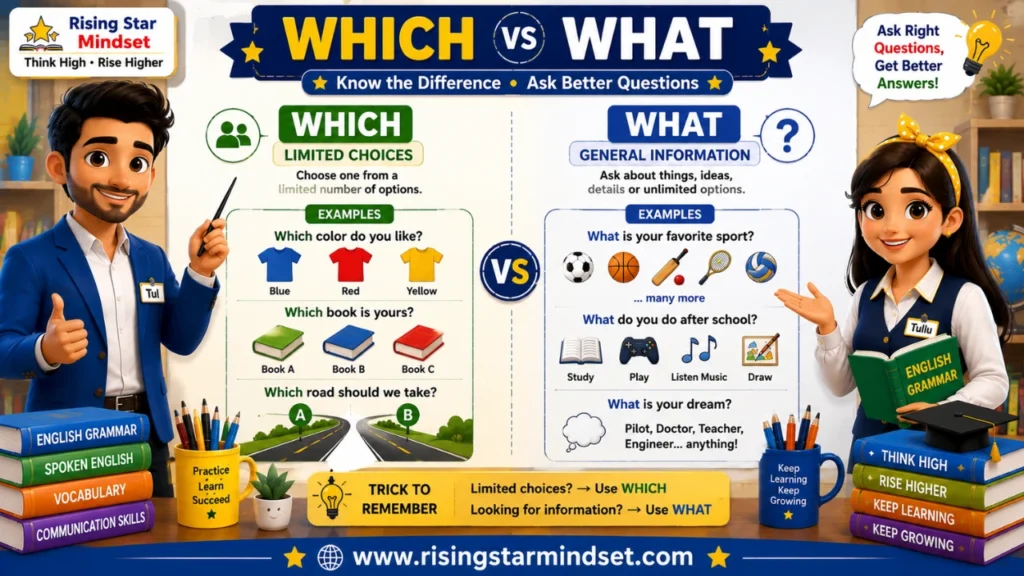
| Limited Choices | Unlimited Choices |
| Select one option | Ask general information |
| Choice-based | Information-based |
Easy Trick
Ask yourself—
Are there only a few options?
➡ Use Which
Are there many or unlimited possibilities?
➡ Use What
Comparison Examples
Which
Which pen is yours?
(There are only three pens.)
What
What is your favourite sport?
(Many possible answers)
Which
Which subject do you like most among English and Science?
What
What do you usually study every evening?
Memory Trick
Remember:
Which = Choice
What = Information
Real-Life Conversation
Conversation 1
Tul:
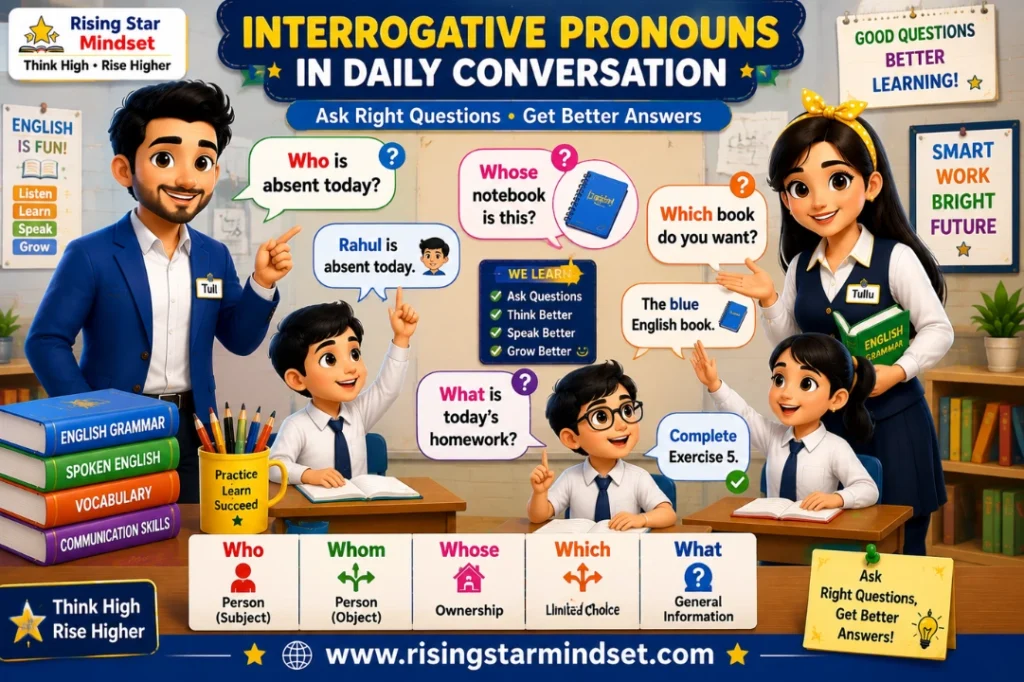
Which book do you want?
Tullu:
I want the blue one.
Conversation 2
Tul:
What is your favourite food?
Tullu:
My favourite food is dosa.
Conversation 3
Tul:
Which road leads to the school?
Tullu:
The road on the left.
Conversation 4
Tul:
What do you want to become?
Tullu:
I want to become an English teacher.
Quick Revision
| Pronoun | Used For | Hindi |
| Which | Choice | कौन–सा |
| What | Information | क्या |
Practice Questions
Choose the correct answer.
- ______ is your favourite game?
- ______ shirt do you want, the blue or the white one?
- ______ is your father’s profession?
- ______ route is shorter?
- ______ do you usually eat for breakfast?
Answers
- What
- Which
- What
- Which
- What
Practice Worksheet
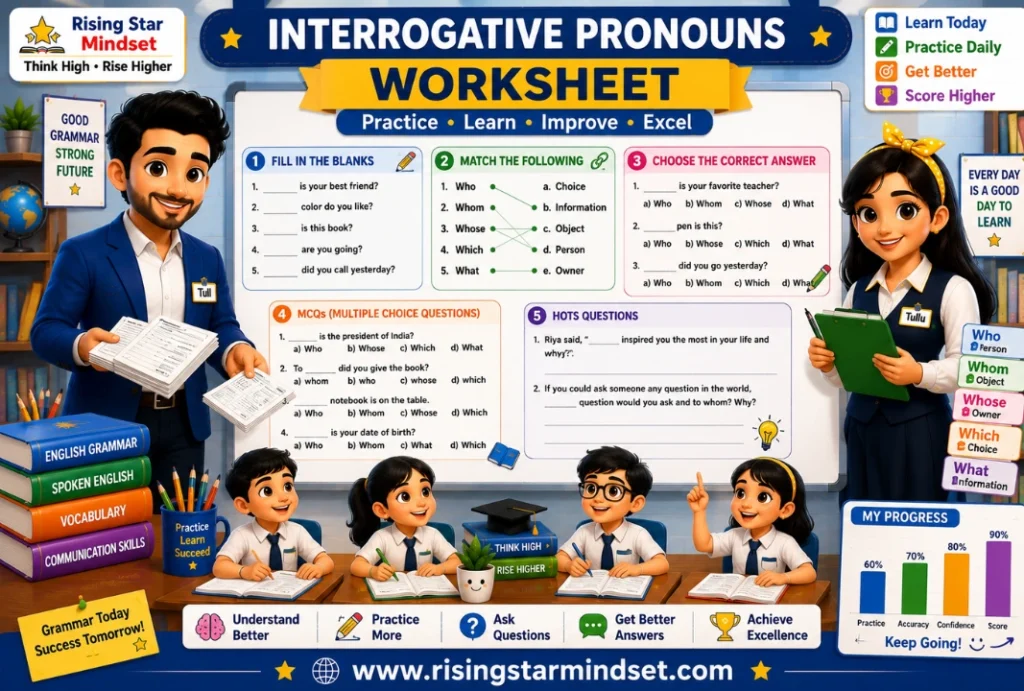
Choose the correct Interrogative Pronoun.
Exercise 1
- ______ is your best friend?
(Who / Which) - ______ bag is this?
(Whose / What) - ______ did you meet yesterday?
(Whom / Which) - ______ is your favourite subject?
(What / Whose) - ______ pen is yours?
(Which / What) - ______ is standing outside?
(Who / Whom) - ______ do you trust the most?
(Whom / What) - ______ car is parked here?
(Whose / Which) - ______ do you want to become?
(What / Which) - ______ teacher teaches Mathematics?
(Which / Whose)
Error Correction
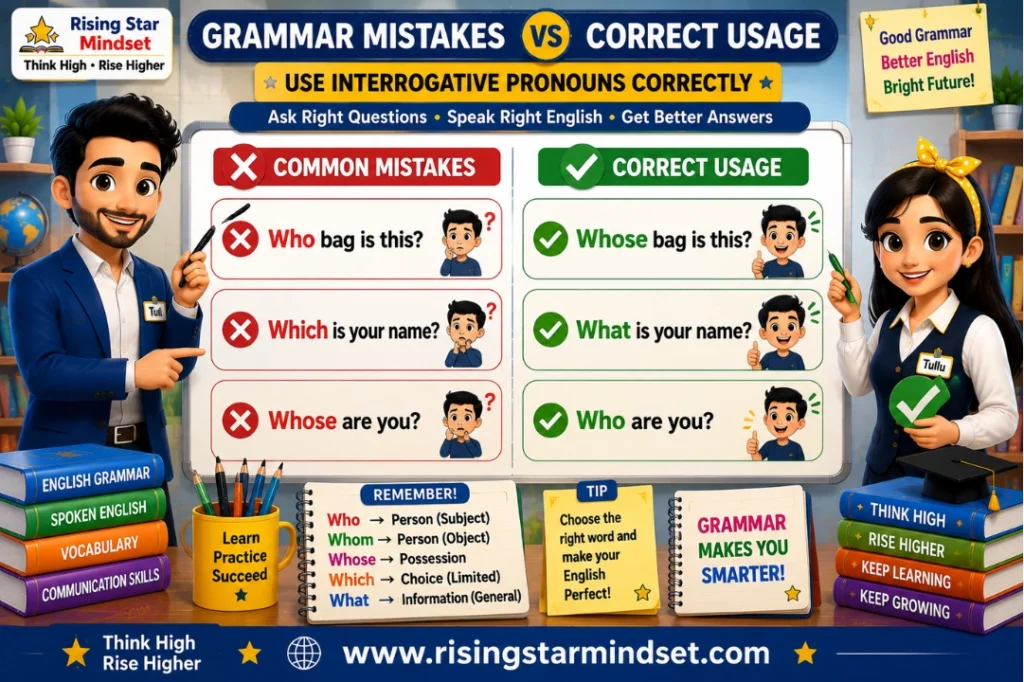
Correct the following sentences.
Question 1
❌ Whose are you?
✅ ___________________________
Question 2
❌ Which is your name?
✅ ___________________________
Question 3
❌ Who book is this?
✅ ___________________________
Question 4
❌ Whom is your English teacher?
✅ ___________________________
Question 5
❌ What pen is yours? (Only two pens are available.)
✅ ___________________________
Question 6
❌ Which do you do?
✅ ___________________________
Question 7
❌ Who did you invite to the party?
(Formal English)
✅ ___________________________
Question 8
❌ What road goes to the railway station? (Only two roads are available.)
✅ ___________________________
Multiple Choice Questions (MCQs)
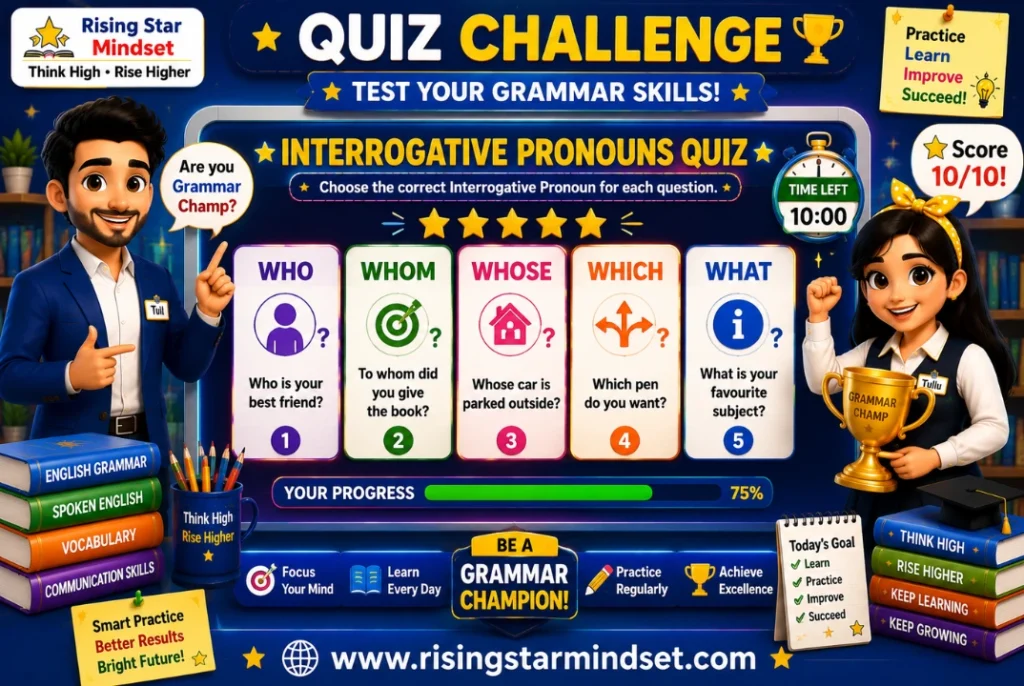
1. Which Interrogative Pronoun asks about a person?
A. What
B. Which
C. Who
D. Whose
✅ Answer: C
2. Which Interrogative Pronoun asks about ownership?
A. Who
B. Whom
C. Which
D. Whose
✅ Answer: D
3. Which Interrogative Pronoun is mainly used for an object person?
A. What
B. Whom
C. Who
D. Which
✅ Answer: B
4. Which Interrogative Pronoun asks about limited choices?
A. Which
B. What
C. Who
D. Whose
✅ Answer: A
5. Which Interrogative Pronoun asks for general information?
A. Which
B. What
C. Whom
D. Whose
✅ Answer: B
6. Choose the correct sentence.
A. Who bag is this?
B. Whose bag is this?
C. What bag is this?
D. Which bag is this?
✅ Answer: B
7. ______ is your favourite sport?
A. Which
B. What
C. Whose
D. Who
✅ Answer: B
8. ______ student won the prize?
A. Which
B. What
C. Whom
D. Whose
✅ Answer: A
9. ______ is knocking at the door?
A. What
B. Whom
C. Who
D. Which
✅ Answer: C
10. ______ did you call yesterday?
A. Who
B. Whom
C. Which
D. What
✅ Answer: B
11. ______ notebook is lying on the table?
A. Which
B. Whose
C. Who
D. What
✅ Answer: B
12. ______ do you usually do after school?
A. Which
B. What
C. Whose
D. Who
✅ Answer: B
13. Choose the correct sentence.
A. Which is your favourite colour?
B. What colour do you choose from these two?
C. Whose are you?
D. Who pen is this?
✅ Answer: A
14. ______ route is shorter?
A. Which
B. What
C. Who
D. Whose
✅ Answer: A
15. ______ invited you?
A. Who
B. Whom
C. Which
D. What
✅ Answer: A
16. ______ are you waiting for?
A. Who
B. Whom
C. Which
D. Whose
✅ Answer: B
17. ______ is your favourite teacher?
A. What
B. Which
C. Whose
D. Whom
✅ Answer: B
18. ______ phone is ringing?
A. Whose
B. Which
C. What
D. Who
✅ Answer: A
19. ______ happened yesterday?
A. Which
B. What
C. Who
D. Whose
✅ Answer: B
20. ______ student answered correctly?
A. Which
B. What
C. Who
D. Whom
✅ Answer: A
HOTS (Higher Order Thinking Skills)
Question 1
Explain the difference between Who and Whom with your own examples.
Question 2
Why do we use Which when choices are limited but What when choices are unlimited?
Question 3
Correct the sentence:
Who bag is this?
Question 4
Write one sentence using each:
- Who
- Whom
- Whose
- Which
- What
Question 5
Differentiate between Which and What with suitable examples.
Question 6
Identify the Interrogative Pronoun in the sentence:
Whose pencil is lying on the desk?
Question 7
Frame five questions that you can ask your teacher using different Interrogative Pronouns.
Question 8
Rewrite the sentence in formal English.
Who did you meet yesterday?
Question 9
Imagine you are interviewing a famous scientist. Write five questions using different Interrogative Pronouns.
Question 10
Write a short classroom conversation using Who, Whom, Whose, Which, and What correctly.
Frequently Asked Questions (FAQs)
Q1. What is an Interrogative Pronoun?
Answer (English)
An Interrogative Pronoun is a pronoun used to ask questions about people, things, ownership, or choices.
उत्तर (हिन्दी)
Interrogative Pronoun वह Pronoun होता है जिसका प्रयोग व्यक्ति, वस्तु, स्वामित्व या विकल्प के बारे में प्रश्न पूछने के लिए किया जाता है।
Q2. Which are the five main Interrogative Pronouns?
Answer (English)
The five main Interrogative Pronouns are:
- Who
- Whom
- Whose
- Which
- What
उत्तर (हिन्दी)
पाँच मुख्य Interrogative Pronouns हैं—
- Who
- Whom
- Whose
- Which
- What
Q3. What is the difference between Who and Whom?
Answer (English)
Who is used for the subject (the person doing the action), while Whom is used for the object (the person receiving the action).
उत्तर (हिन्दी)
Who का प्रयोग कार्य करने वाले व्यक्ति (Subject) के लिए किया जाता है, जबकि Whom का प्रयोग उस व्यक्ति के लिए किया जाता है जिस पर कार्य होता है (Object)।
Q4. When should we use Which instead of What?
Answer (English)
Use Which when the choices are limited. Use What when asking about general information or when there are many possible answers.
उत्तर (हिन्दी)
जब विकल्प सीमित हों, तब Which का प्रयोग करें। सामान्य जानकारी या असीमित विकल्पों के लिए What का प्रयोग किया जाता है।
Q5. Why are Interrogative Pronouns important?
Answer (English)
Interrogative Pronouns help us ask clear questions, improve spoken English, strengthen grammar, and communicate confidently.
उत्तर (हिन्दी)
Interrogative Pronouns सही प्रश्न पूछने, Spoken English सुधारने, Grammar मजबूत करने तथा आत्मविश्वास के साथ संवाद करने में सहायता करते हैं।
Quick Revision Chart
| Pronoun | Used For | Hindi Meaning |
| Who | Subject Person | कौन |
| Whom | Object Person | किसे / किसको |
| Whose | Ownership | किसका |
| Which | Limited Choice | कौन-सा |
| What | General Information | क्या |
Key Points to Remember
English
- Interrogative Pronouns are used to ask questions.
- Who → Subject Person
- Whom → Object Person
- Whose → Ownership
- Which → Limited Choice
- What → General Information
- Always choose the correct Interrogative Pronoun according to the meaning of the question.
- Regular practice improves both grammar and spoken English.
हिन्दी
- Interrogative Pronouns प्रश्न पूछने के लिए प्रयोग किए जाते हैं।
- Who → कार्य करने वाला व्यक्ति
- Whom → जिस पर कार्य होता है
- Whose → स्वामित्व
- Which → सीमित विकल्प
- What → सामान्य जानकारी
- प्रश्न के अर्थ के अनुसार सही Pronoun चुनें।
- नियमित अभ्यास से Grammar और Spoken English दोनों बेहतर होते हैं।
Lesson Summary
English
In this lesson, you learned the meaning, types, grammar rules, and usage of Interrogative Pronouns. You also understood the difference between Who, Whom, Whose, Which, and What through practical examples, conversations, worksheets, MCQs, and HOTS questions. As a result, you can now ask questions more accurately in both spoken and written English.
हिन्दी
इस Lesson में आपने Interrogative Pronouns का अर्थ, प्रकार, नियम और सही प्रयोग सीखा। साथ ही, आपने Who, Whom, Whose, Which और What के बीच का अंतर उदाहरणों, बातचीत, अभ्यास प्रश्नों, MCQs तथा HOTS Questions के माध्यम से समझा। अब आप अंग्रेज़ी में सही और प्रभावी प्रश्न पूछने में अधिक सक्षम हैं।
Previous Lesson
📘 Lesson 11.5 – Demonstrative Pronouns in English
In the previous lesson, you learned:
- Meaning of Demonstrative Pronouns
- This, That, These, Those
- Grammar Rules
- Sentence Structure
- Daily Conversations
- Common Mistakes
- Practice Exercises
- MCQs & HOTS Questions
हिन्दी
पिछले Lesson में आपने सीखा था—
- Demonstrative Pronouns का अर्थ
- This, That, These, Those
- इनके प्रयोग के नियम
- Sentence Structure
- दैनिक बातचीत
- सामान्य गलतियाँ
- अभ्यास प्रश्न
- MCQs एवं HOTS Questions
Next Lesson Notification
🚀 Lesson 11.7 – Relative Pronouns in English
In the next lesson, you will learn:
- What are Relative Pronouns?
- Who, Whom, Whose, Which, That
- Grammar Rules
- Sentence Structure
- Relative Clauses
- Daily Conversations
- Practice Exercises
- MCQs
- HOTS Questions
- FAQs
हिन्दी
अगले Lesson में आप सीखेंगे—
- Relative Pronouns क्या होते हैं?
- Who, Whom, Whose, Which और That का प्रयोग
- Grammar Rules
- Sentence Structure
- Relative Clauses
- दैनिक बातचीत
- अभ्यास प्रश्न
- MCQs
- HOTS Questions
- FAQs
Therefore, don’t miss the next lesson because Relative Pronouns help connect ideas and make English sentences more natural, fluent, and grammatically correct.
Conclusion
English
Congratulations! You have successfully completed Lesson 11.6 – Interrogative Pronouns in English. Throughout this lesson, you learned how to use Who, Whom, Whose, Which, and What correctly in different situations. Moreover, you practised grammar rules, sentence structures, conversations, worksheets, MCQs, and HOTS questions. Consequently, your ability to ask accurate and meaningful questions in English has improved. Keep practising daily because consistent practice is the key to speaking fluent and confident English.
निष्कर्ष (हिन्दी)
बधाई हो! आपने Lesson 11.6 – Interrogative Pronouns in English सफलतापूर्वक पूरा कर लिया है। इस Lesson में आपने Who, Whom, Whose, Which और What का सही प्रयोग विभिन्न परिस्थितियों में करना सीखा। साथ ही, आपने Grammar Rules, Sentence Structure, Daily Conversations, Worksheets, MCQs और HOTS Questions के माध्यम से अपने ज्ञान को मजबूत किया। नियमित अभ्यास करते रहें, क्योंकि निरंतर अभ्यास ही आपको शुद्ध, प्रभावशाली और आत्मविश्वासपूर्ण अंग्रेज़ी बोलने तथा लिखने में सक्षम बनाएगा।

🌐 Continue Learning
➡️ Next Lesson: Lesson 11.7 – Relative Pronouns in English
📚 Complete Spoken English & English Grammar Course
🌟 Keep Learning with Rising Star Mindset
📘 Spoken English Course
🏛️ BPSC Preparation
🎓 School Notes
💡 Daily Motivation
🌐 Website: www.risingstarmindset.com