

Greet and Introduce Yourself in English
Learn to Introduce Yourself Confidently with Hindi Meaning, Examples & Daily Conversation

Table of Contents ( Greet and Introduce Yourself in English )
- What are Greetings?
- What is an Introduction?
- Why are Greetings Important?
- Formal Greetings
- Informal Greetings
- Greetings According to Time
- Greeting Someone for the First Time
- Useful Greeting Expressions
- English + Hindi Examples
- Daily Speaking Practice
- Key Points
- Practice Exercise
- MCQs
- HOTS Questions
- FAQs
- Conclusion
- Previous topic : Top 100 English Words That Will Improve Your Speaking
Abbreviations ( Greet and Introduce Yourself in English )
| Abbreviation | Full Form | Meaning |
| GM | Good Morning | सुप्रभात |
| GA | Good Afternoon | शुभ दोपहर |
| GE | Good Evening | शुभ संध्या |
| GN | Good Night | शुभ रात्रि |
| HI | Hello | नमस्ते |
| TY | Thank You | धन्यवाद |
| YW | You’re Welcome | आपका स्वागत है |
| TC | Take Care | अपना ध्यान रखें |
| BTW | By The Way | वैसे |
| ASAP | As Soon As Possible | जितनी जल्दी हो सके |
Introduction ( Greet and Introduce Yourself in English )
Whenever we meet someone, the very first thing we do is greet them politely. A good greeting creates a positive first impression and helps start a friendly conversation. Therefore, learning common greetings is one of the most important steps in improving your spoken English. ( Greet and Introduce Yourself in English )
Moreover, greetings are used everywhere, including schools, colleges, offices, interviews, meetings, shops, and social events. Consequently, knowing how to greet people correctly makes you sound more confident and professional.
In addition, introducing yourself properly is an essential communication skill. Whether you are meeting a teacher, attending an interview, joining a new class, or talking to a new friend, a good introduction helps build confidence and creates a positive impression.
हिन्दी में
जब भी हम किसी से मिलते हैं, तो सबसे पहले उनका अभिवादन (Greeting) करते हैं। एक अच्छा अभिवादन सामने वाले पर सकारात्मक प्रभाव डालता है और बातचीत की अच्छी शुरुआत करता है। इसलिए Spoken English सीखने का पहला कदम सही Greetings सीखना है।
इसके अलावा, Greetings का उपयोग स्कूल, कॉलेज, ऑफिस, इंटरव्यू, मीटिंग, दुकान और सामाजिक कार्यक्रमों में किया जाता है। इसी प्रकार, अपना परिचय (Introduction) सही तरीके से देना भी एक महत्वपूर्ण Communication Skill है।
What are Greetings?
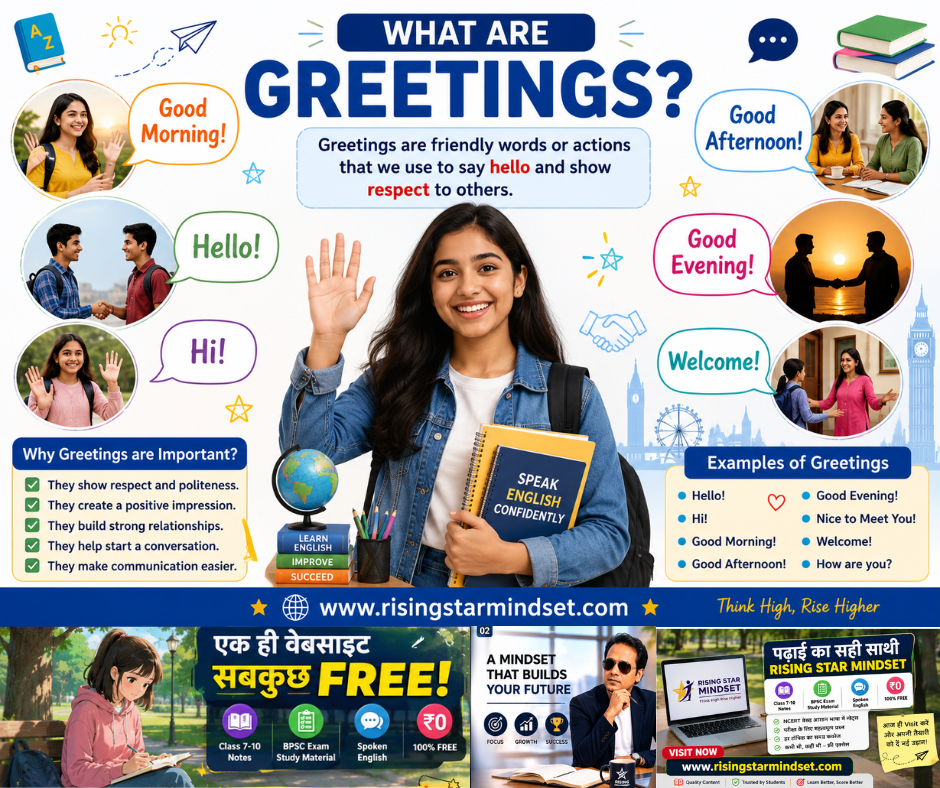
Definition (English)
Greetings are polite words or expressions used when meeting someone, welcoming someone, or starting a conversation.
Examples
- Hello
- Hi
- Welcome
- Nice to meet you
परिभाषा (हिन्दी)
Greeting ऐसे शिष्ट शब्द या वाक्य होते हैं जिनका उपयोग किसी से मिलने, स्वागत करने या बातचीत शुरू करने के लिए किया जाता है।
What is an Introduction?
Definition (English)
An Introduction is the process of telling someone about yourself or introducing another person.
It usually includes—
- Name
- Age
- Place
- Education
- Profession
- Hobbies
- Interests
परिभाषा (हिन्दी)
Introduction का अर्थ है स्वयं का परिचय देना या किसी दूसरे व्यक्ति का परिचय कराना।
एक अच्छे Introduction में सामान्यतः शामिल होते हैं—
- नाम
- आयु
- स्थान
- शिक्षा
- पेशा
- शौक
- रुचियाँ
Why are Greetings Important?
Greetings are important because they show respect, kindness, and good manners. Furthermore, they help people feel comfortable and create a friendly atmosphere. As a result, communication becomes easier and more effective.
Benefits of Greetings
- Create a positive first impression
- Build confidence
- Show respect
- Start conversations politely
- Improve communication skills
- Increase speaking confidence
- Develop personality
- Help in interviews
- Useful in school and office
- Improve spoken English
हिन्दी
Greetings का सही उपयोग करने से—
- अच्छा पहला प्रभाव पड़ता है।
- आत्मविश्वास बढ़ता है।
- सम्मान व्यक्त होता है।
- बातचीत की अच्छी शुरुआत होती है।
- Communication Skills बेहतर होती हैं।
- Spoken English में सुधार आता है।
Types of Greetings ( Greet and Introduce Yourself in English )
There are mainly two types of greetings.
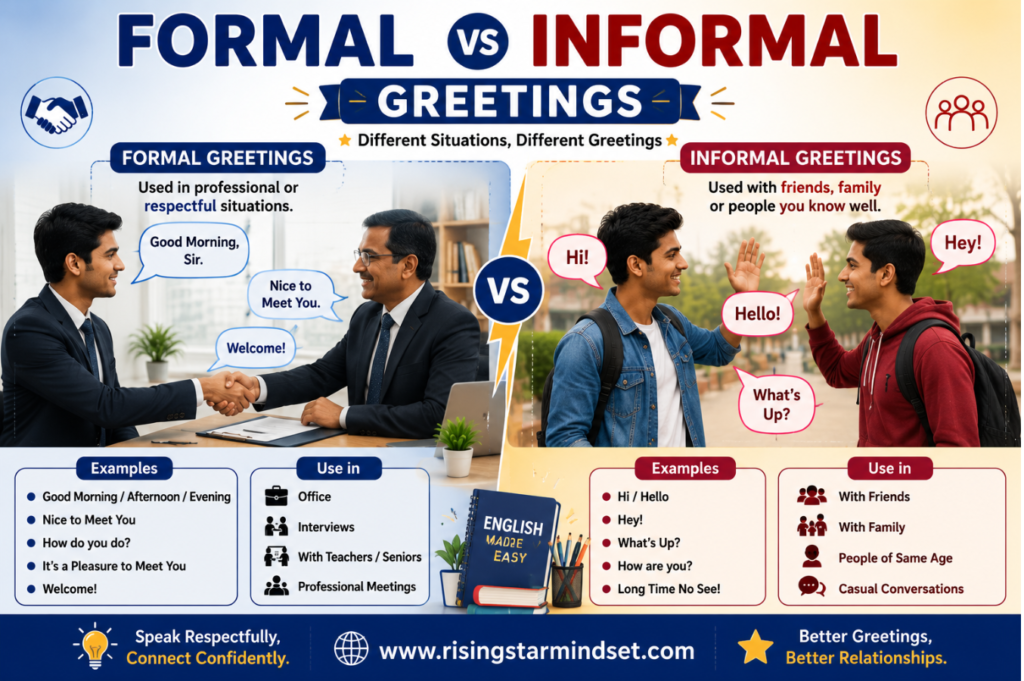
1. Formal Greetings
Formal Greetings are used in professional or official situations.
Examples
- Good Morning
- Good Afternoon
- How do you do?
- It’s a pleasure to meet you.
- Nice to meet you.
- Welcome.
- Have a nice day.
- Good to see you.
हिन्दी
Formal Greetings का प्रयोग—
- Interview
- Office
- School
- College
- Meetings
- Official Functions
में किया जाता है।
Formal Greeting Examples
| Greeting | Hindi Meaning |
| Good Morning | सुप्रभात |
| Good Afternoon | शुभ दोपहर |
| Good Evening | शुभ संध्या |
| Welcome | स्वागत है |
| Nice to meet you | आपसे मिलकर खुशी हुई |
| It’s a pleasure to meet you | आपसे मिलकर बहुत खुशी हुई |
| Have a nice day | आपका दिन शुभ हो |
| Good to see you | आपको देखकर अच्छा लगा |
2. Informal Greetings
Informal Greetings are used with friends, classmates, family members, and people we know well.
Examples
- Hi
- Hello
- Hey
- What’s up?
- How are you?
- How’s everything?
- Long time no see.
- Good to see you.
- See you soon.
- Bye.
हिन्दी
Informal Greetings का प्रयोग—
- दोस्तों
- परिवार
- रिश्तेदारों
- सहपाठियों
के साथ किया जाता है।
Informal Greeting Examples
| Greeting | Hindi Meaning |
| Hi | नमस्ते |
| Hello | नमस्ते |
| Hey | अरे / हेलो |
| What’s up? | क्या हाल है? |
| How are you? | आप कैसे हैं? |
| How’s everything? | सब कैसा चल रहा है? |
| Long time no see. | बहुत दिनों बाद मिले। |
| See you soon. | फिर मिलते हैं। |
| Bye | अलविदा |
| Take care | अपना ध्यान रखें |
Greetings According to Time
| Time | Greeting |
| Morning | Good Morning |
| Afternoon | Good Afternoon |
| Evening | Good Evening |
| Night (while leaving) | Good Night |
Common Greeting Expressions
| English Expression | Hindi Meaning |
| How are you? | आप कैसे हैं? |
| I’m fine, thank you. | मैं ठीक हूँ, धन्यवाद। |
| Nice to meet you. | आपसे मिलकर खुशी हुई। |
| Welcome! | आपका स्वागत है। |
| Have a great day! | आपका दिन शुभ हो। |
| See you later. | फिर मिलते हैं। |
| Take care. | अपना ध्यान रखें। |
| Have a safe journey. | आपकी यात्रा शुभ हो। |
Daily Speaking Practice
Read these greetings aloud every day.
- Good Morning!
- Good Evening!
- Hello!
- Hi!
- Welcome!
- Nice to meet you.
- How are you?
- I am fine, thank you.
- Have a wonderful day!
Key Points ( Greet and Introduce Yourself in English )
- Greetings are the first step in every conversation.
- Always greet politely.
- Use Formal Greetings in professional situations.
- Use Informal Greetings with friends and family.
- Smile while greeting someone.
- Speak clearly and confidently.
- Practice greetings every day.
- Good greetings improve your personality.
- Greetings build confidence.
- They make communication more effective.
Self Introduction in English
What is Self Introduction?
Definition (English)
A Self Introduction is a short and polite way of telling others about yourself. It usually includes your name, age, place, education, profession, hobbies, and future goals.
A good self-introduction creates a positive impression. Therefore, every student should learn how to introduce themselves confidently. Moreover, it helps in schools, colleges, interviews, meetings, and daily conversations.
हिन्दी में
Self Introduction का अर्थ है अपने बारे में संक्षेप और विनम्र तरीके से जानकारी देना।
एक अच्छा परिचय आत्मविश्वास बढ़ाता है और सामने वाले पर अच्छा प्रभाव डालता है। इसलिए प्रत्येक विद्यार्थी को सही तरीके से अपना परिचय देना आना चाहिए।
Basic Structure of Self Introduction
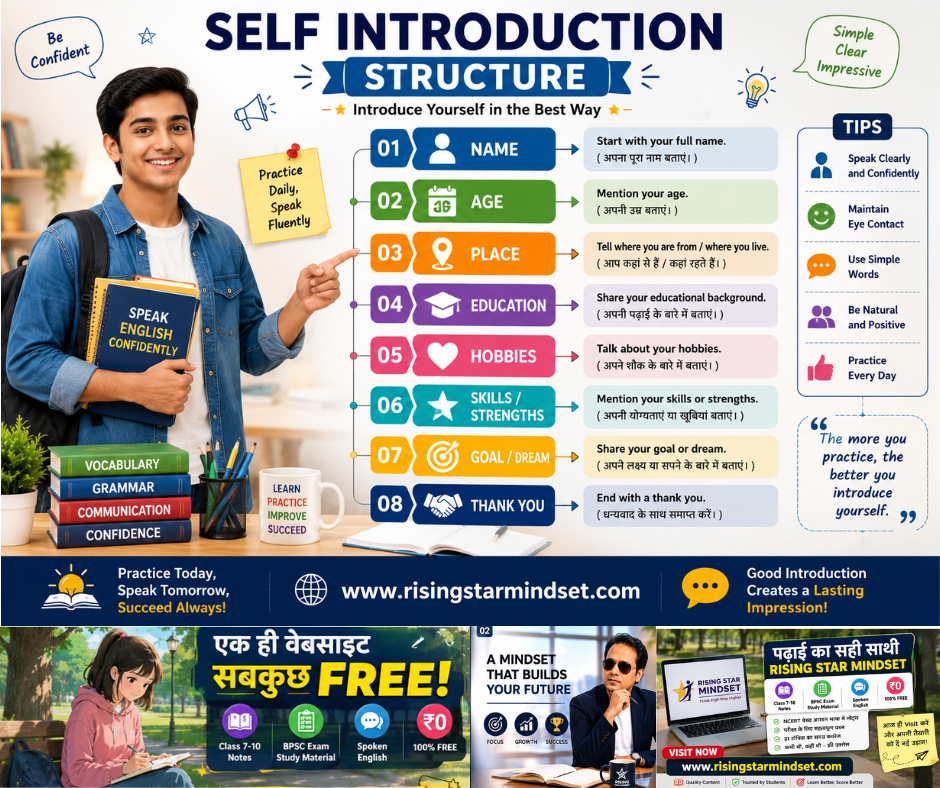
A simple self-introduction generally follows this order:
- Greeting
- Name
- Place
- Education
- Profession (if applicable)
- Hobbies
- Skills
- Future Goal
- Thank You
Self Introduction Template
English
Good morning everyone.
My name is Rahul Kumar, and I am 15 years old.
Currently, I live in Patna, Bihar, with my family.
At present, I study in Class 10 and enjoy learning new subjects every day.
Among all the subjects, English is my favourite because it helps me communicate confidently.
Besides studying, I love reading books, playing badminton, and learning new English words.
In the future, my dream is to become an IAS Officer and serve my country.
Finally, thank you very much for giving me the opportunity to introduce myself
हिन्दी
सुप्रभात सभी को।
मेरा नाम राहुल कुमार है और मेरी आयु 15 वर्ष है।
वर्तमान में मैं पटना, बिहार में अपने परिवार के साथ रहता हूँ।
इस समय मैं कक्षा 10 में पढ़ता हूँ और प्रतिदिन नई-नई चीज़ें सीखना पसंद करता हूँ।
सभी विषयों में अंग्रेज़ी मेरा पसंदीदा विषय है क्योंकि यह मुझे आत्मविश्वास के साथ संवाद करना सिखाती है।
पढ़ाई के अलावा मुझे किताबें पढ़ना, बैडमिंटन खेलना और नए अंग्रेज़ी शब्द सीखना पसंद है।
भविष्य में मेरा सपना IAS अधिकारी बनकर अपने देश की सेवा करना है।
अंत में, मुझे अपना परिचय देने का अवसर देने के लिए आपका बहुत-बहुत धन्यवाद।
Example 1 (School Student)
English
Good morning, everyone.
My name is Rahul Kumar.
I am 15 years old.
I study in Class 10.
Currently, I live in Patna, Bihar.
My favourite subject is English because I enjoy learning new words.
Apart from my studies, I like playing cricket and reading books.
My goal is to become an IAS Officer.
Thank you for listening.
हिन्दी
सुप्रभात सभी को।
मेरा नाम राहुल कुमार है।
मैं 15 वर्ष का हूँ।
मैं कक्षा 10 में पढ़ता हूँ।
वर्तमान में मैं पटना, बिहार में रहता हूँ।
मेरा पसंदीदा विषय अंग्रेज़ी है क्योंकि मुझे नए शब्द सीखना पसंद है।
पढ़ाई के अलावा मुझे क्रिकेट खेलना और किताबें पढ़ना अच्छा लगता है।
मेरा लक्ष्य IAS अधिकारी बनना है।
धन्यवाद।
Example 2 (Job Interview)
English
Good morning, Sir/Madam.
Thank you for giving me this opportunity to introduce myself.
My name is Priya Sharma, and I am from Ranchi, Jharkhand.
I have completed my Bachelor of Commerce (B.Com.).
Additionally, I enjoy learning English, improving my communication skills, and working with new people.
My strengths are honesty, teamwork, and a positive attitude.
I am eager to learn, contribute to your organization, and grow professionally.
Thank you for your valuable time.
हिन्दी
सुप्रभात सर/मैडम।
मुझे अपना परिचय देने का अवसर देने के लिए धन्यवाद।
मेरा नाम प्रिया शर्मा है और मैं रांची, झारखंड से हूँ।
मैंने बी.कॉम. (Bachelor of Commerce) की पढ़ाई पूरी की है।
इसके अलावा, मुझे अंग्रेज़ी सीखना, अपने Communication Skills को बेहतर बनाना और नए लोगों के साथ काम करना पसंद है।
मेरी सबसे बड़ी खूबियाँ ईमानदारी, टीमवर्क और सकारात्मक सोच हैं।
मैं आपकी संस्था के साथ सीखना, योगदान देना और अपने करियर में आगे बढ़ना चाहती हूँ।
धन्यवाद।
Introducing Another Person
Sometimes you need to introduce someone else.
Examples
This is my friend Rahul.
He is my classmate.
She is my sister.
He is our English teacher.
This is my father.
This is my mother.
Please meet my brother.
Let me introduce my friend.
I’d like you to meet my teacher.
Meet my cousin.
हिन्दी
यह मेरे मित्र राहुल हैं।
ये मेरे सहपाठी हैं।
यह मेरी बहन है।
ये हमारे अंग्रेज़ी के शिक्षक हैं।
यह मेरे पिता हैं।
यह मेरी माता हैं।
कृपया मेरे भाई से मिलिए।
मैं आपको अपने मित्र से मिलवाना चाहता हूँ।
मैं आपको अपने शिक्षक से मिलवाना चाहता हूँ।
यह मेरे चचेरे भाई हैं।
Asking Someone’s Name
English
What is your name?
May I know your name?
Could you tell me your name?
How should I address you?
What do your friends call you?
हिन्दी
आपका नाम क्या है?
क्या मैं आपका नाम जान सकता हूँ?
क्या आप अपना नाम बता सकते हैं?
मैं आपको किस नाम से बुलाऊँ?
आपके दोस्त आपको किस नाम से बुलाते हैं?
Responding Politely
English
My name is Amit.
I am Amit.
People call me Amit.
You can call me Amit.
Nice to meet you.
It’s my pleasure.
Thank you.
You’re welcome.
हिन्दी
मेरा नाम अमित है।
मैं अमित हूँ।
लोग मुझे अमित कहते हैं।
आप मुझे अमित कह सकते हैं।
आपसे मिलकर खुशी हुई।
मुझे भी खुशी हुई।
धन्यवाद।
आपका स्वागत है।
Daily English Conversation
Formal Conversation
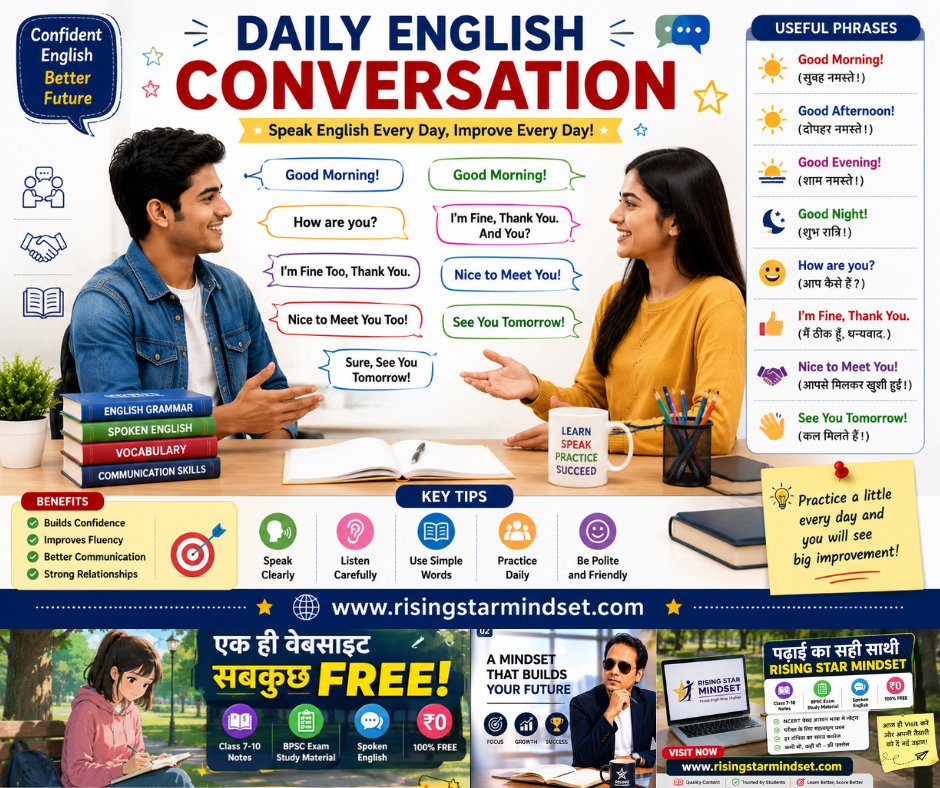
Conversation 1
A: Good morning.
B: A Very Good morning.
A: How are you?
B: I’m fine. Thank you. How about you?
A: I’m doing well.
B: Nice to meet you.
A: Nice to meet you too.
हिन्दी
A: सुप्रभात।
B: सुप्रभात।
A: आप कैसे हैं?
B: मैं ठीक हूँ। धन्यवाद। आप कैसे हैं?
A: मैं भी ठीक हूँ।
B: आपसे मिलकर खुशी हुई।
A: मुझे भी आपसे मिलकर खुशी हुई।
Informal Conversation
Conversation 2
A: Hi!
B: Hello!
A: What’s your name?
B: My name is Arjun.
A: Nice to meet you.
B: Nice to meet you too.
हिन्दी
A: हाय!
B: हेलो!
A: आपका नाम क्या है?
B: मेरा नाम अर्जुन है।
A: आपसे मिलकर खुशी हुई।
B: मुझे भी आपसे मिलकर खुशी हुई।
Daily Use Sentences ( Greet and Introduce Yourself in English )
- Good morning.
- Good evening.
- Hello.
- Hi.
- Welcome.
- Nice to meet you.
- How are you?
- I am fine.
- Thank you.
- You’re welcome.
- Please come in.
- Please have a seat.
- May I come in?
- Excuse me.
- Sorry.
- See you later.
- Have a nice day.
- Take care.
- Goodbye.
Speaking Practice ( Greet and Introduce Yourself in English )
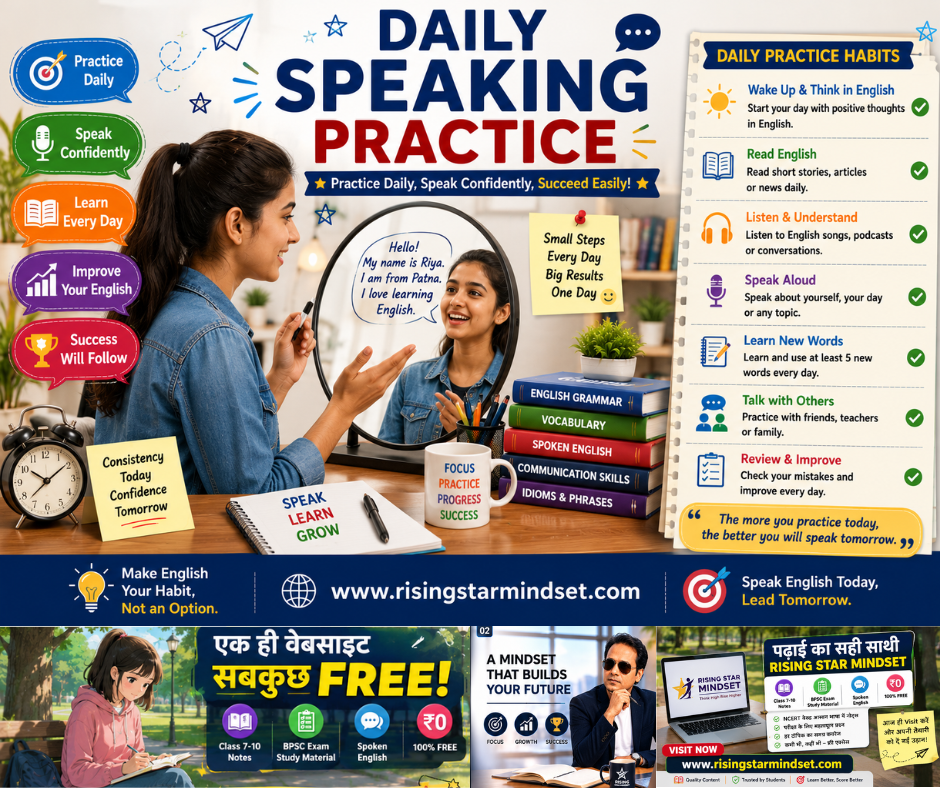
Read these sentences loudly every day.
- Every morning, I wake up early.
- Before breakfast, I brush my teeth.
- After that, I drink a glass of water.
- Every day, I read English for at least 20 minutes.
- With regular practice, I speak English more confidently.
- My parents always support my learning journey.
- Learning English is one of my favourite hobbies.
- With consistent practice, perfection comes gradually.
- Every new day brings a fresh opportunity to learn.
- Step by step, I am becoming a confident English speaker.
हिन्दी
नीचे दिए गए वाक्यों को प्रतिदिन ज़ोर से पढ़ें। इससे आपका उच्चारण (Pronunciation), आत्मविश्वास (Confidence) और English Speaking Skills बेहतर होंगी।
मैं हर दिन एक बेहतर English Speaker बन रहा/रही हूँ।
हर सुबह मैं जल्दी उठता/उठती हूँ।
नाश्ते से पहले मैं अपने दाँत साफ़ करता/करती हूँ।
इसके बाद मैं एक गिलास पानी पीता/पीती हूँ।
मैं प्रतिदिन कम से कम 20 मिनट अंग्रेज़ी पढ़ता/पढ़ती हूँ।
नियमित अभ्यास से मैं अधिक आत्मविश्वास के साथ अंग्रेज़ी बोलता/बोलती हूँ।
मेरे माता-पिता हमेशा मेरा समर्थन करते हैं।
अंग्रेज़ी सीखना मेरे पसंदीदा शौकों में से एक है।
निरंतर अभ्यास से धीरे-धीरे पूर्णता प्राप्त होती है।
हर नया दिन सीखने का एक नया अवसर लेकर आता है।
Common Mistakes ( Greet and Introduce Yourself in English )
❌ Wrong
Myself Rahul.
✅ Correct
My name is Rahul.
❌ Wrong
Myself is Rahul.
✅ Correct
I am Rahul.
❌ Wrong
What yourself name?
✅ Correct
What is your name?
❌ Wrong
I am belong to Bihar.
✅ Correct
I belong to Bihar.
❌ Wrong
My age is 18 years old.
✅ Correct
I am 18 years old.
Key Points ( Greet and Introduce Yourself in English )
- Start with a polite greeting.
- Introduce yourself confidently.
- Speak slowly and clearly.
- Smile while introducing yourself.
- Maintain eye contact.
- Use simple English sentences.
- Avoid grammar mistakes.
- Practice every day.
- Listen carefully before replying.
- Be polite and confident.
Speaking Practice Exercises
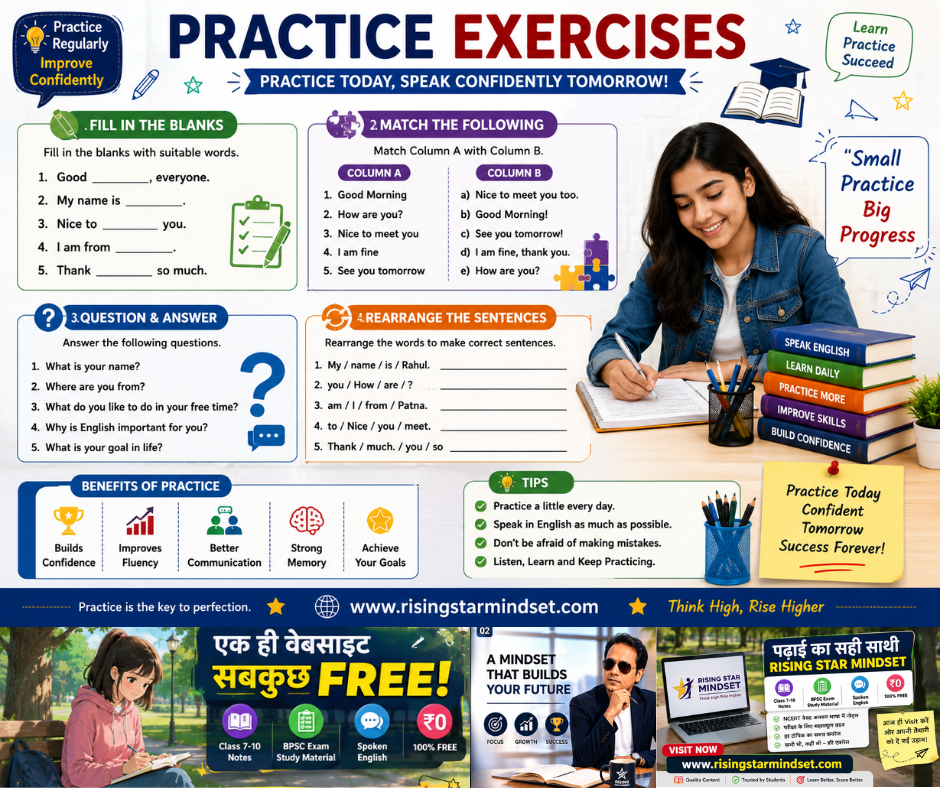
Regular speaking practice is the key to becoming fluent in English. Therefore, try to speak these sentences loudly every day. Moreover, focus on correct pronunciation, confidence, and natural expressions. As a result, your speaking skills will improve steadily.
Exercise 1 – Read Aloud
Read each sentence clearly and confidently.
- Good morning, everyone.
- My name is Rohan.
- I am happy to meet you.
- Welcome to our English class.
- How are you today?
- I am doing well, thank you.
- Please introduce yourself.
- It is nice to meet you.
- Have a wonderful day.
- See you again soon.
Exercise 2 – Change Hindi into English
Translate the following sentences into English.
| Hindi | Your Answer |
| सुप्रभात। | ____________ |
| आपका नाम क्या है? | ____________ |
| मेरा नाम नेहा है। | ____________ |
| आप कैसे हैं? | ____________ |
| मैं ठीक हूँ। | ____________ |
| आपसे मिलकर खुशी हुई। | ____________ |
| धन्यवाद। | ____________ |
| कृपया अंदर आइए। | ____________ |
| फिर मिलते हैं। | ____________ |
| आपका दिन शुभ हो। | ____________ |
Exercise 3 – Change English into Hindi
Translate the following sentences into Hindi.
| English | Your Answer |
| Good Morning. | ____________ |
| My name is Rahul. | ____________ |
| Nice to meet you. | ____________ |
| Welcome to our school. | ____________ |
| Have a nice day. | ____________ |
| Thank you very much. | ____________ |
| Please sit down. | ____________ |
| See you tomorrow. | ____________ |
| I am a student. | ____________ |
| Take care. | ____________ |
Fill in the Blanks
Choose the correct word.
- __________ Morning. (Good / Fine)
- My __________ is Ravi. (book / name)
- I am __________ student. (a / an)
- Nice to __________ you. (meet / eats)
- Thank you __________ much. (very / many)
- __________ are you? (Who / How)
- I __________ fine. (is / am)
- Please __________ in. (come / coming)
- Have a nice __________. (day / book)
- See you __________. (later / apple)
Answers
- Good
- name
- a
- meet
- very
- How
- am
- come
- day
- later
Match the Following
| Column A | Column B |
| Good Morning | Thank You |
| Hello | Hi |
| Good Night | Sleep Well |
| Welcome | Please Come In |
| Nice to Meet You | Nice to Meet You Too |
| Thank You | You’re Welcome |
| Goodbye | See You Later |
| Excuse Me | Sorry |
| Have a Nice Day | Thank You |
| Take Care | See You Soon |
Correct Answers ( Greet and Introduce Yourself in English )
| Column A | Correct Match |
| Good Morning | Good Morning |
| Hello | Hi |
| Good Night | Sleep Well |
| Welcome | Please Come In |
| Nice to Meet You | Nice to Meet You Too |
| Thank You | You’re Welcome |
| Goodbye | See You Later |
| Excuse Me | Sorry |
| Have a Nice Day | Thank You |
| Take Care | See You Soon |
Vocabulary Builder
| Word | Hindi Meaning |
| Greeting | अभिवादन |
| Introduce | परिचय देना |
| Welcome | स्वागत |
| Conversation | बातचीत |
| Friend | मित्र |
| Teacher | शिक्षक |
| Student | विद्यार्थी |
| Office | कार्यालय |
| Interview | साक्षात्कार |
| Confidence | आत्मविश्वास |
Question and Answers
Q1. What is a greeting?
Answer:
A greeting is a polite word or expression used when meeting someone or starting a conversation.
हिन्दी
Greeting किसी से मिलने या बातचीत शुरू करने के लिए प्रयोग किया जाने वाला शिष्ट शब्द या वाक्य है।
Q2. Why are greetings important?
Answer:
Greetings create a positive first impression and help begin conversations politely.
हिन्दी
Greetings अच्छा पहला प्रभाव डालते हैं और बातचीत की अच्छी शुरुआत करते हैं।
Q3. What is a self-introduction?
Answer:
A self-introduction is a short description about yourself including your name, education, hobbies, and goals.
हिन्दी
Self Introduction अपने बारे में संक्षिप्त जानकारी देना है।
Q4. Where do we use formal greetings?
Answer:
Formal greetings are used in schools, offices, interviews, meetings, and official events.
हिन्दी
Formal Greetings का उपयोग स्कूल, ऑफिस, इंटरव्यू, मीटिंग और आधिकारिक कार्यक्रमों में किया जाता है।
Q5. How can you improve your spoken English?
Answer:
Practice speaking every day, learn new vocabulary, listen carefully, and communicate confidently.
हिन्दी
रोज़ अभ्यास करें, नए शब्द सीखें, ध्यान से सुनें और आत्मविश्वास के साथ बोलें।
HOTS (Higher Order Thinking Skills)
1. Why should we use different greetings in formal and informal situations?
Answer:
Because every situation is different. Formal greetings show professionalism and respect, whereas informal greetings create a friendly and relaxed atmosphere.
2. Imagine you are attending your first job interview. How would you greet the interviewer?
Sample Answer:
Good morning, Sir/Madam.
It’s a pleasure to meet you.
Thank you for giving me this opportunity.
3. If a foreign visitor comes to your school, how will you introduce yourself?
Sample Answer:
Hello!
My name is Riya.
I am a student of Class 10.
Welcome to our school.
It is nice to meet you.
4. Why is confidence important while introducing yourself?
Answer:
Confidence helps people trust you and creates a positive impression. Moreover, it makes communication easier and more effective.
5. Which is more important—grammar or confidence? Explain your answer.
Sample Answer:
Both are important. However, confidence helps you start speaking, while grammar helps you speak correctly. Therefore, learners should develop both together.
Real-Life Speaking Activity ( Greet and Introduce Yourself in English )
Work with your partner and practice this conversation.
Student A
Hello!
Good morning.
What is your name?
Where are you from?
Nice to meet you.
Have a nice day.
Student B
Good morning.
My name is __________.
I am from __________.
Nice to meet you too.
Thank you.
Have a wonderful day.
Practice Challenge ( Greet and Introduce Yourself in English )
Complete these tasks today:
- Greet five people in English.
- Introduce yourself without reading.
- Learn five new greeting expressions.
- Speak in English for five minutes.
- Practice in front of a mirror.
Daily Speaking Challenge ( Greet and Introduce Yourself in English )
Repeat these sentences three times every day.
- Good morning, everyone.
- My name is __________.
- I am happy to meet you.
- Welcome to our class.
- Thank you for your support.
- Have a wonderful day.
- I enjoy speaking English.
- Practice makes progress.
- I can speak English confidently.
- Every day I become better at English.
Practice Quiz (MCQs) ( Greet and Introduce Yourself in English )
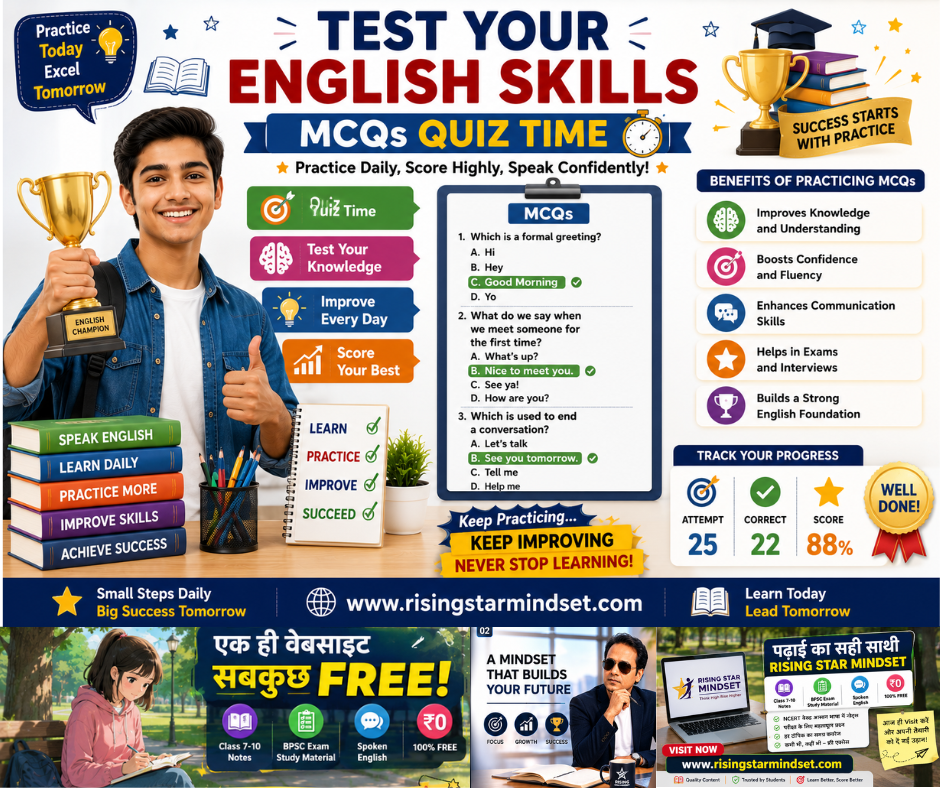
Multiple Choice Questions (1–30)
1. Which greeting is used in the morning?
A. Good Night
B. Good Evening
C. Good Morning
D. Hello
✅ Answer: C
2. Which greeting is generally used before sleeping?
A. Good Morning
B. Good Night
C. Good Afternoon
D. Hi
✅ Answer: B
3. Which greeting is the most formal?
A. Hey
B. Hi
C. Good Morning
D. What’s up?
✅ Answer: C
4. Which sentence is correct?
A. Myself Rahul.
B. I Rahul.
C. My name is Rahul.
D. Me Rahul.
✅ Answer: C
5. “Nice to meet you.” का सही उत्तर क्या होगा?
A. Bye
B. Nice to meet you too.
C. Good Night
D. Sorry
✅ Answer: B
6. What is the meaning of “Welcome”?
A. धन्यवाद
B. स्वागत है
C. माफ़ कीजिए
D. शुभ रात्रि
✅ Answer: B
7. Which greeting is used in the afternoon?
A. Good Afternoon
B. Good Evening
C. Good Night
D. Hi
✅ Answer: A
8. “How are you?” का सही उत्तर क्या है?
A. Thank you.
B. I am fine, thank you.
C. Goodbye.
D. Welcome.
✅ Answer: B
9. Which greeting is informal?
A. Good Evening
B. Hi
C. Good Afternoon
D. Welcome
✅ Answer: B
10. Which sentence introduces yourself?
A. This is my friend.
B. My name is Aman.
C. He is a teacher.
D. They are students.
✅ Answer: B
11. “Please come in.” का हिन्दी अर्थ है—
A. कृपया बैठिए।
B. कृपया अंदर आइए।
C. धन्यवाद।
D. फिर मिलेंगे।
✅ Answer: B
12. Which word shows politeness?
A. Sorry
B. Thank you
C. Please
D. All of the above
✅ Answer: D
13. Which is a formal greeting?
A. Hey!
B. What’s up?
C. Good Morning
D. Yo!
✅ Answer: C
14. “Take care” means—
A. जल्दी आओ
B. अपना ध्यान रखना
C. घर जाओ
D. मिलते हैं
✅ Answer: B
15. Which sentence is correct?
A. I am belong to Patna.
B. I belongs to Patna.
C. I belong to Patna.
D. I belonging to Patna.
✅ Answer: C
16. “Good Evening” is used—
A. In the morning
B. In the afternoon
C. In the evening
D. At midnight
✅ Answer: C
17. Which sentence is grammatically correct?
A. Myself Neha.
B. My name Neha.
C. My name is Neha.
D. Me Neha.
✅ Answer: C
18. Which expression is used while leaving?
A. Welcome
B. See you later.
C. Good Morning
D. Hello
✅ Answer: B
19. “Nice to meet you” is used—
A. When meeting someone for the first time
B. While sleeping
C. During lunch
D. None of these
✅ Answer: A
20. Which sentence is used to ask someone’s name?
A. How are you?
B. What is your name?
C. Where are you?
D. How old are you?
✅ Answer: B
21. Which sentence is the best self-introduction?
A. Myself Rahul.
B. Rahul my name.
C. My name is Rahul.
D. I Rahul.
✅ Answer: C
22. Which greeting is suitable for an interview?
A. Hey!
B. Hi buddy!
C. Good Morning, Sir.
D. What’s up?
✅ Answer: C
23. Which expression shows respect?
A. Please
B. Thank you
C. Excuse me
D. All of the above
✅ Answer: D
24. “Have a nice day” means—
A. आपका दिन शुभ हो।
B. धन्यवाद।
C. जल्दी आइए।
D. शुभ रात्रि।
✅ Answer: A
25. Which sentence is used to welcome someone?
A. Welcome to our school.
B. Bye.
C. Good Night.
D. Excuse me.
✅ Answer: A
26. Which greeting is used among close friends?
A. Good Morning, Sir
B. Hi!
C. Good Afternoon
D. Welcome
✅ Answer: B
27. Which is NOT a greeting?
A. Hello
B. Welcome
C. Thank you
D. Pencil
✅ Answer: D
28. Which sentence is correct?
A. I am 15 years old.
B. My age 15.
C. I 15 years.
D. I am age 15.
✅ Answer: A
29. Which habit improves spoken English?
A. Speaking daily
B. Practicing greetings
C. Learning new words
D. All of the above
✅ Answer: D
30. The best way to become confident in English is—
A. Daily Practice
B. Never Speaking
C. Avoiding Mistakes
D. Memorizing Only
✅ Answer: A
Test Your Score
| Score | Performance |
| 27–30 | 🌟 Excellent |
| 22–26 | 🏆 Very Good |
| 17–21 | 👍 Good |
| 12–16 | 📘 Average |
| 0–11 | 📖 Keep Practicing |
Key Points Revision
- Greetings are the first step of communication.
- Formal greetings are used in offices, schools, and interviews.
- Informal greetings are used with friends and family.
- Always smile while greeting someone.
- Introduce yourself confidently.
- Speak slowly and clearly.
- Use polite expressions like Please, Thank you, and Excuse me.
- Practice daily conversations.
- Learn from your mistakes.
- Consistency is the key to fluent English.
Frequently Asked Questions (FAQs)
Q1. What is a greeting?
A greeting is a polite expression used to welcome someone or start a conversation.
हिन्दी: Greeting किसी का अभिवादन करने या बातचीत शुरू करने का शिष्ट तरीका है।
Q2. What is a self-introduction?
A self-introduction is a brief description about yourself, including your name, education, hobbies, and goals.
हिन्दी: Self Introduction अपने बारे में संक्षिप्त जानकारी देना है।
Q3. Why are greetings important?
Greetings create a positive first impression and make communication polite and effective.
हिन्दी: Greetings अच्छा पहला प्रभाव डालते हैं और बातचीत को विनम्र बनाते हैं।
Q4. How can I improve my spoken English?
Practice speaking every day, learn new vocabulary, read English books, listen to English conversations, and speak confidently.
हिन्दी: रोज़ अभ्यास करें, नए शब्द सीखें, अंग्रेज़ी पढ़ें, सुनें और आत्मविश्वास के साथ बोलें।
Q5. Should I use formal greetings with friends?
No. Formal greetings are generally used in professional situations, while informal greetings are better for friends and family.
हिन्दी: नहीं। दोस्तों और परिवार के साथ Informal Greetings का प्रयोग करना अधिक स्वाभाविक होता है।
English Conclusion ( Greet and Introduce Yourself in English )
Learning Greetings and Introductions is the first step toward becoming a confident English speaker. Moreover, using the right greeting in the right situation helps you create a positive first impression. Therefore, make it a habit to greet people politely every day.
Furthermore, introducing yourself clearly and confidently improves your communication skills and builds self-confidence. In addition, regular speaking practice, daily conversations, and learning useful expressions will gradually improve your fluency.
However, do not worry if you make mistakes at the beginning. Instead, treat every mistake as a learning opportunity and continue practicing. As a result, your confidence will grow, your vocabulary will expand, and your spoken English will become more natural.
Finally, remember that consistency is more important than perfection. So, practice greetings, introductions, and daily conversations regularly. Overall, with patience, confidence, and continuous effort, you will become a fluent English speaker.
Keep Learning • Keep Practicing • Keep Speaking!
हिन्दी निष्कर्ष
Greetings and Introductions सीखना Fluent English की दिशा में पहला और सबसे महत्वपूर्ण कदम है। यदि आप सही तरीके से लोगों का अभिवादन करना और आत्मविश्वास के साथ अपना परिचय देना सीख जाते हैं, तो आपकी Communication Skills में स्वतः सुधार होने लगता है।
रोज़ाना कुछ मिनट English बोलने का अभ्यास करें, नए Greeting Expressions सीखें और उन्हें अपनी दैनिक बातचीत में प्रयोग करें। शुरुआत में गलतियाँ होना बिल्कुल सामान्य है। महत्वपूर्ण बात यह है कि आप लगातार अभ्यास करते रहें और हर दिन कुछ नया सीखने का प्रयास करें।
याद रखें, आत्मविश्वास, नियमित अभ्यास और सही मार्गदर्शन ही आपको एक अच्छा English Speaker बनाएगा। इसलिए सीखते रहें, बोलते रहें और अपने सपनों की ओर आत्मविश्वास के साथ आगे बढ़ते रहें।

🌟 Final Call to Action
Did this guide help you?
- Share it with your friends and classmates.
- Bookmark this page for quick revision.
- Practice the exercises regularly.
- Explore more English Grammar lessons on www.risingstarmindset.com.
Keep Learning, Keep Growing! 🚀
P Kumar | Rising Star Mindset
www.risingstarmindset.com
Together We Will Make The Difference