
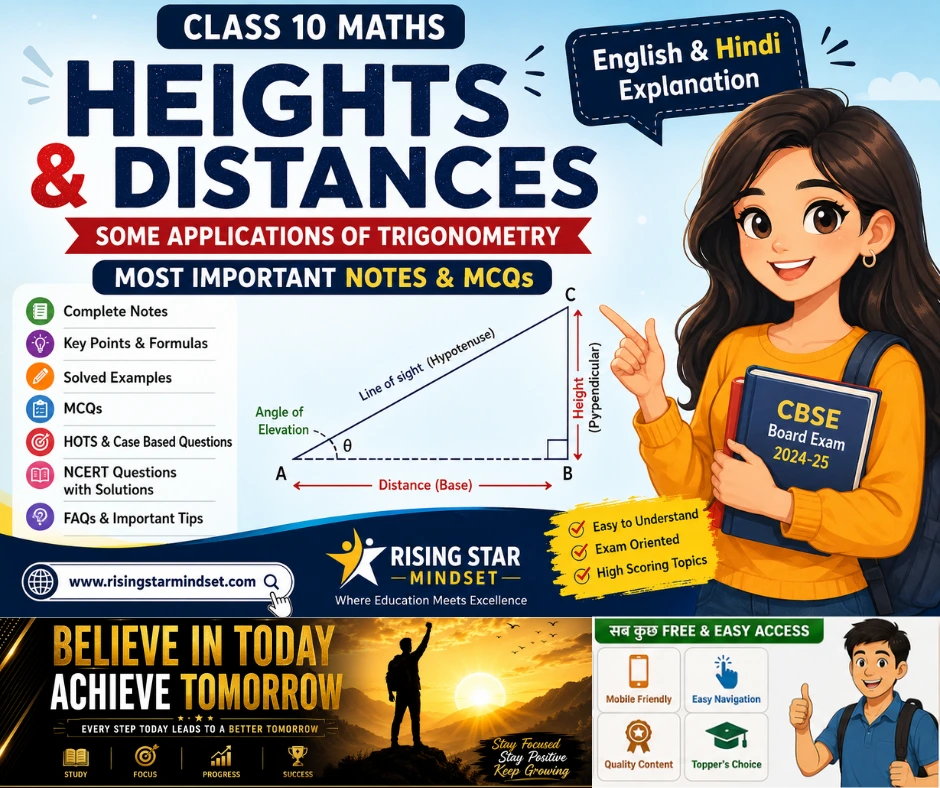
Trigonometry Heights and Distances Class 10 Complete Notes (English & Hindi)
Table of Contents
- Introduction (परिचय)
- Learning Objectives (सीखने के उद्देश्य)
- What are Heights and Distances? (ऊँचाई एवं दूरी क्या है?)
- Real-Life Applications (वास्तविक जीवन में उपयोग)
- Important Abbreviations (महत्वपूर्ण संक्षिप्त रूप)
- Important Terms (महत्वपूर्ण शब्दावली)
- Line of Sight (दृष्टि रेखा)
- Angle of Elevation (उन्नयन कोण)
- Angle of Depression (अवनमन कोण)
- Basic Trigonometric Ratios (मूल त्रिकोणमितीय अनुपात)
- Standard Trigonometric Values (मानक त्रिकोणमितीय मान)
- Important Formula Chart (महत्वपूर्ण सूत्र)
- Key Points for Quick Revision (त्वरित पुनरावृत्ति)
- Solved Examples (हल किए गए उदाहरण)
- Multiple Choice Questions (MCQs)
- Assertion and Reason Questions
- Case Study Questions
- HOTS Questions
- NCERT Exercise Questions with Solutions
- Previous Year Questions (PYQs)
- Common Mistakes to Avoid
- Exam Preparation Tips
- Frequently Asked Questions (FAQs)
- Conclusion (निष्कर्ष)
- RELATED TOPIC : Introduction to Trigonometry
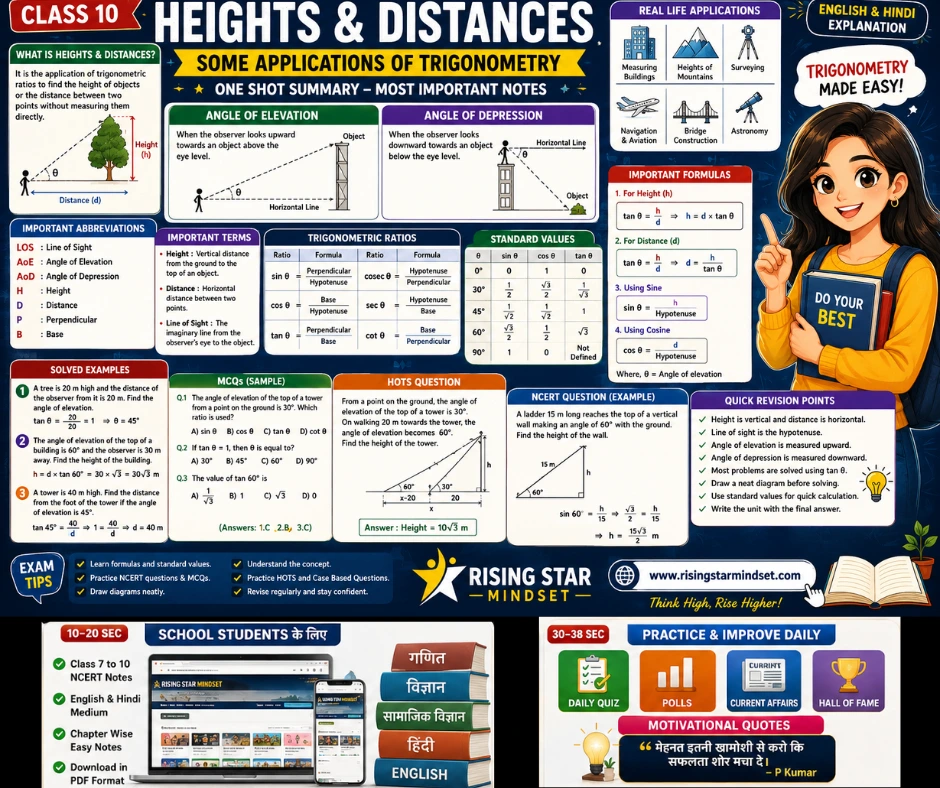
Introduction ( Heights and Distances Class 10 )
English ( Heights and Distances Class 10 )
The chapter Some Applications of Trigonometry helps us calculate the height of tall objects and the distance between two places without measuring them directly.
Using trigonometric ratios such as sin, cos, and tan, we can determine the height of buildings, trees, towers, mountains, bridges, and many other objects.
This chapter is one of the most scoring topics in the Class 10 CBSE Board Examination.
हिन्दी
त्रिकोणमिति के अनुप्रयोग अध्याय में हम बिना सीधे मापे किसी वस्तु की ऊँचाई (Height) तथा दूरी (Distance) ज्ञात करना सीखते हैं।
इस अध्याय में मुख्य रूप से sin, cos तथा tan का प्रयोग किया जाता है।
यह अध्याय बोर्ड परीक्षा के लिए अत्यंत महत्वपूर्ण एवं आसान अंक दिलाने वाला अध्याय है।
Learning Objectives ( Heights and Distances Class 10 )
After completing this chapter, students will be able to
- Understand Angle of Elevation
- Understand Angle of Depression
- Calculate unknown heights
- Calculate unknown distances
- Solve real-life problems
- Apply trigonometric ratios effectively
Real-Life Applications ( Heights and Distances Class 10 )
This chapter is used in
- Measuring building height
- Finding mountain height
- Aircraft navigation
- Bridge construction
- Surveying
- Architecture
- Engineering
- Satellite communication
- Defence
- Astronomy
हिन्दी
इस अध्याय का प्रयोग
- भवन निर्माण
- पुल निर्माण
- सेना
- सर्वेक्षण
- इंजीनियरिंग
- खगोल विज्ञान
- विमानन
- पर्वत की ऊँचाई ज्ञात करने में किया जाता है।
Important Abbreviations
| Abbreviation | Full Form | Meaning |
| LOS | Line of Sight | दृष्टि रेखा |
| AoE | Angle of Elevation | उन्नयन कोण |
| AoD | Angle of Depression | अवनमन कोण |
| H | Height | ऊँचाई |
| D | Distance | दूरी |
| Tan | Tangent | स्पर्शज्या |
| Sin | Sine | ज्या |
| Cos | Cosine | कोज्या |
Important Terms ( Heights and Distances Class 10 )
1. Height
English
Height means the vertical distance from the ground to the top of an object.
हिन्दी
भूमि से किसी वस्तु के शीर्ष तक की लंबवत दूरी को ऊँचाई कहते हैं।
2. Distance
English
Distance means the horizontal distance between two points.
हिन्दी
दो बिंदुओं के बीच क्षैतिज दूरी को Distance कहते हैं।
3. Observer
The person who is looking at the object is called the observer.
हिन्दी: जो व्यक्ति वस्तु को देख रहा हो उसे प्रेक्षक कहते हैं।
Line of Sight (LOS)
English
The imaginary line joining the observer’s eye to the object is called the Line of Sight.
हिन्दी
प्रेक्षक की आँख से वस्तु तक जाने वाली काल्पनिक रेखा को दृष्टि रेखा (Line of Sight) कहते हैं।
Example
A boy looks at the top of a tower.
The line joining his eye and the tower top is called Line of Sight.
Angle of Elevation
English
When the observer looks upward towards an object above eye level, the angle formed between the horizontal line and the line of sight is called the Angle of Elevation.
हिन्दी
जब कोई व्यक्ति अपनी आँखों के स्तर से ऊपर स्थित वस्तु को देखता है, तब क्षैतिज रेखा और दृष्टि रेखा के बीच बनने वाला कोण उन्नयन कोण (Angle of Elevation) कहलाता है।
Examples
- Looking at a kite
- Glance at an airplane
- Looking at a tower
- Looking at a mountain
Angle of Depression
English
When the observer looks downward towards an object below eye level, the angle between the horizontal line and the line of sight is called the Angle of Depression.
हिन्दी
जब कोई व्यक्ति अपनी आँखों के स्तर से नीचे स्थित वस्तु को देखता है, तब बनने वाला कोण अवनमन कोण (Angle of Depression) कहलाता है।
Examples
- Standing on a building and looking down
- Looking from a bridge towards a river
- Looking from a hill towards a road
Basic Trigonometric Ratios Used
| Ratio | Formula |
| sin θ | Perpendicular / Hypotenuse |
| cos θ | Base / Hypotenuse |
| tan θ | Perpendicular / Base |
| cosec θ | Hypotenuse / Perpendicular |
| sec θ | Hypotenuse / Base |
| cot θ | Base / Perpendicular |
Most Important Formula ( Heights and Distances Class 10 )
Height Problems

Therefore
Distance Problems

Using Sine
Using Cosine

Standard Trigonometric Values
| θ | sin | cos | tan |
| 0° | 0 | 1 | 0 |
| 30° | 1/2 | √3/2 | 1/√3 |
| 45° | 1/√2 | 1/√2 | 1 |
| 60° | √3/2 | 1/2 | √3 |
| 90° | 1 | 0 | Not Defined |
Important Key Points ( Heights and Distances Class 10 )
| Height is always vertical. |
| Distance is always horizontal. |
| Line of Sight is always the hypotenuse. |
| Angle of Elevation is measured upward. |
| Angle of Depression is measured downward. |
| Most questions are solved using tan θ. |
| Draw a rough figure before solving any problem. |
| Write the given values first. |
| Use standard trigonometric values wherever possible. |
| Always mention the unit (m, cm, km). |
Solved Example 1
A tree is 20 m high. A person stands 20 m away from it. Find the angle of elevation.
Solution
Height = 20 m
Distance = 20 m
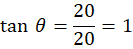
Therefore,
Answer: 45°
हिन्दी
पेड़ की ऊँचाई = 20 m
दूरी = 20 m
tanθ = 1
अतः
उत्तर = 45°
Solved Example 2
The angle of elevation of the top of a building is 60°. The observer is 30 m away. Find the height.
Solution


Answer

हिन्दी
दूरी = 30 m
कोण = 60°
tan60 = H/30
H = 30√3 मीटर
Solved Example 3
A tower is 40 m high. Find the distance if the angle of elevation is 45°.
Solution
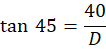

Therefore,

Solved Example 4
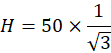
The angle of elevation is 30°. Distance is 50 m. Find the height.
Solution

Solved Example 5
A kite is flying at a height of 25 m. The angle of elevation is 45°. Find the horizontal distance.
Solution
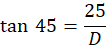


Answer: 25 m
Exam Tips
- Draw a neat right-angled triangle before solving.
- Identify the height, base (distance), and hypotenuse (line of sight) correctly.
- Memorize the standard trigonometric values (0°, 30°, 45°, 60°, 90°).
- Use tan θ whenever height and horizontal distance are involved.
- Check the final answer with the correct unit (m, cm, km).
Multiple Choice Questions (MCQs)
Trigonometry Heights and Distances Class 10
MCQ 1
The line joining the observer’s eye to the object is called
A) Height
B) Base
C) Line of Sight
D) Hypotenuse
Answer: C
MCQ 2
The angle formed when looking upward at an object is called
A) Angle of Depression
B) Angle of Elevation
C) Right Angle
D) Straight Angle
Answer: B
MCQ 3
The angle formed when looking downward from a higher place is known as
A) Angle of Elevation
B) Angle of Depression
C) Reflex Angle
D) Complementary Angle
Answer: B
MCQ 4
Which trigonometric ratio is most commonly used in height and distance problems?
A) sin θ
B) cos θ
C) tan θ
D) sec θ
Answer: C
MCQ 5
If the angle of elevation is 45°, then tan 45° equals
A) √3
B) 1
C) 1/√3
D) 2
Answer: B
MCQ 6
The height of a tower is 20 m and the distance from the observer is 20 m. The angle of elevation is
A) 30°
B) 45°
C) 60°
D) 90°
Answer: B
MCQ 7
If tan θ = √3, then θ is
A) 30°
B) 45°
C) 60°
D) 90°
Answer: C
MCQ 8 ( Heights and Distances Class 10 )
The horizontal distance between two points is called
A) Height
B) Base
C) Hypotenuse
D) Line of Sight
Answer: B
MCQ 9
The line of sight always represents the
A) Base
B) Perpendicular
C) Hypotenuse
D) Height
Answer: C
MCQ 10
The height of a building is 10√3 m. The observer is 10 m away. The angle of elevation is
A) 30°
B) 45°
C) 60°
D) 90°
Answer: C
MCQ 11
The value of tan 30° is
A) 1
B) √3
C) 1/√3
D) 0
Answer: C
MCQ 12
The value of tan 60° is
A) √3
B) 1
C) 1/√3
D) 2
Answer: A
MCQ 13
If the angle of elevation increases while the distance remains constant, then the height will
A) Increase
B) Decrease
C) Remain Same
D) Become Zero
Answer: A
MCQ 14
Which ratio is equal to Height/Distance?
A) sin θ
B) cos θ
C) tan θ
D) sec θ
Answer: C
MCQ 15
If tan θ = 1, then θ equals
A) 30°
B) 45°
C) 60°
D) 90°
Answer: B
MCQ 16
Which of the following is NOT a trigonometric ratio?
A) tan
B) sin
C) cos
D) area
Answer: D
MCQ 17
An observer looks at the top of a pole. The pole is
A) Horizontal
B) Vertical
C) Slant
D) Curved
Answer: B
MCQ 18
The observer stands 30 m from a building. The angle of elevation is 45°. The height of the building is
A) 20 m
B) 25 m
C) 30 m
D) 45 m
Answer: C
MCQ 19
Which angle is measured from the horizontal line?
A) Central Angle
B) Angle of Elevation
C) Exterior Angle
D) Interior Angle
Answer: B
MCQ 20
The value of tan 0° is
A) 0
B) 1
C) √3
D) Undefined
Answer: A
MCQ 21
The value of tan 45° is
A) 0
B) 1
C) √3
D) 2
Answer: B
MCQ 22
The value of tan 90° is
A) 1
B) 0
C) Undefined
D) √3
Answer: C
MCQ 23
If a person looks down from a tower, the angle formed is
A) Angle of Elevation
B) Angle of Depression
C) Acute Angle
D) Straight Angle
Answer: B
MCQ 24
A tree casts no shadow at noon. The angle of elevation of the Sun is approximately
A) 30°
B) 45°
C) 60°
D) 90°
Answer: D
MCQ 25
The trigonometric ratio used to calculate horizontal distance is generally
A) tan θ
B) sin θ
C) cos θ
D) sec θ
Answer: A
Assertion and Reason Questions ( Heights and Distances Class 10 )
Question 1
Assertion (A): The line of sight is always the hypotenuse of the right triangle.
Reason (R): The line of sight joins the observer’s eye to the object.
A) Both A and R are true, and R is the correct explanation of A.
B) Both A and R are true, but R is not the correct explanation.
C) A is true, but R is false.
D) A is false, but R is true.
Answer: A
Question 2
Assertion (A): Angle of Elevation is measured downward.
Reason (R): It is formed when the observer looks upward.
A) Both A and R are true.
B) A is true, but R is false.
C) A is false, but R is true.
D) Both are false.
Answer: C
Question 3
Assertion (A): tan θ = Height/Base.
Reason (R): Height is perpendicular to the ground.
A) Both are true, and R explains A.
B) Both are true, but R does not explain A.
C) A is false.
D) R is false.
Answer: B
Question 4
Assertion (A): Height is always measured vertically.
Reason (R): Distance is measured horizontally.
A) Both A and R are true.
B) A is true, R is false.
C) A is false, R is true.
D) Both are false.
Answer: A
Question 5
Assertion (A): Angle of Depression is measured below the horizontal line.
Reason (R): The observer looks downward.
A) Both A and R are true, and R is the correct explanation.
B) Both are true, but R is not the explanation.
C) A is false.
D) R is false.
Answer: A
Case Study Questions ( Heights and Distances Class 10 )
Case Study 1: Lighthouse
A lighthouse is 30 m high. A boat is 30 m away from its base.
Q1. The angle of elevation of the top of the lighthouse is
A) 30°
B) 45°
C) 60°
D) 90°
Answer: B
Q2. Which trigonometric ratio is directly used?
A) sin
B) cos
C) tan
D) sec
Answer: C
Q3. The line joining the boat and the top of the lighthouse is
A) Height
B) Base
C) Line of Sight
D) Radius
Answer: C
Case Study 2: Building
A student stands 25 m away from a building. The angle of elevation to the top is 45°.
Q1. Height of the building is
A) 15 m
B) 20 m
C) 25 m
D) 30 m
Answer: C
Q2. The building represents the
A) Base
B) Height
C) Hypotenuse
D) Radius
Answer: B
Q3. Which ratio is used?
A) tan θ
B) sec θ
C) cos θ
D) sin θ
Answer: A
Higher Order Thinking Skills (HOTS) Questions
HOTS Question 1
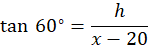
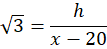
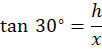
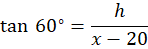
A boy observes the top of a tower at an angle of elevation of 30°. He walks 20 m towards the tower and now the angle of elevation becomes 60°. Find the height of the tower.
Solution
Let the initial distance from the tower = x m
After moving 20 m towards the tower, the distance becomes (x − 20) m
From the first position,


From the second position,
Substitute the value of h,

Therefore,
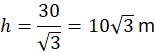
Answer: 10√3 m
हिन्दी
मान लें प्रारम्भिक दूरी = x मीटर
पहले स्थान से
दूसरे स्थान से
दोनों समीकरणों को हल करने पर
ऊँचाई = 10√3 मीटर
HOTS Question 2
A tree breaks due to a storm. The broken part makes an angle of 30° with the ground and touches the ground 8 m away from the base. Find the original height of the tree.
Solution
Distance = 8 m

Length of broken part
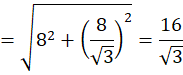
Original Height
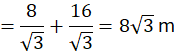
Answer: 8√3 m
HOTS Question 3
From the top of a 40 m building, the angle of depression of a car is 45°.
Find the distance of the car from the building.
Solution
Angle of depression = Angle of elevation = 45°
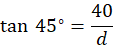


Answer: 40 m
HOTS Question 4
A balloon is flying vertically above a point on the ground. From another point 60 m away, its angle of elevation is 30°.
Find the height of the balloon.
Solution
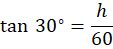

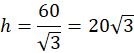
Answer: 20√3 m
HOTS Question 5
A ladder 10 m long is placed against a wall making an angle of 60° with the ground.
Find the height reached on the wall.
Solution
Hypotenuse = 10 m
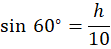


Answer: 5√3 m
NCERT Important Questions with Solutions
Question 1
A ladder 15 m long reaches the top of a vertical wall. If the ladder makes an angle of 60° with the ground, find the height of the wall.
Solution
Given
Length of ladder = 15 m
Angle = 60°

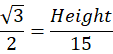
Answer: 15√3/2 m
हिन्दी
सीढ़ी की लंबाई = 15 मीटर
भूमि के साथ कोण = 60°
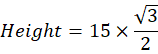
उत्तर = 15√3/2 मीटर
Question 2
The angle of elevation of the top of a tower from a point 50 m away is 45°.
Find the height.
Solution
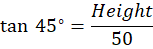
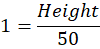
Height = 50 m
Question 3
The angle of elevation of the top of a building is 30°. The observer is 40 m away.
Find the height.
Solution
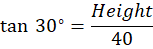
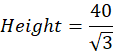
Answer: 40/√3 m
Question 4
A pole 12 m high casts a shadow 4√3 m long.
Find the angle of elevation of the Sun.
Solution
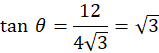
Therefore,

Answer: 60°
Question 5
A kite is flying at a height of 30 m. The angle of elevation is 45°.
Find the horizontal distance.
Solution

Distance = 30 m
NCERT Practice Questions (Without Solutions)
Question 1
A tree is 25 m high. Find the angle of elevation when observed from a point 25 m away.
Question 2
The angle of elevation of the top of a building is 60°. The observer is 20 m away. Find the height.
Question 3
From the top of a tower, the angle of depression of a car is 30°. The height of the tower is 40 m. Find the distance of the car from the tower.
Question 4
A balloon is vertically above a point on the ground. Its angle of elevation from another point is 45° and the distance between the two points is 35 m. Find the height.
Question 5
A ladder 8 m long makes an angle of 60° with the ground. Find the height reached on the wall.
Previous Year CBSE Pattern Questions
1 Mark Question
Define the Angle of Elevation with the help of a diagram.
2 Marks Question
A tower is 30 m high. Find the angle of elevation if the observer is 30 m away.
3 Marks Question
A building is 40 m high. From a point on the ground, the angle of elevation is 60°. Find the distance of the observer from the building.
5 Marks Competency-Based Question ( Heights and Distances Class 10 )
Two students observe the top of a tower from opposite sides. Their distances from the tower are 30 m and 40 m, and the angles of elevation are 45° and 30°, respectively. Verify the height of the tower and compare both observations using trigonometric ratios.
Common Mistakes to Avoid (सामान्य गलतियाँ)
Students often lose marks due to small mistakes. Keep these points in mind:
1. Confusing Angle of Elevation and Angle of Depression
- Angle of Elevation: Looking upward from the horizontal.
- Angle of Depression: Looking downward from the horizontal.
2. Wrong Identification of Sides
- Height (Perpendicular): Vertical side
- Distance (Base): Horizontal side
- Line of Sight (Hypotenuse): Slant side
3. Using the Wrong Trigonometric Ratio
Remember:
- sin θ = Perpendicular / Hypotenuse
- cos θ = Base / Hypotenuse
- tan θ = Perpendicular / Base
4. Incorrect Standard Values
Always memorize: (Heights and Distances Class 10 )
| Angle | sin | cos | tan |
| 0° | 0 | 1 | 0 |
| 30° | 1/2 | √3/2 | 1/√3 |
| 45° | √2/2 | √2/2 | 1 |
| 60° | √3/2 | 1/2 | √3 |
| 90° | 1 | 0 | Not Defined |
5. Forgetting Units
Always write the final answer with the correct unit (m, cm, km).
Quick Revision Notes (One-Shot Revision).
- Height is always vertical.
- Distance is always horizontal.
- Line of Sight is the hypotenuse.
- Angle of Elevation is measured above the horizontal.
- Angle of Depression is measured below the horizontal.
- Most board questions use tan θ.
- Draw a neat diagram before solving.
- Use the correct standard trigonometric values.
Frequently Asked Questions (FAQs)
Q1. What is the Line of Sight?
Answer (English):
The imaginary line joining the observer’s eye to the object is called the Line of Sight.
उत्तर (हिन्दी):
प्रेक्षक की आँख और वस्तु को जोड़ने वाली काल्पनिक रेखा को दृष्टि रेखा (Line of Sight) कहते हैं।
Q2. What is the Angle of Elevation?
Answer (English):
The angle formed between the horizontal line and the line of sight when the observer looks upward is called the Angle of Elevation.
उत्तर (हिन्दी):
जब प्रेक्षक ऊपर की ओर देखता है, तब क्षैतिज रेखा और दृष्टि रेखा के बीच बनने वाला कोण उन्नयन कोण कहलाता है।
Q3. What is the Angle of Depression?
Answer (English):
The angle formed between the horizontal line and the line of sight when looking downward is called the Angle of Depression.
उत्तर (हिन्दी):
जब प्रेक्षक नीचे की ओर देखता है, तब बनने वाला कोण अवनमन कोण कहलाता है।
Q4. Which trigonometric ratio is most commonly used in Heights and Distances?
Answer:
The tangent (tan θ) ratio is used most frequently because:

Q5. Why is this chapter important for Class 10 Board Exams?
Answer:
This chapter is highly scoring because it contains direct formula-based questions, real-life applications, and competency-based problems. With regular practice, students can score full marks.
Q6. What are the real-life applications of Heights and Distances?
Answer:
It is used in:
- Surveying
- Architecture
- Civil Engineering
- Construction of buildings and bridges
- Aviation
- Navigation
- Defence
- Astronomy
Q7. Which standard trigonometric values should every Class 10 student memorize?
Answer:
Students should memorize the values of 0°, 30°, 45°, 60°, and 90° for sin, cos, and tan.
Q8. How can I score full marks in this chapter?
Answer:
- Learn all standard trigonometric values.
- Draw a neat diagram for every question.
- Choose the correct trigonometric ratio.
- Practice NCERT and competency-based questions.
- Revise formulas regularly.
Conclusion (निष्कर्ष) ( Heights and Distances Class 10 )
The chapter Some Applications of Trigonometry (Heights and Distances) is one of the most practical and scoring topics in Class 10 Mathematics. It helps students understand how trigonometric ratios can be used to measure the height of buildings, trees, towers, mountains, and the distance of objects without direct measurement.
By understanding the concepts of Line of Sight, Angle of Elevation, and Angle of Depression, students can solve real-life problems with confidence.
Regular practice of formulas, diagrams, NCERT questions, MCQs, HOTS, and competency-based questions will strengthen conceptual understanding and improve performance in board examinations.
हिन्दी निष्कर्ष ( Heights and Distances Class 10 )
त्रिकोणमिति के अनुप्रयोग (ऊँचाई एवं दूरी) अध्याय कक्षा 10 गणित का एक अत्यंत महत्वपूर्ण एवं अंकदायक अध्याय है। इस अध्याय की सहायता से हम बिना सीधे मापे किसी वस्तु की ऊँचाई तथा दूरी ज्ञात कर सकते हैं।
यदि विद्यार्थी Line of Sight, Angle of Elevation, Angle of Depression तथा सभी महत्वपूर्ण सूत्रों का नियमित अभ्यास करें, तो वे बोर्ड परीक्षा में इस अध्याय से पूरे अंक प्राप्त कर सकते हैं।
Keep Learning, Keep Growing! 🚀
P Kumar | Rising Star Mindset
www.risingstarmindset.com
Together We Will Make The Difference