
Banking, RBI and Budget Notes For BPSC ( Banking RBI Budget Most Important Notes For BPSC Exam )
Series: Economy Series Part-22 ( Banking RBI Budget Most Important Notes For BPSC Exam )
Previous Topic: Basic Economy, GDP & Inflation
Current Topic: Banking, RBI & Budget
Next Topic: Tax System
Table of Contents
- Introduction
- Banking System
- Types of Banks
- Functions of Commercial Banks
- Reserve Bank of India (RBI)
- Functions of RBI
- Monetary Policy Tools
- Union Budget
- Budget Terminologies
- Important Abbreviations
- Key Points for BPSC
- MCQs
- HOTS Questions
- BPSC PYQs
- Question and Answers
- Conclusion

1. Introduction
English
Banking plays an important role in the economy. Banks accept deposits and give loans. RBI controls the banking system. The Union Budget shows the government’s income and spending plan.
हिन्दी
बैंकिंग प्रणाली किसी देश की वित्तीय व्यवस्था की रीढ़ होती है। बैंक बचत को एकत्रित करके आर्थिक विकास के लिए ऋण प्रदान करते हैं। RBI बैंकिंग प्रणाली को नियंत्रित करता है तथा बजट सरकार की वित्तीय योजना को दर्शाता है।
2. Banking System
English
A bank is a financial institution that accepts deposits and provides loans to individuals and businesses.
हिन्दी
बैंक एक वित्तीय संस्था है जो लोगों से जमा (Deposit) स्वीकार करती है तथा ऋण (Loan) प्रदान करती है।
Main Functions
| Function | Description |
|---|---|
| Deposit Acceptance | Accepts public deposits |
| Loan Facility | Provides loans and advances |
| Credit Creation | Creates credit in economy |
| Payment Services | Facilitates transactions |
| Investment | Invests in securities |
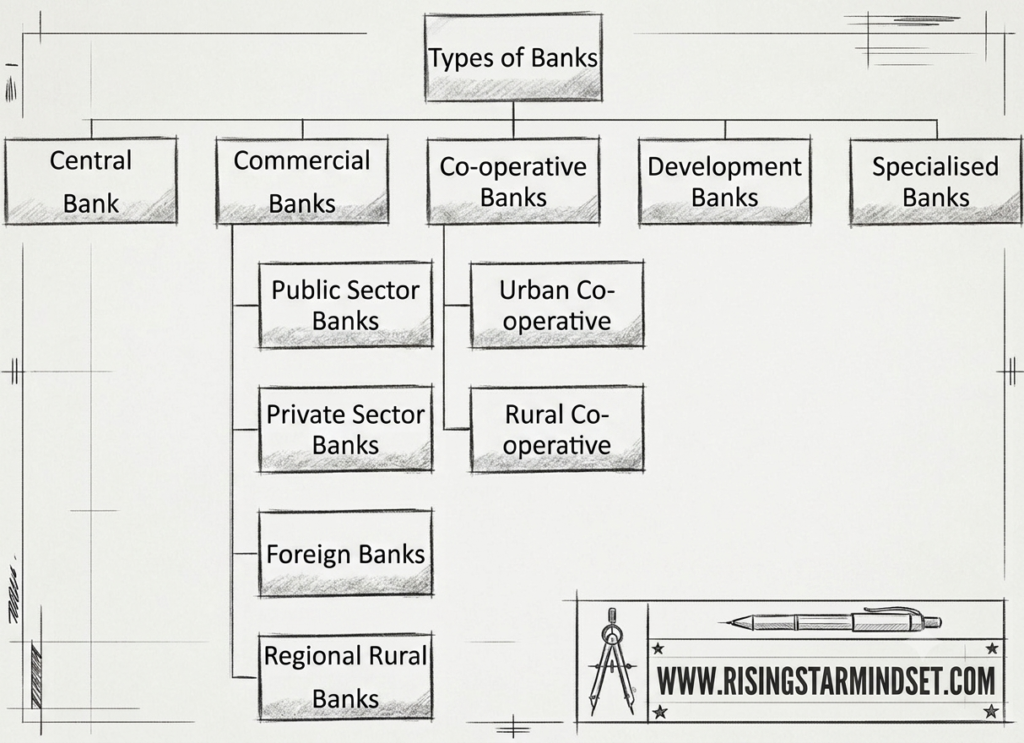
3. Types of Banks
| Type | Description |
|---|---|
| Commercial Banks | Provide banking services to public |
| Regional Rural Banks (RRBs) | Rural development and agriculture |
| Cooperative Banks | Cooperative sector financing |
| Small Finance Banks | Financial inclusion |
| Payments Banks | Limited banking services |
| Development Banks | Industrial development |
Examples
- SBI
- PNB
- Bank of Baroda
- NABARD
- SIDBI
4. Functions of Commercial Banks
Primary Functions
- Accept Deposits
- Provide Loans
- Overdraft Facility
- Cash Credit
Secondary Functions
- ATM Services
- Internet Banking
- Agency Functions
- Fund Transfer
5. Reserve Bank of India (RBI)
English
The Reserve Bank of India (RBI) is the central bank of India. It was established on 1 April 1935. RBI controls and regulates the banking system.
हिन्दी
भारतीय रिजर्व बैंक (RBI) भारत का केंद्रीय बैंक है जिसकी स्थापना 1 अप्रैल 1935 को RBI Act, 1934 के तहत हुई थी।
Headquarters
Mumbai
Nationalized
1 January 1949
Current Role
Regulator of Banking System and Monetary Policy
6. Functions of RBI
| Function | Explanation |
|---|---|
| Issue of Currency | Issues bank notes |
| Banker to Government | Manages government accounts |
| Banker’s Bank | Supervises banks |
| Controller of Credit | Controls money supply |
| Foreign Exchange Management | Manages forex reserves |
| Lender of Last Resort | Provides emergency funds |
7. Monetary Policy Tools
CRR (Cash Reserve Ratio)
Banks keep a percentage of deposits with RBI.
Effect
- CRR Increase → Loan decreases
- CRR Decrease → Loan increases
SLR (Statutory Liquidity Ratio)
Percentage of deposits maintained in liquid assets.
Repo Rate
Rate at which RBI lends money to commercial banks.
Effect
- Repo Rate Increase → Inflation decreases
- Repo Rate Decrease → Liquidity increases
Reverse Repo Rate
Rate at which RBI borrows from banks.
Bank Rate
Long-term lending rate of RBI.
Open Market Operations (OMO)
Purchase and sale of government securities by RBI.
8. Union Budget
English
The Union Budget is prepared every year by the Government of India. It shows expected income and expenditure for the coming financial year.
हिन्दी
केंद्रीय बजट भारत सरकार का वार्षिक वित्तीय विवरण है जिसमें आय और व्यय का अनुमान प्रस्तुत किया जाता है।
Constitutional Provision
Article 112 – Annual Financial Statement
Components of Budget
| Component | Meaning |
|---|---|
| Revenue Receipts | Regular income |
| Capital Receipts | Borrowings and recovery |
| Revenue Expenditure | Day-to-day expenses |
| Capital Expenditure | Asset creation |
Types of Budget Deficits
| Deficit | Meaning |
|---|---|
| Fiscal Deficit | Total Expenditure – Total Receipts |
| Revenue Deficit | Revenue Expenditure – Revenue Receipts |
| Primary Deficit | Fiscal Deficit – Interest Payment |
Importance of Budget ( Banking RBI Budget Most Important Notes For BPSC Exam )
- Economic Growth
- Employment Generation
- Welfare Programmes
- Infrastructure Development
- Fiscal Management
9. Budget Terminologies
| Term | Meaning |
|---|---|
| Fiscal Policy | Government taxation and expenditure policy |
| Public Debt | Government borrowing |
| Subsidy | Financial assistance by government |
| Disinvestment | Sale of government stake |
| FRBM Act | Fiscal Responsibility and Budget Management Act |
10. Important Abbreviations
| Abbreviation | Full Form |
|---|---|
| RBI | Reserve Bank of India |
| CRR | Cash Reserve Ratio |
| SLR | Statutory Liquidity Ratio |
| OMO | Open Market Operations |
| GDP | Gross Domestic Product |
| NABARD | National Bank for Agriculture and Rural Development |
| SIDBI | Small Industries Development Bank of India |
| ATM | Automated Teller Machine |
| FRBM | Fiscal Responsibility and Budget Management |
| RRB | Regional Rural Bank |
11. Key Points ( Banking RBI Budget Most Important Notes For BPSC Exam )
| Reserve Bank of India (RBI ) established in 1935 |
| RBI nationalized in 1949 |
| RBI headquarters – Mumbai |
| Article 112 deals with Union Budget |
| Repo Rate is the policy rate of RBI |
| CRR maintained with RBI |
| SLR maintained by banks themselves |
| Fiscal Deficit is a favorite BPSC question |
| RBI is the lender of last resort |
| Budget is presented annually in Parliament |
12. MCQs ( Banking RBI Budget Most Important Notes For BPSC Exam )
Q1. RBI was established in?
A. 1932
B. 1935
C. 1947
D. 1950
Answer: B
Q2. RBI Headquarters is located at?
A. Delhi
B. Kolkata
C. Mumbai
D. Chennai
Answer: C
Q3. Which Article deals with Union Budget?
A. 110
B. 111
C. 112
D. 123
Answer: C
Q4. Repo Rate refers to?
A. Rate of tax
B. RBI lending rate
C. Deposit rate
D. Exchange rate
Answer: B
Q5. CRR is maintained with?
A. Government
B. RBI
C. Parliament
D. NABARD
Answer: B
Q6. Which institution issues currency in India?
A. SBI
B. Finance Ministry
C. RBI
D. SEBI
Answer: C
Q7. Fiscal Deficit indicates?
A. Revenue loss
B. Total expenditure exceeds receipts
C. Foreign debt
D. Inflation
Answer: B
Q8. OMO stands for?
A. Open Market Operations
B. Official Monetary Office
C. Open Monetary Organization
D. None
Answer: A
Q9. RBI is known as?
A. Commercial Bank
B. Central Bank
C. Cooperative Bank
D. Rural Bank
Answer: B
Q10. SLR stands for?
A. Statutory Liquidity Ratio
B. State Liquidity Ratio
C. Security Loan Ratio
D. Savings Liquidity Ratio
Answer: A
13. HOTS Questions ( Banking RBI Budget Most Important Notes For BPSC Exam )
Q1.
How can RBI control inflation through monetary policy?
Answer:
RBI increases Repo Rate, CRR, and SLR to reduce money supply and control inflation.
Q2.
Differentiate between Fiscal Deficit and Revenue Deficit.
Answer:
Fiscal Deficit includes total expenditure and receipts, whereas Revenue Deficit considers only revenue expenditure and revenue receipts.
Q3.
Why is RBI called the Banker’s Bank?
Answer:
Because commercial banks maintain accounts with RBI and receive financial assistance from it.
14. Previous Year Questions (BPSC Pattern)
Q1.
Which institution acts as the lender of last resort in India?
Answer: RBI
Q2.
Which Article of the Constitution provides for Annual Financial Statement?
Answer: Article 112
Q3.
What is the primary objective of CRR?
Answer: Control liquidity in the economy.
Q4.
Who regulates commercial banks in India?
Answer: RBI
15. Important Question and Answers
Q1. What is Banking?
Answer: Banking refers to accepting deposits and providing loans.
Q2. What is RBI?
Answer: RBI is the Central Bank of India responsible for monetary regulation.
Q3. What is Repo Rate?
Answer: The rate at which RBI lends money to commercial banks.
Q4. What is Fiscal Deficit?
Answer: Excess of total government expenditure over total receipts excluding borrowings.
Q5. What is Budget?
Answer: Annual statement of government income and expenditure.
Q6. What is CRR?
Answer: Portion of bank deposits maintained with RBI.
Q7. What is SLR?
Answer: Portion of deposits maintained by banks in liquid assets.
Q8. What is OMO?
Answer: Purchase and sale of government securities by RBI.
FAQs
Q. What is RBI?
RBI is the central bank of India.
Q. What is Repo Rate?
Repo Rate is the rate at which RBI lends money to banks.
Q. Which Article deals with the Union Budget?
Article 112 deals with the Union Budget.
Quick Revision (One Minute)
- RBI Established → 1935
- Nationalized → 1949
- Headquarters → Mumbai
- Article 112 → Budget
- Repo Rate → RBI lends to banks
- Reverse Repo → RBI borrows from banks
- CRR → Maintained with RBI
- SLR → Maintained by Banks
- OMO → Buy/Sell Government Securities
- Fiscal Deficit → Expenditure > Receipts
Conclusion ( Banking RBI Budget Most Important Notes For BPSC Exam )
Banking, RBI and Budget are important topics for BPSC and other competitive exams. Regular revision of these topics helps candidates score better in the Economy section.
For BPSC and other competitive exam preparation, stay connected with our website: Rising Star Mindset for regular notes, MCQs, PYQs and one-shot revision content.
Keep Learning, Keep Growing! 🚀
P Kumar | Rising Star Mindset
www.risingstarmindset.com
Together We Will Make The Difference