
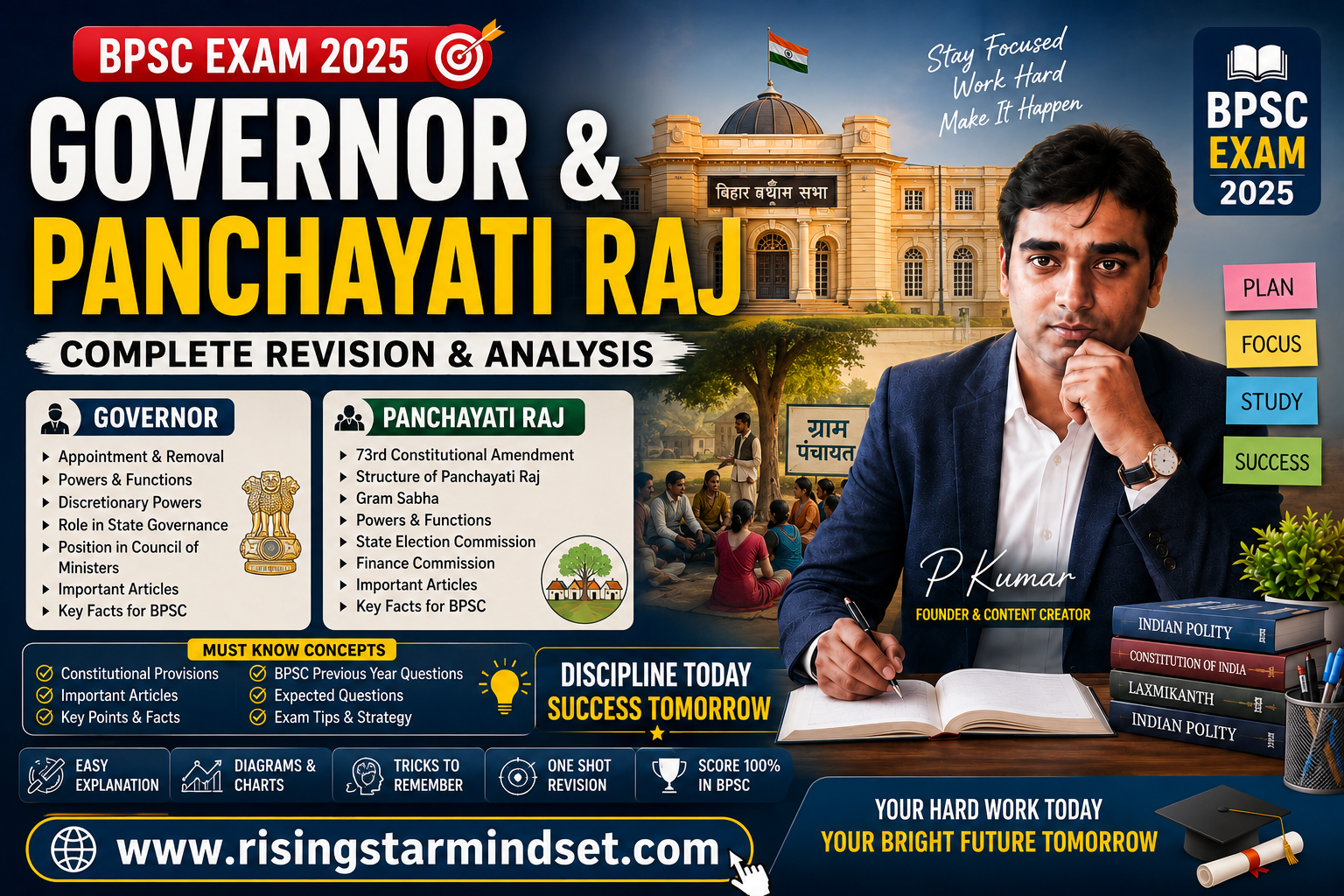
Polity Series Part-19: Governor, Chief Minister & Panchayati Raj Notes (BPSC 2026)
Website: www.risingstarmindset.com ( Governor CM Panchayati Raj )
Series: Polity Series Part-19
Previous Topic: Prime Minister, Parliament & Supreme Court
Next Topic: Constitutional Bodies
Table of Contents ( Governor CM Panchayati Raj )
- Introduction
- Important Abbreviations
- Governor (राज्यपाल)
- Chief Minister (मुख्यमंत्री)
- Governor vs Chief Minister
- Panchayati Raj System
- Three-Tier Panchayati Raj Structure
- 73rd Constitutional Amendment Act, 1992
- Key Points for BPSC
- Previous Year Questions (PYQ)
- HOTS Questions
- Important MCQs
- Short and Long Answer Questions
- FAQs
- Expected Questions for BPSC 2026
- Quick Revision Notes
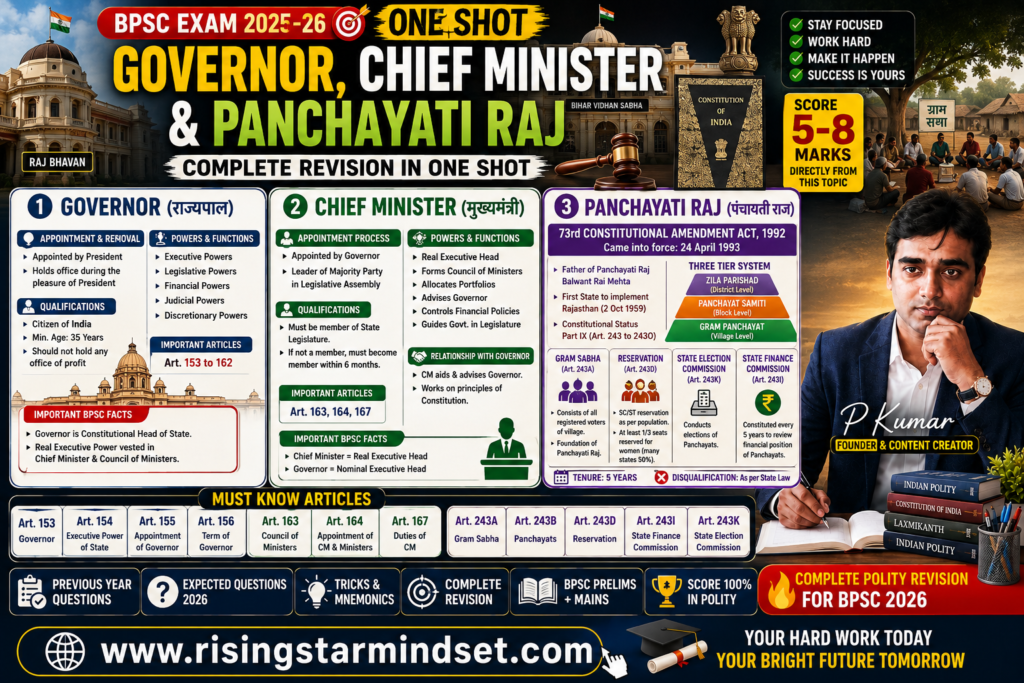
Introduction
India follows a federal system where states have their own governments. The Governor acts as the constitutional head of the state, while the Chief Minister is the real executive head. Panchayati Raj promotes local self-government at the village level.
हिंदी में
भारत एक संघीय व्यवस्था वाला देश है। प्रत्येक राज्य का अपना प्रशासन होता है। राज्यपाल राज्य का संवैधानिक प्रमुख होता है जबकि मुख्यमंत्री वास्तविक कार्यपालिका प्रमुख होता है। पंचायती राज ग्रामीण स्तर पर स्थानीय स्वशासन की व्यवस्था है।
Important Abbreviations ( Governor CM Panchayati Raj )
| Abbreviation | Full Form |
|---|---|
| CM | Chief Minister |
| PRI | Panchayati Raj Institution |
| SEC | State Election Commission |
| SFC | State Finance Commission |
| GS | Gram Sabha |
| GP | Gram Panchayat |
| ZP | Zila Parishad |
Governor (राज्यपाल)
Constitutional Provisions
English Explanation
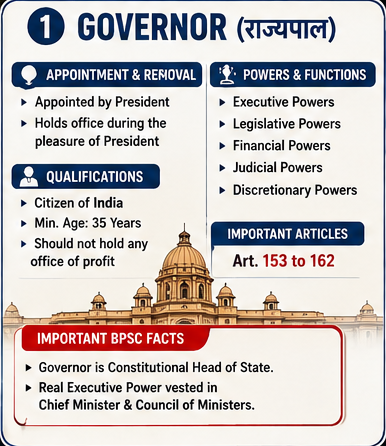
The Governor is the constitutional head of the state and acts as the representative of the President.
Appointment
- Appointed by the President.
- Holds office during the pleasure of the President.
- Normal tenure is 5 years.
Qualifications
- Citizen of India.
- Minimum age 35 years.
- Should not hold office of profit.
Powers of Governor
Executive Powers
- Appoints Chief Minister, Ministers. And Advocate General.
Legislative Powers
- Summons and prorogues State Legislature.
- Can dissolve Legislative Assembly.
- Gives assent to bills.
Financial Powers
- Money Bill introduced only with Governor’s recommendation.
Judicial Powers
- Can grant pardon, reprieve and remission.
हिंदी में
राज्यपाल राज्य का संवैधानिक प्रमुख होता है तथा राष्ट्रपति का प्रतिनिधि माना जाता है।
प्रमुख कार्य
- मुख्यमंत्री की नियुक्ति
- मंत्रियों की नियुक्ति
- विधानसभा को बुलाना एवं स्थगित करना
- विधेयकों को स्वीकृति देना
- क्षमादान प्रदान करना
Chief Minister (मुख्यमंत्री)
English Explanation
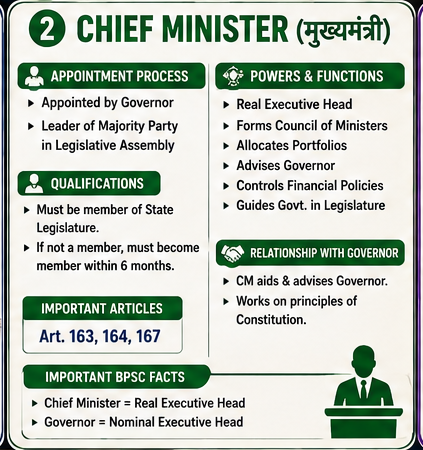
The Chief Minister is the real executive head of the state government.
Constitutional Basis
Functions
- Head of Council of Ministers.
- Advises Governor.
- Formulates state policies.
- Coordinates administration.
Powers
- Recommends appointment of ministers.
- Allocates portfolios.
- Presides over cabinet meetings.
हिंदी में
मुख्यमंत्री राज्य सरकार का वास्तविक प्रमुख होता है।
मुख्य कार्य
- मंत्रिपरिषद का नेतृत्व
- राज्य की नीतियों का निर्माण
- राज्य प्रशासन का संचालन
- राज्यपाल को सलाह देना
Governor vs Chief Minister
| Governor | Chief Minister |
|---|---|
| Nominal Head | Real Executive |
| Appointed by President | Leader of Majority Party |
| Constitutional Head | Political Head |
| Fixed Term | Depends on Assembly Majority |
Panchayati Raj System
English Explanation
Panchayati Raj is the system of rural local self-government.
Recommendation
- Balwant Rai Mehta Committee (1957)
Constitutional Status
- 73rd Constitutional Amendment Act, 1992
Implemented
- 24 April 1993
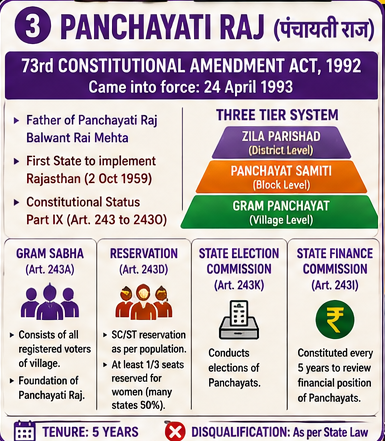
हिंदी में
पंचायती राज ग्रामीण क्षेत्रों में स्थानीय स्वशासन की व्यवस्था है।
संवैधानिक आधार
73वां संविधान संशोधन अधिनियम, 1992
लागू
24 अप्रैल 1993
Three-Tier Panchayati Raj Structure
| Level | Institution |
|---|---|
| Village | Gram Panchayat |
| Block | Panchayat Samiti |
| District | Zila Parishad |
Gram Sabha
English
- Basic unit of Panchayati Raj.
- Includes all registered voters of the village.
हिंदी
- ग्राम सभा पंचायती राज की आधारभूत इकाई है।
- गाँव के सभी मतदाता इसके सदस्य होते हैं।
73rd Constitutional Amendment Act, 1992
Important Features
- Constitutional status to Panchayats.
- Five-year tenure.
- Reservation for SC/ST.
- One-third reservation for women.
- State Finance Commission.
- State Election Commission.
- Eleventh Schedule added.
- 29 subjects transferred.
Key Points for BPSC ( Governor CM Panchayati Raj )
| Governor appointed by President |
| Governor’s minimum age = 35 years |
| CM is real executive head |
| Panchayati Raj introduced on recommendation of Balwant Rai Mehta Committee |
| 73rd Amendment = Panchayati Raj |
| 24 April = National Panchayati Raj Day |
| Eleventh Schedule = 29 Subjects |
Most Important BPSC Articles
| Article | Topic |
|---|---|
| 153 | Governor |
| 154 | Executive Power of State |
| 155 | Appointment of Governor |
| 156 | Term of Governor |
| 163 | Council of Ministers |
| 164 | Appointment of CM |
| 167 | Duties of CM |
| 243A | Gram Sabha |
| 243B | Panchayats |
| 243D | Reservation |
| 243I | State Finance Commission |
| 243K | State Election Commission |
Previous Year Questions (PYQ) ( Governor CM Panchayati Raj )
Q1. Which Constitutional Amendment gave constitutional status to Panchayats?
A. 42nd
B. 44th
C. 73rd
D. 86th
Answer: C
Q2. Who appoints the Governor?
A. Prime Minister
B. Chief Justice of India
C. President
D. Parliament
Answer: C
Q3. Which committee recommended Panchayati Raj?
A. Sarkaria Committee
B. Balwant Rai Mehta Committee
C. Punchhi Committee
D. Ashok Mehta Committee
Answer: B
HOTS Questions ( Governor CM Panchayati Raj )
Q1.
Why is the Chief Minister considered more powerful than the Governor?
Answer:
Because actual executive powers are exercised by the Chief Minister and Council of Ministers.
Q2.
How does Panchayati Raj strengthen democracy?
Answer:
By ensuring people’s participation in local governance and decision-making.
Important MCQs
1. Minimum age for Governor?
A. 25
B. 30
C. 35
D. 40
Answer: C
2. Governor’s power to pardon is under:
A. Article 161
B. Article 163
C. Article 165
D. Article 170
Answer: A
3. Panchayati Raj is included in:
A. Ninth Schedule
B. Tenth Schedule
C. Eleventh Schedule
D. Twelfth Schedule
Answer: C
4. Panchayat elections are conducted by:
A. Election Commission of India
B. State Election Commission
C. Governor
D. Parliament
Answer: B
5. National Panchayati Raj Day is celebrated on:
A. 15 August
B. 26 January
C. 24 April
D. 2 October
Answer: C
Important Question Answers
Short Questions
Q. Who appoints the Governor?
President appoints the Governor.
Q. What is Gram Sabha?
Assembly of all registered voters of a village.
Q. Which amendment introduced Panchayati Raj?
73rd Constitutional Amendment Act, 1992.
Long Questions
Explain powers of Governor.
The Governor possesses executive, legislative, financial and judicial powers. He appoints the Chief Minister, summons the legislature, recommends money bills and grants pardons.
Explain Panchayati Raj System.
Panchayati Raj is a three-tier local self-government system comprising Gram Panchayat, Panchayat Samiti and Zila Parishad. It promotes democratic decentralization.
FAQs
Is Governor elected?
No, Governor is appointed by the President.
Who is the real executive head of a state?
Chief Minister.
Which amendment deals with Panchayati Raj?
73rd Constitutional Amendment.
How many subjects are in Eleventh Schedule?
29 Subjects.
Who conducts Panchayat elections?
State Election Commission.
Expected Questions for BPSC 2026
- Discuss constitutional position of Governor.
- Explain discretionary powers of Governor.
- Compare Governor and Chief Minister.
- Explain importance of Panchayati Raj.
- Discuss major provisions of 73rd Constitutional Amendment.
- What is Gram Sabha?
- Explain structure of Panchayati Raj in India.
- Role of State Finance Commission.
- Functions of State Election Commission.
- Importance of democratic decentralization.
Quick Revision Notes (One Minute Revision)
| Governor → Article 153 |
| Governor appointed by President |
| Minimum age = 35 years |
| Chief Minister = Real Executive Head |
| Article 164 → Appointment of CM |
| Panchayati Raj → 73rd Amendment |
| Implemented → 24 April 1993 |
| Recommendation → Balwant Rai Mehta Committee |
| Three Tiers → Gram Panchayat, Panchayat Samiti, Zila Parishad |
| Eleventh Schedule → 29 Subjects |
| Panchayat Election → State Election Commission |
| Finance Commission → Every 5 Years |
Conclusion
Governor, Chief Minister and Panchayati Raj are important pillars of India’s democratic and administrative system. The Governor acts as the constitutional head of the state, while the Chief Minister is the real executive authority responsible for governance. Panchayati Raj strengthens grassroots democracy by ensuring people’s participation in local administration and development. For BPSC and other competitive examinations, candidates should thoroughly understand the constitutional provisions, powers, functions, important articles, and the 73rd Constitutional Amendment related to these topics. A clear understanding of these concepts will help in both objective and descriptive examinations.
हिंदी में निष्कर्ष
राज्यपाल, मुख्यमंत्री एवं पंचायती राज भारतीय लोकतंत्र और प्रशासनिक व्यवस्था के महत्वपूर्ण अंग हैं। राज्यपाल राज्य का संवैधानिक प्रमुख होता है, जबकि मुख्यमंत्री राज्य सरकार का वास्तविक कार्यकारी प्रमुख होता है। पंचायती राज व्यवस्था स्थानीय स्तर पर लोकतंत्र को मजबूत बनाती है तथा ग्रामीण विकास में महत्वपूर्ण भूमिका निभाती है। BPSC एवं अन्य प्रतियोगी परीक्षाओं की दृष्टि से इन विषयों के संवैधानिक प्रावधान, शक्तियाँ, कार्य एवं 73वें संविधान संशोधन का गहन अध्ययन अत्यंत आवश्यक है। इन विषयों की अच्छी समझ परीक्षा में बेहतर प्रदर्शन करने में सहायक होगी।
Keep Learning, Keep Growing! 🚀
P Kumar | Rising Star Mindset
www.risingstarmindset.com
Together We Will Make The Difference