
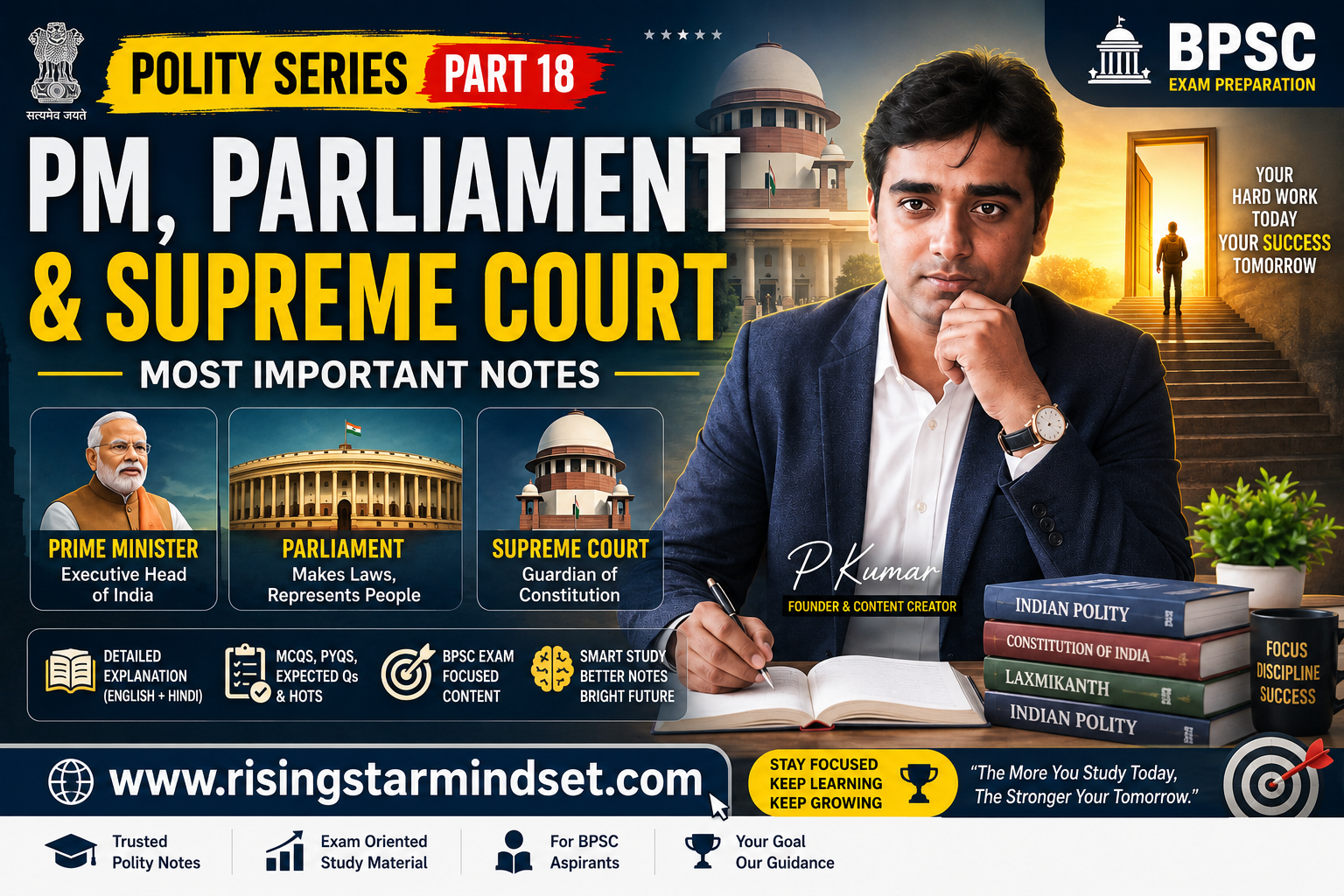
Polity Series Part 18: PM, Parliament and Supreme Court (BPSC Special)
Previous Topic : DPSP, Duties and President Most Important BPSC Polity Notes
Table of Contents ( PM, Parliament and Supreme Court )
- Introduction
- Important Abbreviations
- Prime Minister (प्रधानमंत्री)
- Parliament (संसद)
- Supreme Court (उच्चतम न्यायालय)
- Key Points for Revision
- Comparison Table
- Important MCQs
- HOTS Questions
- Previous Year Questions (BPSC Pattern)
- Expected Questions for BPSC
- Short and Long Answer Questions
- Frequently Asked Questions (FAQ)
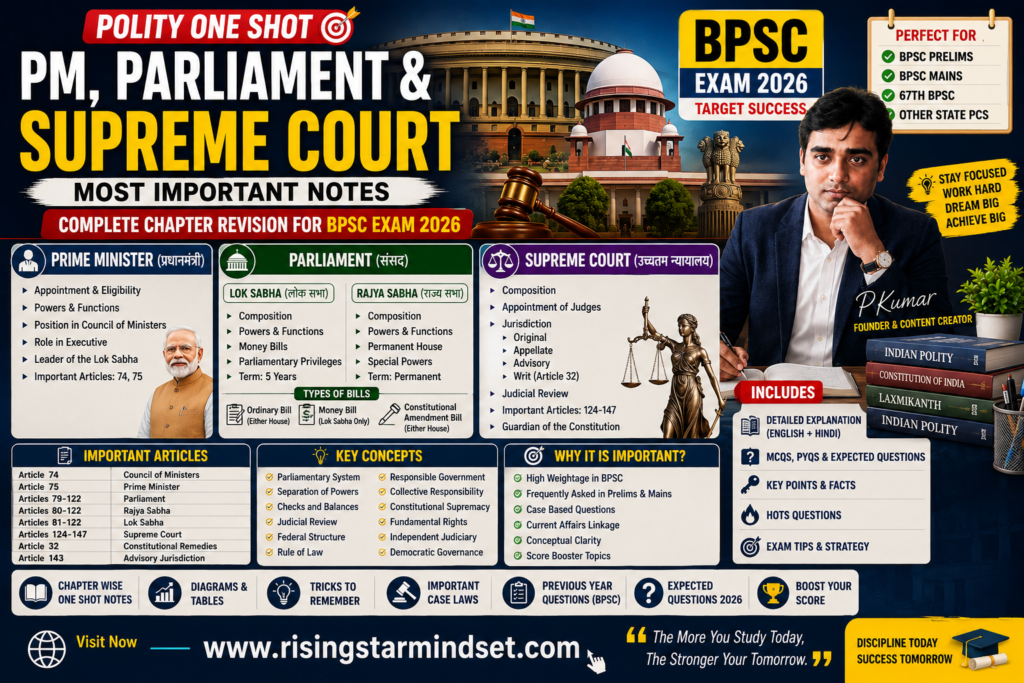
Introduction ( PM, Parliament and Supreme Court )
The Prime Minister, Parliament, and Supreme Court form the three most important pillars of India’s democratic system. The Prime Minister leads the executive, Parliament makes laws, and the Supreme Court protects the Constitution. ( PM, Parliament and Supreme Court )
प्रधानमंत्री, संसद और उच्चतम न्यायालय भारत की लोकतांत्रिक व्यवस्था के तीन महत्वपूर्ण स्तंभ हैं। प्रधानमंत्री कार्यपालिका का नेतृत्व करते हैं, संसद कानून बनाती है और उच्चतम न्यायालय संविधान की रक्षा करता है।
Important Abbreviations ( PM, Parliament and Supreme Court )
| Abbreviation | Full Form |
|---|---|
| PM | Prime Minister |
| MP | Member of Parliament |
| RS | Rajya Sabha |
| LS | Lok Sabha |
| SC | Supreme Court |
| CJI | Chief Justice of India |
| AG | Attorney General |
| UPSC | Union Public Service Commission |
| BPSC | Bihar Public Service Commission |
Prime Minister (प्रधानमंत्री)
Constitutional Basis
Article 74: President shall act according to the advice of the Council of Ministers headed by the Prime Minister.
Article 75: Deals with appointment, tenure, and responsibilities of the Prime Minister and Council of Ministers.
English Explanation
The Prime Minister is the real executive head of the Government of India. Although the President is the nominal head, actual powers are exercised by the Prime Minister and the Council of Ministers.
हिंदी व्याख्या
प्रधानमंत्री भारत सरकार के वास्तविक कार्यकारी प्रमुख होते हैं। राष्ट्रपति नाममात्र के प्रमुख होते हैं, जबकि वास्तविक शक्तियों का प्रयोग प्रधानमंत्री और मंत्रिपरिषद द्वारा किया जाता है।
Appointment
- Appointed by the President.
- Usually leader of the majority party in Lok Sabha.
- Must become a member of Parliament within six months if not already a member.
Powers and Functions
Administrative Powers
- Forms the Council of Ministers.
- Allocates portfolios.
- Can recommend dismissal of ministers.
Legislative Powers
- Advises the President regarding Parliament sessions.
- Plays a key role in law-making.
Executive Powers
- Coordinates between ministries.
- Leads national policies.
International Powers
- Represents India internationally.
- Participates in global summits.
Parliament (संसद)
Constitutional Basis
Articles 79 to 122
Parliament consists of:
- President
- Lok Sabha
- Rajya Sabha
हिंदी व्याख्या
संसद तीन भागों से मिलकर बनती है—
- राष्ट्रपति
- लोकसभा
- राज्यसभा
Lok Sabha
Important Facts
| Feature | Details |
|---|---|
| Maximum Strength | 552 |
| Present Strength | 543 elected members |
| Term | 5 Years |
| Minimum Age | 25 Years |
Powers
- Controls Council of Ministers.
- Passes Money Bills.
- Can remove government through No-Confidence Motion.
Rajya Sabha
| Feature | Details |
|---|---|
| Maximum Strength | 250 |
| Present Strength | 245 |
| Permanent House | Yes |
| Minimum Age | 30 Years |
Special Powers
- Creation of All India Services.
- Authorization on State List during national interest.
Types of Bills
| Bill Type | Introduced In |
|---|---|
| Ordinary Bill | Either House |
| Money Bill | Lok Sabha Only |
| Constitutional Amendment Bill | Either House |
Supreme Court (उच्चतम न्यायालय)
Constitutional Basis
Articles 124 to 147
English Explanation
The Supreme Court is the highest judicial authority in India. It acts as the guardian of the Constitution.
हिंदी व्याख्या
उच्चतम न्यायालय भारत का सर्वोच्च न्यायिक निकाय है तथा संविधान का संरक्षक माना जाता है।
Composition
- Chief Justice of India (CJI)
- Other Judges as determined by Parliament
Appointment of Judges
- Appointed by the President.
- Recommendation through Collegium System.
Jurisdiction
Original Jurisdiction
Disputes between:
- Union and States
- States and States
Appellate Jurisdiction
Appeals from High Courts.
Advisory Jurisdiction
President may seek advice under Article 143.
Writ Jurisdiction
Under Article 32.
Judicial Review
The Supreme Court can declare laws unconstitutional.
Key Points for Revision
| Article | Related Topic |
|---|---|
| 74 | Council of Ministers |
| 75 | Prime Minister |
| 79 | Parliament |
| 80 | Rajya Sabha |
| 81 | Lok Sabha |
| 124 | Supreme Court |
| 32 | Constitutional Remedies |
| 143 | Advisory Jurisdiction |
Comparison Table ( PM, Parliament and Supreme Court )
| Feature | Prime Minister | Parliament | Supreme Court |
|---|---|---|---|
| Organ | Executive | Legislature | Judiciary |
| Head | PM | President | CJI |
| Function | Administration | Law Making | Justice |
| Constitutional Articles | 74-75 | 79-122 | 124-147 |
MCQs for BPSC
Q1. Which Article deals with the Prime Minister?
A. Article 52
B. Article 75
C. Article 124
D. Article 143
Answer: B
Q2. Rajya Sabha is a:
A. Temporary House
B. Judicial Body
C. Permanent House
D. Executive Body
Answer: C
Q3. Article 32 is related to:
A. Governor
B. Prime Minister
C. Fundamental Rights Protection
D. Parliament
Answer: C
Q4. Who appoints the Prime Minister?
A. Chief Justice
B. Speaker
C. President
D. Vice-President
Answer: C
Q5. Guardian of the Constitution is:
A. President
B. Prime Minister
C. Parliament
D. Supreme Court
Answer: D
HOTS Questions
Q1.
Why is the Prime Minister called the “Keystone of the Cabinet Arch”?
Answer:
Because the Prime Minister coordinates and controls the entire Council of Ministers.
Q2.
Why is Judicial Review important in democracy?
Answer:
It prevents unconstitutional actions by government authorities.
Previous Year Questions (BPSC Pattern)
Q1.
Which Article provides Constitutional Remedies?
Answer: Article 32
Q2.
Who is the ex-officio Chairman of Rajya Sabha?
Answer: Vice-President of India
Q3.
Which body can interpret the Constitution?
Answer: Supreme Court
Expected Questions for BPSC 2026
- Discuss powers of the Prime Minister.
- Explain composition of Parliament.
- Differentiate Lok Sabha and Rajya Sabha.
- Explain Judicial Review.
- Discuss Supreme Court’s jurisdiction.
- Why is Article 32 called the Heart and Soul of the Constitution?
- Explain Money Bill procedure.
- Describe appointment of Supreme Court judges.
Short Answer Questions
Q1. Who appoints the Prime Minister?
President of India.
Q2. What is the tenure of Lok Sabha?
Five years.
Q3. What is the minimum age for Rajya Sabha membership?
Thirty years.
Q4. What is Judicial Review?
Power of courts to examine constitutional validity of laws.
Long Answer Questions
Q1. Explain the powers and functions of the Prime Minister.
The Prime Minister leads the government, forms the Council of Ministers, coordinates administration, advises the President, and guides national policies.
Q2. Explain the composition and functions of Parliament.
Parliament consists of the President, Lok Sabha, and Rajya Sabha. It makes laws, controls finances, and ensures executive accountability.
Q3. Discuss the role of the Supreme Court.
The Supreme Court protects the Constitution, safeguards Fundamental Rights, settles disputes, and exercises Judicial Review.
Frequently Asked Questions (FAQ)
Why is the Prime Minister considered the real executive?
Because actual executive powers are exercised through the Prime Minister and Council of Ministers.
Which House is called the Lower House?
Lok Sabha.
Which House is permanent?
Rajya Sabha.
Which Article establishes the Supreme Court?
Article 124.
Who is known as the Guardian of the Constitution?
The Supreme Court.
BPSC Exam Booster (One-Line Revision)
Article 74 deals with the Council of Ministers, Article 75 with the Prime Minister, Article 79 with Parliament, Article 80 with Rajya Sabha, Article 81 with Lok Sabha, Article 124 with the Supreme Court, Article 32 with Constitutional Remedies, and Article 143 with Advisory Jurisdiction.
Next in Polity Series Part 19: Governor and Chief Minister (राज्यपाल एवं मुख्यमंत्री) – Powers, Functions, Appointment, Removal, MCQs, PYQs, and BPSC Special Notes.
Keep Learning, Keep Growing! 🚀
P Kumar | Rising Star Mindset
www.risingstarmindset.com
Together We Will Make The Difference