
Polity Series Part 17 ( DPSP, Duties and President )
DPSP, Fundamental Duties and President
Previous Topic
📖 Constitution Making, Preamble and Fundamental Rights ( DPSP, Duties and President )
Current Topic
- Directive Principles of State Policy (DPSP)
- Fundamental Duties
- President of India
Next Topic
📖 Prime Minister, Parliament and Supreme Court
Table of Contents ( DPSP, Duties and President )
- Introduction
- Directive Principles of State Policy (DPSP)
- Features of DPSP
- Classification of DPSP
- Importance of DPSP
- DPSP and Fundamental Rights
- Fundamental Duties
- Importance of Fundamental Duties
- President of India
- Election of President
- Qualifications of President
- Powers and Functions of President
- Veto Powers of President
- Impeachment of President
- Abbreviations
- Key Points
- Important Questions and Answers
- MCQs
- HOTS Questions
- Previous Year Questions (PYQ)
- Expected Questions for BPSC
- FAQs
- Conclusion
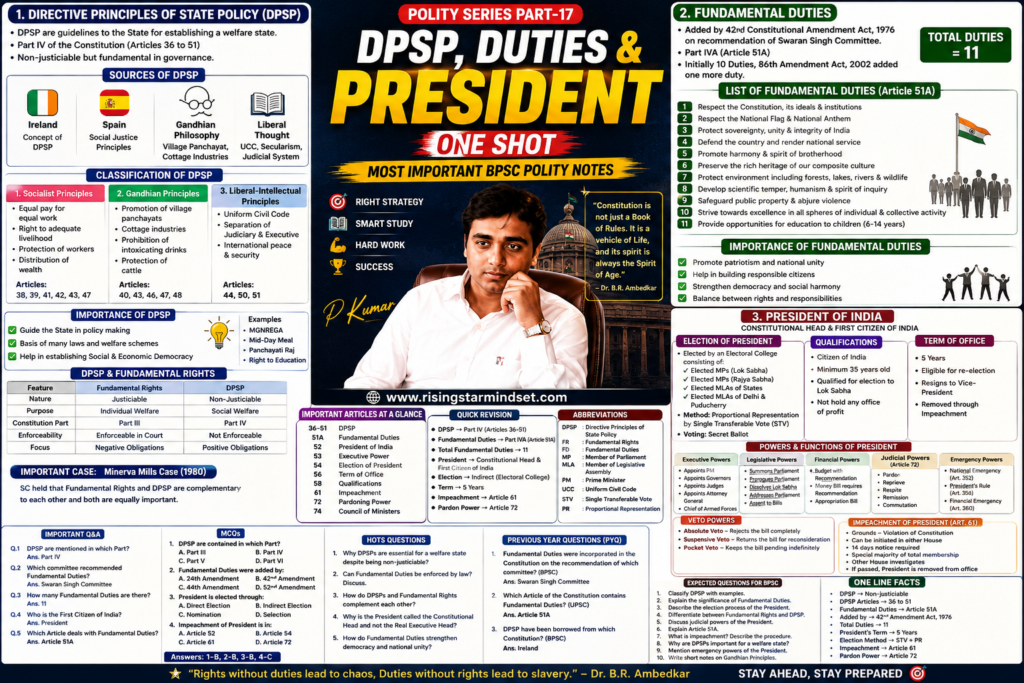
Introduction
The Constitution of India is not merely a legal document. Rather, it is a guiding framework for the governance of the country. Therefore, it contains Fundamental Rights, Directive Principles of State Policy (DPSP), and Fundamental Duties. Together, these provisions help establish social, economic, and political justice.
भारतीय संविधान केवल एक कानूनी दस्तावेज नहीं है। बल्कि यह देश के शासन संचालन का मार्गदर्शक है। इसलिए इसमें मौलिक अधिकार, राज्य के नीति निर्देशक तत्व (DPSP) तथा मौलिक कर्तव्य शामिल किए गए हैं। ये सभी मिलकर सामाजिक, आर्थिक और राजनीतिक न्याय की स्थापना करते हैं।
Directive Principles of State Policy (DPSP)
Meaning of DPSP
The Directive Principles of State Policy are guidelines given to the government for creating a welfare state. Although these principles are not enforceable by courts, they are fundamental in governance.
DPSP are mentioned in Part IV (Articles 36 to 51) of the Constitution.
हिंदी में
राज्य के नीति निर्देशक तत्व (DPSP) सरकार को जनकल्याणकारी राज्य स्थापित करने के लिए दिशा-निर्देश प्रदान करते हैं। यद्यपि इन्हें न्यायालय में लागू नहीं कराया जा सकता, फिर भी शासन संचालन में इनका अत्यंत महत्वपूर्ण स्थान है।
DPSP संविधान के भाग IV (अनुच्छेद 36 से 51) में वर्णित हैं।
Sources of DPSP
| Source | Provision |
|---|---|
| Ireland | DPSP Concept |
| Spain | Social Justice Principles |
| Gandhian Philosophy | Village Panchayat & Cottage Industries |
| Liberal Thought | Uniform Civil Code |
Features of DPSP
English
- Non-justiciable in nature
- Aim at establishing a welfare state
- Guide governments in policy-making
- Promote social and economic democracy
- Complement Fundamental Rights
हिंदी
- न्यायालय में लागू नहीं कराए जा सकते
- कल्याणकारी राज्य की स्थापना का लक्ष्य
- सरकार को नीति निर्माण में मार्गदर्शन
- सामाजिक एवं आर्थिक लोकतंत्र को बढ़ावा
- मौलिक अधिकारों के पूरक
Classification of DPSP
1. Socialist Principles
These principles aim to establish social and economic justice.
Examples
- Equal pay for equal work
- Protection of workers
- Right to adequate livelihood
- Distribution of wealth
Related Articles
Article 38, 39, 41, 42, 43, 47
2. Gandhian Principles
These principles reflect the ideas of Mahatma Gandhi.
Examples
- Promotion of village panchayats
- Cottage industries
- Prohibition of intoxicating drinks
- Protection of cattle
Related Articles
Article 40, 43, 46, 47, 48
3. Liberal-Intellectual Principles
These principles promote modern democratic values.
Examples
- Uniform Civil Code
- Separation of Judiciary and Executive
- International peace and security
Related Articles
Article 44, 50, 51
Importance of DPSP
English
DPSPs help governments formulate welfare-oriented policies. Moreover, many successful schemes and reforms in India are inspired by DPSPs.
हिंदी
DPSP सरकार को जनहितकारी नीतियाँ बनाने में सहायता करते हैं। इसके अतिरिक्त भारत की अनेक योजनाएँ और सुधार DPSP से प्रेरित हैं।
Examples
- MGNREGA
- Mid-Day Meal Scheme
- Panchayati Raj System
- Right to Education
DPSP and Fundamental Rights
| Fundamental Rights | DPSP |
|---|---|
| Justiciable | Non-Justiciable |
| Individual Welfare | Social Welfare |
| Part III | Part IV |
| Legal Protection | Moral Obligation |
Important Case
Minerva Mills Case (1980)
The Supreme Court stated that Fundamental Rights and DPSP are complementary and should work together.
Fundamental Duties ( DPSP, Duties and President )
Introduction
Fundamental Duties were added through the 42nd Constitutional Amendment Act, 1976 based on the recommendation of the Swaran Singh Committee.
These duties are mentioned in Part IVA under Article 51A.
Initially there were 10 duties. Later, the 86th Constitutional Amendment Act, 2002 added one more duty.
Total Fundamental Duties = 11
List of Fundamental Duties ( DPSP, Duties and President )
Every citizen shall:
- Respect the Constitution.
- Respect the National Flag and National Anthem.
- Protect sovereignty and integrity of India.
- Defend the country when called upon.
- Promote harmony and brotherhood.
- Preserve India’s cultural heritage.
- Protect environment and wildlife.
- Develop scientific temper.
- Safeguard public property.
- Strive for excellence.
- Provide education to children between 6 and 14 years.
Importance of Fundamental Duties
English
Fundamental Duties remind citizens that rights and responsibilities go together.
हिंदी
मौलिक कर्तव्य नागरिकों को यह याद दिलाते हैं कि अधिकारों के साथ-साथ कर्तव्य भी आवश्यक हैं।
Benefits
- Strengthen democracy
- Promote patriotism
- Protect national unity
- Encourage responsible citizenship
President of India ( DPSP, Duties and President )
Introduction
The President is the Constitutional Head of the Indian Republic and the First Citizen of India.
Important Articles
| Article | Subject |
|---|---|
| 52 | President of India |
| 53 | Executive Power |
| 54 | Election |
| 56 | Term of Office |
| 58 | Qualifications |
| 61 | Impeachment |
| 72 | Pardoning Power |
| 74 | Council of Ministers |
Election of President
The President is elected indirectly.
Electoral College
- Elected Members of Lok Sabha , Rajya Sabha and MLAs of States
- Elected MLAs of Delhi and Puducherry
Voting Method
- Proportional Representation
- Single Transferable Vote
- Secret Ballot
Qualifications of President
A person must:
- Be a citizen of India
- Not hold any office of profit
- Be at least 35 years old
- qualified for election to Lok Sabha
Term of Office
- Five years
- Eligible for re-election
- Can resign to Vice-President
Powers of President
1. Executive Powers
- Appoints Prime Minister , Governors and Judges
- Appoints Attorney General
2. Legislative Powers
- Summons Parliament
- Prorogues Parliament
- Dissolves Lok Sabha
- Addresses Parliament
- Gives assent to Bills
3. Financial Powers
- Budget presented with recommendation
- Money Bill requires recommendation
4. Judicial Powers
Under Article 72, the President can grant:
- Pardon
- Reprieve
- Respite
- Remission
- Commutation
5. Emergency Powers
National Emergency
Article 352
President’s Rule
Article 356
Financial Emergency
Article 360
Veto Powers of President
Absolute Veto
Bill rejected completely.
Suspensive Veto
Bill returned for reconsideration.
Pocket Veto
President keeps bill pending without action.
Impeachment of President
Grounds
Violation of Constitution
Procedure
- Charge can be initiated in either House.
- 14 days notice required.
- Special majority needed.
- Other House investigates charges.
- If approved, President is removed.
Abbreviations ( DPSP, Duties and President )
| Short Form | Full Form |
|---|---|
| DPSP | Directive Principles of State Policy |
| FR | Fundamental Rights |
| FD | Fundamental Duties |
| PM | Prime Minister |
| MP | Member of Parliament |
| MLA | Member of Legislative Assembly |
| UCC | Uniform Civil Code |
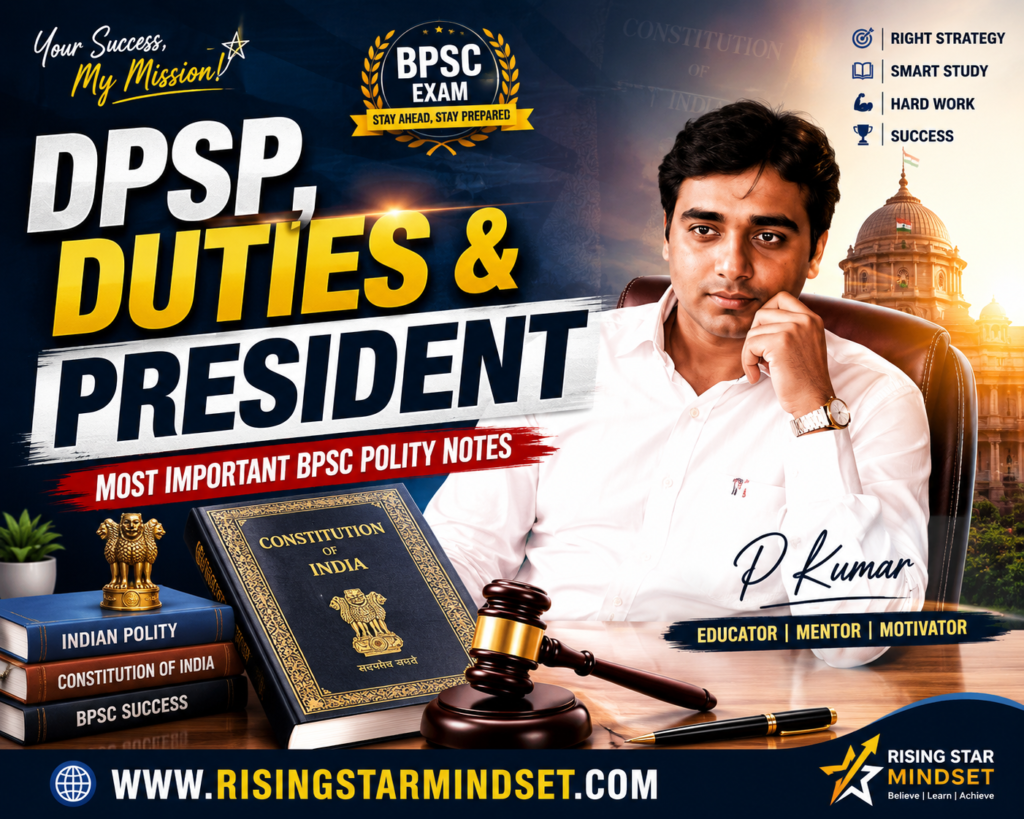
Quick Revision Notes
| DPSP → Part IV |
| Articles 36–51 |
| Fundamental Duties → Article 51A |
| Added by 42nd Amendment |
| Total Duties = 11 |
| President → Constitutional Head |
| Executive Power → Article 53 |
| Election → Article 54 |
| Impeachment → Article 61 |
| Pardon Power → Article 72 |
Important Questions and Answers
Q1. Which country inspired DPSP?
Answer: Ireland
Q2. DPSP are mentioned in which part?
Answer: Part IV
Q3. Which committee recommended Fundamental Duties?
Answer: Swaran Singh Committee
Q4. How many Fundamental Duties are there?
Answer: 11
Q5. Who is the First Citizen of India?
Answer: President
Q6. Which article deals with the election of the President?
Answer: Article 54
Q7. Which article provides pardoning power?
Answer: Article 72
MCQs
1. DPSP are borrowed from:
A. USA
B. Canada
C. Ireland
D. France
✅ Answer: C
2. Fundamental Duties are in:
A. Article 32
B. Article 51A
C. Article 72
D. Article 61
✅ Answer: B
3. President’s Rule is under:
A. Article 352
B. Article 356
C. Article 360
D. Article 368
✅ Answer: B
4. President’s term is:
A. 4 Years
B. 5 Years
C. 6 Years
D. 7 Years
✅ Answer: B
5. Pocket Veto means:
A. Rejecting Bill
B. Returning Bill
C. Keeping Bill Pending
D. Passing Bill
✅ Answer: C
HOTS Questions
1.
Why are DPSPs considered essential despite being non-justiciable?
2.
Can Fundamental Duties become legally enforceable? Explain.
3.
Analyze the balance between Fundamental Rights and DPSP.
4.
Why is the President called the Constitutional Head rather than the Real Executive?
5.
How do Fundamental Duties contribute to nation-building?
Previous Year Questions (PYQ)
BPSC
Q. DPSP have been borrowed from which Constitution?
Answer: Ireland
UPSC
Q. Fundamental Duties were introduced by which Constitutional Amendment?
Answer: 42nd Amendment Act, 1976
BPSC
Q. Which Article contains Fundamental Duties?
Answer: Article 51A
UPSC
Q. What is the method of election of the President of India?
Answer: Proportional Representation by Single Transferable Vote.
Expected Questions for BPSC 2026
- Explain the classification of DPSP.
- Discuss the significance of DPSP in a welfare state.
- Describe the relationship between Fundamental Rights and DPSP.
- Explain Fundamental Duties and their importance.
- Discuss the election process of the President.
- Explain veto powers of the President.
- Describe the impeachment procedure of the President.
- Explain judicial powers of the President.
- Differentiate between President and Prime Minister.
- Write a short note on Article 51A.
FAQs
Are DPSPs enforceable in court?
No, they are non-justiciable.
How many Fundamental Duties are there?
There are 11 Fundamental Duties.
Who elects the President?
The Electoral College elects the President.
What is the age requirement for President?
Minimum 35 years.
Which article provides pardon power?
Article 72.
Conclusion
DPSP, Fundamental Duties and the President are among the most important topics of Indian Polity. While DPSPs guide the government towards social and economic justice, Fundamental Duties encourage responsible citizenship. Furthermore, the President acts as the Constitutional Head of the Republic and performs executive, legislative, judicial, financial and emergency functions. Therefore, this chapter is extremely important for BPSC, UPSC, SSC, Railway and all other competitive examinations.
Keep Learning, Keep Growing! 🚀
P Kumar | Rising Star Mindset
www.risingstarmindset.com
Together We Will Make The Difference