
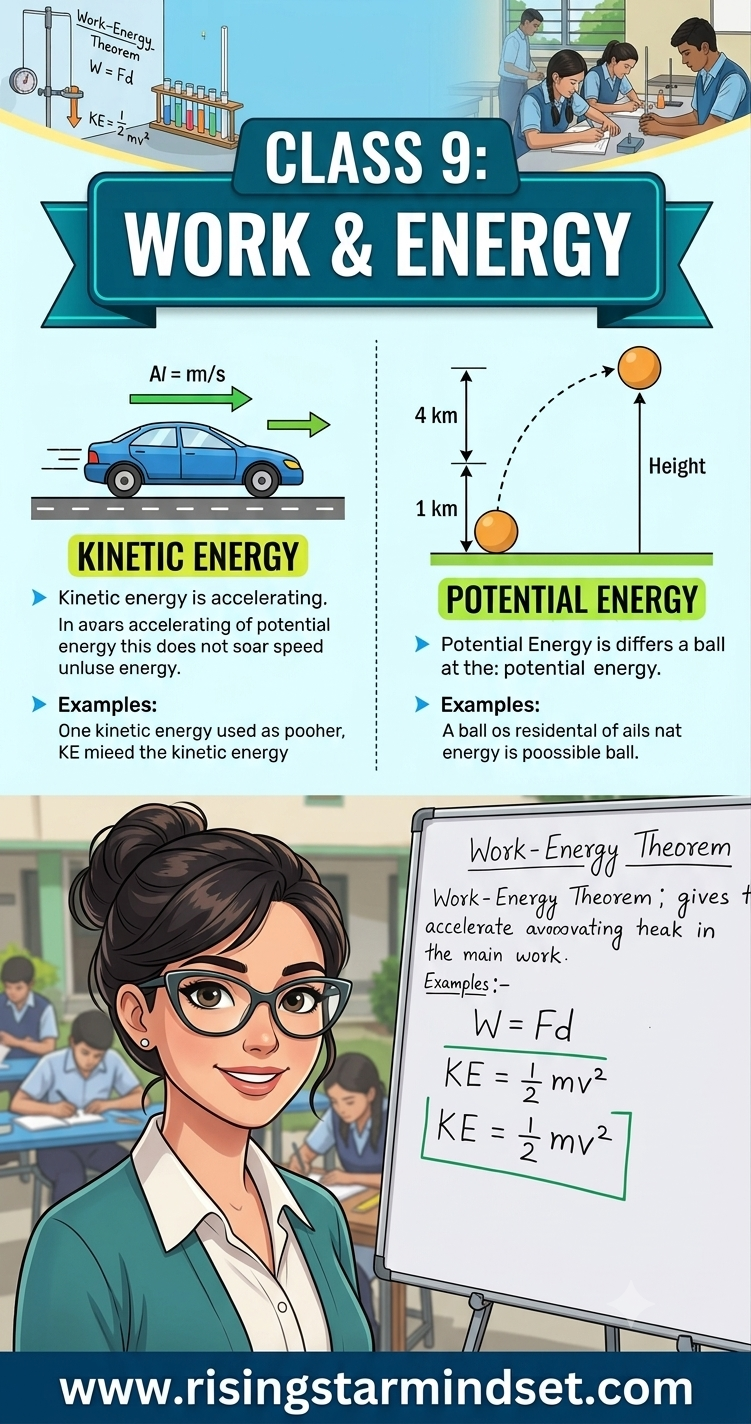
Work and Energy Class 9
Work and Energy Class 9 are fundamental concepts in Physics. They help us understand how forces cause motion and how energy is transferred from one object to another. Therefore, mastering these concepts is essential for scoring well in examinations and understanding everyday phenomena.
Previous topic: Gravitation
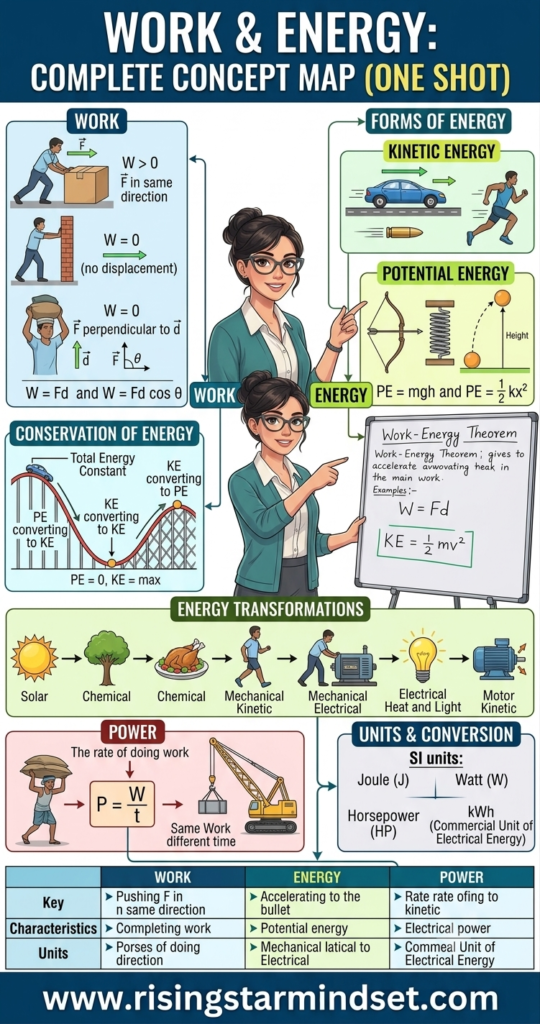
Table of Contents
- Introduction to Work and Energy
- What is Work?
- Conditions for Work Done
- Formula of Work
- SI Unit of Work
- Positive, Negative, and Zero Work
- What is Energy?
- Forms of Energy
- Kinetic Energy
- Potential Energy
- Law of Conservation of Energy
- Power
- Important Formulae
- Abbreviations
- Key Points
- MCQs
- HOTS Questions
- Short Answer Questions
- Long Answer Questions
- Numerical Problems
- FAQs
- Conclusion
Introduction to Work and Energy ( Work and Energy Class 9 )
English
In our daily lives, we use the words “work” and “energy” frequently. However, in Physics, these terms have specific meanings. For example, carrying a bag while standing still may feel tiring, but no physical work is done according to Physics.
हिन्दी
हम अपने दैनिक जीवन में “कार्य” और “ऊर्जा” शब्दों का अक्सर उपयोग करते हैं। लेकिन भौतिकी में इन शब्दों का विशेष अर्थ होता है। उदाहरण के लिए, यदि कोई व्यक्ति बैग उठाकर स्थिर खड़ा है, तो उसे थकान महसूस होगी, लेकिन भौतिकी के अनुसार कोई कार्य नहीं हुआ है।
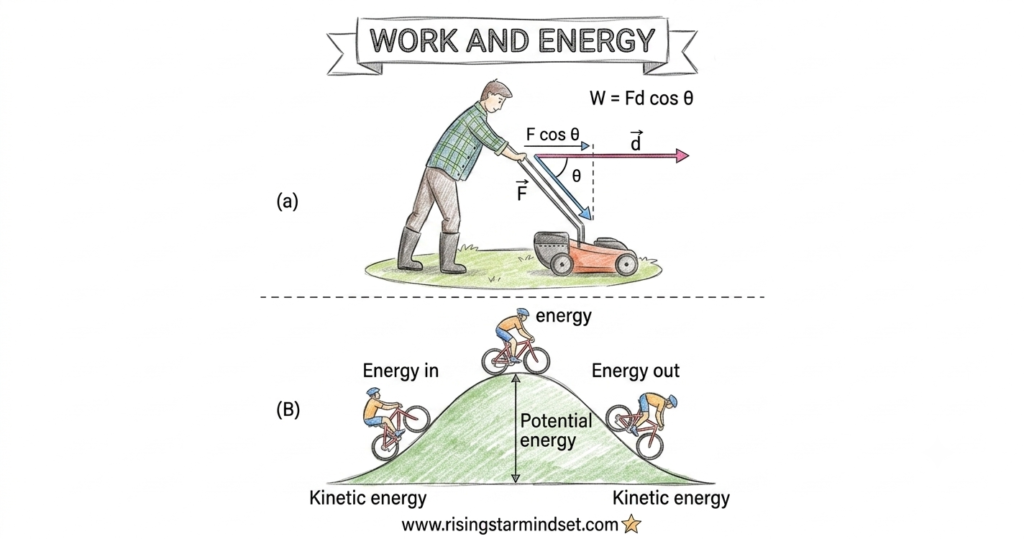
What is Work?
English
Work is said to be done when a force applied on an object causes displacement in the direction of the force.
Definition
Work is done when:
- A force acts on an object.
- The object moves or gets displaced.
हिन्दी
जब किसी वस्तु पर लगाया गया बल उसे विस्थापित करता है, तब कार्य किया जाता है।
कार्य की परिभाषा
कार्य होने के लिए:
- वस्तु पर बल लगना चाहिए।
- वस्तु में विस्थापन होना चाहिए।
Conditions for Work Done
English
Two conditions are necessary:
- Force must act on the object.
- Displacement must occur.
If either condition is absent, no work is done.
हिन्दी
कार्य होने के लिए दो शर्तें आवश्यक हैं:
- वस्तु पर बल लगना चाहिए।
- वस्तु में विस्थापन होना चाहिए।
यदि इनमें से कोई भी शर्त पूरी नहीं होती, तो कार्य नहीं होगा।
Formula of Work
English
Mathematical Expression
Work = Force ( F )× Displacement ( s )
Where:
- W = Work
- F = Force
- s = Displacement
हिन्दी
गणितीय सूत्र
कार्य = बल ( F ) × विस्थापन ( s )
जहाँ:
- W = कार्य
- F = बल
- s = विस्थापन
SI Unit of Work
English
The SI unit of work is Joule (J).
1 Joule = Work done when a force of 1 Newton moves an object by 1 meter.
हिन्दी
कार्य का SI मात्रक जूल (Joule) है।
1 जूल वह कार्य है जो 1 न्यूटन बल द्वारा किसी वस्तु को 1 मीटर विस्थापित करने पर किया जाता है।
Types of Work
1. Positive Work
English
When force and displacement are in the same direction.
Example: Pushing a cart forward.
हिन्दी
जब बल और विस्थापन एक ही दिशा में हों।
उदाहरण: ठेला आगे धकेलना।
2. Negative Work
English
When force acts opposite to displacement.
Example: Friction.
हिन्दी
जब बल विस्थापन की विपरीत दिशा में कार्य करे।
उदाहरण: घर्षण बल।
3. Zero Work
English
When displacement is zero or force is perpendicular to displacement.
Example: Holding a bag while standing.
हिन्दी
जब विस्थापन शून्य हो या बल विस्थापन के लंबवत हो।
उदाहरण: बैग पकड़कर स्थिर खड़ा रहना।
What is Energy?
English
Energy is the capacity to do work.
Without energy, no work can be performed.

हिन्दी
ऊर्जा कार्य करने की क्षमता है।
ऊर्जा के बिना कोई कार्य नहीं किया जा सकता।
Forms of Energy
English
- Mechanical Energy
- Heat Energy
- Light Energy
- Electrical Energy
- Chemical Energy
- Sound Energy
- Nuclear Energy
हिन्दी
- यांत्रिक ऊर्जा
- ऊष्मीय ऊर्जा
- प्रकाश ऊर्जा
- विद्युत ऊर्जा
- रासायनिक ऊर्जा
- ध्वनि ऊर्जा
- नाभिकीय ऊर्जा
Kinetic Energy
English
The energy possessed by an object due to its motion is called kinetic energy.
Formula
KE = ½ mv²
Where:
- m = Mass
- v = Velocity
हिन्दी
किसी वस्तु की गति के कारण प्राप्त ऊर्जा को गतिज ऊर्जा कहते हैं।
सूत्र
KE = ½ mv²
Potential Energy
English
The energy possessed by an object due to its position or configuration is called potential energy.
Formula
Potential Energy = mgh
Where:
- m = Mass
- g = Acceleration due to gravity
- h = Height
हिन्दी
स्थिति या ऊँचाई के कारण प्राप्त ऊर्जा को स्थितिज ऊर्जा कहते हैं।
सूत्र
स्थितिज ऊर्जा = mgh
Law of Conservation of Energy
English
Energy can neither be created nor destroyed. However, it can be transformed from one form to another.
Example
A falling ball converts potential energy into kinetic energy.
हिन्दी
ऊर्जा न तो उत्पन्न की जा सकती है और न ही नष्ट की जा सकती है। यह केवल एक रूप से दूसरे रूप में परिवर्तित होती है।
Power
English
Power is the rate of doing work.
Formula
Power = Work / Time
P = W / t
SI Unit
Watt (W)
हिन्दी
कार्य करने की दर को शक्ति कहते हैं।
सूत्र
P = W / t
SI मात्रक
वाट (W)


Important Formulae
| Quantity | Formula |
|---|---|
| Work | W = F × s |
| Power | P = W/t |
| Kinetic Energy | KE = ½mv² |
| Potential Energy | PE = mgh |
Abbreviations ( Work and Energy Class 9 )
| Abbreviation | Full Form |
|---|---|
| W | Work |
| F | Force |
| KE | Kinetic Energy |
| PE | Potential Energy |
| SI | International System of Units |
| J | Joule |
| N | Newton |
| P | Power |
Key Points ( Work and Energy Class 9 )
- Work requires force and displacement.
- The SI unit of work is Joule.
- Energy is the capacity to do work.
- Kinetic energy depends on mass and velocity.
- Potential energy depends on height.
- Power is the rate of doing work.
- Energy is always conserved.
- Friction generally performs negative work.
MCQs
1. What is the SI unit of work?
A. Newton
B. Joule
C. Watt
D. Meter
Answer: B. Joule
2. Energy is the capacity to:
A. Sleep
B. Walk
C. Do work
D. Rest
Answer: C. Do work
3. Formula of kinetic energy is:
A. mgh
B. F×s
C. ½mv²
D. W/t
Answer: C. ½mv²
4. Which force usually does negative work?
A. Gravity
B. Friction
C. Push
D. Pull
Answer: B. Friction
5. Unit of power is:
A. Joule
B. Meter
C. Watt
D. Newton
Answer: C. Watt
HOTS Questions ( Work and Energy Class 9 )
1.
Why does a person carrying a suitcase on a horizontal road do no work according to Physics?
Answer: Because the force is vertical while displacement is horizontal.
2.
Can an object have energy without motion?
Answer: Yes. An object at a height possesses potential energy.
3.
Why is kinetic energy directly proportional to the square of velocity?
Answer: Because kinetic energy = ½mv². Therefore, doubling velocity increases KE four times.
Short Answer Questions
Q1. Define work.
Answer: Work is done when a force causes displacement.
Q2. What is energy?
Answer: Energy is the capacity to do work.
Q3. State the SI unit of power.
Answer: Watt.
Long Answer Questions
Q1. Explain kinetic and potential energy with examples.
Answer:
Kinetic energy is the energy of motion. For example, a moving car possesses kinetic energy.
Potential energy is the energy due to position. For example, water stored in a dam possesses potential energy.
Numerical Problems
Problem 1
A force of 20 N moves an object by 5 m.
Solution
W = F × s
W = 100 J
Answer: 100 Joules
Problem 2
Calculate kinetic energy of a 4 kg object moving at 3 m/s.
Solution
kinetic energy = ½mv²
KE = ½ × 4 × 3²
KE = 18 J
Answer: 18 Joules
Problem 3
A 5 kg object is raised to a height of 10 m. Calculate potential energy.
(g = 10 m/s²)
Solution
potential energy. = mgh
PE = 5 × 10 × 10
PE = 500 J
Answer: 500 Joules
Frequently Asked Questions (FAQs)
1. What is work in Physics?
Work is done when force causes displacement.
2. What is the SI unit of work?
Joule (J).
3. What is the formula of work?
W = F × s
4. What is kinetic energy?
Energy due to motion.
5. What is potential energy?
Energy due to position or height.
6. What is power?
Power is the rate of doing work.
7. State the law of conservation of energy.
Energy can neither be created nor destroyed; it only changes its form.
Conclusion
Work and Energy are among the most important topics in Class 9 Physics. First, students should understand the concept of work and displacement. Next, they should learn kinetic energy, potential energy, and power. Finally, regular practice of numerical problems and MCQs helps improve conceptual understanding and examination performance. Therefore, a strong foundation in Work and Energy will make future Physics topics much easier to understand..
Keep Learning, Keep Growing! 🚀
P Kumar | Rising Star Mindset
www.risingstarmindset.com
Together We Will Make The Difference
2 thoughts on “Work and Energy Class 9 | One Shot Notes and MCQs”