
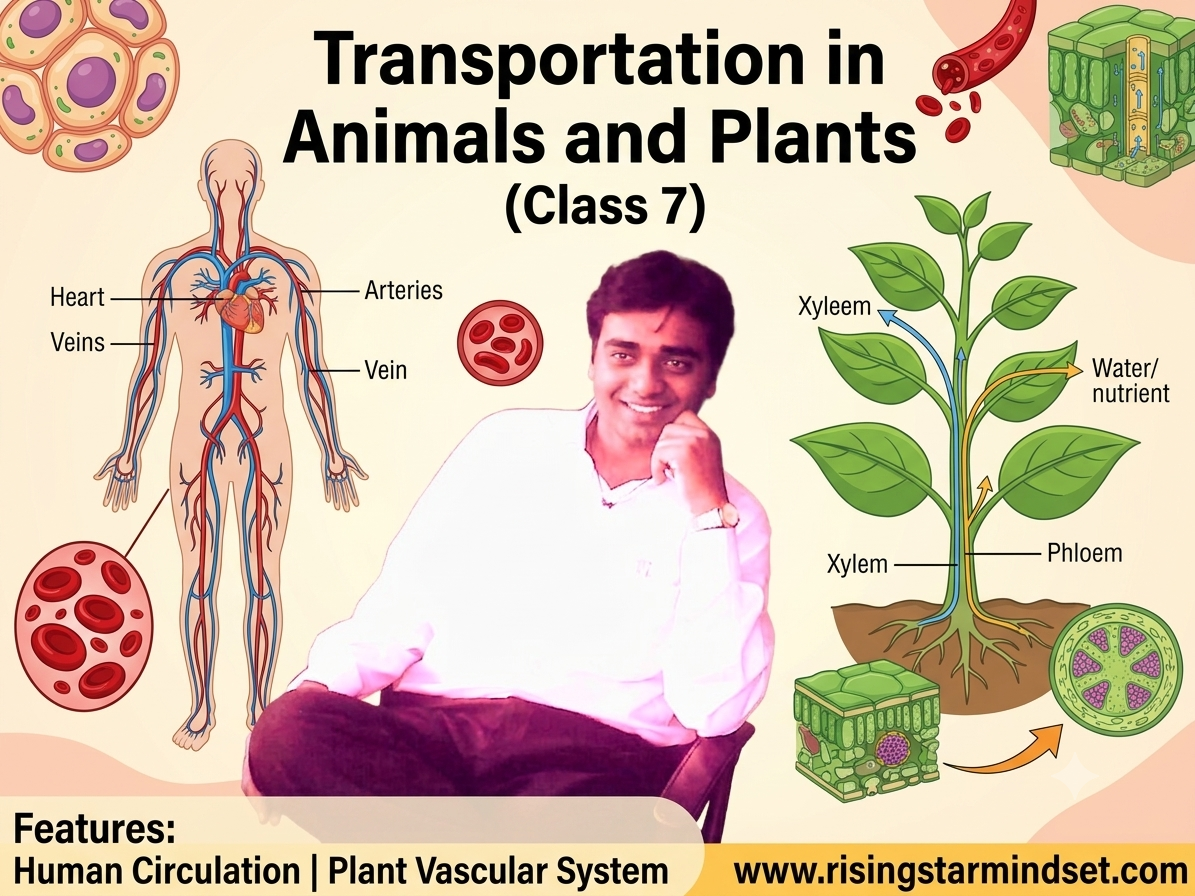
Table of Contents ( Class 7 )
- Introduction (परिचय)
- Transportation in Animals
- Human Circulatory System
- Heart Structure and Function
- Blood and Its Components
- Blood Vessels
- Pulse Rate
- Excretion in Animals
- Human Excretory System
- Transportation in Plants
- Xylem and Phloem
- Transpiration
- Important Differences
- Key Facts
- NCERT Important Questions
- Conclusion
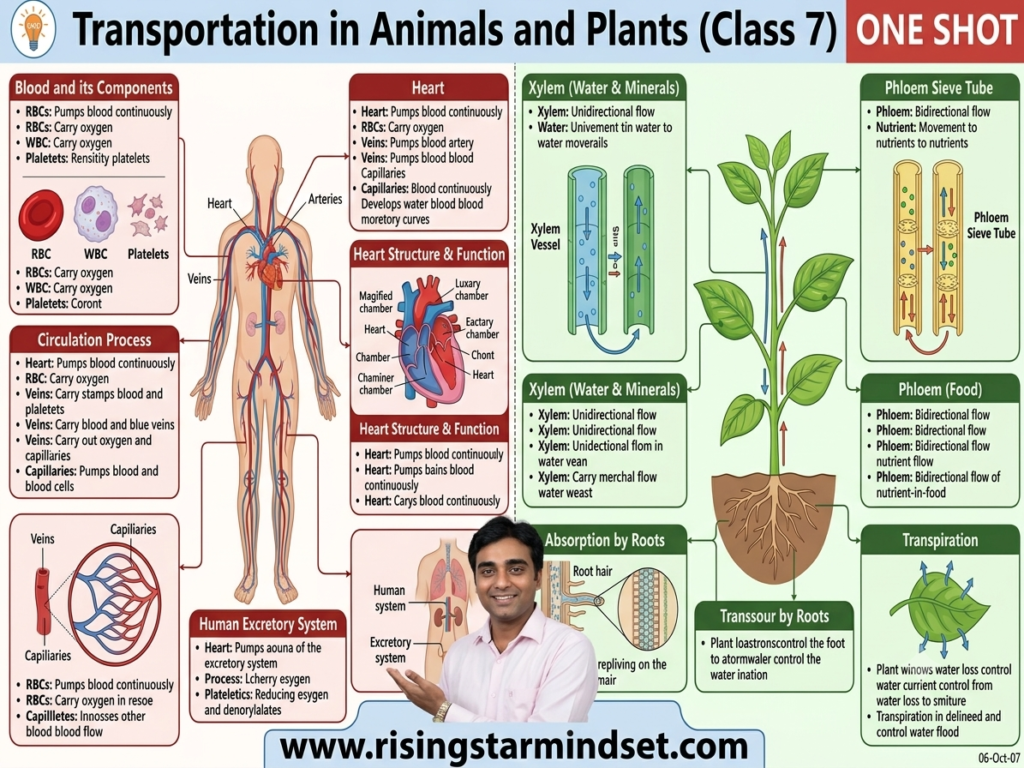
1. Introduction (परिचय) ( Transportation in Animals and Plants )
English
All living organisms need food, water, oxygen, and nutrients. These substances must be transported to different parts of the body. The process of moving materials from one part to another is called Transportation. ( Transportation in Animals and Plants )
हिन्दी
सभी जीवों को भोजन, जल, ऑक्सीजन एवं पोषक तत्वों की आवश्यकता होती है। इन पदार्थों को शरीर के विभिन्न भागों तक पहुँचाने की प्रक्रिया को परिवहन (Transportation) कहते हैं।
2. Transportation in Animals
English
Animals have a well-developed transportation system called the Circulatory System.
Functions:
- Carries oxygen to body cells.
- Transports digested food.
- Removes carbon dioxide.
- Carries hormones.
- Removes waste materials.
हिन्दी
जानवरों में पदार्थों के परिवहन के लिए परिसंचरण तंत्र (Circulatory System) होता है।
कार्य:
- ऑक्सीजन पहुँचाना
- पचा हुआ भोजन पहुँचाना
- कार्बन डाइऑक्साइड हटाना
- हार्मोन पहुँचाना
- अपशिष्ट पदार्थ हटाना
3. Human Circulatory System ( Transportation in Animals and Plants )
Components:
1. Heart ❤️
Pumps blood throughout the body.
2. Blood 🩸
Transports nutrients and oxygen.
3. Blood Vessels
Carry blood to different body parts.
Flow Chart
Heart
  ↓
Arteries
  ↓
Body Cells
  ↓
Veins
  ↓
Heart
4. Heart Structure and Function ( Transportation in Animals and Plants )
English
- Muscular organ.
- Located slightly left in chest.
- Size approximately equal to a fist.
- Works continuously.
Four Chambers
| Chamber | Function |
|---|---|
| Right Atrium | Receives impure blood |
| Right Ventricle | Pumps impure blood to lungs |
| Left Atrium | Receives pure blood |
| Left Ventricle | Pumps pure blood to body |
हिन्दी
- हृदय एक पेशीय अंग है।
- छाती के बाईं ओर स्थित होता है।
- मुट्ठी के आकार का होता है।
- जीवन भर धड़कता रहता है।
5. Blood and Its Components ( Transportation in Animals and Plants )
Blood Composition
| Component | Function |
|---|---|
| Plasma | Carries nutrients |
| RBCs | Carry oxygen |
| WBCs | Fight diseases |
| Platelets | Help clotting |
Red Blood Cells (RBC)
- Contain haemoglobin.
- Transport oxygen.
White Blood Cells (WBC)
- Protect body from diseases.
Platelets
- Help stop bleeding.
6. Blood Vessels ( Transportation in Animals and Plants )
Arteries
- Carry blood away from heart.
- Thick walls.
- Usually carry oxygen-rich blood.
Veins
- Carry blood toward heart.
- Thin walls.
- Usually carry oxygen-poor blood.
Capillaries
- Very thin blood vessels.
- Exchange gases and nutrients.
Difference Between Arteries and Veins
| Arteries | Veins |
|---|---|
| Away from heart | Towards heart |
| Thick walls | Thin walls |
| High pressure | Low pressure |
7. Pulse Rate ( Transportation in Animals and Plants )
English
The rhythmic expansion of arteries due to heartbeats is called Pulse.
Normal Pulse Rate:
- About 72–80 beats per minute.
हिन्दी
हृदय की धड़कनों के कारण धमनियों में उत्पन्न लयबद्ध स्पंदन को नाड़ी (Pulse) कहते हैं।
सामान्य नाड़ी दर:
- लगभग 72–80 प्रति मिनट
8. Excretion in Animals
English
Removal of waste products from the body is called Excretion.
Waste products:
- Urea
- Excess water
- Salts
हिन्दी
शरीर से अपशिष्ट पदार्थों को बाहर निकालने की प्रक्रिया उत्सर्जन (Excretion) कहलाती है।
9. Human Excretory System
Main Organs
Kidneys
Filter blood and remove wastes.
Ureters
Carry urine to urinary bladder.
Urinary Bladder
Stores urine.
Urethra
Expels urine outside body.
Flow Chart
Kidneys
   ↓
Ureters
   ↓
Urinary Bladder
   ↓
Urethra
10. Transportation in Plants
Plants also need transportation for:
- Water
- Minerals
- Food
Sources
| Material | Source |
|---|---|
| Water | Soil |
| Minerals | Soil |
| Food | Leaves |
11. Xylem and Phloem
Xylem
Function
- Carries water and minerals.
- Moves upward from roots.
हिन्दी
जड़ों से पानी और खनिज पदार्थ ऊपर पहुँचाता है।
Phloem
Function
- Carries food from leaves to all parts.
हिन्दी
पत्तियों में बना भोजन पूरे पौधे में पहुँचाता है।
Difference Between Xylem and Phloem
| Xylem | Phloem |
|---|---|
| Water transport | Food transport |
| Root to leaves | Leaves to whole plant |
| Mostly upward | Both directions |
12. Transpiration
Definition
Loss of water in the form of water vapour from leaves is called Transpiration.
Process
Roots absorb water
        ↓
Stem transports water
        ↓
Leaves receive water
        ↓
Water vapour escapes
Importance of Transpiration
- Cooling effect.
- Helps water movement.
- Maintains water balance.
13. Important Differences
Circulatory System vs Excretory System
| Circulatory System | Excretory System |
|---|---|
| Transports materials | Removes wastes |
| Heart is main organ | Kidneys are main organs |
Animals vs Plants Transportation
| Animals | Plants |
|---|---|
| Heart pumps blood | No pumping organ |
| Blood vessels present | Xylem & Phloem present |
14. Key Facts (Exam Revision)
- Heart has four chambers.
- Blood consists of Plasma, RBC, WBC and Platelets.
- Arteries carry blood away from heart.
- Veins carry blood toward heart.
- Kidneys filter blood.
- Xylem transports water and minerals.
- Phloem transports food.
- Loss of water through leaves is called transpiration.
- Pulse rate is related to heartbeat.

15. NCERT Important Questions
Very Short Answer
- What is transportation?
- What is pulse?
- Name the blood vessels that carry blood away from the heart.
- What is excretion?
- What is transpiration?
Short Answer
- Explain the function of heart.
- Differentiate between arteries and veins.
- Write functions of blood.
- Explain the excretory system.
- Differentiate between xylem and phloem.
Long Answer
- Explain human circulatory system with diagram.
- Describe transportation in plants.
- Explain transpiration and its importance.
- Explain blood components and their functions.
Abbreviations
| Short Form | Full Form |
|---|---|
| RBC | Red Blood Cell |
| WBC | White Blood Cell |
| bpm | Beats Per Minute |
Conclusion
Transportation is an essential life process in both animals and plants. In animals, the circulatory and excretory systems ensure proper distribution of nutrients and removal of wastes. In plants, xylem and phloem transport water, minerals, and food to all parts of the plant.
© Rising Star Mindset
For more CBSE Class 7–10 Notes, NCERT Solutions, Science Diagrams, BPSC Study Materials, MCQs, and PYQs, visit:
“Learn Smart, Grow Fast with Rising Star Mindset.”
thanku sir