
Lesson 11.11 – Prepositions in English | Rules, Examples & Common Mistakes
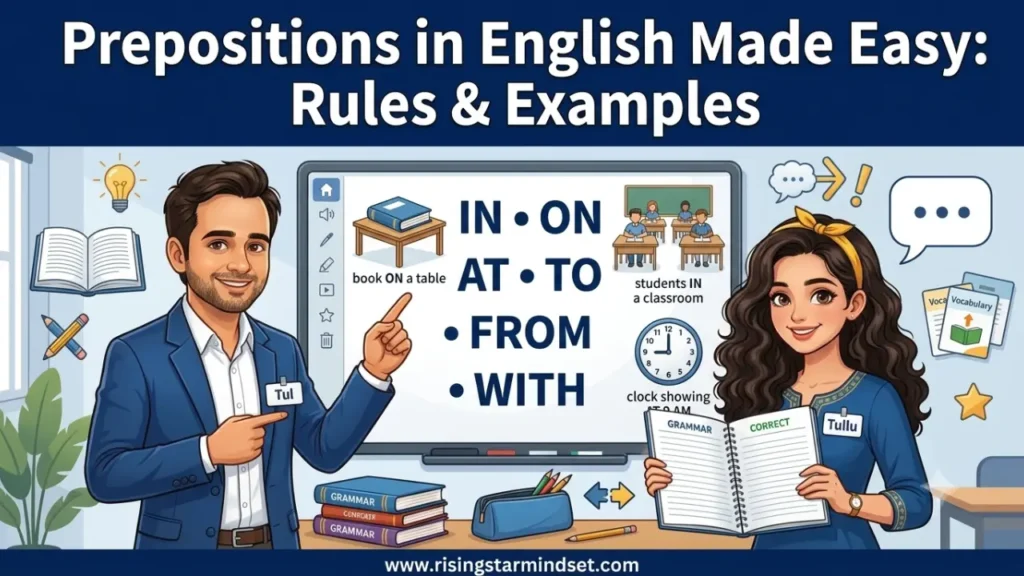
Learning Prepositions in English is essential for speaking and writing correct English because prepositions show the relationship between words in a sentence. For example, they can tell us where something is, when something happens, where someone is going, how something is done, or who is connected to an action.
Consider these sentences:
The book is on the table.
She arrived at 8 o’clock.
We are going to school.
In each sentence, the preposition connects different parts of the sentence and gives important information.
Table of Contents
- What Is a Preposition?
- Definition
- Meaning in Hindi
- Why Are Prepositions Important?
- Types
- Prepositions of Place
- In, On and At for Place
- Prepositions of Time
- In, On and At for Time
- Prepositions of Direction
- To, Into and Towards
- From and Since
- By and With
- Between and Among
- Near, Beside and Besides
- Under, Below, Over and Above
- Behind, In Front of and Opposite
- During, For and While
- Before and After
- Common Preposition Combinations
- Important Grammar Rules
- Common Preposition Mistakes
- English + Hindi Examples
- Daily Conversation Practice
- Key Points
- Fill in the Blanks
- Match the Following
- MCQs
- Question & Answers
- HOTS Questions
- Quick Revision
- FAQs
- Conclusion
- Previous Post : Lesson 11.10 – Pronoun Rules & Common Mistakes in English
1. What Is a Preposition? ( Prepositions in English )
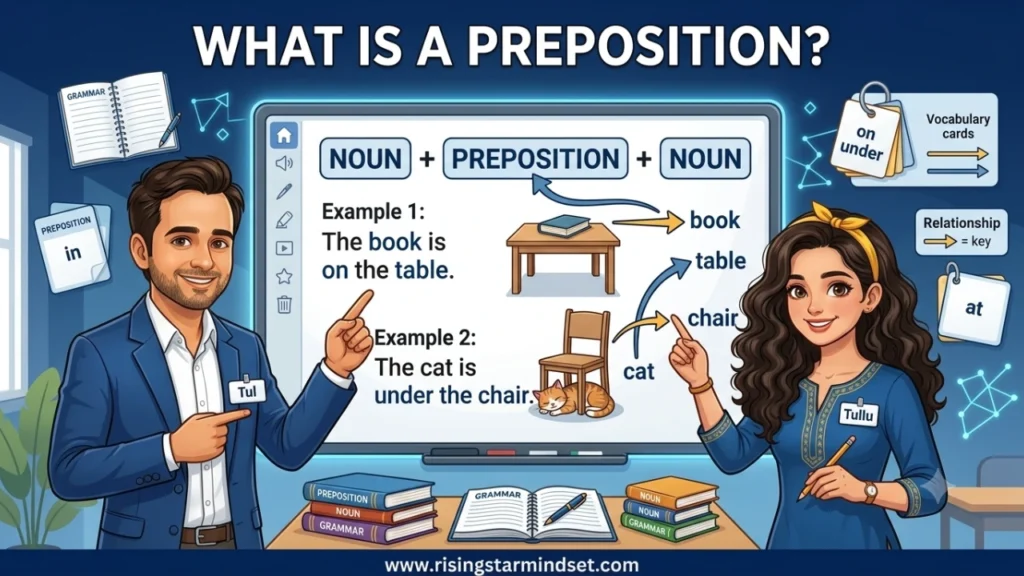
A preposition is a word that shows the relationship between a noun, pronoun, or another word and another part of a sentence.
In simple words, a preposition often tells us:
- Where?
- When?
- Where to?
- Where from?
- How?
- With whom?
Examples
The cat is under the table.
The class starts at 9 a.m.
She walked to the market.
He came from Delhi.
Here, under, at, to, and from are prepositions.
2. Definition of Preposition
English Definition
A preposition is a word that shows the relationship between a noun or pronoun and another word in a sentence.
हिन्दी में परिभाषा
Preposition वह शब्द है जो वाक्य में Noun या Pronoun का संबंध दूसरे शब्दों से बताता है।
For example:
The pen is on the table.
यहाँ on यह बताता है कि pen और table के बीच क्या संबंध है।
On = के ऊपर / पर
3. Preposition Meaning in Hindi
Preposition = संबंधबोधक अव्यय
कुछ सामान्य Prepositions:
| Preposition | Hindi Meaning |
| In | में |
| On | पर / के ऊपर |
| At | पर / में |
| Under | नीचे |
| Over | ऊपर |
| Behind | पीछे |
| Near | पास |
| Beside | बगल में |
| Between | दो के बीच |
| Among | कई के बीच |
| To | की ओर / को |
| From | से |
| With | के साथ |
| By | द्वारा / से |
| For | के लिए |
| Since | से |
| Before | पहले |
| After | बाद |
| During | के दौरान |
| Into | के अंदर |
| Through | के माध्यम से / के बीच से |
4. Why Are Prepositions Important?
Prepositions are extremely important because they help us express relationships accurately.
For example:
The book is on the table.
If we remove on, the relationship between the book and the table becomes unclear.
Similarly:
I will meet you at 5 p.m.
The preposition at tells us the exact time.
Therefore, prepositions are important for:
- Spoken English
- School grammar
- Competitive examinations
- Writing
- Reading comprehension
- Interviews
- Everyday conversation
Moreover, using the correct preposition can completely change the meaning of a sentence.
5. Types of Prepositions ( Prepositions in English )
Prepositions can be grouped according to their function.
Main Types
- Prepositions of Place
- Prepositions of Time
- Prepositions of Direction
- Prepositions of Movement
- Prepositions of Source
- Prepositions of Agent or Instrument
- Prepositions of Purpose
- Prepositions of Relationship
6. Prepositions of Place ( Prepositions in English )
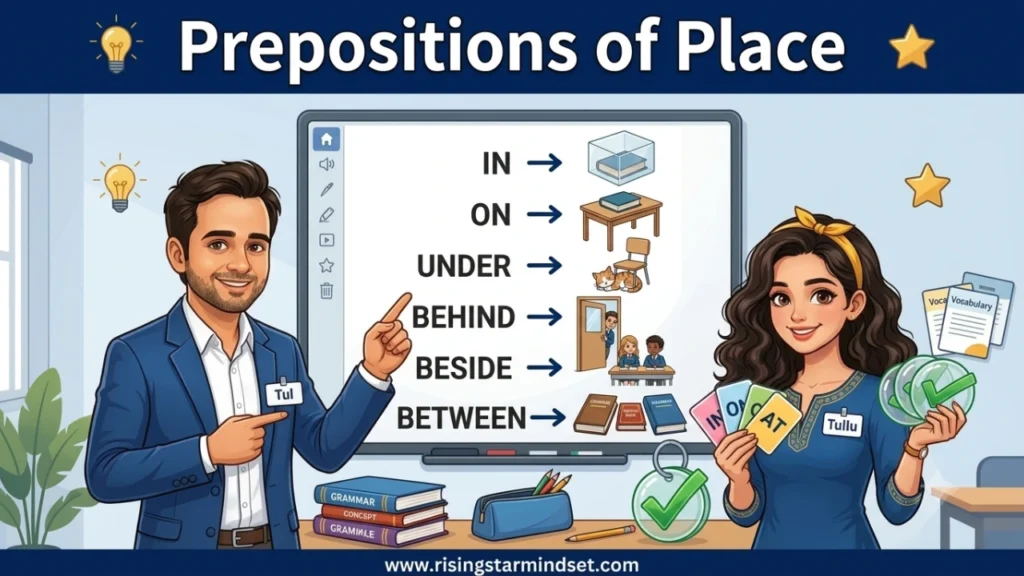
Prepositions of place tell us where something or someone is located.
Common examples include:
- In
- On
- At
- Under
- Over
- Behind
- Beside
- Near
- Between
- Among
- Opposite
- In front of
Examples
The keys are on the table.
चाबियाँ मेज़ पर हैं।
The children are in the classroom.
बच्चे कक्षा में हैं।
The teacher is in front of the students.
शिक्षक छात्रों के सामने हैं।
7. In, On and At for Place ( Prepositions in English )
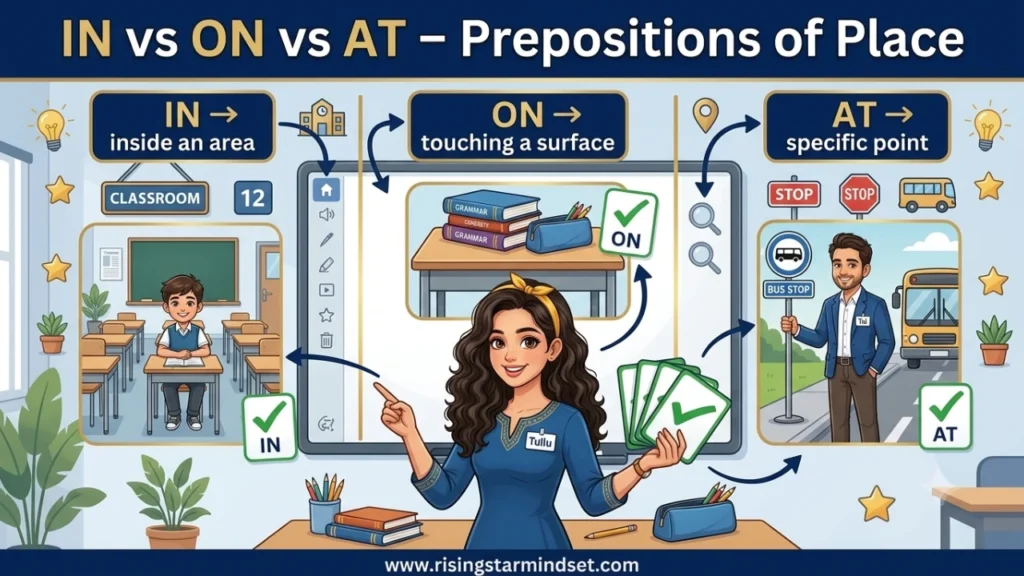
This is one of the most important preposition rules.
IN
Use in for something inside an enclosed space or area.
The students are in the classroom.
छात्र कक्षा में हैं।
She lives in India.
वह भारत में रहती है।
ON
Use on when something is touching a surface.
The book is on the desk.
किताब मेज़ पर है।
The picture is on the wall.
चित्र दीवार पर है।
AT
Use at for a particular point or location.
I am at the bus stop.
मैं बस स्टॉप पर हूँ।
She is at school.
वह स्कूल में/पर है।
Easy Trick
IN → inside an area
ON → surface
AT → specific point
8. Prepositions of Time ( Prepositions in English )
Prepositions of time tell us when something happens.
Common examples:
- At
- On
- In
- Before
- After
- During
- Since
- For
- Until
- By
For example:
I wake up at 6 a.m.
We have a test on Monday.
My birthday is in August.
9. In, On and At for Time ( Prepositions in English )
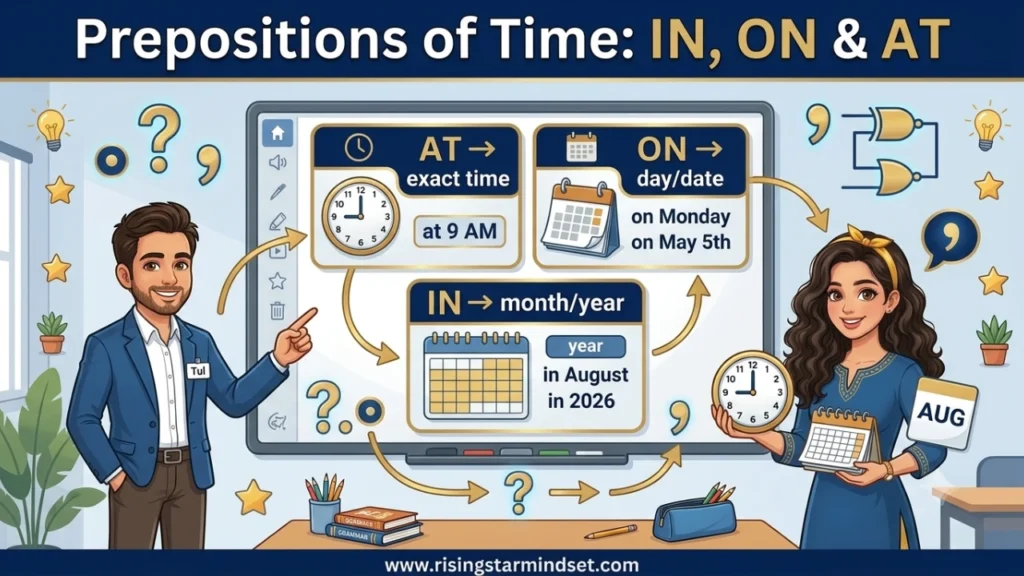
This is another very important rule.
AT → Exact Time
Use at for a specific time.
The class starts at 9 a.m.
कक्षा सुबह 9 बजे शुरू होती है।
I sleep at midnight.
मैं आधी रात को सोता हूँ।
ON → Days and Dates
Use on with days and specific dates.
I will meet you on Monday.
The exam is on 15 August.
हिन्दी
मैं तुमसे सोमवार को मिलूँगा।
परीक्षा 15 अगस्त को है।
IN → Months, Years, Seasons and Longer Periods
Use in with:
- Months
- Years
- Seasons
- Centuries
- Parts of the day
Examples
I was born in 2010.
We will travel in December.
Flowers bloom in spring.
I study in the morning.
Easy Memory Trick
AT → Time
ON → Day/Date
IN → Month/Year/Long Period
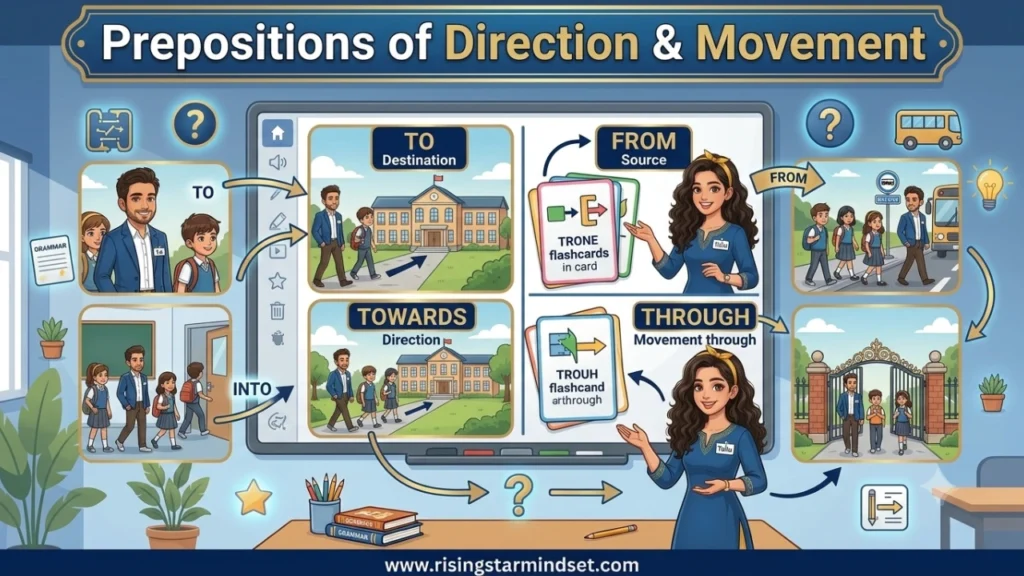
10. Prepositions of Direction ( Prepositions in English )
These prepositions show movement or direction.
Common examples:
- To
- From
- Into
- Towards
- Through
- Across
- Along
- Up
- Down
Examples
She went to school.
वह स्कूल गई।
He came from Delhi.
वह दिल्ली से आया।
The boy ran towards the gate.
लड़का गेट की ओर दौड़ा।
11. To, Into and Towards ( Prepositions in English )
These three are often confused.
To
Shows movement toward a destination.
I am going to the market.
मैं बाज़ार जा रहा हूँ।
Into
Shows movement from outside to inside.
She walked into the room.
वह कमरे के अंदर चली गई।
Towards
Shows movement in the direction of something.
He walked towards me.
वह मेरी ओर चला।
Therefore:
To → destination
Into → entering
Towards → direction
12. From and Since ( Prepositions in English )
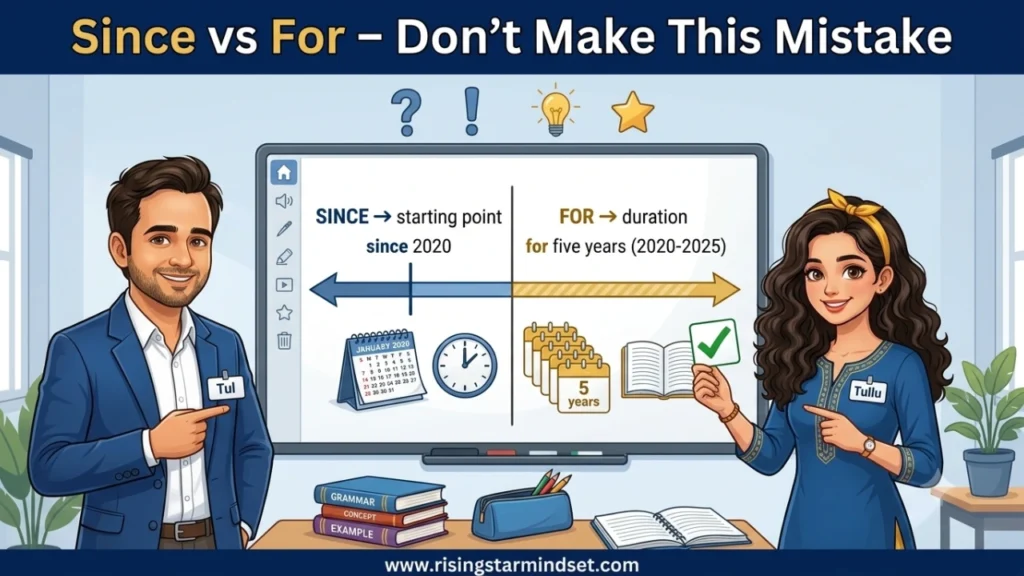
These two prepositions are also commonly confused.
From
Generally shows the starting point of an action, journey, or range.
I work from Monday to Friday.
मैं सोमवार से शुक्रवार तक काम करता हूँ।
She came from Patna.
वह पटना से आई।
Since
Usually refers to a point in time from which something has continued.
I have lived here since 2020.
मैं 2020 से यहाँ रह रहा हूँ।
She has been studying since morning.
वह सुबह से पढ़ रही है।
13. By and With ( Prepositions in English )
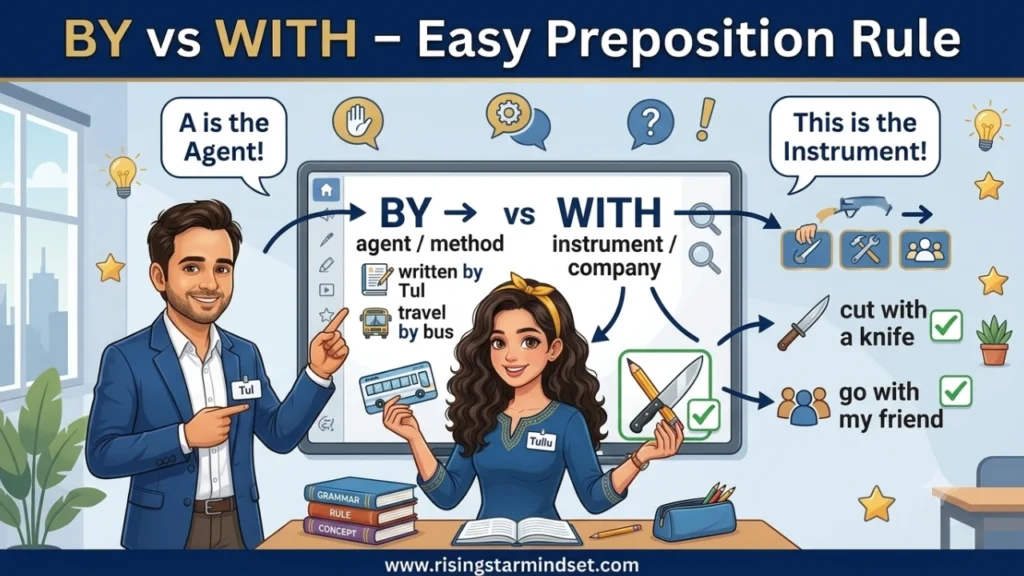
By
By can show the agent performing an action or a method of travel.
The poem was written by William Shakespeare.
कविता William Shakespeare द्वारा लिखी गई थी।
I travel by bus.
मैं बस से यात्रा करता हूँ।
With
With can show an instrument or accompaniment.
He cut the apple with a knife.
उसने चाकू से सेब काटा।
I went there with my friend.
मैं वहाँ अपने दोस्त के साथ गया।
Easy Trick
By → method/agent
With → instrument/company
14. Between and Among ( Prepositions in English )
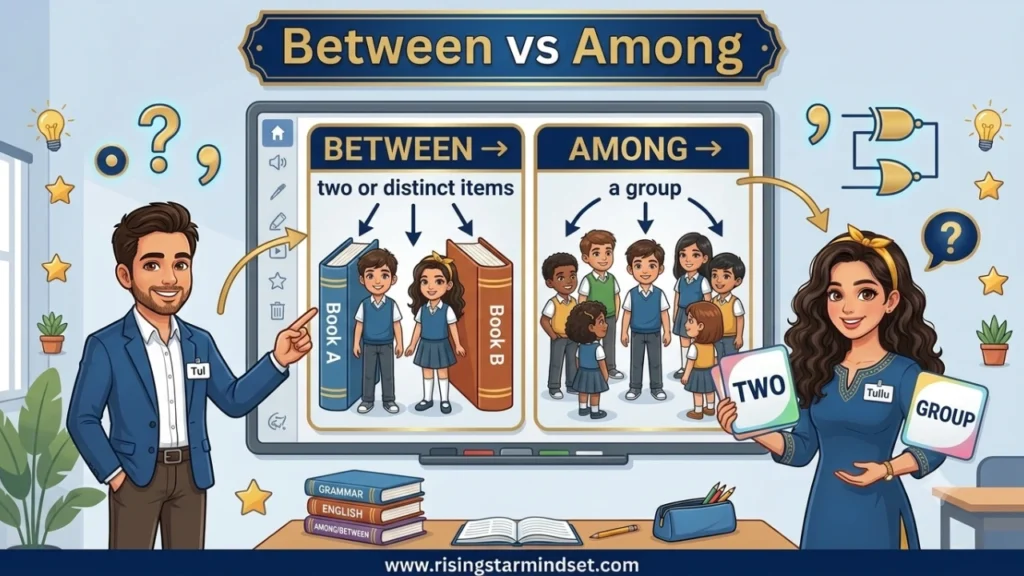
Between
Generally use between when talking about two distinct people, things, or points.
The shop is between the bank and the school.
दुकान बैंक और स्कूल के बीच है।
Among
Use among when referring to a group or more than two people or things considered collectively.
She was sitting among her friends.
वह अपने दोस्तों के बीच बैठी थी।
Therefore:
Between → two/distinct items
Among → group
15. Near, Beside and Besides
These words look similar but have different meanings.
Near
Means close to.
My house is near the school.
मेरा घर स्कूल के पास है।
Beside
Means next to.
She sat beside me.
वह मेरे बगल में बैठी।
Besides
Means in addition to.
Besides English, he speaks Hindi.
अंग्रेज़ी के अलावा, वह हिंदी बोलता है।
Therefore:
Near → पास
Beside → बगल में
Besides → इसके अलावा
16. Under, Below, Over and Above
Under
Means directly below something.
The cat is under the chair.
बिल्ली कुर्सी के नीचे है।
Below
Means at a lower level.
The temperature is below zero.
तापमान शून्य से नीचे है।
Over
Can mean directly above or across.
The plane flew over the city.
विमान शहर के ऊपर से उड़ा।
Above
Means at a higher position.
The picture is above the sofa.
चित्र सोफे के ऊपर है।
17. Behind, In Front of and Opposite
Behind
The car is behind the house.
गाड़ी घर के पीछे है।
In Front of
Tul is standing in front of the board.
Tul बोर्ड के सामने खड़ा है।
Opposite
The bank is opposite the school.
बैंक स्कूल के सामने है।
18. During, For and While ( Prepositions in English )
These words are often confused.
During
Use during before a noun.
We stayed inside during the rain.
हम बारिश के दौरान अंदर रहे।
For
Use for to express duration.
I studied for two hours.
मैंने दो घंटे तक पढ़ाई की।
While
Use while before a clause.
I listened to music while I was studying.
मैंने पढ़ाई करते समय संगीत सुना।
Quick Rule
During + noun
For + period of time
While + subject + verb
19. Before and After ( Prepositions in English )
These prepositions show sequence or time.
Before
Wash your hands before dinner.
रात के खाने से पहले हाथ धोएँ।
After
We went home after school.
हम स्कूल के बाद घर गए।
They can also be used with clauses:
Call me before you leave.
We went out after the rain stopped.
20. Common Preposition Combinations
Some verbs, adjectives, and expressions commonly go with particular prepositions.
Interested in
I am interested in English.
Good at
She is good at mathematics.
Afraid of
He is afraid of dogs.
Proud of
We are proud of you.
Depend on
Success depends on hard work.
Listen to
Please listen to me.
Wait for
I am waiting for you.
Look at
Look at the board.
Therefore, learning these combinations can make spoken English much more natural.
21. Important Grammar Rules ( Prepositions in English )
Rule 1
Use at for exact time.
at 7 p.m.
Rule 2
Use on for days and dates.
on Monday
on 15 August
Rule 3
Use in for months and years.
in July
in 2026
Rule 4
Use in for something inside an area.
in the room
Rule 5
Use on for a surface.
on the table
Rule 6
Use to for a destination.
go to school
Rule 7
Use into for movement inside.
walk into the room
Rule 8
Use since with a starting point in time.
since Monday
Rule 9
Use for with a duration.
for two years
Rule 10
Use between for two distinct items and among for a group.
22. Common Preposition Mistakes
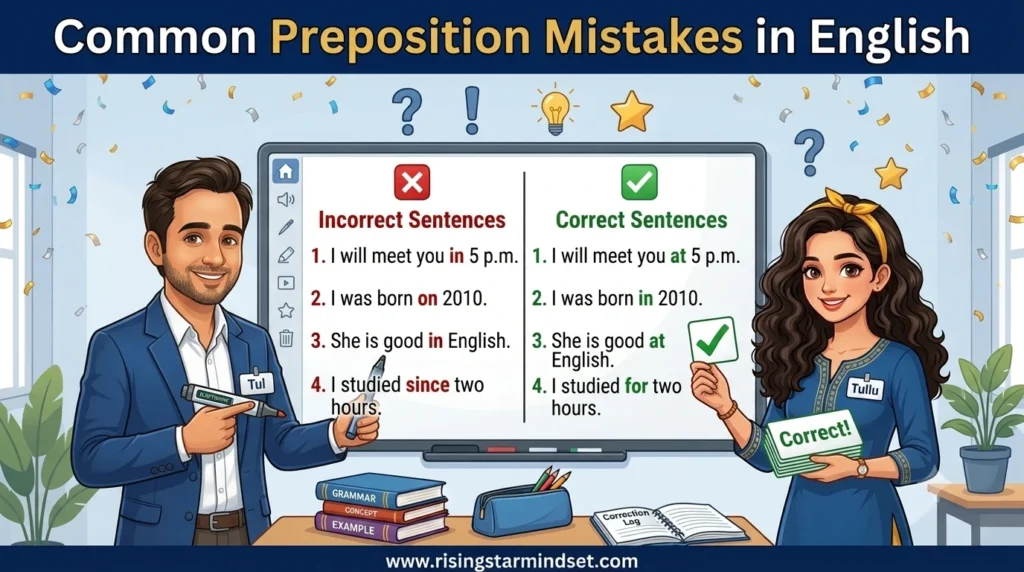
Mistake 1
❌ I will meet you in 5 p.m.
✅ I will meet you at 5 p.m.
Mistake 2
❌ I was born on 2010.
✅ I was born in 2010.
Mistake 3
❌ The book is in the table.
✅ The book is on the table.
Mistake 4
❌ She went in school.
✅ She went to school.
Mistake 5
❌ I have lived here for 2020.
✅ I have lived here since 2020.
Mistake 6
❌ I have been studying since two hours.
✅ I have been studying for two hours.
Mistake 7
❌ He is good in mathematics.
✅ He is good at mathematics.
Mistake 8
❌ Please listen me.
✅ Please listen to me.
23. English + Hindi Examples ( Prepositions in English )
Place
The keys are on the table.
चाबियाँ मेज़ पर हैं।
Time
The class begins at 8 a.m.
कक्षा सुबह 8 बजे शुरू होती है।
Day
We have a test on Monday.
हमारी सोमवार को परीक्षा है।
Month
My birthday is in August.
मेरा जन्मदिन अगस्त में है।
Direction
She went to the market.
वह बाज़ार गई।
Source
He came from Delhi.
वह दिल्ली से आया।
Company
I went with my friend.
मैं अपने दोस्त के साथ गया।
Duration
She studied for three hours.
उसने तीन घंटे तक पढ़ाई की।
Starting Point
He has worked here since 2022.
वह 2022 से यहाँ काम कर रहा है।
24. Daily Conversation Practice ( Prepositions in English )
Conversation 1 – At School
Tul: Where is your notebook?
Tullu: It is on the desk.
Tul: When does the class start?
Tullu: It starts at 9 a.m.
Tul: Are you going to the library?
Tullu: Yes, I am going there with my friend.
हिन्दी
तुल: तुम्हारी नोटबुक कहाँ है?
टुल्लू: वह डेस्क पर है।
तुल: कक्षा कब शुरू होती है?
टुल्लू: यह सुबह 9 बजे शुरू होती है।
तुल: क्या तुम लाइब्रेरी जा रहे हो?
टुल्लू: हाँ, मैं अपने दोस्त के साथ वहाँ जा रहा हूँ।
25. Key Points ( Prepositions in English )
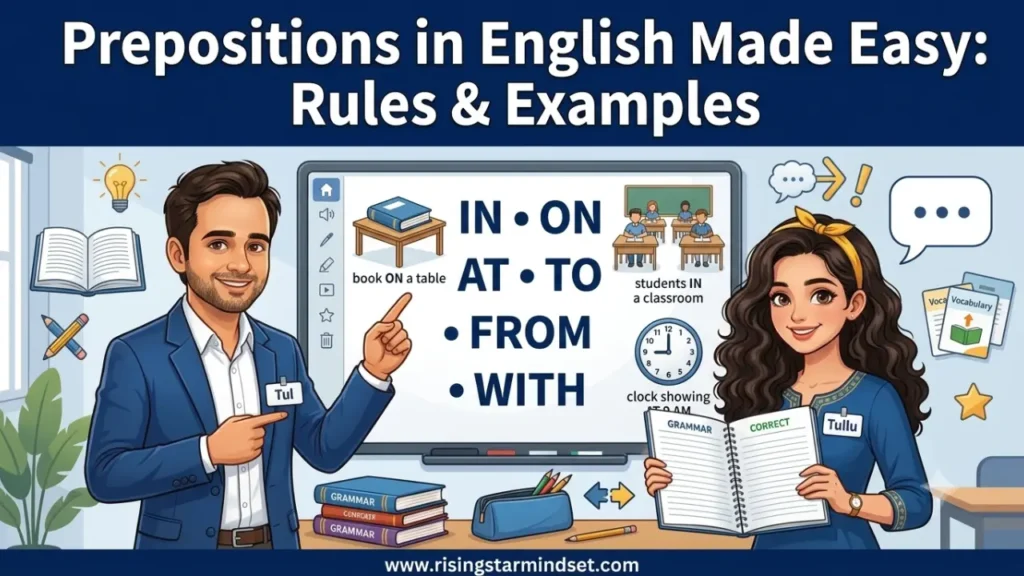
| In → inside / month / year |
| On → surface / day / date |
| At → exact time / specific point |
| To → destination |
| Into → entering |
| Towards → direction |
| From → starting point/source |
| Since → starting time |
| For → duration |
| By → agent/method |
| With → instrument/company |
| Between → two/distinct items |
| Among → group |
| Beside → next to |
| Besides → in addition to |
| During + noun |
| While + clause |
26. Fill in the Blanks ( Prepositions in English )
Choose the correct preposition.
- The book is ___ the table.
(on/in) - The students are ___ the classroom.
(in/on) - The class begins ___ 9 a.m.
(at/on) - I was born ___ 2010.
(in/on) - We have an exam ___ Monday.
(in/on) - She went ___ school.
(to/at) - He came ___ Delhi.
(from/to) - I have lived here ___ 2020.
(since/for) - She studied ___ three hours.
(since/for) - He is good ___ English.
(at/in)
Answers
- on
- in
- at
- in
- on
- to
- from
- since
- for
- at
27. Match the Following ( Prepositions in English )
| Column A | Column B |
| At | Month |
| On | Exact time |
| In | Day |
| Since | Duration |
| For | Starting point |
| To | Destination |
| From | Source |
Answers
At → Exact time
On → Day
In → Month
Since → Starting point
For → Duration
To → Destination
From → Source
28. MCQs ( Prepositions in English )
1. Choose the correct sentence.
A. I was born on 2010.
B. I was born at 2010.
C. I was born in 2010.
D. I was born by 2010.
Answer: C. I was born in 2010.
2. Choose the correct preposition:
The class starts ___ 8 a.m.
A. in
B. on
C. at
D. by
Answer: C. at
3. Which preposition is used with days?
A. In
B. On
C. At
D. From
Answer: B. On
4. Which sentence is correct?
A. The book is in the table.
B. The book is on the table.
C. The book is at the table.
D. The book is to the table.
Answer: B
5. Choose the correct sentence.
A. I have lived here for 2020.
B. I have lived here since 2020.
C. I have lived here at 2020.
D. I have lived here on 2020.
Answer: B
6. Which preposition means “के साथ”?
A. By
B. From
C. With
D. To
Answer: C. With
7. Choose the correct expression.
A. good in English
B. good on English
C. good at English
D. good by English
Answer: C. good at English
8. Which preposition means “के दौरान”?
A. During
B. Since
C. Until
D. From
Answer: A. During
9. Choose the correct sentence.
A. I waited since two hours.
B. I waited for two hours.
C. I waited at two hours.
D. I waited on two hours.
Answer: B
10. Which preposition generally shows movement toward a destination?
A. To
B. From
C. Since
D. Among
Answer: A. To
29. Question and Answers ( Prepositions in English )
Q1. What is a preposition?
A preposition is a word that shows the relationship between a noun or pronoun and another word in a sentence.
Q2. What is the Hindi meaning of preposition?
Preposition is commonly called संबंधबोधक अव्यय in Hindi grammar.
Q3. When do we use “at”?
We commonly use at for exact times and specific points.
at 7 p.m.
at the bus stop
Q4. When do we use “on”?
We use on for surfaces, days, and specific dates.
on the table
on Monday
on 15 August
Q5. When do we use “in”?
We use in for enclosed areas, months, years, seasons, and longer periods.
in the room
in July
in 2026
Q6. What is the difference between since and for?
Since indicates a starting point, whereas for indicates a duration.
since 2020
for five years
Q7. What is the difference between between and among?
Between is commonly used for two or distinct individual items, whereas among is used for a group.
Q8. What is the difference between by and with?
By commonly indicates an agent or method, whereas with can indicate an instrument or company.
30. HOTS Questions ( Prepositions in English )
HOTS 1
Correct the sentence:
I will meet you in 6 p.m.
Answer
✅ I will meet you at 6 p.m.
Because at is used with exact time.
HOTS 2
Correct the sentence:
I have been studying since three hours.
Answer
✅ I have been studying for three hours.
Because for is used with a duration.
HOTS 3
Correct the sentence:
She is good in mathematics.
Answer
✅ She is good at mathematics.
The standard expression is good at.
HOTS 4
Choose the correct sentence:
A. I have lived here since five years.
B. I have lived here for five years.
Answer
✅ I have lived here for five years.
Five years is a duration, so we use for.
HOTS 5
Correct the sentence:
The boy walked in the room.
Answer
If the meaning is that he entered the room:
✅ The boy walked into the room.
Here, into shows movement from outside to inside.
31. Quick Revision Chart ( Prepositions in English )
| Preposition | Main Use | Example |
| In | Inside / month / year | in the room |
| On | Surface / day | on the table |
| At | Exact time / point | at 5 p.m. |
| To | Destination | go to school |
| Into | Entering | walk into the room |
| From | Source | come from Delhi |
| Since | Starting point | since 2020 |
| For | Duration | for two years |
| By | Agent / method | by bus |
| With | Instrument / company | with a pen |
| Between | Two/distinct items | between two houses |
| Among | Group | among friends |
| During | Period/event | during the class |
| Before | Earlier than | before lunch |
| After | Later than | after school |
32. FAQs ( Prepositions in English )
Q1. What are prepositions in English?
Prepositions are words that show relationships between words, especially relationships of place, time, direction, movement, and connection.
Q2. What is the easiest way to remember in, on, and at?
Remember:
In → inside / longer period
On → surface / day
At → exact point / exact time
Q3. Which preposition is used with years?
Use in.
in 2026
Q4. Which preposition is used with days?
Use on.
on Monday
Q5. Which preposition is used with exact time?
Use at.
at 8 p.m.
Q6. What is the difference between since and for?
Since → starting point
For → duration
Q7. What is the difference between to and into?
To shows a destination, whereas into emphasizes movement from outside to inside.
Q8. Is “good in English” correct?
The standard expression is:
good at English
Q9. What is the difference between beside and besides?
Beside means next to, whereas besides means in addition to.
Q10. Why are prepositions difficult?
Prepositions can be difficult because the correct choice often depends on the expression and context. Therefore, learners should practise common combinations rather than translating every preposition word-for-word from Hindi.
33. Conclusion ( Prepositions in English )

In conclusion, Prepositions in English are small but extremely important words. Although they may look simple, they play a major role in making sentences clear, accurate, and meaningful.
First, remember the basic distinction between in, on, and at. Next, practise to, into, from, towards, since, and for. Furthermore, learn common combinations such as good at, interested in, afraid of, proud of, listen to, wait for, and depend on.
Moreover, do not translate prepositions mechanically from Hindi because English usage can be different depending on context. Instead, learn them through complete sentences and everyday examples.
For instance:
I was born in 2010. ✅
I was born on Monday. ✅
The class starts at 9 a.m. ✅
Therefore, regular practice is the best way to master prepositions. In addition, reading English sentences, speaking daily, and correcting your own mistakes will gradually improve your accuracy.
Finally, remember:
IN → Inside / Longer Period
ON → Surface / Day
AT → Exact Point / Time
So, keep learning, keep practising, and keep speaking English with confidence.
🌟 Keep Learning with Rising Star Mindset
📘 Spoken English Course
🏛️ BPSC Preparation
🎓 School Notes
💡 Daily Motivation
🌐 Website: www.risingstarmindset.com