
Data Handling (Class 8 Mathematics)
Table of Contents
- Introduction to Data Handling
- What is Data?
- Types of Data
- Collection of Data
- Organization of Data
- Frequency Distribution Table
- Grouping of Data
- Pictograph
- Bar Graph
- Double Bar Graph
- Pie Chart
- Probability
- Important Formulae
- Key Points
- Abbreviations
- NCERT Based Questions
- Multiple Choice Questions (MCQs)
- HOTS Questions
- Exam Tips
- Readers Challenge
1. Introduction to Data Handling
English
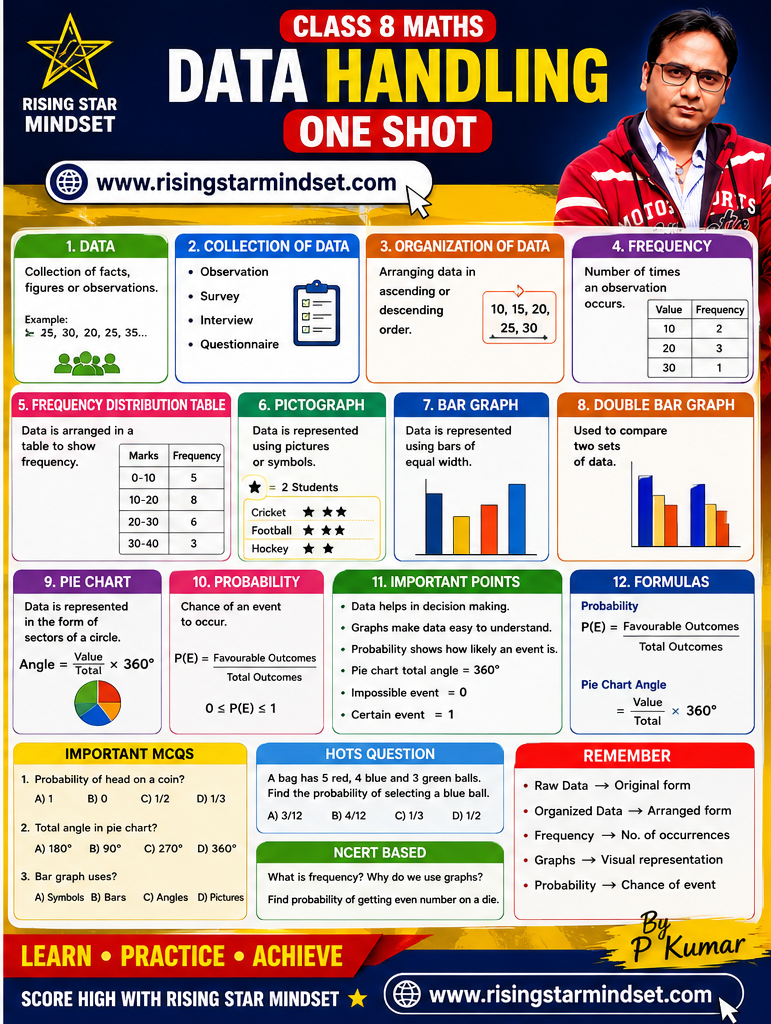
In our daily life, we collect information about marks, temperature, rainfall, population, sports scores, etc. Such information is called Data. The process of collecting, organizing, representing, and interpreting data is known as Data Handling. ( Data Handling Class 8 )
हिंदी
हम अपने दैनिक जीवन में अंक, तापमान, जनसंख्या, खेल स्कोर, वर्षा आदि से संबंधित जानकारी एकत्र करते हैं। इस जानकारी को Data (आंकड़े) कहते हैं। इन आंकड़ों को एकत्रित करना, व्यवस्थित करना, प्रस्तुत करना तथा उनका विश्लेषण करना Data Handling कहलाता है।
2. What is Data?
Definition
A collection of facts, figures, observations, or measurements is called Data.
Example
Marks of students:
12, 15, 18, 20, 15, 12, 10, 18
This set of numbers is called Data.
हिंदी में
तथ्यों एवं संख्याओं के संग्रह को Data कहते हैं।
3. Types of Data
(A) Raw Data
Data collected in its original form.
Example
20, 15, 25, 18, 10, 15
यह असंगठित डेटा है।
(B) Organized Data
Data arranged in ascending or descending order.
Example
10, 15, 15, 18, 20, 25
यह व्यवस्थित डेटा है।
4. Collection of Data
Data can be collected through:
- Observation
- Survey
- Interview
- Questionnaire
- Experiments
Example
Teacher asks students about their favorite sports.
5. Organization of Data
Organizing data makes it easier to understand and analyze.
Example
Favorite Fruit of Students
| Fruit | Number of Students |
|---|---|
| Mango | 10 |
| Apple | 8 |
| Banana | 6 |
| Orange | 4 |
6. Frequency Distribution Table
The number of times an observation occurs is called Frequency.
Example
Marks of students:
20, 15, 18, 20, 15, 20, 10, 18
| Marks | Frequency |
|---|---|
| 10 | 1 |
| 15 | 2 |
| 18 | 2 |
| 20 | 3 |
Hindi
किसी मान के आने की संख्या Frequency कहलाती है।
7. Grouping of Data
When data becomes very large, it is grouped into class intervals.
Example
| Marks | Frequency |
|---|---|
| 0-10 | 5 |
| 10-20 | 8 |
| 20-30 | 10 |
| 30-40 | 6 |
8. Pictograph
A pictograph uses pictures or symbols to represent data.
Example
🌟 = 2 Students
| Sport | Students |
|---|---|
| Cricket | 🌟🌟🌟🌟 |
| Football | 🌟🌟🌟 |
| Hockey | 🌟🌟 |
Advantages
- Easy to understand
- Attractive presentation
- Useful for beginners
9. Bar Graph
A bar graph represents data using bars of equal width.
Example
Number of books read
| Student | Books |
|---|---|
| A | 5 |
| B | 8 |
| C | 4 |
| D | 10 |
Features
- Equal width bars
- Equal spacing
- Vertical or horizontal
10. Double Bar Graph
Used to compare two sets of data.
Example
Comparison of boys and girls.
| Class | Boys | Girls |
|---|---|---|
| VI | 25 | 20 |
| VII | 30 | 28 |
| VIII | 35 | 32 |
Uses
- Comparison
- Statistical analysis
- School surveys
11. Pie Chart
A pie chart represents data in the form of sectors of a circle.
Formula
Central Angle=TotalValue×360∘
Example
Total students = 100
Cricket = 40
Angle:10040×360=144∘
Advantages
- Easy comparison
- Attractive representation
- Shows proportions clearly
12. Probability
Probability tells how likely an event is to occur.
Formula
P(E)=Total outcomesNumber of favourable outcomes
Example 1
A coin is tossed.
Possible outcomes:
H, TP(H)=21
Example 2
A die is rolled.
Probability of getting 3P(3)=61
Important Facts ( Data Handling Class 8 )
Impossible Event
Probability = 0
Certain Event
Probability = 1
Range
0≤P(E)≤1
Important Formulae
| Topic | Formula |
|---|---|
| Probability | Favourable Outcomes / Total Outcomes |
| Pie Chart Angle | Value ÷ Total × 360° |
| Frequency | Number of Occurrences |
Abbreviations
| Abbreviation | Full Form |
|---|---|
| P(E) | Probability of Event |
| F | Frequency |
| D.H. | Data Handling |
| C.I. | Class Interval |
| O.D. | Organized Data |
Key Points for Revision ( Data Handling Class 8 )
- Data means collection of facts
- Frequency means number of occurrences.
- .Pictographs use symbols.
- Bar graphs use bars.
- Double bar graphs compare two datasets.
- Pie charts use sectors of a circle.
- Probability lies between 0 and 1.
- Impossible event = 0.
- Certain event = 1.
- Probability Formula:
- P(E)=Total OutcomesFavourable Outcomes
NCERT Based Questions ( Data Handling Class 8 )
Q1. What is frequency?
Answer
The number of times an observation occurs is called frequency.
Q2. Why do we organize data?
Answer
To understand and analyze it easily.
Q3. What is a bar graph?
Answer
A graphical representation of data using bars of equal width.
Q4. What is probability?
Answer
Probability measures the chance of occurrence of an event.
Q5. Find probability of getting even number on a die.
Solution
Even numbers:
2, 4, 6
Favourable outcomes = 3
Total outcomes = 6P(E)=63=21
MCQs (Most Important) ( Data Handling Class 8 )
1. Frequency means:
A) Data collection
B) Number of occurrences
C) Graph
D) Probability
✅ Answer: B
2. Which graph uses bars?
A) Pie Chart
B) Pictograph
C) Bar Graph
D) Circle
✅ Answer: C
3. Probability of impossible event?
A) 1
B) 0
C) 2
D) 1/2
✅ Answer: B
4. Total angle in pie chart?
A) 180°
B) 90°
C) 270°
D) 360°
✅ Answer: D
5. Probability of getting head on a coin?
A) 1
B) 0
C) 1/2
D) 1/3
✅ Answer: C
6. Double bar graph is used for:
A) Decoration
B) Comparison
C) Addition
D) Multiplication
✅ Answer: B
7. Frequency distribution table shows:
A) Colors
B) Symbols
C) Occurrences
D) Angles
✅ Answer: C
8. Which is not a graph?
A) Bar Graph
B) Pie Chart
C) Double Bar Graph
D) Multiplication Table
✅ Answer: D
9. Probability always lies between:
A) 0 and 1
B) 1 and 2
C) 2 and 3
D) 3 and 4
✅ Answer: A
10. Data in original form is:
A) Organized Data
B) Raw Data
C) Graph
D) Chart
✅ Answer: B
HOTS Questions ( Data Handling Class 8 )
Q1
A box contains 5 red, 3 blue, and 2 green balls. Find probability of selecting a blue ball.
Solution
Total balls = 10
Blue balls = 3P(Blue)=103
Q2
A die is rolled. Find probability of getting a prime number.
Prime numbers:
2, 3, 5P=63=21
Q3
A survey of 100 students shows:
Cricket = 40
Football = 30
Hockey = 20
Others = 10
Find angle for Hockey sector.10020×360=72∘
Q4
Can probability be greater than 1?
Answer
No. Probability always lies between 0 and 1.
Q5
Explain why a pie chart is useful.
Answer
It shows proportions clearly and makes comparison easy.
Exam-Oriented Tips ( Data Handling Class 8 )
CBSE Important Areas
| Frequency Distribution |
| Bar Graph |
| Double Bar Graph |
| Pie Chart |
| Probability |
| Data Interpretation |
| Graph Reading |
Common Mistake
- Wrong scale in graph
- Incorrect frequency counting
- Pie chart angle calculation error
- Probability numerator and denominator confusion
Quick Revision One-Liner
- Data = Collection of information
- Frequency = Number of times data occurs
- Pictograph = Symbols
- Bar Graph = Bars
- Pie Chart = Circle sectors
- Probability = Chance of occurrence
- Impossible Event = 0
- Certain Event = 1
Readers Challenge ⭐
नीचे दिए गए 5 प्रश्नों को हल करके हमें भेजिए। सही उत्तर भेजने वाले विद्यार्थियों का Name & Location हमारी वेबसाइट www.risingstarmindset.com पर प्रदर्शित किया जाएगा।
Question 1
A coin is tossed once. Find the probability of getting Head.
Question 2
A die is rolled. Find the probability of getting an odd number.
Question 3
In a class, 15 students like Cricket, 10 like Football and 5 like Hockey. Find the central angle for Cricket in a pie chart.
Question 4
Prepare a frequency table for:
5, 7, 5, 8, 9, 7, 5, 8, 7, 5
Question 5
A bag contains 4 red balls and 6 blue balls. Find the probability of selecting a red ball.
Conclusion
Data Handling is an important chapter of Class 8 Mathematics that teaches students how to collect, organize, represent, and interpret data. Understanding Frequency Distribution, Bar Graphs, Pie Charts, and Probability helps students solve real-life problems and builds a strong foundation for higher mathematics, statistics, and competitive examinations.
Keep Learning, Keep Growing!
Together We Will Make The Difference
– P. Kumar | Rising Star Mindset
Website: www.risingstarmindset.com
1 thought on “Data Handling Class 8 Most Important Concepts And MCQs”