

📚 Lesson 11.8 – Indefinite Pronouns in English | Complete Beginner Guide (English + Hindi)

Table of Contents ( Indefinite Pronouns in English )
- Introduction
- What are Indefinite Pronouns?
- Definition (English)
- परिभाषा (हिन्दी)
- Why are Indefinite Pronouns Important?
- Types of Indefinite Pronouns
- Complete List of Indefinite Pronouns
- Rules of Indefinite Pronouns
- Subject–Verb Agreement
- Singular Indefinite Pronouns
- Plural Indefinite Pronouns
- Singular or Plural Indefinite Pronouns
- Everyday Examples
- Spoken English Examples
- Easy Tricks
- Common Mistakes
- Key Points
- Practice Questions
- MCQs
- HOTS
- FAQs
- PREVIOUS POST : Lesson 11.7 – How to Use Relative Pronouns in English | Complete Beginner Guide
- Conclusion
Introduction
English ( Indefinite Pronouns in English )
When speaking English in everyday life, we often talk about people or things without mentioning a specific name. Instead of saying exactly who or what we mean, we use words like someone, anyone, everyone, nobody, something, anything, everything, and nothing.
These words help us communicate naturally when the exact identity of a person or thing is unknown, unimportant, or intentionally left unspecified.
Imagine these situations:
- Someone is waiting for you outside.
- Everyone enjoyed the party.
- Nobody answered the phone.
- Is anyone at home?
- Everything looks perfect.
In all these sentences, we are talking about people or things, but we are not identifying any particular person or object. This is exactly where Indefinite Pronouns are used.
Indefinite Pronouns are among the most frequently used words in spoken English. Native speakers use them every day in conversations, emails, meetings, classrooms, interviews, and social media.
Learning these pronouns will make your English sound more fluent, natural, and confident.
हिन्दी
दैनिक जीवन में अंग्रेज़ी बोलते समय हम अक्सर किसी व्यक्ति, वस्तु या स्थान का उल्लेख करते हैं, लेकिन उसका नाम नहीं बताते।
ऐसी स्थिति में हम someone, anyone, everyone, nobody, something, anything, everything जैसे शब्दों का प्रयोग करते हैं।
उदाहरण देखें—
- Someone is calling you.
- Everyone is happy today.
- Nobody knows the answer.
- Is anyone available?
- Everything is ready.
इन सभी वाक्यों में किसी विशेष व्यक्ति या वस्तु का नाम नहीं लिया गया है।
ऐसे शब्दों को Indefinite Pronouns (अनिश्चित सर्वनाम) कहा जाता है।
यदि आप Spoken English को स्वाभाविक और प्रभावशाली बनाना चाहते हैं, तो Indefinite Pronouns का सही प्रयोग सीखना बहुत आवश्यक है।
Learning Objectives ( Indefinite Pronouns in English )
After completing this lesson, you will be able to:
You will learn to—
- Understand the meaning of Indefinite Pronouns.
- Identify them in sentences.
- Use them correctly in daily conversations.
- Avoid common grammar mistakes.
- Choose the correct helping verb.
- Improve your spoken English naturally.
- Answer school and competitive exam questions confidently.
इस अध्याय को पूरा करने के बाद आप सीखेंगे—
- Indefinite Pronouns क्या होते हैं।
- इन्हें वाक्य में कैसे पहचानें।
- इनका सही प्रयोग कैसे करें।
- कौन-सी सामान्य गलतियों से बचना चाहिए।
- सही Verb का चुनाव कैसे करें।
- दैनिक बातचीत में इनका प्रयोग कैसे करें।
- परीक्षा में पूछे जाने वाले प्रश्नों को आसानी से हल करना।
What are Indefinite Pronouns?
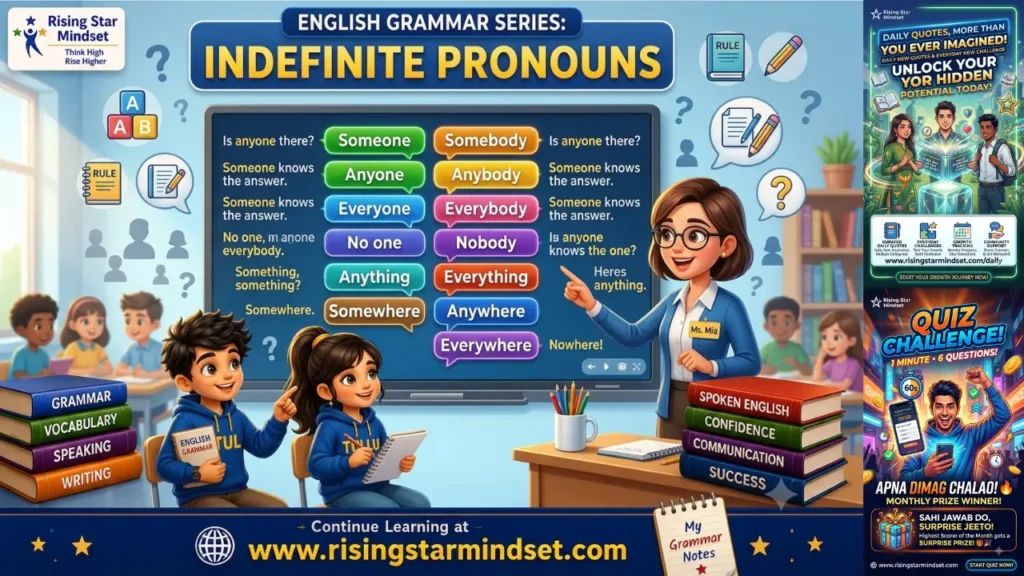
Definition (English)
An Indefinite Pronoun is a pronoun that refers to a person, thing, place, or amount without identifying a particular one.
Instead of naming someone or something specifically, it gives a general or indefinite reference.
परिभाषा (हिन्दी)
Indefinite Pronoun वह सर्वनाम है जो किसी व्यक्ति, वस्तु, स्थान या मात्रा का उल्लेख बिना उसका निश्चित नाम बताए करता है।
अर्थात् यह किसी विशेष व्यक्ति या वस्तु की पहचान नहीं बताता, बल्कि सामान्य रूप से उसका संकेत करता है।
Easy Definition
English
An Indefinite Pronoun does not tell us exactly who or what it refers to.
हिन्दी
Indefinite Pronoun हमें यह नहीं बताता कि व्यक्ति या वस्तु कौन-सी है।
Real-Life Examples ( Indefinite Pronouns in English )
| Sentence | Indefinite Pronoun |
| Someone is knocking at the door. | Someone |
| Everyone loves honesty. | Everyone |
| Nobody came yesterday. | Nobody |
| Is anyone interested? | Anyone |
| Everything is ready. | Everything |
Why Should You Learn Indefinite Pronouns?
English
Indefinite Pronouns are used in almost every English conversation.
You will hear them:
| in schools |
| interviews |
| offices |
| movies |
| YouTube |
| news reports |
| while travelling |
| during phone calls |
| in emails |
| on social media |
Without understanding these pronouns, it becomes difficult to speak natural English.
हिन्दी
Indefinite Pronouns का प्रयोग लगभग हर जगह होता है—
- स्कूल में
- इंटरव्यू में
- ऑफिस में
- फ़िल्मों में
- समाचारों में
- YouTube Videos में
- फोन पर बातचीत में
- ईमेल लिखते समय
- सोशल मीडिया पर
यदि आप इनका सही प्रयोग सीख लेते हैं, तो आपकी Spoken English पहले से अधिक स्वाभाविक और प्रभावशाली हो जाएगी।
Types of Indefinite Pronouns

Indefinite Pronouns are not all used in the same way. Some refer to one person, some refer to many people, while others can be singular or plural depending on the context.
For better understanding, English grammar divides Indefinite Pronouns into three major categories.
- Singular Indefinite Pronouns
- Plural Indefinite Pronouns
- Singular or Plural Indefinite Pronouns
Understanding these categories is very important because the verb changes according to the pronoun.
1. Singular Indefinite Pronouns
English Explanation
Singular Indefinite Pronouns refer to one unspecified person or thing.
Although some words like everyone or everybody seem to indicate many people, they are treated as singular in English grammar.
Therefore, they always take a singular verb.
हिन्दी में समझें
Singular Indefinite Pronouns ऐसे सर्वनाम होते हैं जो एक अनिश्चित व्यक्ति या वस्तु का बोध कराते हैं।
ध्यान रखें—
Everyone का अर्थ “सभी लोग” होता है, लेकिन Grammar में इसे Singular माना जाता है।
इसीलिए इसके साथ हमेशा Singular Verb आती है।
Common Singular Indefinite Pronouns
| Pronoun | Hindi Meaning |
| Someone | कोई व्यक्ति |
| Somebody | कोई व्यक्ति |
| Anyone | कोई भी व्यक्ति |
| Anybody | कोई भी व्यक्ति |
| Everyone | हर कोई |
| Everybody | सभी लोग |
| No one | कोई नहीं |
| Nobody | कोई नहीं |
| Someone else | कोई दूसरा |
| Anyone else | कोई और |
| Everybody else | बाकी सभी |
| Each | प्रत्येक |
| Either | दोनों में से कोई एक |
| Neither | दोनों में से कोई नहीं |
| One | कोई एक |
Examples
Someone is calling you.
कोई आपको बुला रहा है।
Everyone likes honesty.
हर कोई ईमानदारी पसंद करता है।
Nobody knows the answer.
उत्तर किसी को नहीं पता।
Each student has a notebook.
प्रत्येक छात्र के पास एक नोटबुक है।
Either is acceptable.
दोनों में से कोई एक स्वीकार्य है।
Important Rule
All Singular Indefinite Pronouns take Singular Verbs.
| Correct | Incorrect |
| Everyone is happy. | Everyone are happy. |
| Somebody has called. | Somebody have called. |
| Nobody was absent. | Nobody were absent. |
2. Plural Indefinite Pronouns
English Explanation
Plural Indefinite Pronouns refer to more than one unspecified person or thing.
These pronouns always take plural verbs.
हिन्दी
Plural Indefinite Pronouns ऐसे सर्वनाम होते हैं जो एक से अधिक व्यक्तियों या वस्तुओं का बोध कराते हैं।
इनके साथ हमेशा Plural Verb आती है।
Common Plural Indefinite Pronouns
| Pronoun | Hindi Meaning |
| Both | दोनों |
| Many | बहुत से |
| Few | कुछ |
| Several | कई |
| Others | अन्य लोग |
Examples
Many are waiting outside.
बहुत से लोग बाहर इंतजार कर रहे हैं।
Several have already arrived.
कई लोग पहले ही आ चुके हैं।
Both are correct.
दोनों सही हैं।
Few know the truth.
बहुत कम लोग सच्चाई जानते हैं।
Others were busy.
अन्य लोग व्यस्त थे।
Important Rule
Plural Indefinite Pronouns always take Plural Verbs.
| Correct | Incorrect |
| Many are playing. | Many is playing. |
| Several have finished. | Several has finished. |
| Both were ready. | Both was ready. |
3. Singular or Plural Indefinite Pronouns
English Explanation
Some Indefinite Pronouns can be Singular or Plural depending on the noun that follows them.
These include
- All
- Any
- Some
- None
- Most
- More
Their verb depends upon the meaning of the sentence.
हिन्दी
कुछ Indefinite Pronouns कभी Singular होते हैं और कभी Plural।
इनके साथ कौन-सी Verb आएगी, यह इस बात पर निर्भर करता है कि वे किस Noun की ओर संकेत कर रहे हैं।
Examples
Some of the milk is fresh.
कुछ दूध ताज़ा है।
(Milk = Singular)
Some of the students are absent.
कुछ विद्यार्थी अनुपस्थित हैं।
(Students = Plural)
All the water is clean.
सारा पानी साफ है।
All the books are new.
सारी किताबें नई हैं।
None of the money was stolen.
कोई भी पैसा चोरी नहीं हुआ।
None of the players were injured.
कोई भी खिलाड़ी घायल नहीं हुआ।
Easy Comparison Table
| Pronoun | Singular | Plural |
| Some | ✔ | ✔ |
| Any | ✔ | ✔ |
| All | ✔ | ✔ |
| None | ✔ | ✔ |
| Most | ✔ | ✔ |
Quick Memory Trick (Indefinite Pronouns in English)

Remember this simple formula.
Singular
One Person = Singular Verb
Someone
Everyone
Anybody
Nobody
Each
Either
Neither
Plural
Many People = Plural Verb
Many
Few
Several
Both
Others
Depends on Context
Some
Any
All
Most
None
Common Confusion
Everyone
Meaning
All people
Grammar
Singular
Correct
Everyone is happy.
Wrong
Everyone are happy.
Nobody
Meaning
No person
Grammar
Singular
Correct
Nobody has arrived.
Wrong
Nobody have arrived.
Many
Meaning
A large number of people
Grammar
Plural
Correct
Many are waiting.
Wrong
Many is waiting.
Mini Practice
Choose the correct verb.
1.
Everyone ______ ready.
a) are
b) is
✅ Answer
is
2.
Several ______ absent today.
a) is
b) are
✅ Answer
are
3.
Nobody ______ called me.
a) has
b) have
✅ Answer
has
4.
Many ______ interested.
a) are
b) is
✅ Answer
are
5.
Some of the water ______ dirty.
a) is
b) are
✅ Answer
is
Key Points
| Indefinite Pronouns do not refer to a specific person or thing. |
| They are divided into Singular, Plural, and Singular/Plural categories. |
| Most Singular Indefinite Pronouns take Singular Verbs. |
| Plural Indefinite Pronouns always take Plural Verbs. |
| Pronouns like Some, Any, All, Most, and None depend on the noun that follows them. |
Complete List of Indefinite Pronouns

Indefinite Pronouns are used almost every day in English. They help us talk about people, things, places, or quantities without mentioning a specific name.
Most Indefinite Pronouns are formed using four common groups:
- Some-
- Any-
- Every-
- No-
If you understand these four groups, learning Indefinite Pronouns becomes much easier.
Formation Pattern of Indefinite Pronouns
The following chart shows how Indefinite Pronouns are formed.
| Prefix | Person | Thing | Place |
| Some | Someone / Somebody | Something | Somewhere |
| Any | Anyone / Anybody | Anything | Anywhere |
| Every | Everyone / Everybody | Everything | Everywhere |
| No | No one / Nobody | Nothing | Nowhere |
Easy Trick
Remember this formula:
Some + One = Someone
Any + Thing = Anything
Every + Body = Everybody
No + Where = Nowhere
Once you learn these four prefixes, you can easily remember more than 20 Indefinite Pronouns.
Understanding Each Group ( Indefinite Pronouns in English )
1. SOME Group
English Explanation
The Some- group is generally used in affirmative (positive) sentences. It refers to an unspecified person, thing, or place.
हिन्दी Explanation
Some वाले Pronouns का प्रयोग सामान्यतः सकारात्मक (Positive) वाक्यों में किया जाता है। ये किसी अनिश्चित व्यक्ति, वस्तु या स्थान का संकेत करते हैं।
Someone
Meaning
Some unknown person.
Hindi
कोई व्यक्ति
Example
Someone is waiting outside.
कोई बाहर इंतज़ार कर रहा है।
Somebody
Meaning
An unknown person.
Hindi
कोई व्यक्ति
Example
Somebody called you yesterday.
कल किसी ने तुम्हें फ़ोन किया था।
Something
Meaning
An unknown thing.
Hindi
कोई वस्तु
Example
I found something interesting.
मुझे कुछ रोचक मिला।
Somewhere
Meaning
An unknown place.
Hindi
कहीं
Example
Let’s go somewhere peaceful.
चलो कहीं शांत जगह चलते हैं।
2. ANY Group
English Explanation
The Any- group is commonly used in negative sentences, questions, and offers.
हिन्दी Explanation
Any वाले Pronouns का प्रयोग अधिकतर प्रश्नवाचक (Questions) और नकारात्मक (Negative) वाक्यों में किया जाता है।
Anyone
Meaning
Any person.
Hindi
कोई भी
Example
Can anyone help me?
क्या कोई मेरी मदद कर सकता है?
Anybody
Example
Does anybody know the answer?
क्या किसी को उत्तर पता है?
Anything
Example
I don’t want anything.
मुझे कुछ भी नहीं चाहिए।
Anywhere
Example
You can sit anywhere.
तुम कहीं भी बैठ सकते हो।
3. EVERY Group
English Explanation
The Every- group refers to all people, things, or places.
Even though it refers to everyone, it is grammatically singular.
हिन्दी
Every समूह सभी लोगों, वस्तुओं या स्थानों की बात करता है।
लेकिन Grammar में इसे Singular माना जाता है।
Everyone
Meaning
Every person.
Hindi
हर कोई
Example
Everyone enjoyed the picnic.
सभी ने पिकनिक का आनंद लिया।
Everybody
Example
Everybody likes good music.
हर कोई अच्छा संगीत पसंद करता है।
Everything
Example
Everything is ready.
सब कुछ तैयार है।
Everywhere
Example
Flowers were blooming everywhere.
हर जगह फूल खिले हुए थे।
4. NO Group
English Explanation
The No- group gives a negative meaning.
It means “not any.”
हिन्दी
No समूह का अर्थ होता है—
कोई नहीं
या
कुछ भी नहीं
Nobody
Example
Nobody came to school.
कोई भी स्कूल नहीं आया।
No one
Example
No one answered my question.
किसी ने मेरे प्रश्न का उत्तर नहीं दिया।
Nothing
Example
Nothing is impossible.
कुछ भी असंभव नहीं है।
Nowhere
Example
I could find it nowhere.
मुझे वह कहीं नहीं मिला।
Complete Master Table ( Indefinite Pronouns in English )
| Pronoun | Meaning | Example |
| Someone | कोई व्यक्ति | Someone called me. |
| Somebody | कोई व्यक्ति | Somebody is waiting. |
| Something | कोई वस्तु | Something smells good. |
| Somewhere | कहीं | Let’s go somewhere. |
| Anyone | कोई भी | Anyone can join. |
| Anybody | कोई भी | Anybody may answer. |
| Anything | कुछ भी | Anything is possible. |
| Anywhere | कहीं भी | Sit anywhere. |
| Everyone | हर कोई | Everyone is happy. |
| Everybody | सभी लोग | Everybody smiled. |
| Everything | सब कुछ | Everything is ready. |
| Everywhere | हर जगह | Birds are everywhere. |
| Nobody | कोई नहीं | Nobody knows. |
| No one | कोई नहीं | No one came. |
| Nothing | कुछ नहीं | Nothing happened. |
| Nowhere | कहीं नहीं | He went nowhere. |
Daily Use Conversation ( Indefinite Pronouns in English )

Conversation 1
Riya:
Is anyone at home?
Rahul:
Yes, somebody is inside.
हिन्दी
रिया:
क्या घर पर कोई है?
राहुल:
हाँ, कोई अंदर है।
Conversation 2
Teacher:
Did everyone complete the homework?
Students:
Yes Ma’am.
हिन्दी
शिक्षक:
क्या सभी ने गृहकार्य पूरा किया?
विद्यार्थी:
हाँ मैडम।
Conversation 3
Mother:
Did you eat anything?
Son:
No, I ate nothing.
हिन्दी
माँ:
क्या तुमने कुछ खाया?
बेटा:
नहीं, मैंने कुछ नहीं खाया।
Easy Memory Trick ( Indefinite Pronouns in English )

Remember these four words:
Some
Positive
Any
Questions + Negative
Every
All
No
None
Quick Revision Chart
| Word | Use |
| Some | Positive |
| Any | Negative / Questions |
| Every | All |
| No | None |
Practice Time
Choose the correct Indefinite Pronoun.
1.
________ is waiting outside.
a) Someone
b) Everything
c) Nothing
Answer:
Someone
2.
I don’t have ________ to say.
a) somebody
b) anything
c) everyone
Answer
Anything
3.
________ loves success.
a) Everybody
b) Nobody
c) Somewhere
Answer
Everybody
4.
We searched ________ but couldn’t find the keys.
a) everywhere
b) nobody
c) something
Answer
Everywhere
5.
________ answered the phone.
a) No one
b) Everyone
c) Anything
Answer
No one
Key Points
| Indefinite Pronouns are mainly formed using Some-, Any-, Every-, and No- |
| Some is mostly used in affirmative sentences. |
| Any is commonly used in questions and negative sentences. |
| Every refers to all people or things but takes a singular verb. |
| No gives a negative meaning without using “not.” |
Rules of Indefinite Pronouns
Learning the rules of Indefinite Pronouns is essential because even advanced learners often make mistakes while choosing the correct verb or pronoun.
If you understand these rules properly, you will be able to write and speak grammatically correct English.
नियम 1 – Most Indefinite Pronouns are Singular
English Explanation
Most Indefinite Pronouns are treated as singular, even if they refer to many people.
Therefore, they always take a singular verb.
Examples
- Everyone is ready.
- Somebody has called you.
- Nobody knows the answer.
- Each student has a notebook.
हिन्दी में समझें
अधिकांश Indefinite Pronouns को Grammar में Singular माना जाता है।
इसलिए इनके साथ हमेशा Singular Verb आती है।
Incorrect
❌ Everyone are happy.
Correct
✅ Everyone is happy.
Incorrect
❌ Somebody have arrived.
Correct
✅ Somebody has arrived.
Rule 2 – Plural Indefinite Pronouns Take Plural Verbs
English Explanation
Pronouns like many, several, both, few, others always take plural verbs.
Examples
Many are playing football.
Several have completed the project.
Both were absent yesterday.
Few know the truth.
Others were waiting outside.
हिन्दी
Many, Several, Both, Few और Others जैसे Pronouns हमेशा Plural Verb लेते हैं।
Rule 3 – Some Pronouns Depend on the Noun
English Explanation
Some pronouns can be singular or plural depending on the noun after of.
These include
- All
- Some
- Any
- Most
- None
- More
Example 1
Some of the milk is fresh.
(Milk = Singular)
Example 2
Some of the students are absent.
(Students = Plural)
हिन्दी
कुछ Pronouns कभी Singular और कभी Plural होते हैं।
इनके साथ Verb इस बात पर निर्भर करती है कि बाद वाला Noun Singular है या Plural।
Rule 4 – Everyone and Everybody are Singular
Many students think these words are plural because they refer to many people.
This is incorrect.
Grammar treats them as Singular.
Correct
Everyone is ready.
Everybody has arrived.
Wrong
Everyone are ready.
Everybody have arrived.
Rule 5 – No One and Nobody are Singular
Both pronouns always take Singular Verbs.
Correct
Nobody knows the answer.
No one has called me.
Incorrect
Nobody know the answer.
No one have called.
Rule 6 – Each Always Takes a Singular Verb
Each refers to every individual separately.
Examples
Each student has a bag.
Each participant receives a certificate.
Wrong
Each students have books.
Correct
Each student has a book.
Rule 7 – Either and Neither are Singular
Although they refer to two people or things, they always take Singular Verbs.
Correct
Either is fine.
Neither was absent.
Neither has completed the work.
Wrong
Either are fine.
Neither were absent.
Rule 8 – Somebody, Someone and Anyone Refer to Persons
Use these pronouns only for people.
Correct
Someone is knocking.
Anybody can participate.
Someone has taken my pen.
Wrong
Someone is broken.
(Use “Something”)
Rule 9 – Something and Anything Refer to Things
Use these pronouns for objects, ideas or situations.
Examples
Something smells good.
Anything is possible.
Did you buy anything?
Nothing happened.
Rule 10 – Somewhere and Anywhere Refer to Places
Examples
Let’s go somewhere quiet.
You can sit anywhere.
I couldn’t find it anywhere.
Nowhere was safe.
Subject–Verb Agreement ( Indefinite Pronouns in English )
One of the biggest mistakes students make is using the wrong verb after an Indefinite Pronoun.
Remember this table.
| Pronoun | Correct Verb |
| Everyone | is |
| Everybody | has |
| Someone | is |
| Somebody | has |
| Anyone | is |
| Anybody | has |
| Nobody | is |
| No one | has |
| Each | has |
| Either | is |
| Neither | was |
| Many | are |
| Few | are |
| Several | have |
| Both | were |
Easy Formula ( Indefinite Pronouns in English )
Singular Pronoun
Singular Pronoun + Singular Verb
Example
Everyone is happy.
Plural Pronoun
Plural Pronoun + Plural Verb
Example
Many are waiting.
Context-Based Pronoun
Depends on the noun.
Example
Some of the water is clean.
Some of the books are new.
Common Grammar Mistakes ( Indefinite Pronouns in English )

Mistake 1
❌ Everybody are waiting.
✔ Everybody is waiting.
Mistake 2
❌ Nobody know me.
✔ Nobody knows me.
Mistake 3
❌ Several has completed the work.
✔ Several have completed the work.
Mistake 4
❌ Each students have books.
✔ Each student has a book.
Mistake 5
❌ Some of the students is absent.
✔ Some of the students are absent.
Mistake 6
❌ Some of the milk are fresh.
✔ Some of the milk is fresh.
Mistake 7
❌ Anyone have a pen?
✔ Does anyone have a pen?
Mistake 8
❌ Everything are ready.
✔ Everything is ready.
Error Spotting Practice ( Indefinite Pronouns in English )
Find the mistake.
1.
Everyone are playing.
Answer
Everyone is playing.
2.
Nobody have called me.
Answer
Nobody has called me.
3.
Many is waiting outside.
Answer
Many are waiting outside.
4.
Each students have books.
Answer
Each student has a book.
5.
Something smell good.
Answer
Something smells good.
Easy Trick to Identify Indefinite Pronouns
Ask yourself these questions.
- Is the person unknown?
- Is no specific name mentioned?
- Does the sentence refer to everybody or nobody?
- Is the object unspecified?
- Is the place unknown?
If your answer is Yes, the highlighted word is probably an Indefinite Pronoun.
Quick Revision Table ( Indefinite Pronouns in English )
| Rule | Remember |
| Everyone | Singular |
| Somebody | Singular |
| Nobody | Singular |
| Many | Plural |
| Several | Plural |
| Both | Plural |
| Some | Depends on context |
| Any | Depends on context |
| All | Depends on context |
| Most | Depends on context |

Key Points
- Most Indefinite Pronouns are Singular.
- Use a Singular Verb with Everyone, Someone, Nobody, Each, Either, and Neither.
- Use a Plural Verb with Many, Several, Few, Both, and Others.
- Pronouns like Some, Any, All, Most, and None may be singular or plural depending on the noun they refer to.
- Always check Subject–Verb Agreement before completing a sentence.
Daily Use Indefinite Pronouns in Real Life
Learning grammar is useful only when you can apply it in real-life conversations. Indefinite Pronouns are used every day while talking to friends, teachers, family members, customers, and colleagues.
The following examples will help you understand how native speakers naturally use Indefinite Pronouns in different situations.
दैनिक जीवन में Indefinite Pronouns का प्रयोग
Grammar सीखना तभी उपयोगी है जब आप उसे अपनी दैनिक बातचीत में प्रयोग कर सकें।
Indefinite Pronouns का प्रयोग हम हर दिन स्कूल, कॉलेज, ऑफिस, बाज़ार और घर पर करते हैं।
आइए इन्हें वास्तविक उदाहरणों के माध्यम से समझते हैं।
At Home Conversation ( Indefinite Pronouns in English )
Conversation 1
Mother: Is anybody in the kitchen?
Son: Yes, somebody is preparing tea.
हिन्दी
माँ: क्या रसोई में कोई है?
बेटा: हाँ, कोई चाय बना रहा है।
Conversation 2
Father: Did anyone call me?
Daughter: Yes, someone from your office called.
हिन्दी
पिता: क्या किसी ने मुझे फोन किया?
बेटी: जी हाँ, आपके ऑफिस से किसी का फोन आया था।
Conversation 3
Mother: Is everything ready for dinner?
Son: Yes, everything is ready.
हिन्दी
माँ: क्या रात के खाने की सारी तैयारी हो गई?
बेटा: जी हाँ, सब कुछ तैयार है।
In the Classroom ( Indefinite Pronouns in English )
Conversation
Teacher: Has everyone completed the homework?
Students: Yes, everyone has completed it.
हिन्दी
शिक्षक: क्या सभी ने गृहकार्य पूरा कर लिया?
विद्यार्थी: जी हाँ, सभी ने पूरा कर लिया।
Conversation
Teacher: Did anybody answer Question No. 5?
Student: Nobody knew the answer.
हिन्दी
शिक्षक: क्या किसी ने पाँचवें प्रश्न का उत्तर दिया?
विद्यार्थी: किसी को उत्तर नहीं पता था।
At School ( Indefinite Pronouns in English )
Example 1
Someone forgot his notebook.
किसी ने अपनी नोटबुक भूल दी।
Example 2
Everyone enjoyed the annual function.
सभी ने वार्षिक समारोह का आनंद लिया।
Example 3
Nobody was absent today.
आज कोई अनुपस्थित नहीं था।
Example 4
Everything went smoothly.
सब कुछ अच्छे से हुआ।
Example 5
Anybody can participate in this competition.
इस प्रतियोगिता में कोई भी भाग ले सकता है।
At the Office
Conversation
Manager: Has anyone submitted today’s report?
Employee: Yes, somebody submitted it this morning.
हिन्दी
मैनेजर: क्या किसी ने आज की रिपोर्ट जमा कर दी?
कर्मचारी: जी हाँ, किसी ने आज सुबह जमा कर दी।
Conversation
Boss: Is everybody ready for the meeting?
Staff: Yes, everyone is ready.
हिन्दी
बॉस: क्या सभी मीटिंग के लिए तैयार हैं?
स्टाफ: जी हाँ, सभी तैयार हैं।
At the Market ( Indefinite Pronouns in English )
Example 1
Someone is waiting outside the shop.
दुकान के बाहर कोई इंतज़ार कर रहा है।
Example 2
Did anybody buy fresh vegetables?
क्या किसी ने ताज़ी सब्जियाँ खरीदीं?
Example 3
Everything is available here.
यहाँ सब कुछ उपलब्ध है।
Example 4
Nothing is too expensive today.
आज कुछ भी ज़्यादा महँगा नहीं है।
While Travelling ( Indefinite Pronouns in English )
Conversation
Tourist: Is there anybody who speaks English?
Guide: Yes, someone can help you.
हिन्दी
पर्यटक: क्या यहाँ कोई अंग्रेज़ी बोलता है?
गाइड: जी हाँ, कोई आपकी मदद कर सकता है।
Conversation
Friend: Where shall we go?
Friend: Let’s go somewhere quiet.
हिन्दी
मित्र: हम कहाँ चलें?
मित्र: चलो कहीं शांत जगह चलते हैं।
Telephone Conversation ( Indefinite Pronouns in English )
Conversation
A: Hello! Is anybody there?
B: Yes, someone is speaking.
हिन्दी
A: हेलो! क्या कोई है?
B: जी हाँ, कोई बात कर रहा है।
Conversation
A: Did anyone leave a message?
B: No, nobody left any message.
हिन्दी
A: क्या किसी ने कोई संदेश छोड़ा?
B: नहीं, किसी ने कोई संदेश नहीं छोड़ा।
English to Hindi Practice ( Indefinite Pronouns in English )
Translate the following sentences.
1.
Someone is waiting for you.
उत्तर
कोई आपका इंतज़ार कर रहा है।
2.
Everybody likes honesty.
उत्तर
हर कोई ईमानदारी पसंद करता है।
3.
Nobody helped me.
उत्तर
किसी ने मेरी मदद नहीं की।
4.
Everything is under control.
उत्तर
सब कुछ नियंत्रण में है।
5.
Anyone can learn English.
उत्तर
कोई भी अंग्रेज़ी सीख सकता है।
Hindi to English Translation Practice
Translate these sentences into English.
1.
कोई दरवाज़े पर खड़ा है।
Answer:
Someone is standing at the door.
2.
हर कोई खुश है।
Answer:
Everyone is happy.
3.
मुझे कुछ नहीं चाहिए।
Answer:
I want nothing.
OR
I don’t want anything.
4.
क्या कोई मेरी मदद कर सकता है?
Answer:
Can anyone help me?
5.
सब कुछ ठीक है।
Answer:
Everything is fine.
6.
कोई भी यह काम कर सकता है।
Answer:
Anybody can do this work.
7.
किसी ने मेरा बैग ले लिया।
Answer:
Someone took my bag.
8.
कहीं भी बैठ जाइए।
Answer:
Sit anywhere.
9.
हर जगह फूल खिले हुए हैं।
Answer:
Flowers are blooming everywhere.
10.
किसी को इसका उत्तर नहीं पता।
Answer:
Nobody knows the answer.
Daily Speaking Practice ( Indefinite Pronouns in English )

Read these sentences aloud every day.
- Someone is waiting outside.
- Everyone is ready for the meeting.
- Nobody knows the truth.
- Everything looks perfect today.
- Anybody can achieve success with hard work.
- I don’t need anything right now.
- Let’s go somewhere peaceful this weekend.
- Nothing is impossible when you believe in yourself.
- Everyone deserves respect.
- Somebody has left a message for you.
Mini Conversation Practice ( Indefinite Pronouns in English )
Conversation 1
A: Is anyone at home?
B: Yes, somebody is inside.
Conversation 2
A: Who completed the project?
B: Everyone worked together.
Conversation 3
A: Did you buy anything?
B: No, I bought nothing.
Conversation 4
A: Where should we meet?
B: We can meet anywhere.
Conversation 5
A: Is everything ready?
B: Yes, everything is ready.
Quick Revision ( Indefinite Pronouns in English )
| Situation | Indefinite Pronoun |
| Unknown person | Someone / Anybody |
| Unknown thing | Something / Anything |
| Unknown place | Somewhere / Anywhere |
| All people | Everyone / Everybody |
| No person | Nobody / No one |
| No thing | Nothing |
| All things | Everything |
| No place | Nowhere |
How to Identify an Indefinite Pronoun?
Many students get confused between Personal Pronouns, Relative Pronouns, Demonstrative Pronouns, and Indefinite Pronouns.
The easiest way to identify an Indefinite Pronoun is to ask a few simple questions.
हिन्दी में समझें
कई विद्यार्थी Personal Pronoun, Relative Pronoun, Demonstrative Pronoun और Indefinite Pronoun में अंतर नहीं समझ पाते।
लेकिन कुछ आसान प्रश्न पूछकर आप किसी भी Indefinite Pronoun को आसानी से पहचान सकते हैं।
Easy Trick to Identify Indefinite Pronouns
Ask yourself these questions:
- Is the person unknown or unspecified?
- Does it refer to a thing that is not clearly identified?
- Check if the place is not mentioned by name.
- Are you referring to no specific person or object?
- Can the word be replaced with a specific noun (Rahul, the book, Delhi, etc.)?
If the answer is Yes, then the highlighted word is most likely an Indefinite Pronoun.
आसान पहचानने की ट्रिक (हिन्दी)
अपने आप से ये प्रश्न पूछें—
- क्या व्यक्ति का नाम नहीं बताया गया है?
- अज्ञात वस्तु की बात हो रही है?
- स्थान का नाम स्पष्ट रूप से नहीं लिखा गया है?
- बिना किसी विशेष व्यक्ति या वस्तु की बात की जा रही है?
- उदाहरण स्वरूप, क्या उस शब्द की जगह किसी विशेष नाम (जैसे राहुल, दिल्ली) का प्रयोग हो सकता है?
यदि उत्तर हाँ है, तो वह शब्द Indefinite Pronoun हो सकता है।
Practice: Identify the Indefinite Pronoun
Sentence 1
Someone is waiting outside.
Indefinite Pronoun: Someone
Sentence 2
Everything looks beautiful.
Indefinite Pronoun: Everything
Sentence 3
Nobody answered the question.
Indefinite Pronoun: Nobody
Sentence 4
Anyone can become successful.
Indefinite Pronoun: Anyone
Sentence 5
Nothing is impossible.
Indefinite Pronoun: Nothing
Comparison: Indefinite Pronouns vs Personal Pronouns
| Personal Pronoun | Indefinite Pronoun |
| Refers to a specific person | Refers to an unknown or unspecified person |
| I, You, He, She, We, They | Someone, Anyone, Everyone, Nobody |
| Identity is known | Identity is unknown |
Examples
Personal Pronoun
She is my best friend.
(“She” refers to a specific person.)
Indefinite Pronoun
Someone is calling you.
(The person’s identity is unknown.)
Indefinite Pronouns vs Demonstrative Pronouns
| Demonstrative Pronoun | Indefinite Pronoun |
| This, That, These, Those | Someone, Anybody, Everything |
| Points to a specific thing | Refers to an unspecified person or thing |
Examples
This is my laptop.
(“This” points to a particular laptop.)
Something is on the table.
(“Something” does not identify the object.)
Indefinite Pronouns vs Relative Pronouns
| Relative Pronoun | Indefinite Pronoun |
| Who, Whom, Whose, Which, That | Someone, Everyone, Nobody |
| Joins two clauses | Refers to an unknown person or thing |
Examples
The boy who won the prize is my brother.
(“Who” connects two clauses.)
Someone won the prize.
(“Someone” does not identify the person.)
Indefinite Pronouns vs Interrogative Pronouns
| Interrogative Pronoun | Indefinite Pronoun |
| Who, Whom, Which, What | Someone, Anybody, Nobody |
| Used to ask questions | Used to refer generally |
Examples
Who is your teacher?
(Question)
Someone is your teacher.
(General reference)
Common Errors and Corrections
These are some of the most common mistakes made by English learners.
Error 1
❌ Everyone are excited.
✅ Everyone is excited.
Reason: “Everyone” is singular.
Error 2
❌ Somebody have my notebook.
✅ Somebody has my notebook.
Reason: “Somebody” takes a singular verb.
Error 3
❌ Many is waiting.
✅ Many are waiting.
Reason: “Many” is plural.
Error 4
❌ Nobody don’t know the answer.
✅ Nobody knows the answer.
Reason: “Nobody” already has a negative meaning, so do not use another negative (“don’t”).
Error 5
❌ I didn’t buy nothing.
✅ I bought nothing.
OR
✅ I didn’t buy anything.
Reason: Avoid double negatives in standard English.
Error 6
❌ Each students are ready.
✅ Each student is ready.
Reason: “Each” is singular.
Error 7
❌ Everybody have completed the task.
✅ Everybody has completed the task.
Error 8
❌ Everything are fine.
✅ Everything is fine.
Advanced Usage Rules ( Indefinite Pronouns in English )
Rule 1 – Avoid Double Negatives
Incorrect
I don’t know nobody.
Correct
I don’t know anybody.
OR
Nobody knows me.
Rule 2 – Use “Any” in Most Questions
Correct
Did anyone call me?
Do you need anything?
Can anybody help us?
Rule 3 – Use “Some” in Positive Statements
Correct
Someone called you.
Something is wrong.
Somebody is waiting outside.
Rule 4 – “Everyone” Refers to the Whole Group
Example
Everyone enjoyed the movie.
(Every member of the group enjoyed it.)
Rule 5 – “No One” and “Nobody” Have the Same Meaning
Examples
No one knows the answer.
Nobody knows the answer.
Both sentences are correct.
Memory Tricks ( Indefinite Pronouns in English )
Trick 1
Someone = Some + One
One unknown person.
Trick 2
Everyone = Every + One
Every person in the group.
Trick 3
Nobody = No + Body
No person.
Trick 4
Everything = Every + Thing
All things.
Trick 5
Anything = Any + Thing
No restriction; any object or matter.
Error Spotting Practice ( Indefinite Pronouns in English )
Find and correct the errors.
1.
Everyone have a ticket.
✅ Everyone has a ticket.
2.
Nobody were absent.
✅ Nobody was absent.
3.
Many is working today.
✅ Many are working today.
4.
Each students has a pen.
✅ Each student has a pen.
5.
I don’t need nothing.
✅ I don’t need anything.
OR
✅ I need nothing.
Quick Revision Chart (Indefinite Pronouns in English)
| Word | Meaning | Verb |
| Someone | Unknown person | Singular |
| Everyone | All people | Singular |
| Nobody | No person | Singular |
| Everything | All things | Singular |
| Many | A large number | Plural |
| Several | More than two | Plural |
| Both | Two people/things | Plural |
| Some | Depends on context | Singular/Plural |
Key Points
- Indefinite Pronouns refer to unspecified people, things, or places.
- Learn to distinguish them from Personal, Demonstrative, Relative, and Interrogative Pronouns.
- Avoid double negatives such as don’t know nobody.
- Remember that Everyone, Everybody, Someone, Somebody, Nobody, No one, Each, Either, and Neither take singular verbs.
- Regular practice with conversations and exercises will help you use these pronouns confidently.
Question & Answer on Indefinite Pronouns
The following questions and answers will help you revise the concept of Indefinite Pronouns quickly. These questions are useful for CBSE School Exams, Spoken English learners, SSC, Banking, Railway, NDA, CDS, CUET, and other competitive exams.
हिन्दी में
नीचे दिए गए प्रश्न और उत्तर Indefinite Pronouns की पूरी समझ विकसित करने में आपकी सहायता करेंगे। ये प्रश्न स्कूल परीक्षाओं तथा विभिन्न प्रतियोगी परीक्षाओं के लिए भी उपयोगी हैं।
Basic Level Questions
Q1. What is an Indefinite Pronoun?
Answer (English)
An Indefinite Pronoun is a pronoun that refers to a person, thing, place, or quantity without mentioning a specific name.
उत्तर (हिन्दी)
Indefinite Pronoun वह सर्वनाम है जो किसी व्यक्ति, वस्तु, स्थान या मात्रा का उल्लेख बिना उसका निश्चित नाम बताए करता है।
Q2. Why are they called Indefinite Pronouns?
Answer (English)
They are called Indefinite Pronouns because they do not identify a particular person, place, or thing.
उत्तर (हिन्दी)
इन्हें Indefinite Pronouns इसलिए कहा जाता है क्योंकि ये किसी विशेष व्यक्ति, वस्तु या स्थान की पहचान नहीं बताते।
Q3. Give five examples of Indefinite Pronouns.
Answer (English)
- Someone
- Anyone
- Everyone
- Nobody
- Everything
उत्तर (हिन्दी)
- Someone
- Anyone
- Everyone
- Nobody
- Everything
Q4. Which verb is used with “Everyone”?
Answer (English)
A singular verb is used with Everyone.
Example:
Everyone is ready.
उत्तर (हिन्दी)
Everyone के साथ हमेशा Singular Verb का प्रयोग होता है।
उदाहरण:
Everyone is ready.
Q5. Is “Everybody” singular or plural?
Answer (English)
Although “Everybody” refers to many people, it is grammatically singular.
उत्तर (हिन्दी)
“Everybody” का अर्थ सभी लोग होता है, लेकिन Grammar में इसे Singular माना जाता है।
Intermediate Level Questions
Q6. What is the difference between “Someone” and “Anyone”?
Answer (English)
Someone is generally used in affirmative sentences, whereas Anyone is commonly used in questions and negative sentences.
Examples
Someone called me yesterday.
Did anyone call me?
उत्तर (हिन्दी)
Someone का प्रयोग सामान्यतः सकारात्मक वाक्यों में होता है, जबकि Anyone का प्रयोग अधिकतर प्रश्नवाचक और नकारात्मक वाक्यों में किया जाता है।
Q7. What is the difference between “Nobody” and “No one”?
Answer (English)
There is no difference in meaning. Both mean no person.
Examples
Nobody came to school.
No one came to school.
उत्तर (हिन्दी)
अर्थ की दृष्टि से दोनों समान हैं। दोनों का अर्थ है कोई भी व्यक्ति नहीं।
Q8. Can “Some” be singular and plural?
Answer (English)
Yes.
It depends on the noun that follows.
Examples
Some of the water is clean.
Some of the students are absent.
उत्तर (हिन्दी)
हाँ।
यह बाद वाले Noun पर निर्भर करता है।
Q9. Can “None” be singular and plural?
Answer (English)
Yes.
It depends on the meaning of the sentence.
Examples
None of the milk is left.
None of the students are absent.
उत्तर (हिन्दी)
हाँ।
यह वाक्य के अर्थ और Noun पर निर्भर करता है।
Q10. Which Indefinite Pronouns are always plural?
Answer (English)
- Many
- Few
- Several
- Both
- Others
उत्तर (हिन्दी)
- Many
- Few
- Several
- Both
- Others
Advanced Level Questions ( Indefinite Pronouns in English )
Q11. Why does “Everyone” take a singular verb?
Answer (English)
Because English grammar treats Everyone as one complete group.
Therefore, it always takes a singular verb.
उत्तर (हिन्दी)
क्योंकि Grammar में Everyone को एक समूह के रूप में Singular माना जाता है।
Q12. Why should we avoid double negatives?
Answer (English)
Double negatives make a sentence grammatically incorrect in standard English.
Example
❌ I don’t know nobody.
✅ I don’t know anybody.
उत्तर (हिन्दी)
Standard English में Double Negative गलत माना जाता है।
Q13. Which Indefinite Pronouns refer to places?
Answer (English)
- Somewhere
- Anywhere
- Everywhere
- Nowhere
उत्तर (हिन्दी)
- Somewhere
- Anywhere
- Everywhere
- Nowhere
Q14. Which Indefinite Pronouns refer to things?
Answer (English)
- Something
- Anything
- Everything
- Nothing
उत्तर (हिन्दी)
- Something
- Anything
- Everything
- Nothing
Q15. Which Indefinite Pronouns refer to people?
Answer (English)
- Someone
- Somebody
- Anyone
- Anybody
- Everyone
- Everybody
- Nobody
- No one
उत्तर (हिन्दी)
- Someone
- Somebody
- Anyone
- Anybody
- Everyone
- Everybody
- Nobody
- No one
True or False ( Indefinite Pronouns in English )
1. Everyone takes a plural verb.
Answer: False ❌
2. Somebody refers to an unknown person.
Answer: True ✅
3. Nothing refers to a person.
Answer: False ❌
4. Many is a plural Indefinite Pronoun.
Answer: True ✅
5. Everything refers to all things.
Answer: True ✅
Think and Answer ( Indefinite Pronouns in English )
Q1.
Why do we use Indefinite Pronouns instead of names?
Sample Answer:
Because sometimes the person’s identity is unknown, unimportant, or we do not want to mention it.
Q2.
Why is “Everyone are happy” incorrect?
Sample Answer:
Because Everyone is grammatically singular, so it takes the singular verb is.
Q3.
Write five sentences using different Indefinite Pronouns.
Sample Answer
- Someone is at the gate.
- Everybody loves music.
- Nobody answered my call.
- Everything is ready.
- Anyone can learn English.
Quick Oral Practice
Answer these questions in English.
- Is anyone waiting for you?
- Did somebody help you today?
- Does everybody in your family speak Hindi?
- Is everything ready for tomorrow?
- Did you buy anything yesterday?
Speaking Challenge
Speak for one minute using at least five Indefinite Pronouns.
Try to include words like:
- Someone
- Anybody
- Everything
- Nothing
- Everyone
Key Points
- Indefinite Pronouns are frequently asked in school and competitive exams.
- Understanding the concept is more important than memorizing the list.
- Practice speaking and writing with these pronouns daily.
- Always remember the correct Subject–Verb Agreement.
Practice Zone ( Indefinite Pronouns in English )
Now it’s time to test what you have learned.
This practice section is designed for CBSE students, Spoken English learners, SSC, Banking, Railway, Defence, CUET, and other competitive exams.
Try to answer every question without looking at the answers first.
हिन्दी में
अब समय है अपनी तैयारी को परखने का।
नीचे दिए गए अभ्यास प्रश्न आपकी समझ को मजबूत करेंगे और परीक्षा की तैयारी में भी बहुत उपयोगी होंगे।
Tip: पहले स्वयं उत्तर देने का प्रयास करें, फिर उत्तर मिलाएँ।
Multiple Choice Questions (MCQs)
Q1. Which of the following is an Indefinite Pronoun?
A. He
B. Rahul
C. Someone
D. My friend
✅ Answer: C. Someone
Q2. Which sentence is grammatically correct?
A. Everyone are happy.
B. Everyone is happy.
C. Everyone have happy.
D. Everyone were happy.
✅ Answer: B. Everyone is happy.
Q3. Which Indefinite Pronoun refers to an unknown person?
A. Everything
B. Someone
C. Somewhere
D. Nothing
✅ Answer: B. Someone
Q4. Which word refers to all people?
A. Anybody
B. Nobody
C. Everyone
D. Someone
✅ Answer: C. Everyone
Q5. Which Indefinite Pronoun means “no person”?
A. Everyone
B. Anybody
C. Nobody
D. Somebody
✅ Answer: C. Nobody
Q6. Choose the correct sentence.
A. Somebody have called me.
B. Somebody has called me.
C. Somebody are calling me.
D. Somebody were calling me.
✅ Answer: B. Somebody has called me.
Q7. Which pronoun refers to all things?
A. Everything
B. Anyone
C. Nobody
D. Somewhere
✅ Answer: A. Everything
Q8. Which Indefinite Pronoun is always plural?
A. Everyone
B. Somebody
C. Several
D. Nothing
✅ Answer: C. Several
Q9. Which sentence is correct?
A. Many is waiting.
B. Many are waiting.
C. Many has waited.
D. Many was waiting.
✅ Answer: B. Many are waiting.
Q10. Which word means “any place”?
A. Somewhere
B. Everywhere
C. Anywhere
D. Nowhere
✅ Answer: C. Anywhere
Q11. “Nothing” refers to—
A. A person
B. A place
C. A thing
D. A group
✅ Answer: C. A thing
Q12. Which sentence is correct?
A. Nobody know me.
B. Nobody knows me.
C. Nobody knowing me.
D. Nobody have known me.
✅ Answer: B. Nobody knows me.
Q13. Which pronoun is used mostly in positive sentences?
A. Any
B. Some
C. No
D. Every
✅ Answer: B. Some
Q14. Which pronoun is commonly used in questions?
A. Somebody
B. Someone
C. Anyone
D. Everyone
✅ Answer: C. Anyone
Q15. Which sentence is correct?
A. Each students have books.
B. Each student has a book.
C. Each students has books.
D. Each student have books.
✅ Answer: B. Each student has a book.
Fill in the Blanks ( Indefinite Pronouns in English )
Fill in the blanks using suitable Indefinite Pronouns.
1.
________ is knocking at the door.
✅ Answer: Someone / Somebody
2.
I don’t have ________ to eat.
✅ Answer: Anything
3.
________ can learn English with regular practice.
✅ Answer: Anyone / Anybody
4.
________ in the class completed the assignment.
✅ Answer: Everyone / Everybody
5.
There is ________ in my bag.
✅ Answer: Something
6.
________ knows the future.
✅ Answer: Nobody / No one
7.
Let’s go ________ peaceful this weekend.
✅ Answer: Somewhere
8.
She searched ________ but couldn’t find her keys.
✅ Answer: Everywhere
9.
There is ________ left in the bottle.
✅ Answer: Nothing
10.
You may sit ________ you like.
✅ Answer: Anywhere
Tick (✔) the Correct Answer
1.
Everyone ____ ready.
☐ are
☑ is
2.
Several ____ completed the task.
☐ has
☑ have
3.
Nobody ____ the answer.
☐ know
☑ knows
4.
Many ____ waiting outside.
☐ is
☑ are
5.
Everything ____ fine.
☐ are
☑ is
Match the Following
| Column A | Column B |
| Someone | कोई व्यक्ति |
| Everything | सब कुछ |
| Nobody | कोई नहीं |
| Anywhere | कहीं भी |
| Everywhere | हर जगह |
| Nothing | कुछ नहीं |
| Someone | कोई व्यक्ति |
| Anybody | कोई भी व्यक्ति |
Answers
- Someone → कोई व्यक्ति
- Everything → सब कुछ
- Nobody → कोई नहीं
- Anywhere → कहीं भी
- Everywhere → हर जगह
- Nothing → कुछ नहीं
- Anybody → कोई भी व्यक्ति
Choose the Correct Indefinite Pronoun
1.
I don’t know ________ here.
a) someone
b) anyone
c) everyone
✅ Answer: anyone
2.
________ forgot the keys.
a) Somebody
b) Nobody
c) Everything
✅ Answer: Somebody
3.
________ is impossible if you work hard.
a) Nothing
b) Everything
c) Nobody
✅ Answer: Nothing (Meaning: “Nothing is impossible…”)
4.
Is ________ interested in this course?
a) everyone
b) anyone
c) nobody
✅ Answer: anyone
5.
________ was absent yesterday.
a) Nobody
b) Everybody
c) Everything
✅ Answer: Nobody
Error Spotting ( Indefinite Pronouns in English )
Find the mistake and write the correct sentence.
1.
Everyone are excited.
✅ Correct: Everyone is excited.
2.
Nobody have completed the work.
✅ Correct: Nobody has completed the work.
3.
Many is waiting outside.
✅ Correct: Many are waiting outside.
4.
Each students have a notebook.
✅ Correct: Each student has a notebook.
5.
I don’t need nothing.
✅ Correct: I don’t need anything.
OR
✅ I need nothing.
Rewrite the Sentences Correctly
1.
Everybody are happy.
✅ Everybody is happy.
2.
Someone have taken my pen.
✅ Someone has taken my pen.
3.
Several has finished the test.
✅ Several have finished the test.
4.
Nothing are impossible.
✅ Nothing is impossible.
5.
Each students is present.
✅ Each student is present.
Mini Quiz Challenge
Choose the correct answer without looking back.
- Which pronoun refers to an unknown person?
- Identify the pronoun that means “no place”.
- Is Everyone or Many always singular?
- Can you guess which pronoun is used mainly in questions: Someone or Anyone?
- What pronoun refers to all things?
Answers:
- Someone
- Nowhere
- Everyone
- Anyone
- Everything
⭐ Quick Revision Box

| Someone / Somebody → Unknown person |
| Anyone / Anybody → Any person |
| Everyone / Everybody → All people |
| Nobody / No one → No person |
| Something → Unknown thing |
| Anything → Any thing |
| Everything → All things |
| Nothing → No thing |
| Somewhere → Unknown place |
| Anywhere → Any place |
| Everywhere → All places |
| Nowhere → No place |
Key Takeaways
- Practice is the key to mastering Indefinite Pronouns.
- Focus on Subject–Verb Agreement while solving questions.
- Learn the difference between Someone, Anyone, Everyone, and Nobody.
- Regular practice with MCQs and exercises will improve your grammar and spoken English.
Higher Order Thinking Skills (HOTS)
HOTS (Higher Order Thinking Skills) questions help learners apply grammar concepts in real-life situations instead of simply memorizing rules.
These questions are useful for CBSE Competency-Based Questions, CUET, SSC, Banking, Spoken English Interviews, and Communication Skills.
हिन्दी में
HOTS प्रश्न विद्यार्थियों की सोचने, समझने और Grammar का सही प्रयोग करने की क्षमता को विकसित करते हैं।
इनका उद्देश्य केवल नियम याद कराना नहीं, बल्कि उन्हें वास्तविक जीवन में प्रयोग करना सिखाना है।
HOTS Questions
Q1.
Why do we say “Everyone is happy” instead of “Everyone are happy”?
Answer (English)
Because Everyone is grammatically singular even though it refers to many people.
उत्तर (हिन्दी)
क्योंकि Grammar में Everyone को Singular माना जाता है, इसलिए इसके साथ is का प्रयोग होता है।
Q2.
Which sentence sounds more natural?
A. I don’t know nobody.
B. I don’t know anybody.
Answer
✅ B
Explanation
Standard English avoids double negatives.
हिन्दी
Standard English में Double Negative का प्रयोग नहीं किया जाता।
Q3.
Read the sentence.
Someone has taken my umbrella.
Can you identify the person?
Answer
No.
The person’s identity is unknown.
हिन्दी
नहीं।
व्यक्ति का नाम नहीं बताया गया है।
Q4.
Why do we use Someone instead of Rahul in some situations?
Sample Answer
Because we either do not know the person’s identity or do not want to mention it.
हिन्दी
क्योंकि या तो हमें व्यक्ति का नाम नहीं पता होता या हम उसका नाम बताना नहीं चाहते।
Q5.
Can “Everything” refer to people?
Answer
No.
It refers only to things, ideas, situations, or events.
हिन्दी
नहीं।
Everything केवल वस्तुओं, परिस्थितियों या विचारों के लिए प्रयोग होता है।
Case Study – 1
Read the paragraph carefully and answer the questions.
Paragraph
It was Sunday morning. Everyone in Riya’s family was preparing for a picnic. Somebody packed the food. Someone filled the water bottles. Everything was ready on time. Suddenly, nobody could find the car keys. Everyone started searching everywhere. Finally, Riya found them under the sofa.
हिन्दी
रविवार की सुबह थी। रिया के परिवार में सभी लोग पिकनिक की तैयारी कर रहे थे। किसी ने खाना पैक किया। किसी ने पानी की बोतलें भरीं। सब कुछ समय पर तैयार था। अचानक किसी को कार की चाबी नहीं मिली। सभी लोग हर जगह खोजने लगे। अंत में रिया को चाबी सोफे के नीचे मिल गई।
Answer the Questions
Q1.
Which Indefinite Pronoun refers to all family members?
Answer: Everyone
Q2.
Which word refers to an unknown person?
Answer: Somebody / Someone
Q3.
Which pronoun refers to all things?
Answer: Everything
Q4.
Which pronoun means “no person”?
Answer: Nobody
Q5.
Which pronoun refers to all places?
Answer: Everywhere
Case Study – 2
Paragraph
A teacher entered the classroom and asked,
“Has everybody completed the homework?”
Most students nodded.
However, nobody answered the next question.
The teacher smiled and said,
“Anyone can ask questions without fear.”
हिन्दी
शिक्षक कक्षा में आए और पूछा,
“क्या सभी ने गृहकार्य पूरा कर लिया?”
अधिकांश विद्यार्थियों ने सिर हिलाया।
लेकिन अगले प्रश्न का उत्तर किसी ने नहीं दिया।
शिक्षक मुस्कुराए और बोले,
“कोई भी बिना डर के प्रश्न पूछ सकता है।”
Questions
1.
Find all the Indefinite Pronouns.
Answer
Everybody
Nobody
Anyone
2.
Which pronoun refers to all students?
Answer
Everybody
3.
Which pronoun has a negative meaning?
Answer
Nobody
4.
Which pronoun encourages all students?
Answer
Anyone
Conversation-Based Questions
Read the conversation.
Rahul:
Did anyone call me?
Riya:
Yes.
Someone from your office called.
Rahul:
Did they leave anything?
Riya:
No.
They left nothing.
Questions
1.
Find all the Indefinite Pronouns.
Answer
Anyone
Someone
Anything
Nothing
2.
Which pronoun refers to an unknown person?
Answer
Someone
3.
Which pronoun refers to an unknown object?
Answer
Anything
4.
Which pronoun gives a negative meaning?
Answer
Nothing
Identify the Indefinite Pronoun
1.
Everybody enjoyed the movie.
Answer
Everybody
2.
Nothing is impossible.
Answer
Nothing
3.
Someone is waiting outside.
Answer
Someone
4.
Anyone can solve this question.
Answer
Anyone
5.
Everything looks perfect.
Answer
Everything
Classroom Activity
Activity 1
Stand up and introduce yourself using at least three Indefinite Pronouns.
Example
Hello everyone.
Someone helped me today.
I learned something new.
Activity 2
Work in pairs.
Student A asks questions.
Student B answers using Indefinite Pronouns.
Example
A: Did anybody call you?
B: Yes, somebody called me.
Group Discussion Activity
Topic
Helping Someone in Need
Instructions
Each student should use at least five Indefinite Pronouns while speaking.
Example words
- Someone
- Anyone
- Everyone
- Nobody
- Everything
Speaking Challenge
Speak continuously for one minute using the following words.
- Someone
- Anybody
- Everything
- Nothing
- Everywhere
Writing Activity
Write 10 sentences using different Indefinite Pronouns.
Suggested words
Someone
Anybody
Everything
Nothing
Somewhere
Anywhere
Everyone
Nobody
Something
Everything
Worksheet
Complete the sentences.
- __________ can participate in this competition.
- I don’t have __________ to write.
- __________ knows the answer.
- __________ is possible with hard work.
- Let’s go __________ after school.
Answers
- Anyone
- Anything
- Nobody
- Everything
- Somewhere
Challenge Yourself

Rewrite the sentences using a suitable Indefinite Pronoun.
1.
A person is waiting outside.
Answer
Someone is waiting outside.
2.
No person answered the question.
Answer
Nobody answered the question.
3.
All people were happy.
Answer
Everyone was happy.
4.
An unknown thing is making noise.
Answer
Something is making noise.
5.
No place was safe.
Answer
Nowhere was safe.
⭐ Real-Life Practice Challenge
For the next 7 days, try to use at least five Indefinite Pronouns every day while speaking English with your friends or family.
Example:
- Someone helped me today.
- Everything is going well.
- Nobody was absent.
- Anyone can learn English.
- Let’s go somewhere peaceful.
This simple habit will improve your spoken English naturally.
📌 Key Points
- HOTS questions improve your logical thinking and grammar application.
- Case studies help you understand Indefinite Pronouns in real-life contexts.
- Conversation practice builds confidence in spoken English.
- Writing and speaking activities strengthen long-term learning.
- Daily practice is the best way to master Indefinite Pronouns.
Final Revision Notes
Before moving to the next lesson, revise these important points.
English Revision
- An Indefinite Pronoun refers to a person, thing, place, or quantity without naming it specifically.
- Most Indefinite Pronouns are singular.
- Use singular verbs with Everyone, Somebody, Nobody, Anyone, Each, Either, Neither.
- Use plural verbs with Many, Several, Few, Both, Others.
- Some pronouns (All, Some, Any, Most, None) may be singular or plural depending on the noun.
- Avoid double negatives like I don’t know nobody.
- Practice these pronouns daily in speaking and writing.
हिन्दी पुनरावृत्ति
- Indefinite Pronoun किसी व्यक्ति, वस्तु, स्थान या मात्रा का अनिश्चित रूप से उल्लेख करता है।
- अधिकांश Indefinite Pronouns Singular होते हैं।
- Everyone, Somebody, Nobody, Anyone, Each, Either, Neither के साथ Singular Verb आती है।
- Many, Several, Few, Both, Others के साथ Plural Verb आती है।
- Some, All, Any, Most, None का Verb बाद वाले Noun पर निर्भर करता है।
- Double Negative का प्रयोग नहीं करना चाहिए।
- रोज़ अभ्यास करने से Spoken English बेहतर होती है।
Grammar Cheat Sheet
| Type | Examples | Verb |
| Unknown Person | Someone, Somebody | Singular |
| Any Person | Anyone, Anybody | Singular |
| All People | Everyone, Everybody | Singular |
| No Person | Nobody, No one | Singular |
| Unknown Thing | Something | Singular |
| Any Thing | Anything | Singular |
| All Things | Everything | Singular |
| No Thing | Nothing | Singular |
| Unknown Place | Somewhere | Singular |
| Any Place | Anywhere | Singular |
| Every Place | Everywhere | Singular |
| No Place | Nowhere | Singular |
| Plural Pronouns | Many, Several, Few, Both | Plural |

20 Frequently Asked Questions (FAQs)
Q1. What is an Indefinite Pronoun?
It is a pronoun that refers to a person, thing, place, or quantity without naming it specifically.
हिन्दी: यह ऐसा Pronoun है जो बिना किसी विशेष नाम का उल्लेख किए व्यक्ति, वस्तु, स्थान या मात्रा का संकेत करता है।
Q2. Give five examples.
Answer
Someone
Anyone
Everyone
Nothing
Everything
Q3. Is “Everyone” singular?
Yes.
Grammar treats Everyone as singular.
Q4. Is “Many” singular?
No.
Many is plural.
Q5. Which pronoun means “no person”?
Nobody
No one
Q6. Which pronoun means “all things”?
Everything
Q7. Which pronoun means “unknown place”?
Somewhere
Q8. Which pronoun means “any place”?
Anywhere
Q9. Which pronoun means “all places”?
Everywhere
Q10. Which pronoun means “no place”?
Nowhere
Q11. Which pronouns are used for unknown people?
Someone
Somebody
Anyone
Anybody
Q12. Can “Someone” be used in positive sentences?
Yes.
Q13. Can “Anyone” be used in questions?
Yes.
Q14. Why is “Everybody is” correct?
Because Everybody is grammatically singular.
Q15. Which verb comes after “Nobody”?
Singular verb.
Example:
Nobody knows me.
Q16. Can “Some” take singular and plural verbs?
Yes.
It depends on the noun.
Q17. Which pronoun is used for all people?
Everyone
Everybody
Q18. Is “Nothing are impossible” correct?
No.
Correct sentence:
Nothing is impossible.
Q19. Which pronoun refers to unknown things?
Something
Anything
Q20. Which tense is used with Indefinite Pronouns?
Indefinite Pronouns can be used in all tenses, depending on the sentence.
Daily Speaking Practice
Read these sentences aloud every day.
- Someone is waiting outside.
- Everyone is ready.
- Nobody knows the answer.
- Everything is under control.
- Anybody can learn English.
- Nothing is impossible.
- Let’s go somewhere quiet.
- Everything happens for a reason.
- Everyone deserves respect.
- Somebody has called you.
Final Assignment
Section A
Write ten sentences using
- Someone
- Anybody
- Nobody
- Everyone
- Everything
Section B
Translate into English.
- कोई मेरा इंतज़ार कर रहा है।
- सब कुछ तैयार है।
- कोई भी यह कर सकता है।
- किसी को उत्तर नहीं पता।
- हर कोई खुश है।
Section C
Write a short paragraph (80–100 words) using at least eight Indefinite Pronouns.
Section D
Speak for two minutes using these words.
Someone
Anybody
Everything
Nothing
Everyone
Anywhere
Somewhere
Nobody
Self-Assessment Checklist
| Question | Yes | No |
| Can I identify Indefinite Pronouns? | ☐ | ☐ |
| Can I use correct verbs? | ☐ | ☐ |
| Can I avoid double negatives? | ☐ | ☐ |
| Can I make my own sentences? | ☐ | ☐ |
| Can I use them while speaking? | ☐ | ☐ |
Final Revision Challenge
Correct the following sentences.
- Everyone are ready.
- Nobody have called.
- Many is playing.
- Everything are fine.
- Somebody have my notebook.
Answers
- Everyone is ready.
- Nobody has called.
- Many are playing.
- Everything is fine.
- Somebody has my notebook.
Motivation for Learners
English
Don’t worry if you make mistakes while learning English. Every mistake teaches you something new. Practice every day, speak confidently, and keep improving. Small daily efforts lead to great success.
हिन्दी
अंग्रेज़ी सीखते समय गलतियाँ होना बिल्कुल सामान्य है। हर गलती आपको कुछ नया सिखाती है। रोज़ अभ्यास करें, आत्मविश्वास के साथ बोलें और लगातार सीखते रहें। छोटे-छोटे दैनिक प्रयास आपको बड़ी सफलता तक पहुँचाते हैं।

Conclusion
Conclusion (English)
Indefinite Pronouns are one of the most important topics in English Grammar because they are used in everyday conversations, writing, exams, and professional communication. In this lesson, you learned their meaning, types, formation, rules, subject–verb agreement, common mistakes, daily-use examples, conversations, practice questions, HOTS, worksheets, and revision notes. With regular practice, you will be able to use Indefinite Pronouns naturally and confidently in both spoken and written English.
निष्कर्ष (हिन्दी)
Indefinite Pronouns अंग्रेज़ी व्याकरण का एक अत्यंत महत्वपूर्ण विषय है क्योंकि इनका प्रयोग दैनिक बातचीत, लेखन, परीक्षाओं और व्यावसायिक संचार में बार-बार होता है। इस पाठ में आपने इनके अर्थ, प्रकार, निर्माण, नियम, Subject–Verb Agreement, सामान्य गलतियाँ, दैनिक जीवन के उदाहरण, वार्तालाप, अभ्यास प्रश्न, HOTS, वर्कशीट और पुनरावृत्ति का विस्तृत अध्ययन किया। यदि आप नियमित अभ्यास करेंगे, तो आप इन्हें अपनी Spoken English और Written English दोनों में आत्मविश्वास के साथ प्रयोग कर पाएँगे।
⭐ Lesson Completed Successfully!
Next Lesson (11.9): Reciprocal Pronouns (Each Other & One Another)
In the next lesson, you will learn:
- What are Reciprocal Pronouns?
- Difference between Each Other and One Another
- Rules with English & Hindi explanations
- 100+ Examples
- Daily Use Conversations
- MCQs
- HOTS Questions
- Worksheets
- FAQs
- Final Practice Test
This will continue your Complete Spoken English Roadmap in a structured and beginner-friendly way.
🌟 Keep Learning with Rising Star Mindset
📘 Spoken English Course
🏛️ BPSC Preparation
🎓 School Notes
💡 Daily Motivation
🌐 Website: www.risingstarmindset.com
Giving lots of effort appericated
Like our commitment towards work