
Subject Pronouns in English | Complete Beginner Guide
Introduction (English) ( How to Use Subject Pronouns Correctly in English )
After understanding Introduction to Pronouns, it is now time to learn the first and most important type of Pronouns—Subject Pronouns. ( How to Use Subject Pronouns Correctly in English )
Whenever we communicate in English, almost every sentence has a subject that performs an action. To make communication smoother and avoid repeating the same names repeatedly, we use words pronoun . As a result, sentences become shorter, clearer, and easier to understand. Therefore, mastering these subject words is an essential step towards speaking fluent and confident English.
For example,
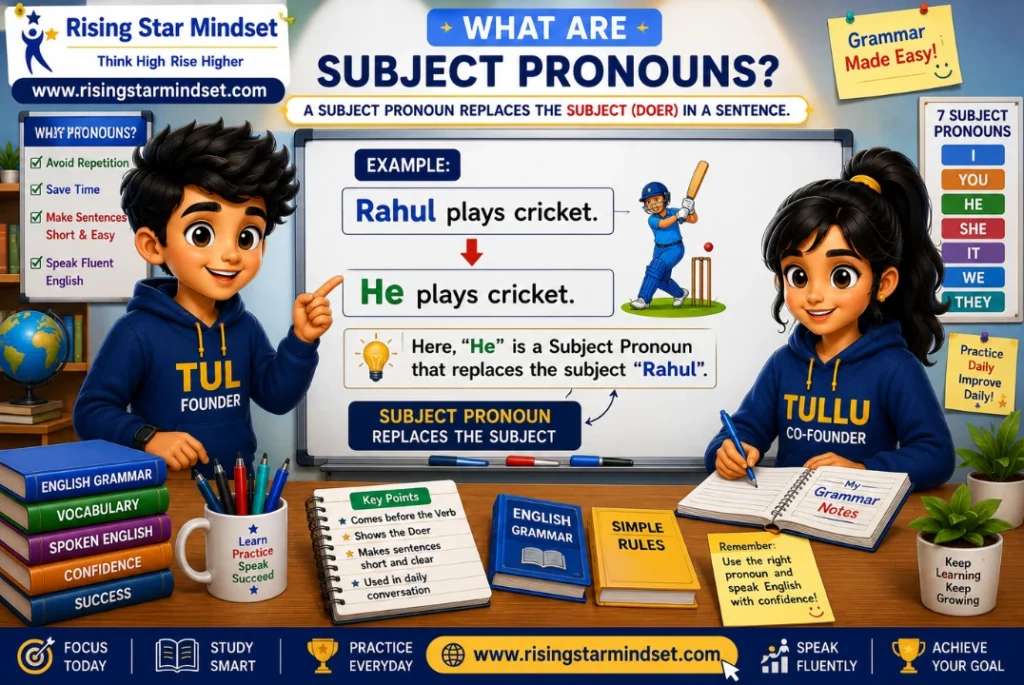
Rahul is playing cricket. He is very happy.
Here, the word He replaces Rahul and makes the sentence shorter, smoother, and more natural.
Similarly,
Riya is reading a book. She loves English.
Again, She replaces Riya.
As a result, Subject Pronouns make English easier to read, easier to write, and much more comfortable to speak.
Moreover, every English learner uses Subject Pronouns hundreds of times every day without even realizing it. Whether you are introducing yourself, talking to your friends, writing emails, answering interview questions, or speaking in class, Subject Pronouns are always there.
In this lesson, you will learn everything about Subject Pronouns through simple English explanations, Hindi explanations, classroom examples, daily conversations, practice questions, memory tricks, and Spoken English activities.
By the end of this lesson, you will confidently use pronoun in both speaking and writing.
परिचय (Hindi)
अब जबकि आपने Pronouns का परिचय (Introduction to Pronouns) अच्छी तरह समझ लिया है, तो अब समय है Pronouns के सबसे पहले और सबसे महत्वपूर्ण प्रकार—Subject Pronouns को सीखने का।
जब भी हम अंग्रेज़ी में कोई वाक्य बोलते या लिखते हैं, लगभग हर वाक्य किसी Subject (कर्ता) से शुरू होता है। यदि हम हर बार किसी व्यक्ति, वस्तु या स्थान का नाम दोहराएँ, तो वाक्य लंबे और अप्राकृतिक लगने लगते हैं। इसलिए अंग्रेज़ी भाषा में Subject Pronouns का प्रयोग किया जाता है।
जैसे—
Rahul is playing cricket. He is very happy.
यहाँ He, Rahul की जगह प्रयोग हुआ है।
इसी प्रकार—
Riya is reading a book. She loves English.
यहाँ She, Riya की जगह प्रयोग हुआ है।
इस प्रकार Subject Pronouns हमारी भाषा को सरल, प्रभावशाली और स्वाभाविक बनाते हैं।
इसके अलावा, चाहे आप अपना परिचय दें, दोस्तों से बात करें, स्कूल में उत्तर लिखें, इंटरव्यू दें या रोज़मर्रा की अंग्रेज़ी बोलें, Subject Pronouns का प्रयोग हर जगह होता है।
इस Lesson में हम Subject Pronouns को बहुत आसान भाषा में सीखेंगे। साथ ही, अंग्रेज़ी और हिन्दी दोनों में नियम, उदाहरण, Daily Conversation, अभ्यास, Memory Tricks तथा Spoken English Activities भी समझेंगे।
Learning Objectives ( How to Use Subject Pronouns Correctly in English )
After completing this lesson, you will be able to:
| Understand Subject Pronouns clearly |
| Identify Subject Pronouns in sentences. |
| Replace nouns with correct Subject Pronouns. |
| Speak simple English sentences confidently. |
| Avoid common beginner mistakes. |
| Improve Spoken English naturally. |
| Build a strong grammar foundation. |
Table of Contents
- What are Subject Pronouns?
- Subject Pronouns Definition (English & Hindi)
- Why Subject Pronouns are Important?
- List of Subject Pronouns
- Rules for Using Subject Pronouns
- Subject Pronouns with Examples
- Daily Conversation Using Subject Pronouns
- Common Mistakes Beginners Make
- Practice Questions
- Fill in the Blanks
- Match the Following
- MCQs
- HOTS Questions
- FAQs
- Conclusion
- Previous Lesson
- Next Lesson
- Previous post : Introduction to Pronouns
Pronouns Course Roadmap
Lesson 11 – Pronouns
| ✅ Lesson 11.1 – Introduction to Pronouns (Completed) |
| 📘 Lesson 11.2 – Subject Pronouns (Current Lesson) |
| 11.3 – Object Pronouns |
| 11.4 – Possessive Pronouns |
| 11.5 – Demonstrative Pronouns |
| 11.6 – Interrogative Pronouns |
| 11.7 – Relative Pronouns |
| 11.8 – Reflexive Pronouns |
| 11.9 – Indefinite Pronouns |
| 11.10 – Distributive Pronouns |
| 11.11 – Pronoun Practice Exercises & Quiz |
Abbreviations ( How to Use Subject Pronouns Correctly in English )
| Abbreviation | Full Form | हिन्दी अर्थ |
| SP | Subject Pronoun | कर्ता सर्वनाम |
| S | Subject | कर्ता |
| V | Verb | क्रिया |
| O | Object | कर्म |
| Eng. | English | अंग्रेज़ी |
| Hin. | Hindi | हिन्दी |
| Ex. | Example | उदाहरण |
| Q&A | Question and Answer | प्रश्न एवं उत्तर |
| MCQ | Multiple Choice Question | बहुविकल्पीय प्रश्न |
| HOTS | Higher Order Thinking Skills | उच्च स्तरीय सोच आधारित प्रश्न |
What are Subject Pronouns?
Definition (English)
A Subject Pronoun is a Pronoun that is used as the subject (doer of the action) in a sentence. It tells us who or what is performing the action.
Subject Pronouns always come before the main verb in a sentence.
Formula
Subject Pronoun + Verb + Object
परिभाषा (हिन्दी)
Subject Pronoun (कर्ता सर्वनाम) वह सर्वनाम है जो किसी वाक्य में कार्य करने वाले (कर्ता) की जगह प्रयोग किया जाता है।
यह बताता है कि कार्य कौन कर रहा है।
Subject Pronouns सामान्यतः Verb (क्रिया) से पहले आते हैं।
सूत्र
Subject Pronoun + Verb + Object
Why are Subject Pronouns Important?
Subject Pronouns are one of the most frequently used words in English. Therefore, learning them correctly is essential for speaking, writing, reading, and understanding English naturally.
Moreover, whenever we introduce ourselves, talk to friends, answer questions, write emails, or participate in conversations, Subject Pronouns appear repeatedly. Consequently, mastering them helps us communicate with confidence.
Subject Pronouns क्यों महत्वपूर्ण हैं?
Subject Pronouns अंग्रेज़ी भाषा के सबसे अधिक उपयोग होने वाले शब्दों में से एक हैं। इसलिए इन्हें सही तरीके से सीखना बहुत आवश्यक है।
इसके अलावा, जब भी हम अपना परिचय देते हैं, दोस्तों से बात करते हैं, किसी प्रश्न का उत्तर देते हैं या अंग्रेज़ी लिखते हैं, तब बार-बार Subject Pronouns का प्रयोग होता है। इसलिए इनकी अच्छी समझ आपकी Spoken English और Writing Skills दोनों को बेहतर बनाती है।
Key Points ( How to Use Subject Pronouns Correctly in English )
1. Subject Pronouns replace the Subject.
English
Instead of repeating a noun again and again, we use a Subject Pronoun.
Example
Rahul is intelligent.
He is intelligent.
हिन्दी
बार-बार Noun दोहराने के बजाय Subject Pronoun का प्रयोग किया जाता है।
2. Subject Pronouns come before the Verb.
Examples
He plays football.
She studies English.
They live in Delhi.
हिन्दी
कर्ता सर्वनाम हमेशा क्रिया से पहले आता है।
3. Subject Pronouns make sentences shorter.
Without Pronoun
Butul is a student.
Butul studies every day.
With Pronoun
Butul is a student.
He studies every day.
हिन्दी
Pronouns वाक्य को छोटा, सरल और स्वाभाविक बनाते हैं।
4. Subject Pronouns improve Spoken English.
People never repeat names again and again while speaking.
Instead they use
He
She
They
We
I
हिन्दी
Fluent English बोलने वाले लोग बार-बार नाम नहीं दोहराते, बल्कि Subject Pronouns का प्रयोग करते हैं।
5. Every English sentence needs a Subject.
Examples
I am happy.
She is reading.
They are playing.
We are friends.
हिन्दी
लगभग प्रत्येक अंग्रेज़ी वाक्य में एक Subject होता है और कई बार वह Subject Pronoun होता है।
When do we use Subject Pronouns?
We use Subject Pronouns:
- While introducing ourselves
- During conversations
- In schools
- During interviews
- In emails
- daily speaking
- During presentations
- In competitive examinations
- While writing essays
Subject Pronouns का प्रयोग कब किया जाता है?
हम Subject Pronouns का प्रयोग करते हैं—
- अपना परिचय देते समय
- बातचीत करते समय
- स्कूल में
- इंटरव्यू में
- ईमेल लिखते समय
- कहानी लिखते समय
- रोज़मर्रा की अंग्रेज़ी बोलते समय
- भाषण या प्रस्तुति देते समय
- प्रतियोगी परीक्षाओं में
- निबंध लिखते समय
Real-Life Examples ( How to Use Subject Pronouns Correctly in English )
Example 1
I am a student.
मैं एक विद्यार्थी हूँ।
Example 2
She is my sister.
वह मेरी बहन है।
Example 3
He plays cricket.
वह क्रिकेट खेलता है।
Example 4
They are my classmates.
वे मेरे सहपाठी हैं।
Example 5
We love English.
हम अंग्रेज़ी पसंद करते हैं।
Example 6
It is my school bag.
यह मेरा स्कूल बैग है।
Daily Life Conversation
Conversation 1
A: Who are you?
B: I am Rahul.
Conversation 2
A: Where is Riya?
B: She is in the classroom.
Conversation 3
A: Where is Amit?
B: He is in the library.
Conversation 4
A: Are you students?
B: Yes, we are.
Conversation 5
A: Who are those boys?
B: They are my friends.
Memory Trick ( How to Use Subject Pronouns Correctly in English )
Remember this simple order:
I → तुम → He → She → It → We → They
Rather than memorizing them randomly, imagine this sequence as a journey:
- 👤 self (I)
- 👥 Someone in front of you तुम
- 👦 One boy (He)
- 👧 One girl (She)
- 📘 One thing (It)
- 👨👩👧 own group (We)
- 👥 Other people or things (They)
As a result, remembering the complete order becomes much easier.
याद रखने की आसान ट्रिक ( How to Use Subject Pronouns Correctly in English )
मैं → तुम → लड़का → लड़की → वस्तु → हम → वे
यही Subject Pronouns का क्रम है।
Important Note ( How to Use Subject Pronouns Correctly in English )
⚠️ Subject Pronouns are never used as Objects.
For example:
✅ He plays cricket.
❌ Cricket likes he.
महत्वपूर्ण बात
Subject Pronouns केवल कर्ता (Subject) के रूप में प्रयोग किए जाते हैं, कर्म (Object) के रूप में नहीं।
Complete List of Subject Pronouns
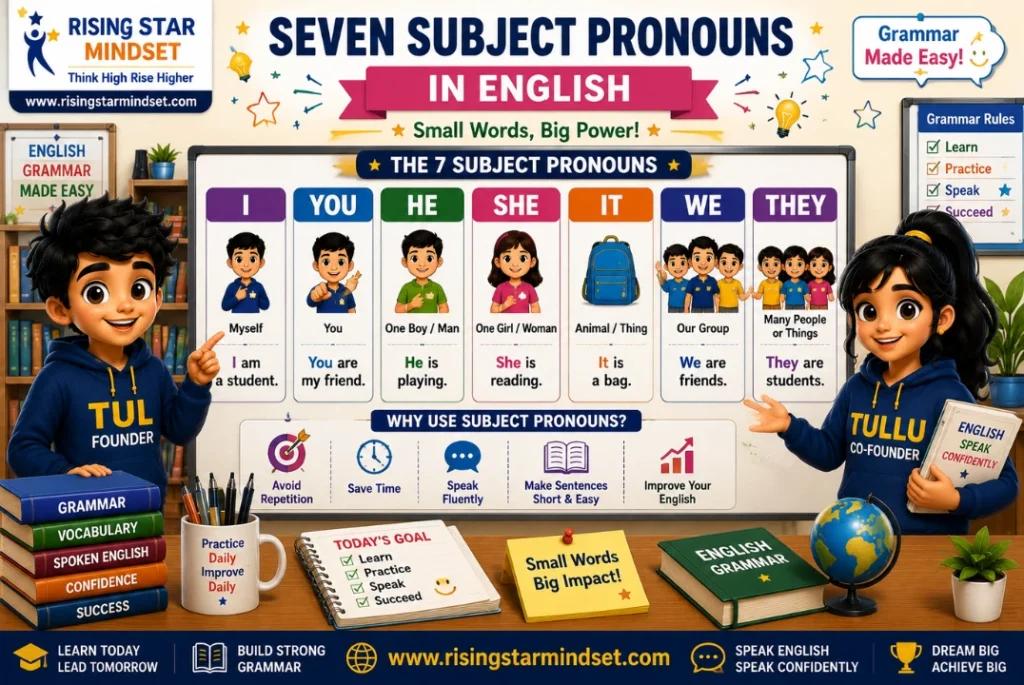
Subject Pronouns are used as the subject of a sentence. There are seven main Subject Pronouns in English.
| Subject Pronoun | Used For | हिन्दी अर्थ |
| I | Myself | मैं |
| You | One person or many people | तुम / आप |
| He | One male person | वह (लड़का/पुरुष) |
| She | One female person | वह (लड़की/महिला) |
| It | Animal, thing or idea | यह / वह (वस्तु या जानवर) |
| We | Group including myself | हम |
| They | More than one person, animal or thing | वे |
1. Subject Pronoun – I
English Explanation
I is used when the speaker talks about himself or herself.
It is always written with a capital letter (I), even in the middle of a sentence.
हिन्दी व्याख्या
जब कोई व्यक्ति अपने बारे में बात करता है, तब I का प्रयोग किया जाता है।
ध्यान रखें कि I हमेशा Capital Letter में लिखा जाता है।
Examples
I am a student.
मैं एक विद्यार्थी हूँ।
I like English.
मुझे अंग्रेज़ी पसंद है।
I play cricket every evening.
मैं हर शाम क्रिकेट खेलता हूँ।
I live in Bihar.
मैं बिहार में रहता हूँ।
Spoken English Examples
I am ready.
I can help you.
2. Subject Pronoun – तुम ( you )
English Explanation
The pronoun “ तुम“ is used for both one person and many people.
Interestingly, English does not have separate words for singular and plural “you”.
Therefore, the same word is used in both situations.
हिन्दी व्याख्या
“ तुम“ का प्रयोग एक व्यक्ति और अनेक व्यक्तियों दोनों के लिए किया जाता है।
दिलचस्प बात यह है कि अंग्रेज़ी में इसके लिए अलग-अलग शब्द नहीं हैं।
इसलिए, “ तुम” का प्रयोग दोनों परिस्थितियों में समान रूप से किया जाता है।
Examples
3. Subject Pronoun – He
English Explanation
The pronoun “He” refers to one male person.
For example, Rahul becomes “He”.
Moreover, it always works as the subject of a sentence.
हिन्दी व्याख्या
He का प्रयोग किसी एक पुरुष या लड़के के लिए किया जाता है।
Examples
He is my brother.
वह मेरा भाई है।
He plays football.
वह फुटबॉल खेलता है।
He studies every day.
वह प्रतिदिन पढ़ाई करता है।
Spoken English
He is busy.
He is waiting.
4. Subject Pronoun – She
English Explanation
“She” refers to one female person.
For instance, Riya can be replaced with “She”.
As a result, the sentence becomes shorter and more natural.
हिन्दी व्याख्या
She का प्रयोग किसी एक महिला या लड़की के लिए किया जाता है।
Examples
She is my sister.
वह मेरी बहन है।
She is a doctor.
वह डॉक्टर है।
She loves music.
उसे संगीत पसंद है।
Spoken English
She teaches English.
She likes reading books.
5. Subject Pronoun – It
English Explanation
It is used for:
- Animals
- Things
- Places (in some contexts)
- Weather
- Time
- Distance
हिन्दी व्याख्या
It का प्रयोग किया जाता है—
- जानवरों के लिए
- वस्तुओं के लिए
- मौसम के लिए
- समय बताने के लिए
- दूरी बताने के लिए
Examples
It is my bag.
यह मेरा बैग है।
It is raining.
बारिश हो रही है।
It is very hot today.
आज बहुत गर्मी है।
It is 8 o’clock.
आठ बज चुके हैं।
Spoken English
It looks beautiful.
It is my laptop.
6. Subject Pronoun – We
English Explanation
We is used when the speaker includes himself or herself with others.
हिन्दी व्याख्या
जब बोलने वाला स्वयं को अन्य लोगों के साथ शामिल करता है, तब We का प्रयोग होता है।
Examples
We are students.
हम विद्यार्थी हैं।
We play together.
हम साथ खेलते हैं।
We love our country.
हम अपने देश से प्रेम करते हैं।
Spoken English
We are ready.
We should study daily.
7. Subject Pronoun – They
English Explanation
They is used for more than one person, animal, or thing.
हिन्दी व्याख्या
They का प्रयोग एक से अधिक व्यक्तियों, जानवरों या वस्तुओं के लिए किया जाता है।
Examples
They are my friends.
वे मेरे मित्र हैं।
They study in Class 10.
वे कक्षा 10 में पढ़ते हैं।
They are playing cricket.
वे क्रिकेट खेल रहे हैं।
Spoken English
They are waiting.
They are happy.
Quick Revision Table ( How to Use Subject Pronouns Correctly in English )
| Pronoun | Used For | Example |
| I | Myself | I am happy. |
| You | You / You all | You are kind. |
| He | One boy/man | He is a teacher. |
| She | One girl/woman | She is a doctor. |
| It | Animal/Thing | It is a pen. |
| We | Our group | We are friends. |
| They | Many people/things | They are students. |
Rules for Using Subject Pronouns
Learning Subject Pronouns becomes much easier when you understand a few simple rules. Therefore, instead of memorizing everything, try to understand how these Pronouns work in real-life situations.
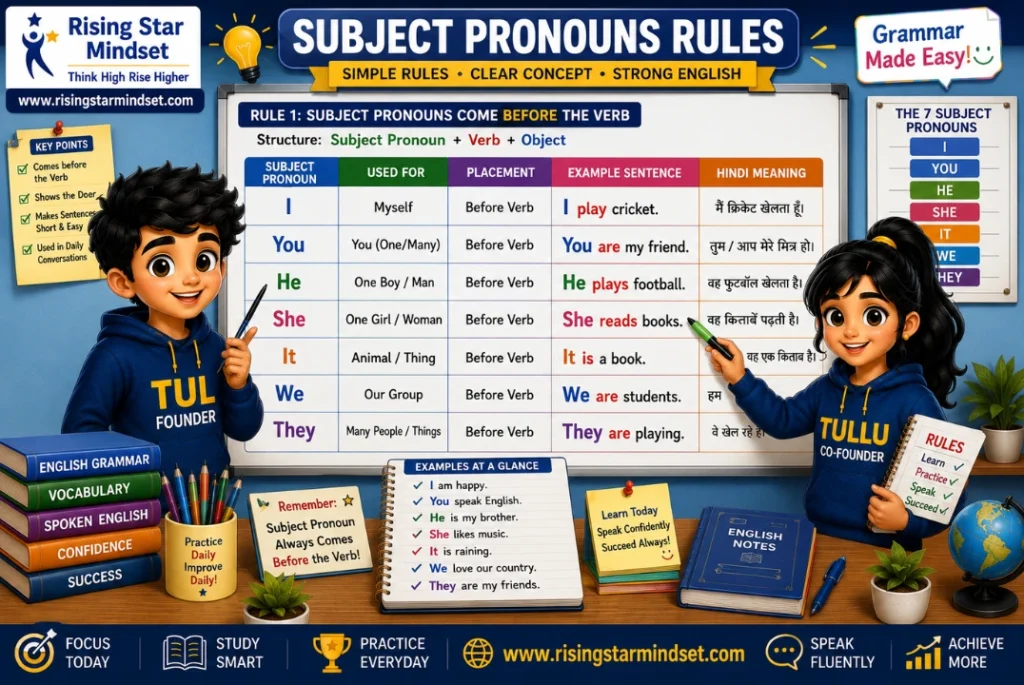
Rule 1: Subject Pronouns Always Come Before the Verb
English Explanation
A Subject Pronoun usually comes before the main verb because it performs the action.
Structure
Subject Pronoun + Verb + Object
Examples
He plays football.
She reads books.
They study together.
हिन्दी व्याख्या
Subject Pronoun सामान्यतः क्रिया (Verb) से पहले आता है क्योंकि वही कार्य करने वाला (कर्ता) होता है।
उदाहरण
✅ He plays football.
वह फुटबॉल खेलता है।
✅ She sings well.
वह अच्छा गाती है।
Rule 2: Choose the Correct Pronoun
Always use the Pronoun according to the noun.
| Noun | Subject Pronoun |
| Rahul | He |
| Riya | She |
| Book | It |
| Students | They |
| My friends and I | We |
हिन्दी
हमेशा Noun के अनुसार सही Subject Pronoun चुनें।
Rule 3: Do Not Repeat the Noun
Wrong
Rahul is my friend.
Rahul studies every day.
Correct
Rahul is my friend.
He studies every day.
He plays cricket.
हिन्दी
बार-बार Noun दोहराने के बजाय Subject Pronoun का प्रयोग करें।
Rule 4: “I” is Always Capital
Even in the middle of a sentence,
“I” is always written in capital letters.
Correct
My brother and I are students.
Incorrect
My brother and i are students.
हिन्दी
“I” हमेशा Capital Letter में लिखा जाता है।
Rule 5: One Person = He / She
Boy
He is playing.
Girl
She is dancing.
हिन्दी
यदि व्यक्ति लड़का है → He
यदि व्यक्ति लड़की है → She
Rule 6: Many People = They
Examples
The students are studying.
They are studying.
The boys are playing.
They are playing.
हिन्दी
एक से अधिक व्यक्ति, जानवर या वस्तु होने पर They प्रयोग किया जाता है।
Rule 7: Things and Animals = It
Examples
The cat is sleeping.
It is sleeping.
The bag is heavy.
It is heavy.
हिन्दी
वस्तु तथा सामान्य जानवरों के लिए It का प्रयोग किया जाता है।
Common Beginner Mistakes
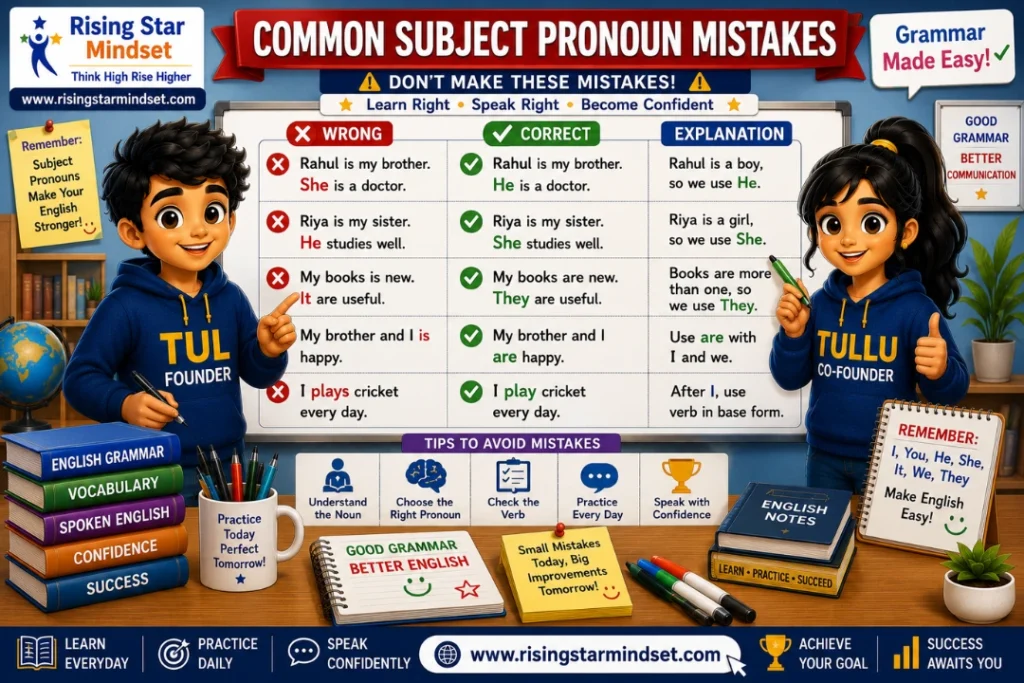
Mistake 1
❌ Rahul is a good boy.
She is intelligent.
✅ Rahul is a good boy.
He is intelligent.
Mistake 2
❌ Riya is my sister.
He studies well.
✅ Riya is my sister.
She studies well.
Mistake 3
❌ My books are new.
It is on the table.
✅ My books are new.
They are on the table.
Mistake 4
❌ My brother and I is happy.
✅ My brother and I are happy.
Mistake 5
❌ I plays cricket.
✅ I play cricket.
Daily Conversation Using Subject Pronouns
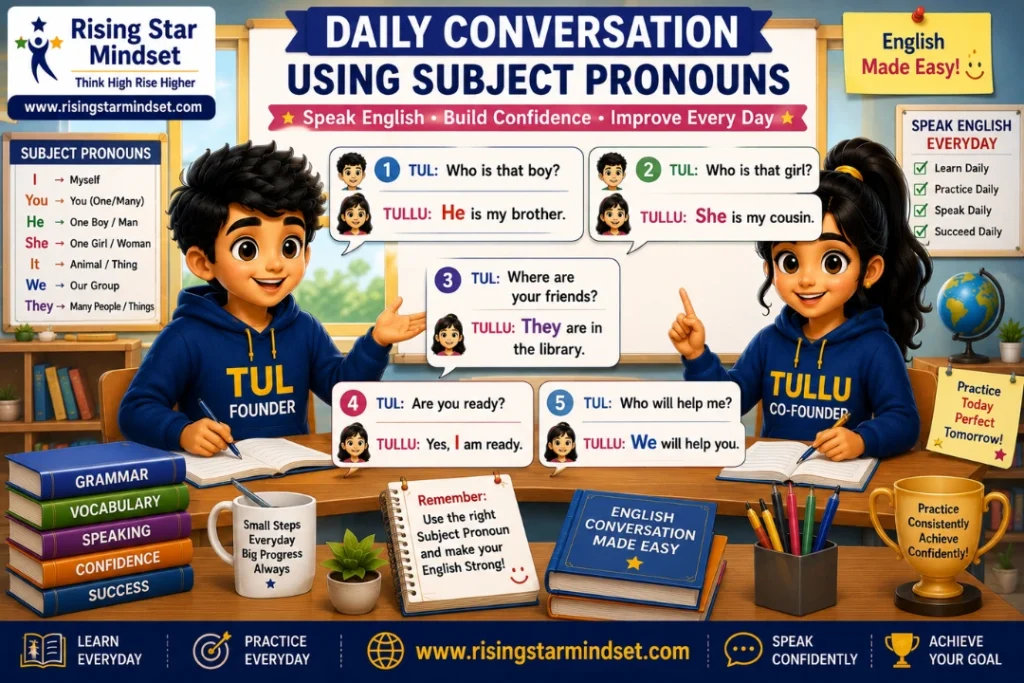
Conversation 1
Tul:
Who is that boy?
Tullu:
He is my brother.
Conversation 2
Tul:
Who is that girl?
Tullu:
She is my cousin.
Conversation 3
Tul:
Where are your friends?
Tullu:
They are in the library.
Conversation 4
Tul:
Are you ready?
Tullu:
Yes, I am ready.
Conversation 5
Tul:
Who will help me?
Tullu:
We will help you.
Practice Questions
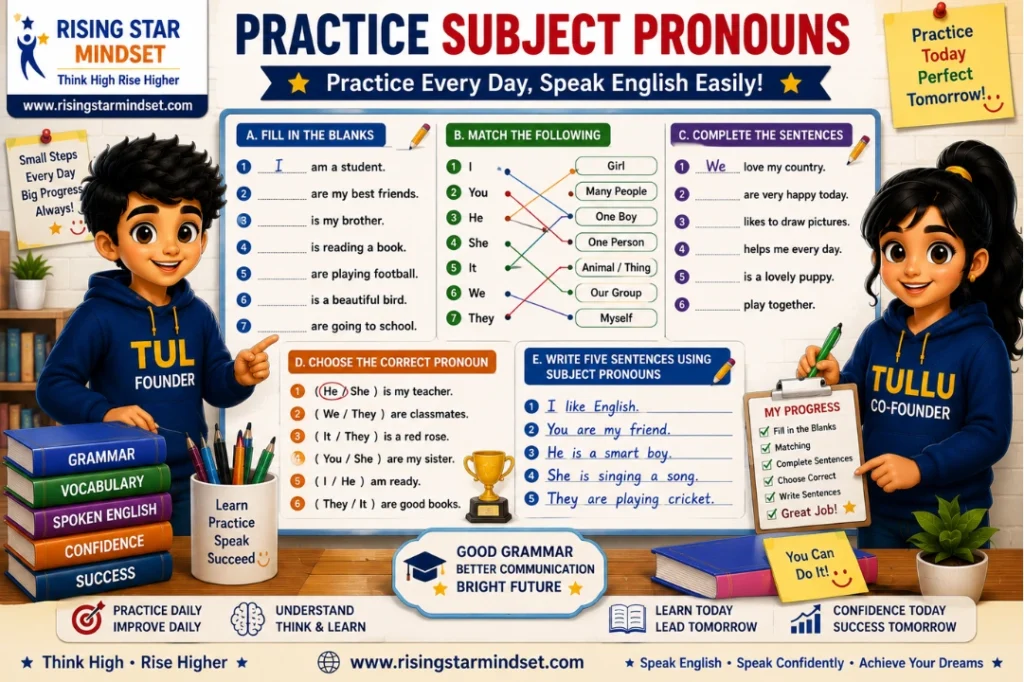
Choose the Correct Subject Pronoun
Rahul is playing cricket.
____ is playing cricket.
Riya is reading a story.
____ is reading a story.
My parents are teachers.
____ teach in a school.
The dog is sleeping.
____ is sleeping.
My friends and I are happy.
____ are happy.
Fill in the Blanks ( How to Use Subject Pronouns Correctly in English )
Choose from Pronouns
- ______ am learning English.
- Rahul is my friend. ______ studies every day.
- My sister is a doctor. ______ works in a hospital.
- My parents are at home. ______ are watching TV.
- The book is interesting. ______ is very useful.
- My classmates and I play football. ______ play every evening.
- ______ are a good student.
- The cat is hungry. ______ wants milk.
- My cousins live in Delhi. ______ visit us every year.
- ______ am proud of my country.
Match the Following ( How to Use Subject Pronouns Correctly in English )
| Column A | Column B |
| Rahul | He |
| Riya | She |
| Pen | It |
| Students | They |
| Myself | I |
| My friends and I | We |
| Teacher | You |
Speaking Practice ( How to Use Subject Pronouns Correctly in English )
Read these sentences loudly five times.
I am a student.
He is playing football.
She is reading a book.
It is raining.
We are learning English.
They are going to school.
Daily Challenge
Replace the nouns with correct Subject Pronouns.
- Rahul is singing.
- Riya is dancing.
- The dog is barking.
- My parents are working.
- Aman and I are studying.
Memory Trick
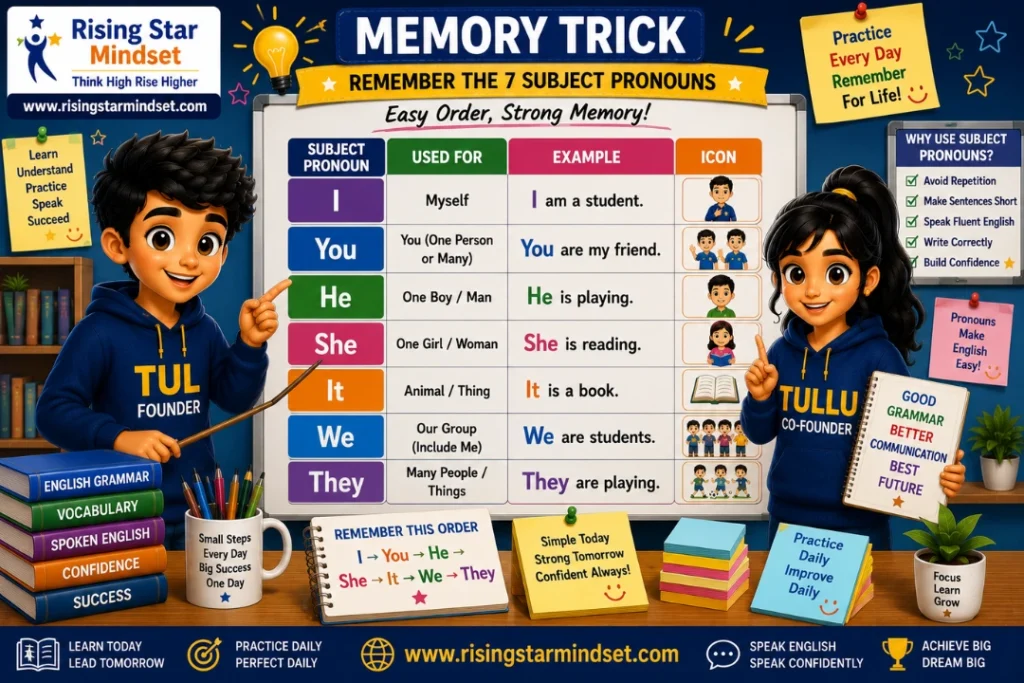
Remember this simple sentence:
Easy Memory Sequence
- मैं→ Self
- सामने वाला → Listener
- लड़का→ Male
- लड़की → Female
- वस्तु / जानवर → Object / Animal
- हमारा समूह → Including Me
- अन्य लोग → Others
Practice this sentence every day to remember all Subject Pronouns quickly.
Subject Pronouns MCQs
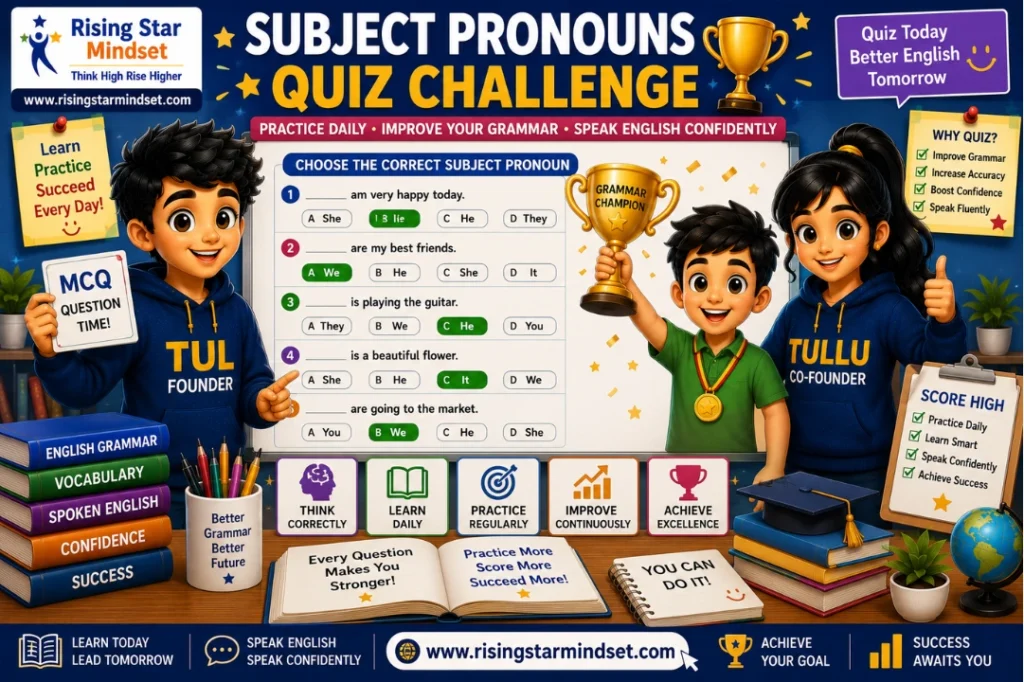
Choose the correct answer.
1. Rahul is my friend. ____ is very kind.
A) She
B) It
C) He
D) They
✅ Answer: C) He
2. Riya is reading a novel.
____ likes reading.
A) He
B) She
C) They
D) We
✅ Answer: B) She
3. My parents are teachers.
____ work in a government school.
A) We
B) He
C) They
D) It
✅ Answer: C) They
4. My school bag is new.
____ is blue.
A) It
B) They
C) She
D) He
✅ Answer: A) It
5. Aman and I are classmates.
____ study together.
A) They
B) We
C) He
D) It
✅ Answer: B) We
6. ____ am learning Spoken English.
A) We
B) they
C) I
D) They
✅ Answer: C) I
7. Which sentence is correct?
A) He are playing.
B) She is playing.
D) He were playing.
✅ Answer: B) He is playing.
8. Which Subject Pronoun is used for animals and things?
A) He
B) She
C) They
D) It
✅ Answer: D) It
9. “My friends” can be replaced by—
A) We
B) They
C) It
D) He
✅ Answer: B) They
10. Which Subject Pronoun is always written in Capital Letter?
A) We
B) It
C) I
D) They
✅ Answer: C) I
HOTS (Higher Order Thinking Skills)
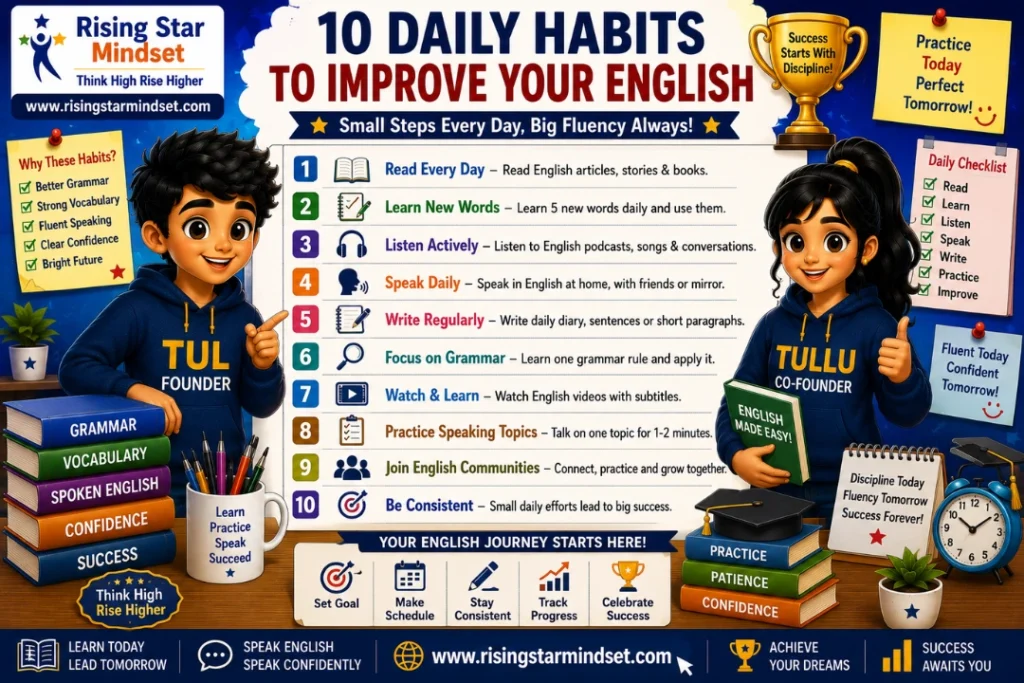
1.
Replace the noun with the correct Subject Pronoun.
Neha is a brilliant student. Neha always helps others.
Answer
Neha is a brilliant student.
She always helps others.
2.
Correct the sentence.
Rahul is my brother. She is a doctor.
Answer
Rahul is my brother.
He is a doctor.
3.
Read carefully.
The books are on the table. It are very useful.
Find the mistake.
Answer
“It” should be replaced by They.
Correct sentence:
The books are on the table.
They are very useful.
4.
Fill the correct Subject Pronoun.
My parents and I are going to Delhi.
_____ are travelling tomorrow.
Answer
We
5.
Write sentences using different Subject Pronouns.
Sample Answer
- I like English.
- He is a teacher.
- She sings well.
- They play football.
Frequently Asked Questions (FAQs)
Q1. What is a Subject Pronoun?
English
A Subject Pronoun is a pronoun used as the subject of a sentence.
हिन्दी
Subject Pronoun वह सर्वनाम है जो वाक्य में कर्ता (Subject) के रूप में प्रयोग होता है।
Q2. How many Subject Pronouns are there in English?
There are seven main Subject Pronouns:
Q3. Why are Subject Pronouns important?
Subject Pronouns make sentences shorter, clearer, and more natural. They also improve Spoken English and Writing Skills.
हिन्दी
Subject Pronouns वाक्यों को छोटा, स्पष्ट और प्रभावशाली बनाते हैं तथा अंग्रेज़ी बोलने और लिखने की क्षमता को बेहतर करते हैं।
Q4. . When should we use the Subject Pronoun “I”?
Use “I” when talking about yourself. It is always used as the subject of a sentence and is written with a capital letter, even in the middle of a sentence.
Q5. When do we use “It”?
“It” is used for:
- Things
- Animals
- Weather
- Time
- Distance
Q6. Which Subject Pronoun is used for a group including yourself?
We
Example:
We are students.
Q7. Which Subject Pronoun replaces “Rahul”?
He
Q8. Which Subject Pronoun replaces “Riya”?
She
Q9. Which Subject Pronoun replaces “Books”?
They
Q10. Why is “I” always written in capital letters?
Unlike other pronouns, “I” is always capitalized in English grammar, whether it appears at the beginning, middle, or end of a sentence.
Lesson Summary
After completing this lesson, you have learned:
| Meaning of Subject Pronouns |
| English and Hindi explanations |
| Seven Subject Pronouns |
| Grammar Rules |
| Sentence Formation |
| Daily Conversation |
| Common Mistakes |
| Practice Exercises |
| Fill in the Blanks |
| Match the Following |
| MCQs |
| HOTS Questions |
| Frequently Asked Questions |
Conclusion (English)
Congratulations!
Now you understand how Subject Pronouns replace nouns and help us speak English naturally. Moreover, you have learned where to use Subject pronoun, along with their grammar rules and practical examples.
However, learning English is a continuous journey. Therefore, revise this lesson regularly and practise speaking with Subject Pronouns every day. The more you use them in daily conversations, the more confident and fluent you will become.
Finally, remember that strong grammar builds strong communication. Keep learning one lesson at a time, and your Spoken English will improve steadily.
निष्कर्ष (Hindi) (How to Use Subject Pronouns Correctly in English )
बधाई हो! आपने Lesson 11.2 – Subject Pronouns in English सफलतापूर्वक पूरा कर लिया है।
अब आप समझ चुके हैं कि Subject Pronouns क्या होते हैं, उनका सही प्रयोग कैसे किया जाता है तथा वे अंग्रेज़ी भाषा को सरल, प्रभावशाली और स्वाभाविक कैसे बनाते हैं। इसके अलावा, आपने Subject Pronouns का सही उपयोग, उनके नियम, उदाहरण और अभ्यास भी सीखा।
हालाँकि, केवल पढ़ना पर्याप्त नहीं है। इसलिए इस Lesson का नियमित अभ्यास करें और रोज़मर्रा की बातचीत में Subject Pronouns का प्रयोग करने की आदत विकसित करें। जितना अधिक अभ्यास करेंगे, उतनी ही आपकी Spoken English, Writing Skills और आत्मविश्वास में वृद्धि होगी।
अंततः, याद रखें कि अंग्रेज़ी सीखने का सबसे अच्छा तरीका Daily Practice है। छोटे-छोटे कदम ही आपको धाराप्रवाह अंग्रेज़ी बोलने की मंज़िल तक पहुँचाते हैं।
“Practice a little every day, and one day English will become your natural language.”
📚 Previous Lesson
⬅️ Lesson 11.1 – Introduction to Pronouns in English
पिछले Lesson में आपने निम्न महत्वपूर्ण विषयों का अध्ययन किया था:
- सर्वनाम (Pronouns) का अर्थ और परिचय
- इनके प्रयोग की आवश्यकता
- अंग्रेज़ी व्याकरण में इनका महत्व
- विभिन्न प्रकारों (Types) का संक्षिप्त परिचय
- संज्ञा (Noun) की पुनरावृत्ति से बचने का सही तरीका
🚀 Next Lesson (How to Use Subject Pronouns Correctly in English )
➡️ Lesson 11.3 – Object Pronouns in English
Coming Next, you will learn:
- What are Object Pronouns?
- Me, Him, Her, It, Us, Them
- Subject vs Object Pronouns
- Easy Rules
- English + Hindi Explanation
- Daily Conversations
- Common Mistakes
- Practice Exercises
- MCQs
- HOTS
- FAQs
🌟 Keep Learning with Rising Star Mindset
📘 Spoken English Course
🏛️ BPSC Preparation
🎓 School Notes
💡 Daily Motivation
🌐 Website: www.risingstarmindset.com
Think High • Rise Higher