
Economy Series Part-21 ( Economy GDP Inflation )
Topic: Basic Economy, GDP & Inflation
Previous Topic: Constitutional Bodies (Polity Series)
Next Topic: Banking, RBI & Budget
Table of Contents
- Introduction to Economy
- Important Abbreviations
- Basic Economic Concepts
- Types of Economy
- Factors of Production
- GDP (Gross Domestic Product)
- Types of GDP
- Inflation
- Causes of Inflation
- Effects of Inflation
- Key Points for BPSC
- BPSC Expected Questions
- MCQs
- HOTS Questions
- Short & Long Answer Questions
- FAQ
- Conclusion
Introduction to Economy ( Economy GDP Inflation )
English
Economics is the study of production, distribution, and consumption of goods and services. It helps us understand how individuals, businesses, and governments make economic decisions. ( Economy GDP Inflation )
हिन्दी
अर्थशास्त्र (Economics) वस्तुओं एवं सेवाओं के उत्पादन, वितरण और उपभोग का अध्ययन है। यह बताता है कि व्यक्ति, व्यवसाय और सरकार अपने सीमित संसाधनों का उपयोग कैसे करते हैं।
Important Abbreviations
| Abbreviation | Full Form |
|---|---|
| GDP | Gross Domestic Product |
| GNP | Gross National Product |
| NDP | Net Domestic Product |
| NNP | Net National Product |
| RBI | Reserve Bank of India |
| CPI | Consumer Price Index |
| WPI | Wholesale Price Index |
| IMF | International Monetary Fund |
| WTO | World Trade Organization |
| FDI | Foreign Direct Investment |
Basic Economic Concepts
| Concept | English | हिन्दी |
|---|---|---|
| Wants | Human desires | मानव इच्छाएँ |
| Goods | Physical products | वस्तुएँ |
| Services | Non-physical activities | सेवाएँ |
| Scarcity | Limited resources | संसाधनों की कमी |
| Opportunity Cost | Cost of next best alternative | अवसर लागत |
Types of Economy
| Type | Explanation |
|---|---|
| Capitalist Economy | Private ownership dominates |
| Socialist Economy | Government ownership dominates |
| Mixed Economy | Both government and private sectors work together |
India follows a Mixed Economy.
हिन्दी
भारत मिश्रित अर्थव्यवस्था (Mixed Economy) का पालन करता है जिसमें निजी एवं सार्वजनिक दोनों क्षेत्र कार्य करते हैं।
Factors of Production
| Factor | Reward |
|---|---|
| Land | Rent |
| Labour | Wages |
| Capital | Interest |
| Entrepreneur | Profit |
BPSC Fact
इन चारों को अर्थव्यवस्था के उत्पादन के मुख्य साधन माना जाता है।
GDP (Gross Domestic Product)
Definition
English
GDP is the total monetary value of all final goods and services produced within a country’s geographical boundaries during one year.
हिन्दी
किसी देश की सीमाओं के भीतर एक वर्ष में उत्पादित अंतिम वस्तुओं एवं सेवाओं के कुल मौद्रिक मूल्य को GDP कहा जाता है।
Formula
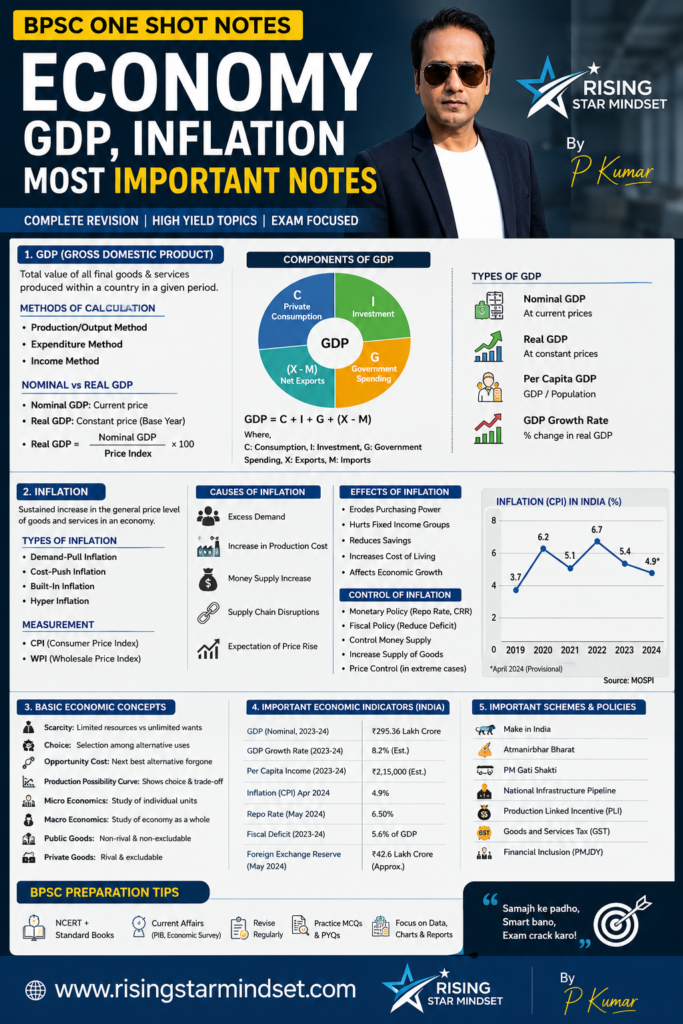
GDP = Consumption + Investment + Government Expenditure + Net Exports
GDP = C + I + G + (X-M)
Where:
- C = Consumption
- I = Investment
- G = Government Spending
- X = Exports
- M = Imports
Types of GDP
| Type | Meaning |
|---|---|
| Nominal GDP | Current prices |
| Real GDP | Constant prices |
| Per Capita GDP | GDP ÷ Population |
| GDP at Market Price | Includes taxes |
| GDP at Factor Cost | Excludes indirect taxes |
BPSC Important Fact
भारत में GDP का अनुमान National Statistical Office (NSO) द्वारा लगाया जाता है।
Inflation
Definition
English
Inflation is the continuous rise in the general price level of goods and services over time.
हिन्दी
समय के साथ वस्तुओं एवं सेवाओं के सामान्य मूल्य स्तर में निरंतर वृद्धि को मुद्रास्फीति (Inflation) कहते हैं।
Causes of Inflation
| Cause | Explanation |
|---|---|
| Demand Pull Inflation | Demand exceeds supply |
| Cost Push Inflation | Increase in production cost |
| Excess Money Supply | More money in circulation |
| Supply Chain Disruptions | Shortage of goods |
Effects of Inflation
Positive Effects
- Encourages investment
- Increases business profits
- Promotes economic growth
Negative Effects
- Reduces purchasing power
- Hurts fixed-income groups
- Increases cost of living
हिन्दी
मुद्रास्फीति से वस्तुओं की कीमतें बढ़ती हैं तथा आम जनता की क्रय शक्ति घटती है।
Key Points For BPSC
| India has a Mixed Economy. |
| GDP measures economic growth |
| NSO estimates India’s GDP. |
| Inflation means rising prices. |
| RBI controls inflation through monetary policy. |
| CPI and WPI are important inflation indicators. |
| Per Capita GDP indicates average income. |
| Inflation decreases purchasing power. |
Expected BPSC Questions
1. GDP का आकलन भारत में कौन करता है?
Answer: NSO
2. भारत किस प्रकार की अर्थव्यवस्था अपनाता है?
Answer: Mixed Economy
3. Inflation का अर्थ क्या है?
Answer: वस्तुओं एवं सेवाओं के मूल्य में निरंतर वृद्धि।
4. GDP का पूर्ण रूप क्या है?
Answer: Gross Domestic Product
5. Inflation को नियंत्रित करने वाली संस्था कौन है?
Answer: RBI
MCQs
Q1. GDP का पूर्ण रूप क्या है?
A. Gross Domestic Product ✅
B. General Domestic Product
C. Global Domestic Product
D. Government Domestic Product
Q2. भारत में GDP का अनुमान कौन लगाता है?
A. RBI
B. NITI Aayog
C. NSO ✅
D. SEBI
Q3. भारत की अर्थव्यवस्था किस प्रकार की है?
A. Capitalist
B. Socialist
C. Mixed Economy ✅
D. Traditional
Q4. Inflation का अर्थ है
A. Price Fall
B. Price Stability
C. Continuous Rise in Prices ✅
D. Tax Reduction
Q5. मुद्रास्फीति नियंत्रण का प्रमुख दायित्व किसका है?
A. Parliament
B. RBI ✅
C. Supreme Court
D. Finance Commission
HOTS Questions
Q1.
यदि किसी देश की GDP बढ़ रही है लेकिन Per Capita Income नहीं बढ़ रही है, तो इसका क्या कारण हो सकता है?
Answer:
जनसंख्या वृद्धि GDP वृद्धि के बराबर या उससे अधिक हो सकती है।
Q2.
क्या उच्च GDP हमेशा बेहतर जीवन स्तर को दर्शाती है?
Answer:
नहीं। आय वितरण, शिक्षा, स्वास्थ्य एवं रोजगार भी महत्वपूर्ण हैं।
Q3.
अत्यधिक Inflation अर्थव्यवस्था को कैसे प्रभावित करती है?
Answer:
क्रय शक्ति घटती है, बचत कम होती है और आर्थिक अस्थिरता बढ़ती है।
Short Answer Questions
1. अर्थव्यवस्था क्या है?
उत्पादन, वितरण एवं उपभोग की प्रणाली को अर्थव्यवस्था कहते हैं।
2. GDP क्या है?
देश के भीतर उत्पादित अंतिम वस्तुओं एवं सेवाओं का कुल मूल्य।
3. Inflation क्या है?
सामान्य मूल्य स्तर में निरंतर वृद्धि।
4. Mixed Economy क्या है?
जहाँ निजी एवं सार्वजनिक दोनों क्षेत्र कार्य करते हैं।
5. Per Capita GDP क्या है?
GDP को कुल जनसंख्या से विभाजित करने पर प्राप्त मान।
Long Answer Questions
1. GDP का अर्थ एवं महत्व समझाइए।
GDP किसी देश की आर्थिक गतिविधियों का प्रमुख मापदंड है। इससे आर्थिक विकास, निवेश, उत्पादन एवं आय स्तर का अनुमान लगाया जाता है।
2. Inflation के कारण एवं प्रभावों का वर्णन कीजिए।
Inflation मांग वृद्धि, उत्पादन लागत वृद्धि तथा मुद्रा आपूर्ति बढ़ने से उत्पन्न होती है। इसके कारण कीमतें बढ़ती हैं, क्रय शक्ति घटती है तथा जीवनयापन महंगा हो जाता है।
FAQ
Q1. GDP और GNP में क्या अंतर है?
GDP देश की सीमा के भीतर उत्पादन को मापता है जबकि GNP नागरिकों द्वारा अर्जित कुल उत्पादन को मापता है।
Q2. Real GDP और Nominal GDP में अंतर?
Real GDP स्थिर कीमतों पर तथा Nominal GDP वर्तमान कीमतों पर मापा जाता है।
Q3. Inflation मापने के प्रमुख सूचक कौन हैं?
CPI और WPI।
Q4. RBI Inflation को कैसे नियंत्रित करता है?
Repo Rate, Reverse Repo Rate और Monetary Policy के माध्यम से।
Q5. BPSC में Economy से कितने प्रश्न आते हैं?
सामान्यतः 8–15 प्रश्न प्रत्यक्ष एवं अप्रत्यक्ष रूप से पूछे जाते हैं।
Quick Revision Box
| Economics = Study of Production, Distribution & Consumption |
| India = Mixed Economy |
| GDP = Economic Growth Indicator |
| GDP = C + I + G + (X-M) |
| NSO Calculates GDP |
| Inflation = Rise in Prices |
| RBI Controls Inflation |
| CPI & WPI Measure Inflation |
| Per Capita GDP = GDP ÷ Population |
Conclusion ( Economy GDP Inflation )
Basic Economy, GDP और Inflation BPSC, UPSC, SSC तथा अन्य प्रतियोगी परीक्षाओं के लिए अत्यंत महत्वपूर्ण विषय हैं। GDP किसी देश की आर्थिक प्रगति को दर्शाती है जबकि Inflation मूल्य स्तर में होने वाली वृद्धि को मापती है। इन दोनों अवधारणाओं की स्पष्ट समझ से अर्थव्यवस्था से जुड़े अधिकांश प्रश्नों को आसानी से हल किया जा सकता है। नियमित रूप से इन नोट्स का अध्ययन और MCQs का अभ्यास BPSC Exam 2026 में सफलता की संभावना को बढ़ाएगा।
Economy Series Part-21 समाप्त।
➡️ Next Part (Economy Series Part-22): Banking, RBI & Budget.
Keep Learning, Keep Growing! 🚀
P Kumar | Rising Star Mindset
www.risingstarmindset.com
Together We Will Make The Difference