
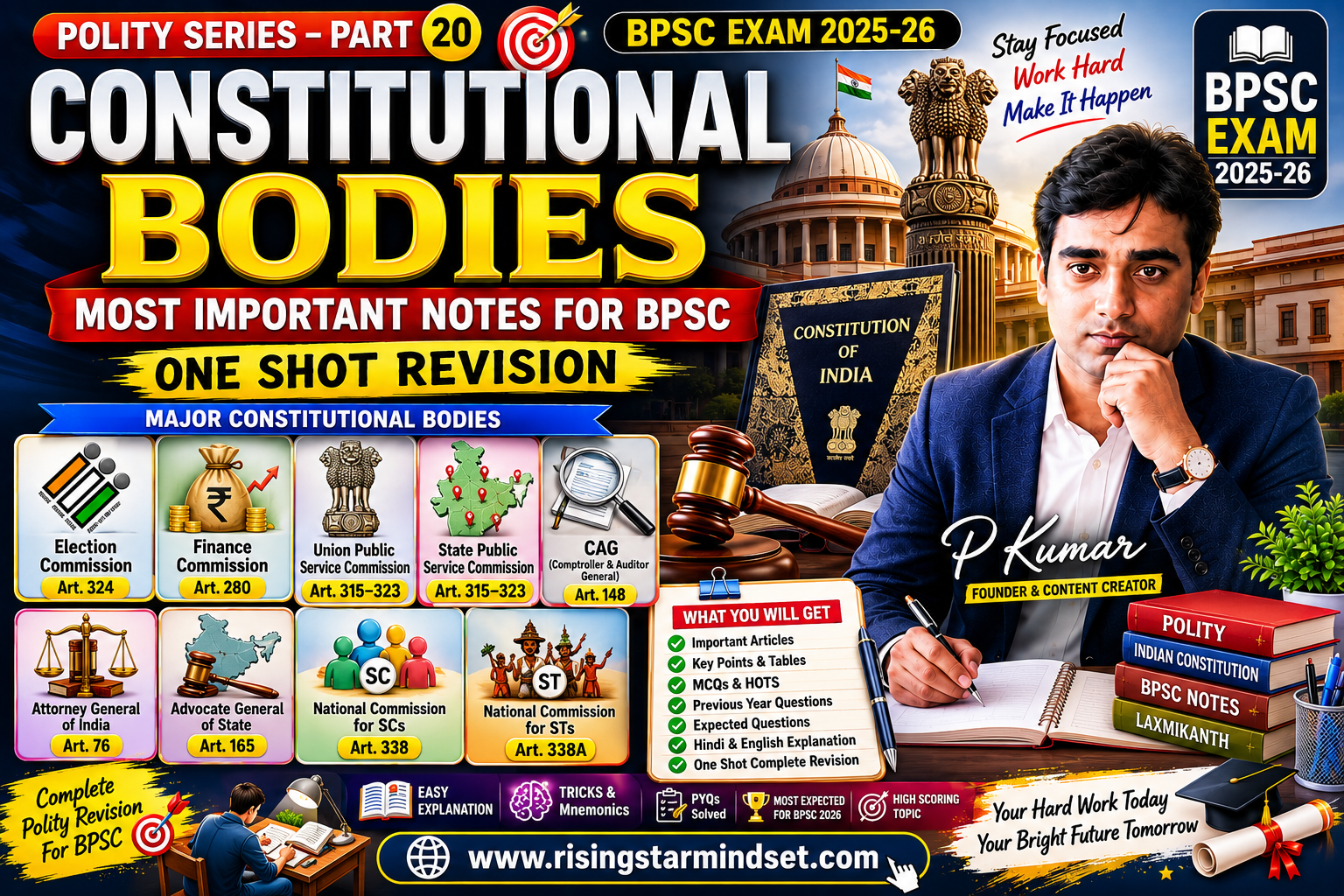
Polity Series Part–20: Constitutional Bodies – Complete Notes for BPSC 2026
संवैधानिक निकाय (Constitutional Bodies) – BPSC One Shot Revision
Series Name: Polity Series ( Constitutional Bodies )
Part No.: 20
Current Topic: Constitutional Bodies
Previous Topic: Governor, Chief Minister & Panchayati Raj
Next Topic: Economic Series – Basic Economy, GDP & Inflation
Table of Contents
- Introduction
- What are Constitutional Bodies?
- Constitutional Bodies at a Glance
- Election Commission of India (ECI)
- Finance Commission
- Union Public Service Commission (UPSC)
- State Public Service Commission (SPSC)
- Comptroller and Auditor General (CAG)
- Attorney General of India
- Advocate General of State
- National Commission for SCs
- National Commission for STs
- Important Articles
- Abbreviations
- Key Points for BPSC
- Previous Year Questions (PYQs)
- MCQs
- HOTS Questions
- Expected BPSC Questions
- Conclusion
Introduction
English
Constitutional Bodies are institutions created directly by the Constitution of India. Their powers, functions, and responsibilities are defined in the Constitution itself.
हिंदी
संवैधानिक निकाय वे संस्थाएं हैं जिनका गठन सीधे भारतीय संविधान द्वारा किया गया है। इनके अधिकार, कार्य और शक्तियाँ संविधान में वर्णित होती हैं।
What are Constitutional Bodies?
English
These bodies ensure transparency, accountability, free elections, financial discipline, and efficient governance.
हिंदी
ये संस्थाएं लोकतंत्र को मजबूत बनाती हैं तथा निष्पक्ष चुनाव, वित्तीय अनुशासन और सुशासन सुनिश्चित करती हैं।
Major Constitutional Bodies
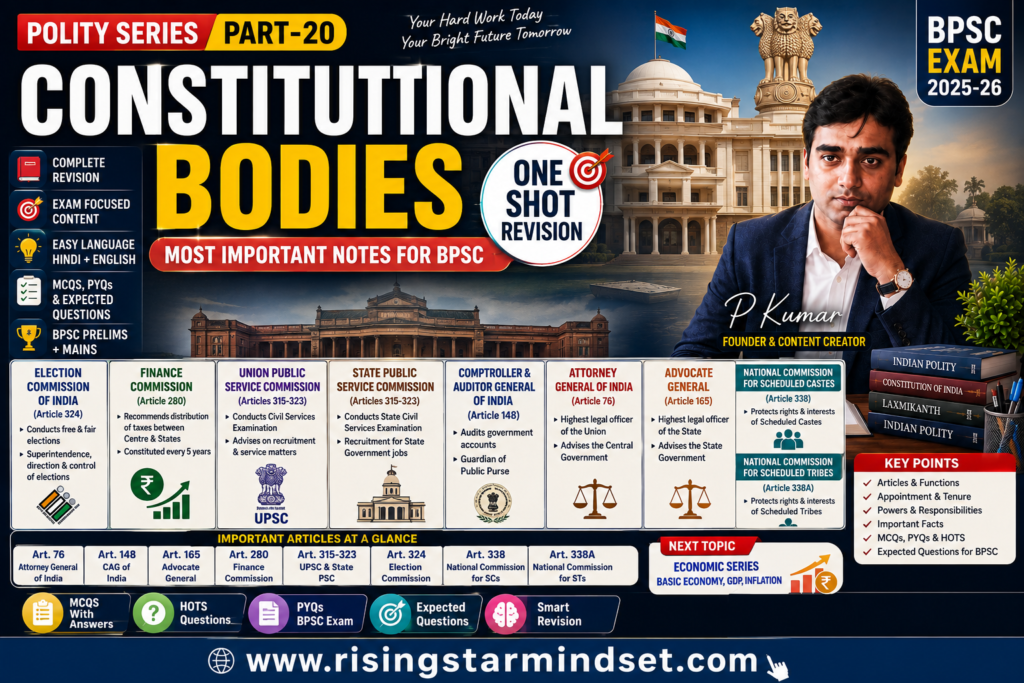
| Constitutional Body | Article |
|---|---|
| Election Commission | 324 |
| Finance Commission | 280 |
| UPSC | 315-323 |
| State PSC | 315-323 |
| CAG | 148 |
| Attorney General | 76 |
| Advocate General | 165 |
| National Commission for SC | 338 |
| National Commission for ST | 338A |
1. Election Commission of India (ECI)
Article 324
English
The Election Commission conducts free and fair elections in India.
हिंदी
भारत में स्वतंत्र एवं निष्पक्ष चुनाव कराने का कार्य निर्वाचन आयोग करता है।
Functions
- Conducts Lok Sabha Elections, Rajya Sabha Elections, State Assembly Elections, Presidential Elections, Vice-Presidential Elections
BPSC Fact
Chief Election Commissioner can be removed like a Supreme Court Judge.
2. Finance Commission
Article 280
English
Finance Commission recommends distribution of taxes between Centre and States.
हिंदी
वित्त आयोग केंद्र और राज्यों के बीच करों के वितरण की सिफारिश करता है।
Appointed By
President of India
Tenure
Every 5 years
3. Union Public Service Commission (UPSC)
Articles 315–323
Functions
- Conducts Civil Services Examination
- Advises Government on recruitment
Hindi
UPSC संघीय सेवाओं के लिए भर्ती एवं चयन करता है।
4. State Public Service Commission (SPSC)
Articles 315–323
Functions
- Conducts State Civil Services Examination
- Recruitment for State Government Jobs
Hindi
राज्य स्तरीय सरकारी नौकरियों के लिए भर्ती परीक्षा आयोजित करता है।
5. Comptroller and Auditor General (CAG)
Article 148
English
CAG audits government expenditure.
हिंदी
CAG सरकारी खर्चों का ऑडिट करता है।
Appointment
President of India
BPSC Fact
Known as “Guardian of Public Purse.”
6. Attorney General of India
Article 76
Functions
- Highest Legal Officer of India
- Advises Central Government
हिंदी
भारत सरकार का सर्वोच्च विधिक सलाहकार।
7. Advocate General
Article 165
Functions
- Highest Legal Officer of State
हिंदी
राज्य सरकार का सर्वोच्च विधिक सलाहकार।
8. National Commission for SCs
Article 338
Functions
- Protects interests of Scheduled Castes
हिंदी
अनुसूचित जातियों के हितों की रक्षा करता है।
9. National Commission for STs
Article 338A
Functions
- Protects interests of Scheduled Tribes
हिंदी
अनुसूचित जनजातियों के हितों की रक्षा करता है।
Abbreviations
| Short Form | Full Form |
|---|---|
| ECI | Election Commission of India |
| UPSC | Union Public Service Commission |
| BPSC | Bihar Public Service Commission |
| CAG | Comptroller and Auditor General |
| AGI | Attorney General of India |
| PSC | Public Service Commission |
| NCSC | National Commission for SCs |
| NCST | National Commission for STs |
Important Articles for BPSC
| Article | Topic |
|---|---|
| 76 | Attorney General |
| 148 | CAG |
| 165 | Advocate General |
| 280 | Finance Commission |
| 324 | Election Commission |
| 338 | NCSC |
| 338A | NCST |
| 315-323 | UPSC/SPSC |
Key Points for Quick Revision
| Election Commission – Article 324 |
| Finance Commission – Article 280 |
| CAG – Article 148 |
| Attorney General – Article 76 |
| Advocate General – Article 165 |
| UPSC/SPSC – Article 315-323 |
| NCSC – Article 338 |
| NCST – Article 338A |
Previous Year Type Questions (PYQs)
Q1.
Finance Commission is constituted under which Article?
Answer: Article 280
Q2.
CAG is appointed by whom?
Answer: President of India
Q3.
Election Commission is mentioned under which Article?
Answer: Article 324
Q4.
Attorney General is appointed by whom?
Answer: President of India
MCQs
1. Election Commission is established under:
A. Article 280
B. Article 324
C. Article 148
D. Article 76
✅ Answer: B
2. Finance Commission is mentioned in:
A. Article 324
B. Article 76
C. Article 280
D. Article 165
✅ Answer: C
3. CAG is provided under:
A. Article 148
B. Article 338
C. Article 280
D. Article 76
✅ Answer: A
4. UPSC is mentioned under:
A. Article 148
B. Article 315-323
C. Article 338
D. Article 280
✅ Answer: B
5. Advocate General belongs to:
A. Centre
B. State
C. Parliament
D. Judiciary
✅ Answer: B
HOTS Questions
Q1.
Why is CAG called the Guardian of Public Purse?
Answer: Because it audits government expenditure and ensures public money is spent legally and efficiently.
Q2.
Differentiate between Attorney General and Advocate General.
| Attorney General | Advocate General |
|---|---|
| Centre | State |
| Article 76 | Article 165 |
| Advises Union Govt | Advises State Govt |
Q3.
How does Election Commission strengthen democracy?
Answer: By conducting free, fair, transparent and impartial elections.
Expected Questions for BPSC 2026
Very Important
- Constitutional Bodies and their Articles.
- Functions of Election Commission.
- Composition and role of Finance Commission.
- Powers and functions of CAG.
- Difference between Attorney General and Advocate General.
- UPSC vs State PSC.
- NCSC and NCST.
- Constitutional vs Statutory Bodies.
- Appointment and removal of Chief Election Commissioner.
- Role of Constitutional Bodies in Indian Democracy.
Conclusion
English
Constitutional Bodies are the backbone of India’s democratic system. They ensure transparency, accountability, financial discipline, free elections, and protection of constitutional values. Questions from these bodies are frequently asked in BPSC Prelims and Mains.
हिंदी
संवैधानिक निकाय भारतीय लोकतंत्र की रीढ़ हैं। ये निष्पक्ष चुनाव, वित्तीय अनुशासन, जवाबदेही और संविधान के मूल्यों की रक्षा सुनिश्चित करते हैं। BPSC परीक्षा में इस अध्याय से नियमित रूप से प्रश्न पूछे जाते हैं, इसलिए इसके Articles और Functions को अवश्य याद करें।
BPSC One-Line Revision
324 → Election Commission
280 → Finance Commission
148 → CAG
76 → Attorney General
165 → Advocate General
315–323 → UPSC/SPSC
338 → NCSC
338A → NCST
Keep Learning, Keep Growing! 🚀
P Kumar | Rising Star Mindset
www.risingstarmindset.com
Together We Will Make The Difference