

Nutrition in Plants Class 7 Questions and Answers
Nutrition in Plants is one of the most important chapters of Class 7 Science. Questions from this chapter are frequently asked in school examinations, Olympiads, and scholarship tests. This post contains MCQs, Fill in the Blanks, Short Answer Questions, and Long Answer Questions for complete revision. ( Class 7 Nutrition In Plants )
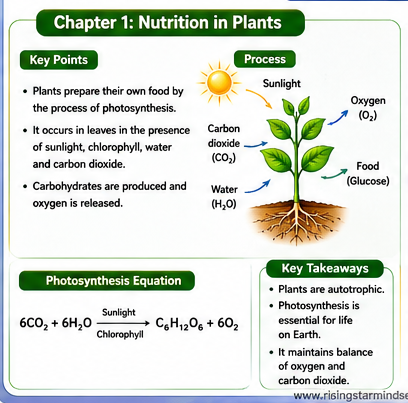
Table of Contents ( Class 7 Nutrition In Plants )
- Important MCQs
- Fill in the Blanks
- Very Short Answer Questions
- Short Answer Questions
- Long Answer Questions
- HOTS Questions
- Chapter Summary
Part A: Multiple Choice Questions (MCQs) ( Class 7 Nutrition In Plants )
Q1. The process by which green plants prepare their own food is called:
A. Respiration
B. Digestion
C. Photosynthesis
D. Transpiration
✅ Answer: C. Photosynthesis
Q2. Which pigment gives green colour to leaves?
A. Hemoglobin
B. Chlorophyll
C. Carotene
D. Melanin
✅ Answer: B. Chlorophyll
Q3. Plants take carbon dioxide from:
A. Soil
B. Water
C. Atmosphere
D. Roots
✅ Answer: C. Atmosphere
Q4. Which part of the plant absorbs water?
A. Flower
B. Stem
C. Root
D. Leaf
✅ Answer: C. Root
Q5. Cuscuta is an example of:
A. Autotroph
B. Parasite
C. Saprotroph
D. Insectivorous Plant
✅ Answer: B. Parasite
Q6. Pitcher Plant is:
A. Parasitic Plant
B. Saprotrophic Plant
C. Insectivorous Plant
D. Non-green Plant
✅ Answer: C. Insectivorous Plant
Q7. The food prepared by plants is stored mainly in the form of:
A. Protein
B. Vitamins
C. Starch
D. Minerals
✅ Answer: C. Starch
Q8. Sunlight is necessary for:
A. Germination
B. Respiration
C. Photosynthesis
D. Absorption
✅ Answer: C. Photosynthesis
Q9. Fungi obtain nutrients through:
A. Photosynthesis
B. Saprotrophic Nutrition
C. Autotrophic Nutrition
D. Symbiosis Only
✅ Answer: B. Saprotrophic Nutrition
Q10. Lichens are an example of:
A. Parasitism
B. Symbiosis
C. Saprotrophism
D. Insectivorous Nutrition
✅ Answer: B. Symbiosis
Part B: Fill in the Blanks
- Green plants are called __________ because they make their own food.
✅ Autotrophs
- The green pigment present in leaves is called __________.
✅ Chlorophyll
- Plants use __________ gas during photosynthesis.
✅ Carbon Dioxide
- Food prepared by plants is stored as __________.
✅ Starch
- Cuscuta is a __________ plant.
✅ Parasitic
- Mushrooms show __________ mode of nutrition.
✅ Saprotrophic
- Sun is the ultimate source of __________.
✅ Energy
- Rhizobium bacteria help plants by fixing __________.
✅ Nitrogen
- Plants absorb water through their __________.
✅ Roots
- The process of food making in plants is called __________.
✅ Photosynthesis
Part C: Very Short Answer Questions ( Class7 Nutrition In Plants )
Q1. What is nutrition?
Answer:
Nutrition is the process by which living organisms obtain and utilize food.
Q2. What is photosynthesis?
Answer:
Photosynthesis is the process by which green plants prepare their food using sunlight, water, carbon dioxide, and chlorophyll.
Q3. What are autotrophs?
Answer:
Organisms that prepare their own food are called autotrophs.
Q4. Name a parasitic plant.
Answer:
Cuscuta (Amarbel).
Q5. What is chlorophyll?
Answer:
Chlorophyll is the green pigment present in leaves that helps in photosynthesis.
Part D: Short Answer Questions ( Class 7 Nutrition In Plants )
Q1. Why are green plants called producers?
Answer:
Green plants produce their own food through photosynthesis. Therefore, they are called producers.
Q2. What are the raw materials required for photosynthesis?
Answer:
- Water
- Carbon Dioxide
- Sunlight
- Chlorophyll
Q3. Explain saprotrophic nutrition.
Answer:
In saprotrophic nutrition, organisms obtain nutrients from dead and decaying matter by secreting digestive juices and absorbing dissolved nutrients.
Examples: Mushroom and Fungi.
Q4. What is symbiotic relationship?
Answer:
A relationship in which two organisms live together and benefit each other is called symbiosis.
Example:
Lichen (Algae + Fungus)
Q5. Why do insectivorous plants trap insects?
Answer:
They trap insects to obtain nitrogen because they grow in nitrogen-deficient soil.
Part E: Long Answer Questions ( Class 7 Nutrition In Plants )
Q1. Explain the process of photosynthesis.
Answer:
Photosynthesis is the process by which green plants prepare food.
Steps:
- Roots absorb water from soil.
- Leaves take carbon dioxide from air.
- Chlorophyll captures sunlight.
- Food (glucose) is prepared.
- Oxygen is released into the atmosphere.
Photosynthesis helps maintain oxygen balance on Earth.
Q2. Differentiate between Autotrophic and Heterotrophic Nutrition.
| Autotrophic Nutrition | Heterotrophic Nutrition |
|---|---|
| Organisms make their own food | Organisms depend on others for food |
| Requires chlorophyll | Chlorophyll not required |
| Example: Green Plants | Example: Animals |
Q3. Describe different modes of nutrition in plants.
Answer:
Autotrophic Nutrition
Plants prepare their own food.
Parasitic Nutrition
Plants obtain food from host plants.
Example: Cuscuta
Saprotrophic Nutrition
Food obtained from dead organisms.
Example: Mushroom
Insectivorous Nutrition
Plants trap insects for nutrients.
Example: Pitcher Plant
Symbiotic Nutrition
Two organisms benefit each other.
Example: Lichen
Part F: HOTS (Higher Order Thinking Skills)
Q1. Why can’t a plant survive without sunlight?
Answer:
Without sunlight, photosynthesis cannot occur. Therefore, the plant cannot prepare food and may eventually die.
Q2. Why are plants considered the foundation of all food chains?
Answer:
Plants are producers. They provide food directly or indirectly to all living organisms.
Q3. What would happen if all green plants disappeared from Earth?
Answer:
- Oxygen level would decrease.
- Food chains would collapse.
- Most living organisms would not survive.
- Ecological balance would be disturbed.
Chapter Summary ( Class 7 Nutrition In Plants )
Plants prepare food through photosynthesis.
Chlorophyll helps capture sunlight.
Carbon dioxide and water are raw materials for photosynthesis.
Plants are called producers.
Cuscuta is a parasitic plant.
Mushroom shows saprotrophic nutrition.
Pitcher plant is insectivorous.
Lichen represents symbiosis.
Photosynthesis releases oxygen into the atmosphere.
Conclusion (Class 7 Nutrition In Plants )
Mastering the “Nutrition in Plants” chapter is essential for building a strong foundation in Biology. Practice these MCQs, Fill in the Blanks, and Question-Answers regularly to score higher marks in examinations and competitive tests.
🌟 For more Class 7 Science Notes, MCQs, One-Shot Revision, Worksheets, Previous Year Questions, and Exam-Oriented Study Materials, keep visiting www.risingstarmindset.com regularly and continue your learning journey with Rising Star Mindset.
Keep Learning, Keep Growing! 🚀
P Kumar | Rising Star Mindset
www.risingstarmindset.com
Together We Will Make The Difference
2 thoughts on “Class 7 Nutrition In Plants Important Questions And Answers”