
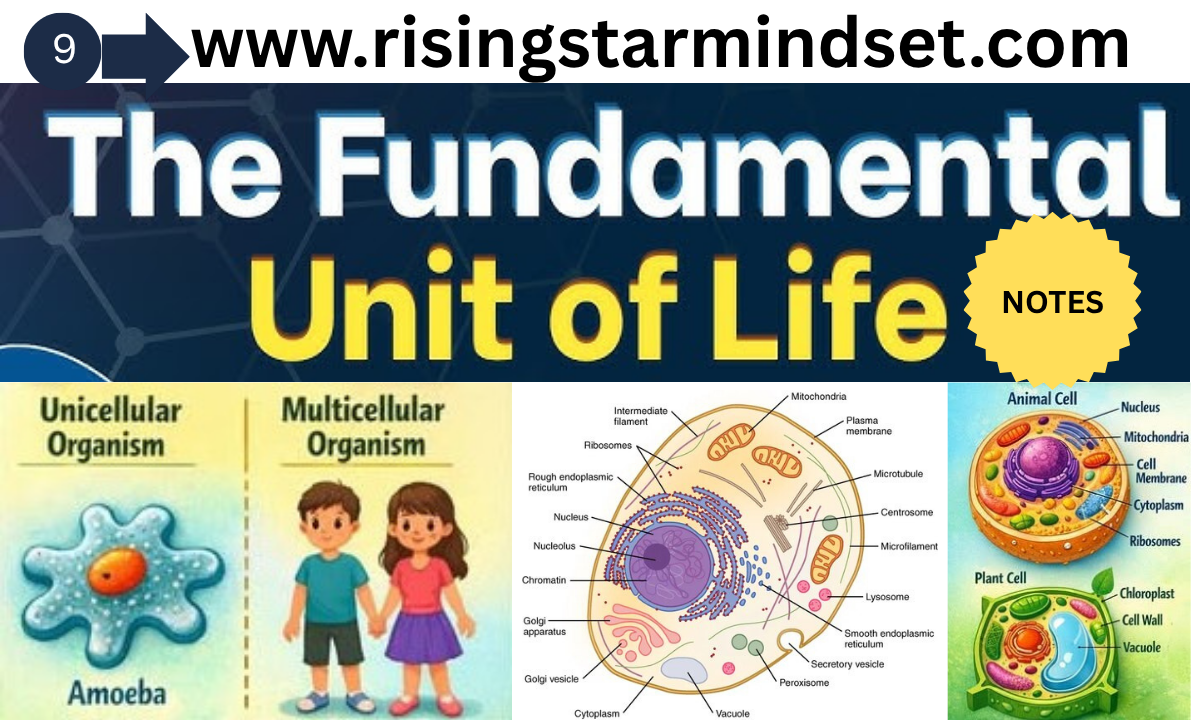
The Fundamental Unit of Life – Introduction
All living organisms are made up of tiny units called cells.
A cell is known as the basic structural and functional unit of life. (The Fundamental Unit of Life)
हिंदी में:
सभी जीवित प्राणी छोटी-छोटी इकाइयों से बने होते हैं जिन्हें कोशिका (Cell) कहा जाता है।
कोशिका जीवन की संरचनात्मक एवं क्रियात्मक इकाई कहलाती है।
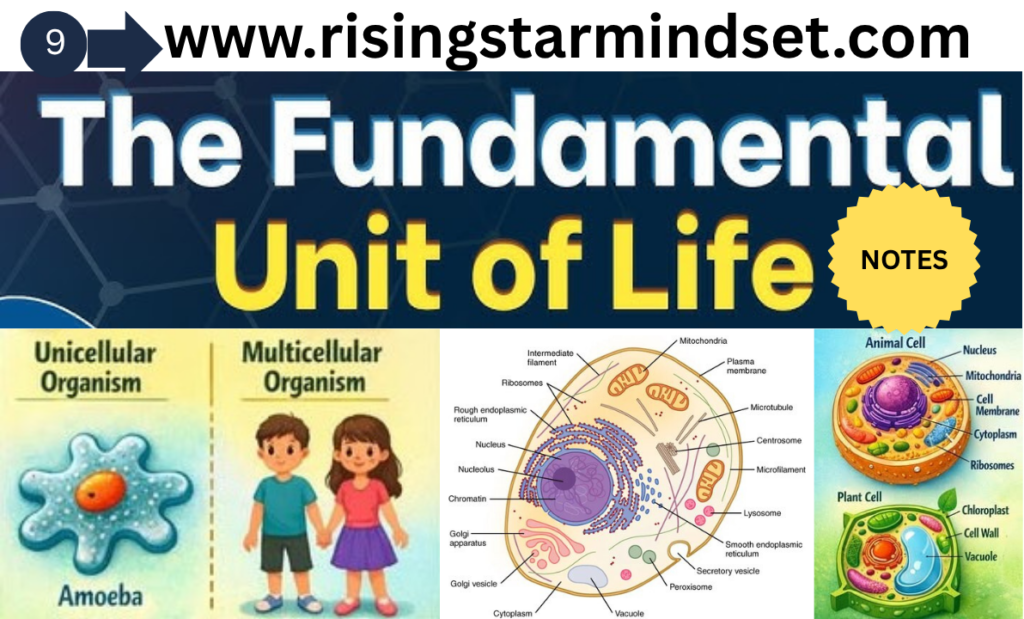
What is a Cell?
A cell performs all important life processes such as:
- Respiration
- Nutrition
- Excretion
- Growth
- Reproduction
हिंदी में:
कोशिका जीवन की सभी आवश्यक क्रियाएँ करती है जैसे:
- श्वसन
- पोषण
- उत्सर्जन
- वृद्धि
- प्रजनन
Discovery of Cell
In 1665, Robert Hooke observed a thin slice of cork under a microscope and found small box-like structures. He named them “Cells”.
हिंदी में:
1665 में रॉबर्ट हुक ने कॉर्क को माइक्रोस्कोप में देखा और छोटे-छोटे खाने जैसे ढाँचे पाए जिन्हें उन्होंने “Cell” नाम दिया।
Living Cells Discovery
Antonie van Leeuwenhoek was the first scientist who observed living cells.
हिंदी में:
एंटोनी वॉन ल्यूवेनहॉक ने पहली बार जीवित कोशिकाओं को देखा।
Cell Theory
Cell theory was proposed by:
- Matthias Schleiden
- Theodor Schwann
Later modified by:
- Rudolf Virchow
Main Points of Cell Theory
- All living organisms are made up of cells.
- Cell is the basic unit of life.
- New cells arise from pre-existing cells.
हिंदी में:
कोशिका सिद्धांत के मुख्य बिंदु:
- सभी जीव कोशिकाओं से बने हैं।
- कोशिका जीवन की मूल इकाई है।
- नई कोशिकाएँ पुरानी कोशिकाओं से बनती हैं।
Types of Organisms
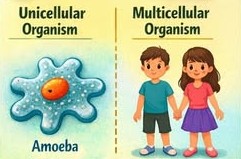
1. Unicellular Organisms
Organisms made up of only one cell.
Examples
- Amoeba
- Bacteria
- Paramecium
हिंदी में:
जो जीव केवल एक कोशिका से बने होते हैं उन्हें एककोशिकीय जीव कहते हैं।
2. Multicellular Organisms
Organisms made up of many cells.
Examples
- Human beings
- Plants
- Animals
हिंदी में:
जो जीव अनेक कोशिकाओं से बने होते हैं उन्हें बहुकोशिकीय जीव कहते हैं।
Cell Shape and Size
Cells have different shapes and sizes depending on their functions.
| Cell Type | Shape |
|---|---|
| RBC | Round |
| Nerve Cell | Long |
| Muscle Cell | Spindle-shaped |
हिंदी में:
कोशिकाओं का आकार और आकृति उनके कार्य के अनुसार अलग-अलग होता है।
Cell Structure
A cell mainly consists of:
- Cell Membrane
- Cytoplasm
- Nucleus
Cell Membrane (Plasma Membrane)
The outer covering of the cell is called cell membrane.
Functions of Cell Membrane
- Protects the cell
- Controls movement of substances
- Selectively permeable
हिंदी में:
कोशिका झिल्ली कोशिका की बाहरी परत होती है जो पदार्थों के अंदर-बाहर जाने को नियंत्रित करती है।
Diffusion
Movement of substances from higher concentration to lower concentration is called diffusion.
Example
Perfume smell spreading in a room.
हिंदी में:
अधिक सांद्रता से कम सांद्रता की ओर पदार्थों का जाना विसरण कहलाता है।
Osmosis
Movement of water through a semipermeable membrane is called osmosis.
हिंदी में:
अर्धपारगम्य झिल्ली के माध्यम से जल का संचरण परासरण कहलाता है।
Types of Solutions
1. Hypotonic Solution
Water enters the cell.
Effect
Cell swells.
हिंदी में:
इस घोल में कोशिका के अंदर पानी प्रवेश करता है।
2. Hypertonic Solution
Water moves out of the cell.
Effect
Cell shrinks.
हिंदी में:
इस घोल में कोशिका से पानी बाहर निकलता है।
3. Isotonic Solution
No net movement of water.
हिंदी में:
इस घोल में पानी का संतुलित आदान-प्रदान होता है।
Cell Wall
Cell wall is present only in plant cells.
Functions
- Gives shape
- Provides protection
- Made up of cellulose
हिंदी में:
कोशिका भित्ति पौधों की कोशिकाओं में पाई जाती है और सुरक्षा प्रदान करती है।
Cytoplasm
The jelly-like substance inside the cell is called cytoplasm.
हिंदी में:
कोशिका के अंदर पाया जाने वाला जेली जैसा पदार्थ साइटोप्लाज्म कहलाता है।
Cell Organelles and Their Functions
1. Endoplasmic Reticulum (ER)
Types
- Rough ER
- Smooth ER
Functions
- Transport of materials
- Protein synthesis
हिंदी में:
ER पदार्थों के परिवहन का कार्य करता है।
2. Ribosomes
Known as protein factories of the cell.
Function: Protein synthesis
हिंदी में:
राइबोसोम प्रोटीन बनाने का कार्य करते हैं।
3. Golgi Apparatus
Functions
- Packaging
- Storage
- Secretion
हिंदी में:
गोल्जी उपकरण पदार्थों की पैकिंग और स्राव में मदद करता है।
4. Lysosomes
Known as suicidal bags of the cell.
Function
Digest waste materials.
हिंदी में:
लाइसोसोम अपशिष्ट पदार्थों को पचाते हैं।
5. Mitochondria
Known as powerhouse of the cell.
Function
Produces energy in the form of ATP.
ATP
हिंदी में:
माइटोकॉन्ड्रिया कोशिका को ऊर्जा प्रदान करता है।
6. Plastids
Present only in plant cells.
Types of Plastids
- Chloroplast
- Chromoplast
- Leucoplast
हिंदी में:
प्लास्टिड पौधों की कोशिकाओं में पाए जाते हैं।
7. Vacuoles
Storage sacs of the cell.
Function
Store food and water.
हिंदी में:
वैक्यूल भोजन और पानी का संग्रह करते हैं।
Nucleus
The nucleus controls all activities of the cell.
Parts of Nucleus
- Nuclear membrane
- Nucleolus
- Chromosomes
हिंदी में:
केंद्रक कोशिका की सभी क्रियाओं को नियंत्रित करता है।
Chromosomes and DNA
Chromosomes carry hereditary information.
They are made up of DNA.
DNA
हिंदी में:
क्रोमोसोम आनुवंशिक जानकारी को वहन करते हैं।
Prokaryotic and Eukaryotic Cells
| Feature | Prokaryotic Cell | Eukaryotic Cell |
|---|---|---|
| Nucleus | Absent | Present |
| Size | Small | Large |
| Example | Bacteria | Plants and Animals |
Plant Cell vs Animal Cell
| Plant Cell | Animal Cell |
|---|---|
| Cell wall present | Cell wall absent |
| Plastids present | Plastids absent |
| Large vacuole | Small vacuole |
Important Abbreviations and Meanings
| Abbreviation | Full Form | Meaning |
|---|---|---|
| DNA | Deoxyribonucleic Acid | Genetic material |
| RNA | Ribonucleic Acid | Helps in protein synthesis |
| ATP | Adenosine Triphosphate | Energy currency of cell |
| ER | Endoplasmic Reticulum | Transport system |
| RER | Rough Endoplasmic Reticulum | Protein synthesis |
| SER | Smooth Endoplasmic Reticulum | Fat synthesis |
| RBC | Red Blood Cell | Carries oxygen |
| WBC | White Blood Cell | Fights diseases |
| NCERT | National Council of Educational Research and Training | Educational organization |
| CBSE | Central Board of Secondary Education | Education board |
Important NCERT Questions
Q1. Who discovered the cell?
Answer: Robert Hooke
Q2. Why is mitochondria called powerhouse of cell?
Answer: Because it produces energy in the form of ATP.
Q3. What is osmosis?
Answer: Movement of water through a semipermeable membrane.
Q4. What is the function of ribosome?
Answer: Protein synthesis.
Important Diagram Topics
Students should practice:
- Plant Cell Diagram
- Animal Cell Diagram
- Nucleus Diagram
- Osmosis Experiment
Summary of the Chapter
- Cell is the fundamental unit of life.
- Cell membrane controls movement of substances.
- Nucleus controls all cell activities.
- Mitochondria produce energy.
- Plant cells contain cell wall and plastids.
- Osmosis is movement of water through semipermeable membrane.
Conclusion
The chapter “The Fundamental Unit of Life” is one of the most important chapters of Class 9 Science. It helps students understand the structure and functions of cells which are the building blocks of life.
हिंदी में:
यह अध्याय कोशिका की संरचना और कार्यों को समझने में मदद करता है। कोशिका सभी जीवित प्राणियों का आधार है।