
INTRODUCTION ( CLASS 7 CH-02)
Acids, Bases and Salts are important topics for class 7 in science because they help students understand many daily life reactions. For example, lemon contains acid, while soap contains base. Therefore, learning about acids, bases, and salts becomes very interesting and useful.
In this chapter, students will learn the properties of acids and bases, indicators, neutralization reactions, and their uses in daily life. Moreover, simple examples and memory tricks make this topic easier to understand.
🧪Acids, Bases and Salts class 7
🔹 1. What are Acids? ( class 7 )
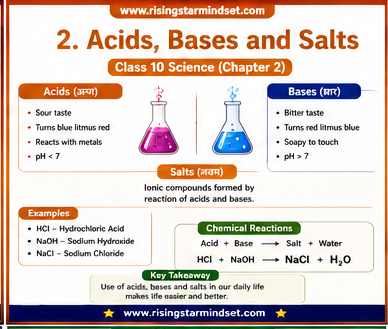
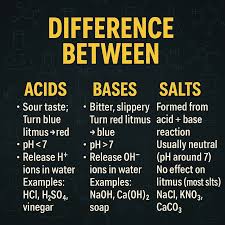
Acids are substances that have a sour taste.
Examples:
- Lemon juice
- Vinegar
Properties of Acids:
- Sour in taste
- Turn blue litmus paper → red
- Can react with metals to produce hydrogen gas
🔹 2. What are Bases? (class 7 )
Bases are substances that have a bitter taste and feel soapy/slippery.
Examples:
- Soap solution
- Baking soda
Properties of Bases:
- Bitter in taste
- Turn red litmus paper → blue
- Feel slippery
👉 Bases that dissolve in water are called Alkalis.
🔹 3. What are Salts? ( class 7 )
Salts are formed when an acid reacts with a base. This reaction is called Neutralization.
Example:
Acid + Base → Salt + Water
Example:
Hydrochloric acid + Sodium hydroxide → Sodium chloride (salt) + Water
🔹 4. Indicators
Indicators are substances that change color to show whether something is acidic or basic.
TYPES
- Litmus (most common)
- Turmeric
- China rose
🔹 5. Neutralization in Daily Life
- Antacids help reduce acidity in the stomach
- Toothpaste is basic, helps neutralize acids in mouth
🧪 अम्ल, क्षार और लवण (Hindi) ( class 7 )
🔹 1. अम्ल (Acids) क्या होते हैं?
अम्ल वे पदार्थ होते हैं जिनका स्वाद खट्टा होता है।
उदाहरण:
- नींबू का रस
- सिरका
गुण:
- खट्टा स्वाद
- नीला लिटमस → लाल कर देते हैं
- धातु के साथ अभिक्रिया करते हैं
🔹 2. क्षार (Bases) क्या होते हैं? ( class 7 )
क्षार वे पदार्थ होते हैं जिनका स्वाद कड़वा होता है और छूने पर चिकने/फिसलन वाले लगते हैं।
उदाहरण:
- साबुन
- बेकिंग सोडा
गुण:
- कड़वा स्वाद
- लाल लिटमस → नीला कर देते हैं
- फिसलन वाले होते हैं
👉 जो क्षार पानी में घुल जाते हैं, उन्हें क्षारीय (Alkali) कहते हैं।
🔹 3. लवण (Salts) क्या होते हैं?
जब अम्ल और क्षार की अभिक्रिया होती है, तब लवण बनता है। इसे उदासीनीकरण (Neutralization) कहते हैं।
उदाहरण:
अम्ल + क्षार → लवण + पानी
🔹 4. संकेतक (Indicators)
संकेतक ऐसे पदार्थ होते हैं जो रंग बदलकर बताते हैं कि पदार्थ अम्लीय है या क्षारीय।
उदाहरण:
- लिटमस
- हल्दी
- गुड़हल (China rose)
🔹 5. दैनिक जीवन में उपयोग
- एंटासिड पेट की अम्लता कम करते हैं
- टूथपेस्ट अम्ल को निष्क्रिय करता है
🔹 Key Points
- Acids → Sour, turn blue litmus red
- Bases → Bitter, turn red litmus blue
- Alkali → Base soluble in water
- Salt → Formed by neutralization
🔹 🧪 Simple Diagram (Reaction)
Acid + Base → Salt + Water
(HCl) (NaOH) (NaCl)
👉 This process is called Neutralization
🔹 🧠 Memory Trick
- A → Acid → Angry → Red (litmus turns red)
- B → Base → Blue
🔹 🔍 Indicators Table
| Indicator | Acid | Base |
| Litmus | Red | Blue |
| Turmeric | No change | Reddish |
| China Rose | Dark pink | Green |
📘 ✨ नोट्स (Hindi)
🔹 मुख्य बिंदु
- अम्ल → खट्टा, नीला लिटमस लाल करता है
- क्षार → कड़वा, लाल लिटमस नीला करता है
- क्षारीय (Alkali) → पानी में घुलने वाला क्षार
- लवण → उदासीनीकरण से बनता है
🔹 🧪 अभिक्रिया चित्र
अम्ल + क्षार → लवण + पानी
👉 इसे उदासीनीकरण कहते हैं
🔹 🧠 याद रखने की ट्रिक
- A = Acid = Red
- B = Base = Blue
3 thoughts on “Acids, Bases and Salts Notes in English and Hindi | Class 7 Science Chapter”