Gandhi Jayanti 2026: 157th Birth Anniversary, Timeline, 10 Quotes & Legacy
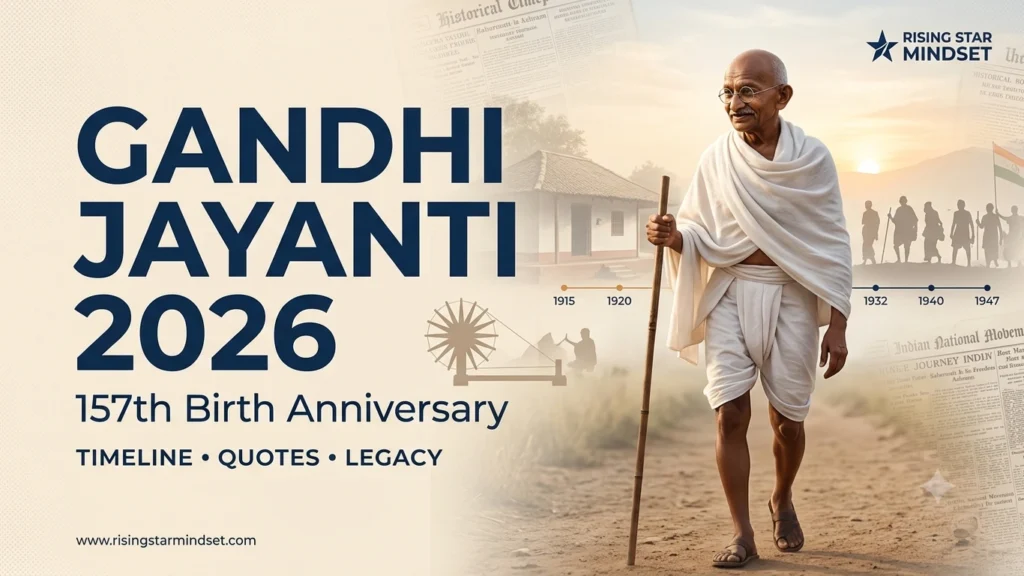
Gandhi Jayanti 2026 is observed on October 2, 2026, marking the 157th birth anniversary of Mahatma Gandhi, who was born on October 2, 1869, in Porbandar, Gujarat. The day is remembered in India for Gandhi’s role in the freedom movement and for the ideas of truth, non-violence, Satyagraha, self-discipline and service associated with his public life. The Government of India has also highlighted the continuing relevance of his message of peace and non-violence.
But Gandhi Jayanti can be understood as more than a day for speeches, posters and quotations.
It is also an opportunity to look at how a political and social movement developed over time, how ordinary people became part of major campaigns, and why Gandhi’s ideas were discussed far beyond India.
गांधी जयंती 2026 का अर्थ | Gandhi Jayanti 2026 in Hindi
गांधी जयंती 2026 महात्मा गांधी की 157वीं जयंती के रूप में 2 अक्टूबर को मनाई जा रही है। गांधी जी के सार्वजनिक जीवन को समझने के लिए केवल उनके प्रसिद्ध नारों को याद करना पर्याप्त नहीं है। उनके जीवन में सत्य, अहिंसा, सत्याग्रह, स्वदेशी, आत्म-अनुशासन, सेवा और जनभागीदारी जैसे विचार व्यवहार और आंदोलनों से जुड़े हुए थे।
इसीलिए गांधी जयंती विद्यार्थियों के लिए इतिहास, नागरिक शास्त्र, नैतिक शिक्षा और सामान्य ज्ञान—इन सभी विषयों को जोड़ने वाला एक उपयोगी अवसर बन सकती है।
RELATED POST : Quit India Day 2026: Why Is 8 August Important?
Gandhi Jayanti 2026: Quick Facts
| Topic | Details |
| Occasion | Gandhi Jayanti |
| Date | October 2, 2026 |
| Birth | October 2, 1869 |
| Birthplace | Porbandar, Gujarat |
| Anniversary in 2026 | 157th birth anniversary |
| Known for | Satyagraha, non-violence and mass mobilisation |
| Major Indian campaigns | Champaran, Non-Cooperation, Civil Disobedience, Quit India |
| Famous 1930 event | Dandi March |
| United Nations observance | International Day of Non-Violence |
| Gandhi’s death | January 30, 1948 |
October 2 is also observed internationally as the International Day of Non-Violence, established by a United Nations General Assembly resolution in 2007.
Who Was Mahatma Gandhi? (Gandhi Jayanti 2026)
Mohandas Karamchand Gandhi became one of the most influential figures of India’s freedom movement.
His political method was closely associated with Satyagraha, a form of resistance that placed emphasis on truth, non-violence, discipline and willingness to face suffering rather than respond with physical violence.
However, Gandhi’s public life was not limited to political campaigns.
He also worked on issues such as:
- village development
- Khadi and Swadeshi
- social reform
- communal harmony
- removal of untouchability
- education
- sanitation
- self-reliance
- constructive work
His approach therefore connected political freedom with questions about how people should live and participate in society.
Gandhi’s Freedom Struggle Timeline: 1915–1947
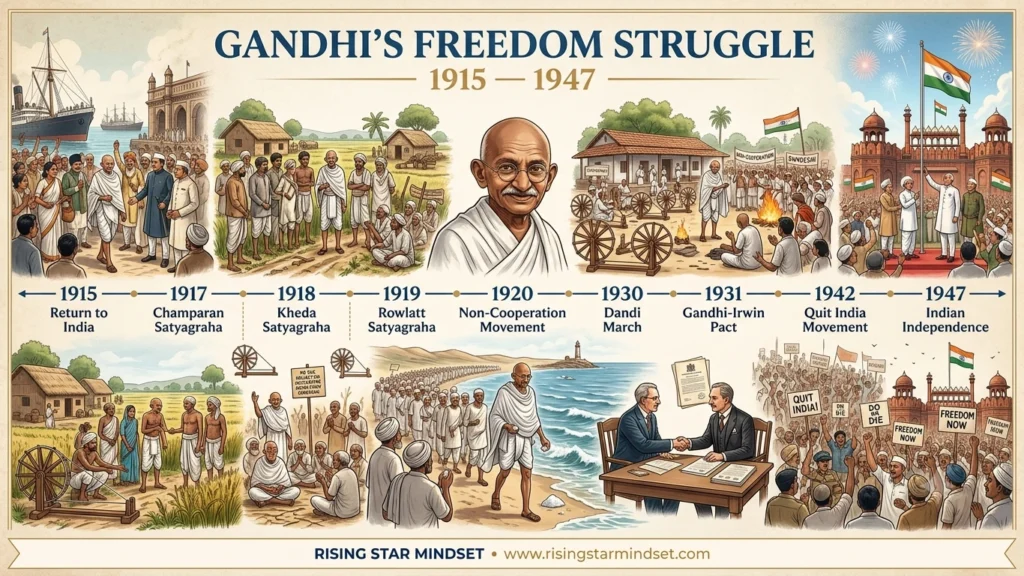
The following timeline focuses mainly on Gandhi’s major activities in India’s freedom movement.
| Year | Event | Why It Matters |
| 1915 | Gandhi returned to India | Began the next major phase of his public life in India |
| 1917 | Champaran Satyagraha | One of Gandhi’s important early Satyagrahas in India, connected with indigo cultivators in Bihar |
| 1918 | Ahmedabad Mill Workers’ Satyagraha | Gandhi became involved in a labour dispute and advocated a non-violent method |
| 1918 | Kheda Satyagraha | Peasants’ grievances over revenue demands became a major issue |
| 1919 | Rowlatt Satyagraha | Gandhi organised an all-India protest against the Rowlatt legislation |
| 1920–22 | Non-Cooperation Movement | Boycott and non-cooperation became major instruments of the national movement |
| 1922 | Chauri Chaura | After violence occurred, Gandhi withdrew the Non-Cooperation Movement |
| 1929 | Complete Independence resolution | The demand for complete independence gained formal prominence in the Congress movement |
| 1930 | Dandi March | Gandhi began the Salt March from Ahmedabad to Dandi, challenging the salt law |
| 1930–31 | Civil Disobedience Movement | Salt became a powerful symbol of resistance to colonial rule |
| 1931 | Gandhi-Irwin Pact | Gandhi and the British administration reached an agreement before the Round Table Conference |
| 1932 | Yeravada fast | Gandhi undertook a fast in connection with the issue of separate electorates for the Depressed Classes |
| 1940 | Individual Satyagraha | Gandhi supported a limited form of individual civil disobedience |
| 1942 | Quit India Movement | The Congress passed the Quit India resolution in August 1942 |
| 1942–44 | Imprisonment | Gandhi was detained at Aga Khan Palace following the Quit India movement |
| 1946 | Communal harmony efforts | Gandhi travelled extensively amid communal tensions |
| 1947 | Independence and Partition | India became independent while Partition brought widespread violence and displacement |
| 1948 | Gandhi’s assassination | Gandhi died on January 30, 1948 |
Government of India’s Rajghat chronology records key events including Champaran in 1917, Ahmedabad and Kheda in 1918, Non-Cooperation in 1920–21, the Dandi March in 1930 and Quit India in 1942.
A useful point for students ( Gandhi Jayanti 2026 )
Gandhi’s freedom struggle was not one continuous movement with one method.
Different periods involved different forms of action—Satyagraha, non-cooperation, civil disobedience, negotiations, constructive programmes, fasting and social mobilisation.
This is an important distinction when studying the freedom movement.
10 Famous Gandhi Quotes and Their Meaning
Gandhi’s writings and speeches contain a large number of statements on truth, non-violence, service, peace and social responsibility. Some frequently circulated internet quotations have uncertain attribution, so it is better to use quotations that can be traced to Gandhi-related publications and collections.
1. “My life is my message.” ( Gandhi Jayanti 2026 )
This short statement captures an important feature of Gandhi’s public philosophy: actions should support the values a person claims to believe in.
The phrase appears in Gandhi-related publications from Navajivan and in accounts of his interactions with others.
2. “An ounce of practice is more than tons of preaching.”
Meaning: Practical action can be more meaningful than simply giving advice.
For students, the lesson is simple: learning becomes valuable when it is applied.
The statement is attributed to Gandhi’s Young India, June 25, 1931.
3. “Truth never damages a cause that is just.”
Meaning: Gandhi placed truth at the centre of his ethical thinking and believed that truth should not be abandoned merely because it is difficult.
This statement appears in Gandhi’s writings on Truth.
4. “The best way to find yourself is to lose yourself in the service of others.”
Meaning: Service can help a person develop empathy, responsibility and a stronger sense of purpose.
This quotation is reproduced in Gandhi-related educational publications.
5. “You must not lose faith in humanity.”
Gandhi connected this idea with his belief that the mistakes or wrongdoing of some individuals should not automatically destroy one’s faith in humanity as a whole.
6. “A ‘No’ uttered from the deepest conviction is better than a ‘Yes’ merely uttered to please.”
Meaning: A decision made honestly can be more valuable than agreeing simply because of social pressure.
This idea is particularly relevant to students learning how to develop independent judgment.
7. “Earth provides enough to satisfy every man’s needs, but not every man’s greed.”
This statement is often discussed in relation to Gandhi’s ideas about consumption, resources and human needs.
8. “The day the power of love overrules the love of power, the world will know peace.”
The statement reflects the importance Gandhi attached to replacing domination and violence with values associated with peace and human relationships.
9. “There are many causes I would die for. There is not a single cause I would kill for.”
This statement strongly expresses the distinction Gandhi made between commitment to a cause and the use of violence.
10. “In a gentle way, you can shake the world.”
This line is associated with Gandhi’s approach to peaceful action and moral courage and is reproduced in Gandhi-related publications.
What connects these 10 quotes? ( Gandhi Jayanti 2026 )
They are not simply motivational sentences.
Together, they point toward several recurring ideas:
Truth → Practice → Service → Self-discipline → Humanity → Peace → Responsible action
That connection makes the quotations more useful for students than presenting them as an isolated list.
What Did Other Famous Leaders and Thinkers Say About Gandhi? ( Gandhi Jayanti 2026 )
Gandhi’s influence was discussed by people from India and abroad. Their comments also show that his personality and methods were interpreted in different ways.
1. Albert Einstein on Gandhi
Einstein wrote about Gandhi on the occasion of his 70th birthday in 1939:
“Generations to come, will scarce believe, that such a man as this one, ever in flesh and blood walked upon this earth.”
The quotation appears in collections of Einstein’s writings and Gandhi-related archival material.
Einstein’s observation is notable because it presents Gandhi not simply as an Indian political figure but as a person whose influence had wider significance.
2. Jawaharlal Nehru on Gandhi
After Gandhi’s assassination on January 30, 1948, Nehru addressed the nation and famously began:
“The light has gone out of our lives…”
Nehru then explained that the “light” associated with Gandhi represented enduring truth and guidance. The Nehru Archive preserves the 1948 broadcast and related documents.
3. Martin Luther King Jr. on Gandhi
Martin Luther King Jr. studied Gandhi’s approach to non-violent resistance and later described Gandhi as the “guiding light” of the technique of nonviolent social change used by his movement.
King’s own writings explain the distinction he saw between the spiritual inspiration he associated with Christianity and the method of nonviolent resistance he learned from Gandhi.
4. Rabindranath Tagore on Gandhi
Tagore and Gandhi were close associates, although they disagreed on several political, social and economic questions.
In his essay “Gandhi the Man,” Tagore wrote that Gandhi was greater as a human being than as a politician, organiser, leader or moral reformer because these activities did not limit his humanity.
Tagore’s relationship with Gandhi is therefore particularly useful for students because it shows that respect and intellectual disagreement can exist together.
5. Sarojini Naidu on Gandhi ( Gandhi Jayanti 2026 )
Sarojini Naidu, a major figure in India’s freedom movement, described Gandhi as the “high priest or honoured guru” of the Satyagraha movement.
Her description reflects the personal respect with which Gandhi was viewed by several colleagues within the national movement.
Gandhi’s Personality: What Made His Leadership Distinct? ( Gandhi Jayanti 2026 )
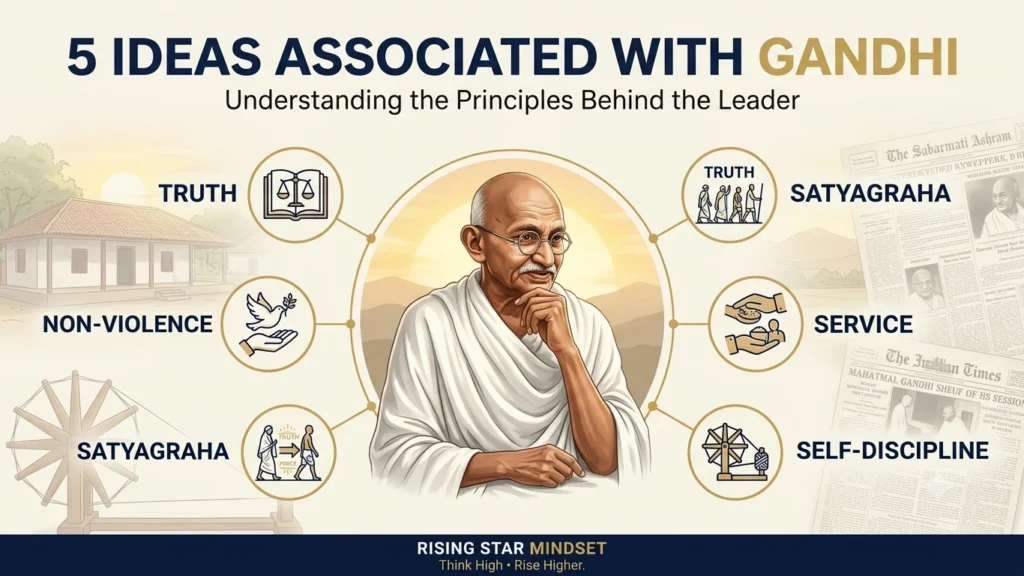
Instead of reducing Gandhi’s personality to a few adjectives, we can examine recurring characteristics visible in his public life.
1. Personal discipline
He often tried to connect his personal behaviour with the principles he publicly advocated.
2. Simplicity
His clothing, food habits, lifestyle and use of the spinning wheel became part of his public communication.
3. Willingness to negotiate
Gandhi could oppose the colonial government while also entering negotiations when he considered dialogue useful.
4. Mass communication
He developed ways to communicate political ideas through symbols and everyday issues such as salt, cloth and village life.
5. Moral pressure
Fasting and voluntary suffering became part of his political and social vocabulary.
6. Willingness to stop a movement
The withdrawal of the Non-Cooperation Movement after the Chauri Chaura violence is an important historical example. Gandhi considered non-violence central to the character of the movement.
Gandhi and the Salt March: Why Did Salt Become So Important?
The Dandi March of 1930 is one of the most recognisable events associated with Gandhi.
On March 12, 1930, Gandhi began the march from Ahmedabad with 78 ashramites and others. He reached Dandi and broke the salt law on April 6.
Why salt?
Because salt was an everyday necessity.
This transformed an apparently simple commodity into a powerful symbol of a much larger political issue.
The lesson for students
A successful public movement does not always begin with a complicated symbol.
Sometimes an ordinary object can communicate a complicated issue in a way that millions of people understand.
Gandhi and Students: What Can We Learn Today?
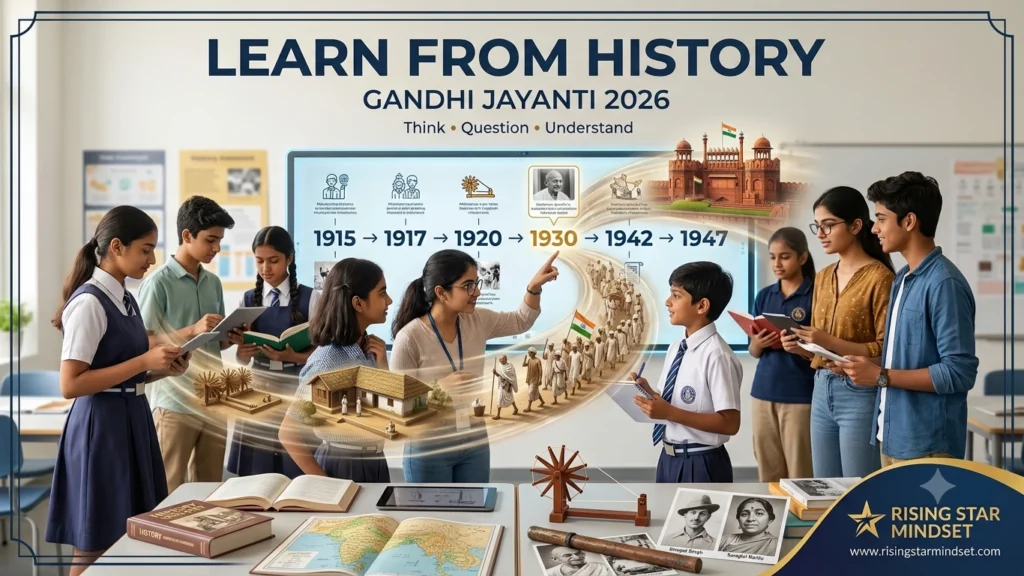
Gandhi’s historical methods cannot simply be copied into modern life. However, some underlying lessons can still be discussed.
Lesson 1: Think before reacting
A disagreement does not always need an aggressive response.
Lesson 2: Practice what you believe
Values become meaningful when they influence behaviour.
Lesson 3: Learn to say “No”
Students need the confidence to reject cheating, bullying and harmful peer pressure.
Lesson 4: Service develops responsibility
Helping others can develop empathy and leadership.
Lesson 5: Simplicity can improve focus
A simpler routine can reduce unnecessary distractions.
Lesson 6: Disagreement does not require hatred
Gandhi’s relationship with Tagore demonstrates that people can respect one another while disagreeing on important questions.
A Gandhi Jayanti Activity for Students
“One Principle, One Action”
Instead of simply writing an essay about Gandhi, students can choose one principle and connect it with one practical action.
| Gandhi-related idea | Student action |
| Truth | Avoid copying homework |
| Non-violence | Resolve one disagreement calmly |
| Service | Help someone without expecting a reward |
| Simplicity | Reduce unnecessary screen time for one day |
| Cleanliness | Improve one shared space |
| Self-discipline | Complete one task without procrastination |
| Respect | Listen carefully to another person’s opinion |
This converts Gandhi Jayanti from a memorisation exercise into a small learning activity.
Gandhi Jayanti 2026 and the International Day of Non-Violence
October 2 has significance beyond India.
The United Nations observes October 2 as the International Day of Non-Violence. The UN General Assembly established the observance in 2007 to disseminate the message of non-violence.
This gives October 2 a broader international context: Gandhi’s legacy is discussed not only through India’s independence movement but also through questions of peaceful conflict resolution and non-violent action.
Gandhi Jayanti 2026: Important Facts for Exams
- Mahatma Gandhi was born on October 2, 1869.
- His birthplace was Porbandar, Gujarat.
- He returned to India in 1915.
- Champaran Satyagraha took place in 1917.
- Ahmedabad and Kheda became important Satyagraha campaigns in 1918.
- The Rowlatt Satyagraha was associated with 1919.
- The Non-Cooperation Movement began in 1920.
- The Dandi March began on March 12, 1930.
- Gandhi reached Dandi and broke the salt law on April 6, 1930.
- The Quit India resolution was passed on August 8, 1942.
- Gandhi was assassinated on January 30, 1948.
- October 2 is observed by the United Nations as the International Day of Non-Violence.
The Government of India’s Gandhi chronology provides the dates and events used for the major timeline above.
Gandhi Jayanti 2026: Frequently Asked Questions
When is Gandhi Jayanti 2026?
Gandhi Jayanti 2026 is observed on October 2, 2026.
Which birth anniversary of Mahatma Gandhi is celebrated in 2026?
2026 marks Gandhi’s 157th birth anniversary.
Where was Mahatma Gandhi born?
Gandhi was born in Porbandar, Gujarat, on October 2, 1869.
Why is October 2 also important internationally?
The United Nations observes October 2 as the International Day of Non-Violence.
What was Gandhi’s main method of political resistance?
Satyagraha and non-violent resistance were central to Gandhi’s political method.
Which was Gandhi’s first major Satyagraha in India?
The Champaran Satyagraha of 1917 is generally identified as one of Gandhi’s first major Satyagrahas in India.
When was the Dandi March?
The Dandi March began on March 12, 1930, and Gandhi reached Dandi on April 6, 1930.
When did the Quit India Movement begin?
The Quit India resolution was passed on August 8, 1942, at Bombay. Gandhi was arrested the following day.
What is Gandhi’s most famous message?
One of the best-known statements associated with Gandhi is “My life is my message.”
Gandhi Jayanti 2026: Key Takeaways
Gandhi Jayanti is not only about remembering a historical personality.
It provides an opportunity to understand:
- how India’s freedom movement developed;
- how Satyagraha became a political method;
- why the Salt March became a powerful symbol;
- how mass participation changed the freedom struggle;
- how Gandhi connected political freedom with social responsibility;
- why his ideas influenced figures outside India;
- and how historical ideas can be examined critically rather than simply memorised.
The Government of India continues to mark Gandhi’s birth anniversary while emphasising values such as peace, non-violence, empathy and inclusion.
Conclusion: Remembering Gandhi Beyond a Single Day
Gandhi Jayanti 2026 can be remembered through photographs, speeches and famous quotations. However, history becomes more meaningful when we look beyond a single date.
The timeline from Champaran to Dandi and from Non-Cooperation to Quit India shows how India’s freedom struggle developed through different phases.
The quotations attributed to Gandhi reveal recurring themes of truth, practice, service, humanity and non-violence. The words of Einstein, Nehru, King, Tagore and Sarojini Naidu show that Gandhi’s personality and methods were interpreted and discussed by people with very different backgrounds.
For students, perhaps the most useful approach is not to simply ask, “What did Gandhi say?”
A better historical question is:
“What did Gandhi do, why did he choose those methods, what happened as a result, and what can we learn by studying that history?”
That is where Gandhi Jayanti becomes more than a celebration—it becomes a lesson in history, leadership, responsibility and human behaviour.
🌐 Website: www.risingstarmindset.com