
Mauryan Empire: Rise, Administration, Ashoka and Decline | Ancient Indian History Part 2
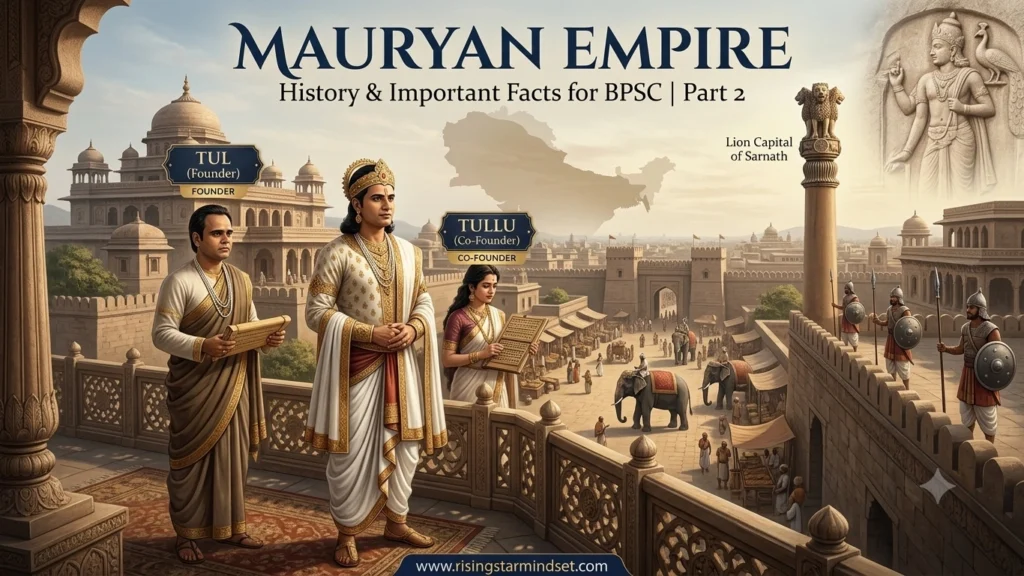
The Mauryan Empire was one of the largest and most powerful empires of ancient India. It played a major role in the political, administrative, economic and cultural development of the Indian subcontinent.
From Chandragupta Maurya to Ashoka, the Mauryan period witnessed the rise of a powerful centralized state, an organized administrative system, economic development, military expansion and the spread of Buddhism.
इस लेख में हम Mauryan Empire (मौर्य साम्राज्य) को आसान English और Hindi explanation के साथ समझेंगे। यह topic BPSC, UPSC, SSC, Railway, State PCS और अन्य competitive examinations के लिए बहुत महत्वपूर्ण है।
Ancient Indian History Series:
Part 1 – Ancient Indian History: One Post for Complete Preparation
Part 2 – Mauryan Empire: Rise, Administration, Ashoka and Decline
📌 इस Part में क्या-क्या पढ़ेंगे?
- Mauryan Empire – Introduction
- Rise of the Mauryan Empire
- Chandragupta Maurya
- Chanakya / Kautilya
- Chandragupta Maurya and Seleucus
- Mauryan Administration
- Economic System
- Army and Military Organization
- Bindusara
- Ashoka the Great
- Kalinga War
- Ashoka’s Dhamma
- Ashokan Edicts
- Spread of Buddhism
- Mauryan Art and Architecture
- Mauryan Economy and Society
- Decline of the Mauryan Empire
- Important Mauryan Rulers
- Important Facts for BPSC
- MCQs
- Short Answer Questions
- HOTS Questions
- Fill in the Blanks
- Match the Following
- FAQs
- Quick Revision
1. Mauryan Empire – Introduction
English Explanation
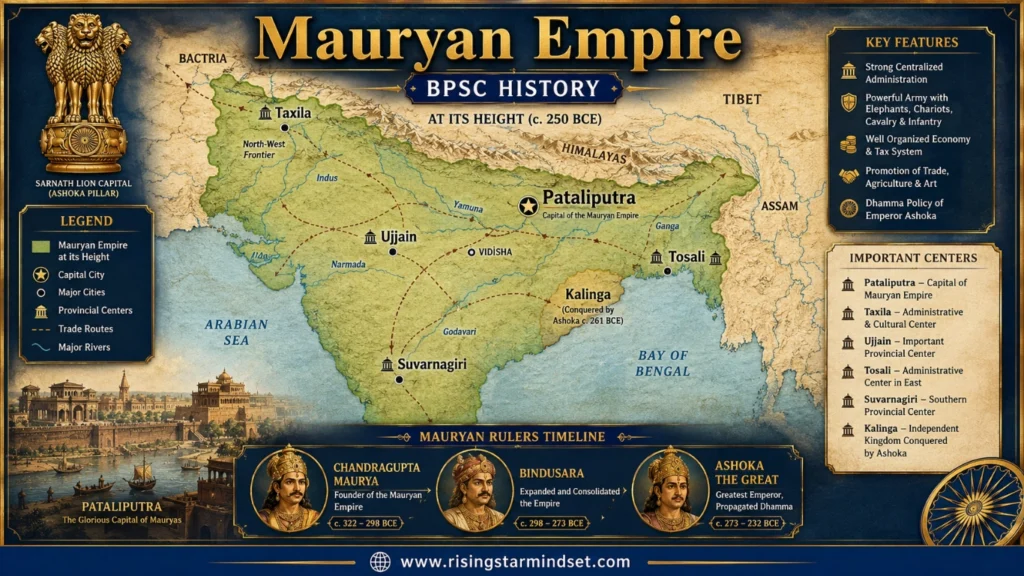
The Mauryan Empire was one of the earliest large-scale empires in Indian history. It was founded by Chandragupta Maurya around 322 BCE.
The empire initially rose in the region of Magadha and gradually expanded across a large part of the Indian subcontinent.
The Mauryan Empire reached its greatest territorial extent under Ashoka.
हिंदी में समझिए
मौर्य साम्राज्य प्राचीन भारत के सबसे शक्तिशाली और विशाल साम्राज्यों में से एक था।
इसकी स्थापना लगभग 322 ईसा पूर्व में चंद्रगुप्त मौर्य ने की थी। इसका प्रारंभिक केंद्र मगध था।
बाद में मौर्य साम्राज्य का विस्तार बहुत बड़े क्षेत्र में हुआ और सम्राट अशोक के समय यह अपने सबसे बड़े क्षेत्रीय विस्तार तक पहुँचा।
Important Facts
- Founder – Chandragupta Maurya
- Capital – Pataliputra
- Important adviser – Chanakya / Kautilya
- Major rulers – Chandragupta Maurya, Bindusara, Ashoka
- Greatest territorial expansion – Ashoka
- Last Mauryan ruler – Brihadratha
2. Rise of the Mauryan Empire
English Explanation
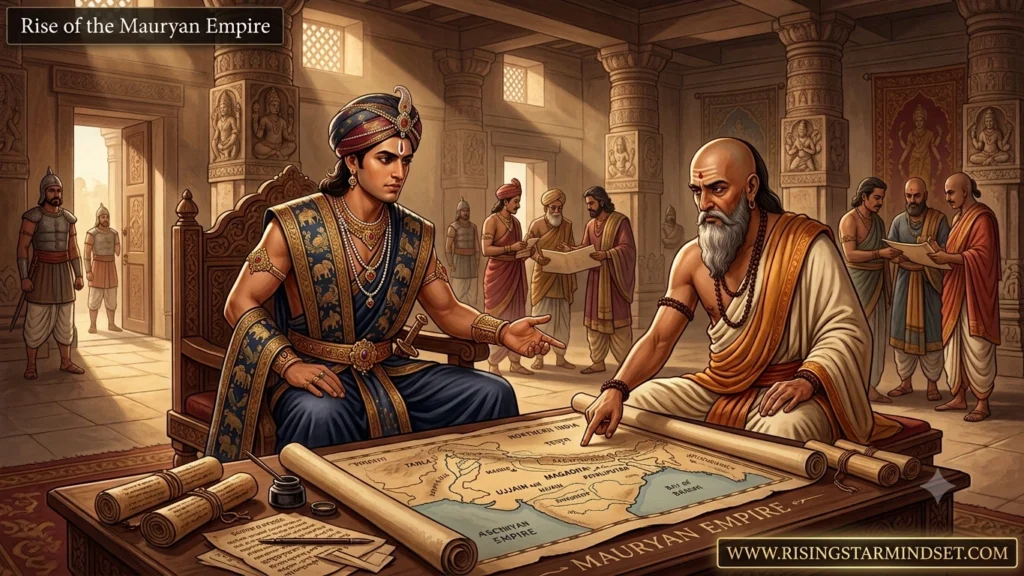
Before the rise of the Mauryas, the Nanda dynasty ruled Magadha.
Chandragupta Maurya, guided by Chanakya, overthrew the Nanda ruler and established the Mauryan dynasty.
The political situation after the campaigns of Alexander in north-western India also created an opportunity for the rise of a strong Indian power.
हिंदी में समझिए
मौर्यों के उदय से पहले नंद वंश का शासन मगध पर था।
चंद्रगुप्त मौर्य ने चाणक्य (कौटिल्य) के मार्गदर्शन में नंद सत्ता को समाप्त करके मौर्य साम्राज्य की स्थापना की।
उत्तर-पश्चिम भारत में सिकंदर के अभियानों के बाद उत्पन्न राजनीतिक परिस्थितियों ने भी चंद्रगुप्त के विस्तार में मदद की।
3. Chandragupta Maurya
Chandragupta Maurya was the founder of the Mauryan Empire.
English Explanation
Chandragupta established a powerful centralized empire with Pataliputra as its capital.
He expanded his territory towards north-western India and later came into conflict with Seleucus I Nicator, one of Alexander’s successors.
The Greek ambassador Megasthenes visited the Mauryan court at Pataliputra.
हिंदी में ( Mauryan Empire )
चंद्रगुप्त मौर्य ने एक शक्तिशाली और केंद्रीकृत साम्राज्य की स्थापना की।
उसकी राजधानी पाटलिपुत्र थी।
उसने उत्तर-पश्चिम भारत में भी अपना प्रभाव बढ़ाया और बाद में सेल्यूकस प्रथम निकेटर से संघर्ष हुआ।
यूनानी राजदूत मेगस्थनीज चंद्रगुप्त के दरबार में आया था।
Remember
Chandragupta Maurya → Founder of Mauryan Empire
4. Chanakya / Kautilya ( Mauryan Empire )
Chanakya is traditionally identified with Kautilya and Vishnugupta.
He was an important adviser to Chandragupta Maurya.
Arthashastra
The Arthashastra is a major ancient Indian work dealing with:
- Statecraft
- Administration
- Economy
- Diplomacy
- Warfare
- Taxation
- Law and order
- Intelligence system
हिंदी में ( Mauryan Empire )
चाणक्य, जिन्हें कौटिल्य और विष्णुगुप्त के नाम से भी जाना जाता है, चंद्रगुप्त मौर्य के प्रमुख सलाहकार थे।
अर्थशास्त्र में शासन, प्रशासन, अर्थव्यवस्था, कूटनीति, युद्ध, कर व्यवस्था और राज्य संचालन से संबंधित महत्वपूर्ण विचार मिलते हैं।
Exam Point:
Arthashastra is an important source for understanding ancient Indian statecraft.
5. Chandragupta Maurya and Seleucus
After Alexander’s death, his empire was divided among his successors.
One of them was Seleucus I Nicator.
English Explanation
Chandragupta Maurya and Seleucus came into conflict in the north-western region.
The conflict eventually resulted in an agreement.
Chandragupta gained control over large territories in the north-west, while diplomatic relations developed between the two powers.
Megasthenes was later sent to the Mauryan court as an ambassador.
हिंदी में ( Mauryan Empire )
चंद्रगुप्त मौर्य और सेल्यूकस के बीच उत्तर-पश्चिम क्षेत्र में संघर्ष हुआ।
बाद में दोनों के बीच समझौता हुआ और मौर्य शक्ति का उत्तर-पश्चिम में विस्तार हुआ।
इसी राजनयिक संबंध के संदर्भ में मेगस्थनीज को मौर्य दरबार में राजदूत के रूप में भेजा गया।
6. Megasthenes and Indica
Megasthenes was a Greek ambassador associated with the Mauryan court.
He wrote a work called Indica.
Although the original text of Indica is not completely available today, later writers preserved parts of his observations.
Indica tells us about:
- Pataliputra
- Mauryan administration
- Society
- Economy
- Agriculture
- Military organization
- Indian customs
हिंदी में ( Mauryan Empire )
मेगस्थनीज ने Indica नामक ग्रंथ लिखा था।
मूल Indica आज पूर्ण रूप से उपलब्ध नहीं है, लेकिन बाद के लेखकों के माध्यम से इसके कई अंशों की जानकारी मिलती है।
Exam Shortcut
Megasthenes → Indica → Mauryan India
7. Mauryan Administration
The Mauryan administration was highly organized and centralized.
Central Administration
The king was the central authority.
He was assisted by ministers and various officials.
हिंदी में
मौर्य शासन व्यवस्था काफी संगठित और केंद्रीकृत थी।
राजा सर्वोच्च सत्ता था और विभिन्न मंत्री एवं अधिकारी प्रशासन चलाने में उसकी सहायता करते थे।
Provincial Administration ( Mauryan Empire )
The large empire was divided into administrative units.
Important provincial centers included:
- Taxila
- Ujjain
- Tosali
- Suvarnagiri
These centers helped the Mauryan rulers control different parts of the empire.
हिंदी में ( Mauryan Empire )
विशाल साम्राज्य को नियंत्रित करने के लिए अलग-अलग प्रशासनिक क्षेत्रों का उपयोग किया जाता था।
प्रमुख प्रशासनिक केंद्रों में तक्षशिला, उज्जैन, तोसली और सुवर्णगिरि शामिल थे।
8. Mauryan Administration – Important Officials
The Mauryan state had many officials responsible for different functions.
Important terms include:
- Amatyas – Important administrative officials
- Mahamatras – Senior officials
- Rajukas – Officials associated with administration and justice
- Yuktas – Officials involved in administrative work
During Ashoka’s reign, Dhamma Mahamatras were appointed to promote and supervise aspects related to Dhamma.
हिंदी में ( Mauryan Empire )
मौर्य प्रशासन में अलग-अलग कार्यों के लिए अलग-अलग अधिकारी नियुक्त किए जाते थे।
अशोक के समय धम्म महामात्र जैसे अधिकारियों की भूमिका विशेष रूप से महत्वपूर्ण हुई।
9. Mauryan Army
The Mauryan Empire maintained a large and powerful army.
It included:
- Infantry
- Cavalry
- Chariots
- Elephants
हिंदी में
मौर्य साम्राज्य की सेना बहुत शक्तिशाली थी।
सेना में मुख्य रूप से:
- पैदल सैनिक
- घुड़सवार
- रथ
- हाथी
शामिल थे।
War elephants played an important role in ancient Indian warfare.
10. Mauryan Economy
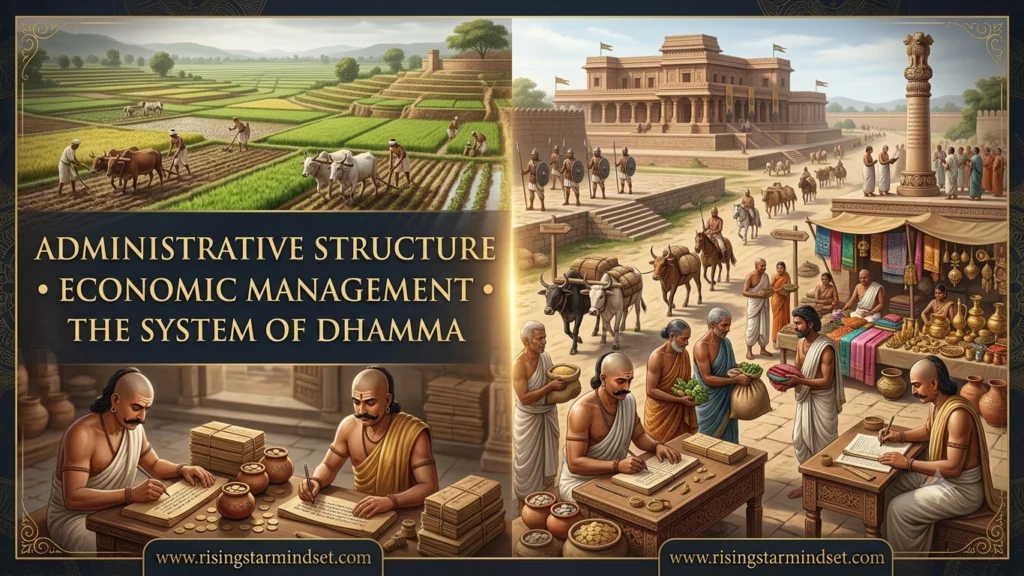
Agriculture was the foundation of the Mauryan economy.
The state collected taxes and maintained administrative control over economic activities.
Other important economic activities included:
- Agriculture
- Trade
- Crafts
- Mining
- Forestry
- Animal husbandry
हिंदी में
मौर्य अर्थव्यवस्था का मुख्य आधार कृषि था।
इसके अलावा व्यापार, शिल्प, खनन, वन संसाधन और पशुपालन भी महत्वपूर्ण थे।
राज्य विभिन्न प्रकार के करों से राजस्व प्राप्त करता था।
11. Trade and Communication
The Mauryan Empire controlled important routes connecting different regions.
Trade routes helped connect:
- North India
- Deccan
- North-western regions
- Eastern India
Roads and communication networks were important for administration and military movement.
हिंदी में
मौर्य काल में विभिन्न क्षेत्रों को जोड़ने वाले व्यापारिक मार्गों का विकास हुआ।
सड़कें और संचार व्यवस्था प्रशासन, व्यापार तथा सेना की आवाजाही के लिए महत्वपूर्ण थीं।
12. Bindusara ( Mauryan Empire )
After Chandragupta Maurya, his son Bindusara became the ruler.
English Explanation
Bindusara continued the expansion and consolidation of the Mauryan Empire.
Greek sources refer to him by names such as Amitrochates, generally understood as a Greek form related to his name or title.
He maintained diplomatic contacts with the Hellenistic world.
हिंदी में
चंद्रगुप्त मौर्य के बाद उसका पुत्र बिंदुसार शासक बना।
उसने मौर्य साम्राज्य को मजबूत बनाए रखने और उसके विस्तार को आगे बढ़ाने का कार्य किया।
Important Sequence
Chandragupta Maurya → Bindusara → Ashoka
13. Ashoka the Great ( Mauryan Empire )
Ashoka is one of the most famous rulers in Indian history.
He became emperor after the death of Bindusara and eventually ruled over a vast Mauryan Empire.
Ashoka is especially remembered for his transformation after the Kalinga War and his promotion of Dhamma.
हिंदी में
सम्राट अशोक भारतीय इतिहास के सबसे प्रसिद्ध शासकों में से एक थे।
कलिंग युद्ध के बाद उनके जीवन में महत्वपूर्ण परिवर्तन आया।
उन्होंने युद्ध और विजय के स्थान पर धम्म, नैतिकता, सहिष्णुता और जनकल्याण पर अधिक जोर दिया।
14. Kalinga War ( Mauryan Empire )
The Kalinga War is one of the most important events in Ashoka’s life.
It is generally dated to around 261 BCE.
Kalinga was located roughly in present-day Odisha.
English Explanation
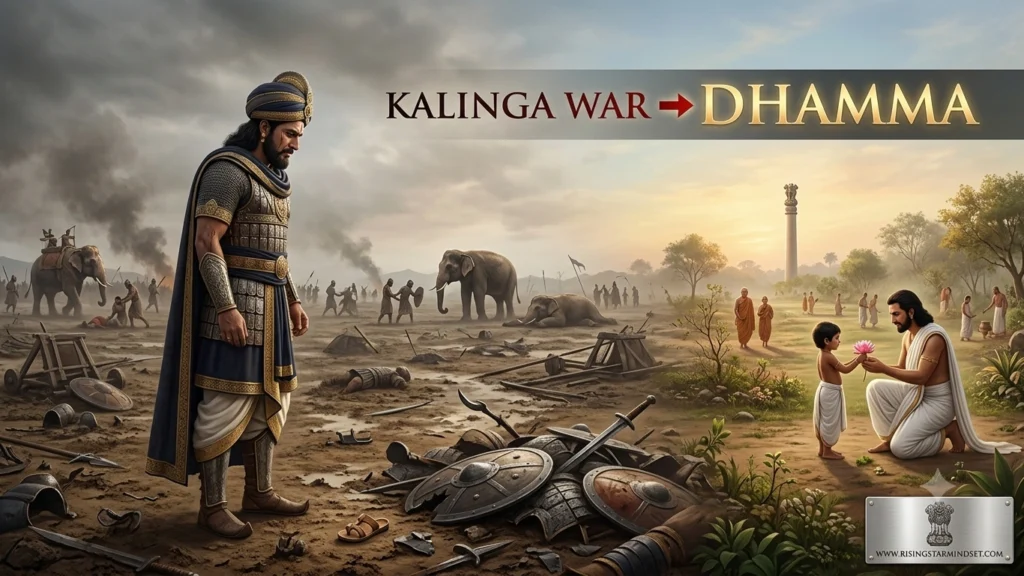
The war caused enormous suffering and loss of life.
Ashoka expressed deep remorse after witnessing the consequences of the war.
This experience influenced his later policy and his emphasis on Dhamma.
हिंदी में
कलिंग युद्ध लगभग 261 ईसा पूर्व में हुआ माना जाता है।
इस युद्ध में भारी जनहानि और विनाश हुआ।
युद्ध के बाद अशोक ने इसके परिणामों पर गहरा पश्चाताप व्यक्त किया।
इसके बाद उसके शासन की दिशा में महत्वपूर्ण परिवर्तन आया और उसने धम्म पर अधिक जोर दिया।
15. Ashoka’s Dhamma ( Mauryan Empire )
Ashoka’s Dhamma was a broad ethical and social philosophy.
It was not simply a formal religious doctrine.
Major principles included:
- Respect for parents
- Respect for elders
- Kindness towards living beings
- Tolerance
- Compassion
- Good behavior
- Religious harmony
- Welfare of people
हिंदी में
अशोक का धम्म केवल एक धार्मिक सिद्धांत नहीं था।
इसमें नैतिक और सामाजिक मूल्यों पर जोर दिया गया।
इसके प्रमुख तत्व थे:
- माता-पिता का सम्मान
- बड़ों का सम्मान
- जीवों के प्रति दया
- सहिष्णुता
- करुणा
- अच्छा आचरण
- धार्मिक सद्भाव
- जनकल्याण
Important Point
Kalinga War → Ashoka’s remorse → Greater emphasis on Dhamma
16. Ashoka and Buddhism ( Mauryan Empire )
Ashoka is closely associated with the spread and patronage of Buddhism.
He supported Buddhist institutions and promoted ethical principles through his inscriptions.
Traditional Buddhist accounts also associate his reign with the Third Buddhist Council at Pataliputra.
हिंदी में
अशोक का संबंध बौद्ध धर्म के संरक्षण और उसके प्रसार से गहराई से जुड़ा हुआ है।
उसने बौद्ध संस्थाओं को संरक्षण दिया और नैतिक संदेशों को अपने अभिलेखों के माध्यम से व्यापक रूप से प्रचारित किया।
परंपरागत बौद्ध स्रोत तीसरी बौद्ध संगीति को अशोक के शासनकाल में पाटलिपुत्र से जोड़ते हैं।
17. Ashokan Edicts ( Mauryan Empire )
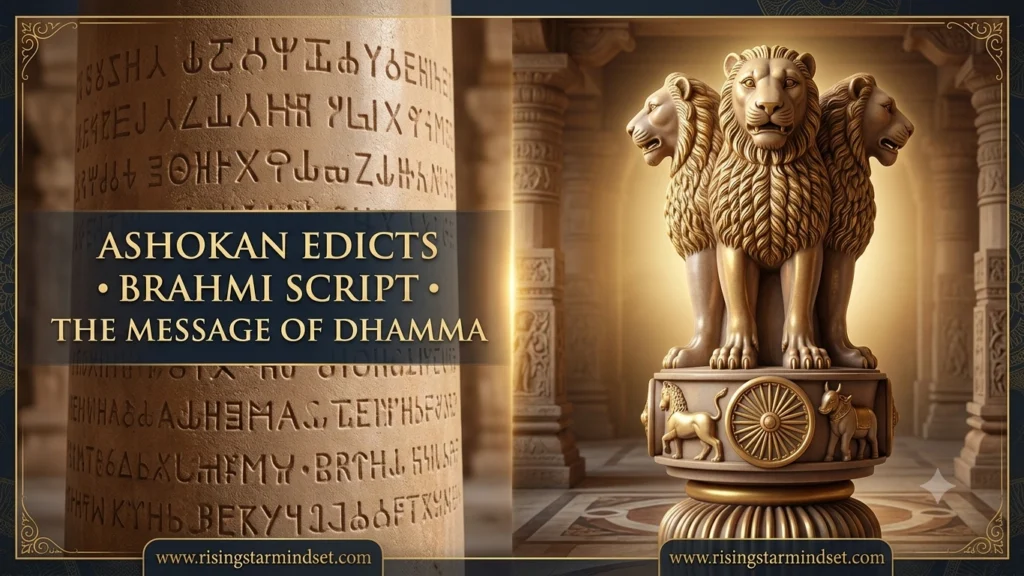
The Edicts of Ashoka are among the most important sources for studying his reign.
These inscriptions were engraved on:
- Rocks
- Pillars
- Other surfaces
They communicate Ashoka’s policies, moral ideas, administrative concerns and messages to his subjects.
हिंदी में
अशोक के अभिलेख उसके शासन और विचारों को समझने के सबसे महत्वपूर्ण स्रोतों में से हैं।
ये मुख्य रूप से:
- शिलाओं
- स्तंभों
- अन्य सतहों
पर खुदवाए गए थे।
इनमें धम्म, प्रशासन, जनकल्याण, धार्मिक सहिष्णुता और नैतिक आचरण से संबंधित बातें मिलती हैं।
18. Languages and Scripts of Ashokan Inscriptions
Ashoka’s inscriptions were written in different languages and scripts depending on the region.
Important examples:
Prakrit + Brahmi
Most inscriptions in the Indian subcontinent used Prakrit written in Brahmi.
Kharosthi
Some north-western inscriptions used Kharosthi.
Greek and Aramaic
Some inscriptions from the north-western region were written in Greek and/or Aramaic.
हिंदी में
अशोक के अभिलेख अलग-अलग क्षेत्रों में अलग-अलग भाषाओं और लिपियों में मिलते हैं।
सबसे सामान्य रूप से प्राकृत भाषा और ब्राह्मी लिपि का प्रयोग हुआ।
उत्तर-पश्चिम में खरोष्ठी तथा कुछ स्थानों पर यूनानी और अरामाइक का भी प्रयोग हुआ।
19. Ashoka’s Pillars ( Mauryan Empire )
Ashoka’s pillars are famous examples of Mauryan craftsmanship.
They are known for their:
- Polished stone
- Artistic design
- Animal capitals
- Inscriptions
The Lion Capital of Sarnath is especially famous.
Lion Capital of Sarnath
The four-lion capital from Sarnath has become the State Emblem of India.
The Dharma Chakra (Ashoka Chakra) appears at the center of India’s national flag.
हिंदी में
अशोक के स्तंभ मौर्यकालीन कला और स्थापत्य के शानदार उदाहरण हैं।
सारनाथ का सिंह स्तंभशीर्ष भारत का राजकीय प्रतीक है।
अशोक चक्र भारत के राष्ट्रीय ध्वज के मध्य में दिखाई देता है।
20. Mauryan Art and Architecture ( Mauryan Empire)
The Mauryan period witnessed important developments in art and architecture.
Important examples:
- Ashokan Pillars
- Sarnath Lion Capital
- Stupas
- Rock-cut caves
- Polished stone architecture
Barabar Caves
The Barabar Caves are among the important examples of Mauryan-period rock-cut architecture.
They are associated particularly with the reign of Ashoka and his successor Dasharatha.
हिंदी में
मौर्य काल में पत्थर की कला, स्तंभ निर्माण और गुफा वास्तुकला का विकास हुआ।
बराबर की गुफाएँ मौर्यकालीन शैल-कट वास्तुकला का महत्वपूर्ण उदाहरण हैं।
21. Mauryan Society
Mauryan society was diverse and included:
- Farmers
- Traders
- Artisans
- Soldiers
- Officials
- Religious groups
- Urban populations
Cities such as Pataliputra were major political and economic centers.
हिंदी में
मौर्य समाज में किसान, व्यापारी, शिल्पकार, सैनिक, अधिकारी और विभिन्न धार्मिक समूह शामिल थे।
पाटलिपुत्र एक महत्वपूर्ण राजनीतिक और आर्थिक केंद्र था।
22. Pataliputra ( Mauryan Empire )
Pataliputra was the capital of the Mauryan Empire.
It was located near the confluence of major rivers in present-day Bihar.
Why was Pataliputra important?
- Political center
- Administrative center
- Economic center
- Strategic location
- Major urban settlement
हिंदी में
पाटलिपुत्र मौर्य साम्राज्य की राजधानी थी।
यह वर्तमान बिहार के क्षेत्र में स्थित था और अपनी भौगोलिक स्थिति के कारण राजनीतिक एवं आर्थिक दृष्टि से बहुत महत्वपूर्ण था।
23. Mauryan Empire and Bihar
For Bihar, the Mauryan period is particularly important.
Pataliputra, located in present-day Bihar, served as the imperial capital.
Important events associated with the Mauryan period include:
- Rise of Chandragupta Maurya
- Development of Pataliputra
- Ashoka’s administration
- Third Buddhist Council traditionally associated with Pataliputra
- Spread of Buddhism
BPSC Special Point
अगर आप BPSC की तैयारी कर रहे हैं, तो मौर्य काल को केवल सामान्य Ancient History topic की तरह न पढ़ें।
Pataliputra + Mauryan Administration + Ashoka + Buddhism + Bihar’s historical importance को साथ में पढ़ना अधिक उपयोगी रहेगा।
24. Mauryan Empire – Important Rulers
| Ruler | Important Contribution |
| Chandragupta Maurya | Founded Mauryan Empire |
| Bindusara | Consolidated and expanded empire |
| Ashoka | Greatest territorial expansion; Dhamma policy |
| Brihadratha | Last Mauryan ruler |
Quick Memory Trick
C → B → A
Chandragupta → Bindusara → Ashoka
25. Decline of the Mauryan Empire
After Ashoka’s death, the Mauryan Empire gradually weakened.
Major factors behind the decline
- Weak successors
- Administrative difficulties
- Large empire became difficult to control
- Political instability
- Regional forces became stronger
- Possible financial pressures
- Decline in central authority
The exact causes of the Mauryan decline are debated among historians, so it is better to understand the decline as a combination of factors, rather than attributing it to one single reason.
हिंदी में ( Mauryan Empire )
अशोक की मृत्यु के बाद मौर्य साम्राज्य धीरे-धीरे कमजोर होने लगा।
इसके पीछे कई कारण माने जाते हैं:
- कमजोर उत्तराधिकारी
- विशाल साम्राज्य को नियंत्रित करने में कठिनाई
- प्रशासनिक समस्याएँ
- केंद्रीय सत्ता का कमजोर होना
- क्षेत्रीय शक्तियों का बढ़ना
- आर्थिक एवं राजनीतिक दबाव
26. End of the Mauryan Dynasty
The last Mauryan ruler was Brihadratha.
According to traditional accounts, he was killed by his military commander Pushyamitra Shunga.
This marked the end of the Mauryan dynasty and the beginning of the Shunga dynasty.
हिंदी में
मौर्य वंश का अंतिम शासक बृहद्रथ था।
परंपरागत विवरणों के अनुसार उसके सेनापति पुष्यमित्र शुंग ने उसकी हत्या कर सत्ता पर अधिकार कर लिया।
इसके साथ मौर्य वंश का अंत हुआ और शुंग वंश का उदय हुआ।
27. Mauryan Empire – Important Sources
To understand the Mauryan period, historians use several sources.
Major Sources
1. Arthashastra
Associated with Kautilya; important for statecraft and administration.
2. Indica
Associated with Megasthenes; provides information about Mauryan India.
3. Ashokan Edicts
Direct evidence for Ashoka’s policies and ideas.
4. Buddhist Texts
Provide traditions about Ashoka and Buddhism.
5. Jain Traditions
Important for understanding traditions associated with Chandragupta Maurya.
हिंदी में
मौर्य काल को समझने के लिए साहित्यिक और पुरातात्विक दोनों प्रकार के स्रोत महत्वपूर्ण हैं।
🧠 One-Minute Revision – Mauryan Empire
| Topic | Remember |
| Founder | Chandragupta Maurya |
| Capital | Pataliputra |
| Adviser | Chanakya / Kautilya |
| Major Text | Arthashastra |
| Greek Ambassador | Megasthenes |
| His Book | Indica |
| Chandragupta’s Successor | Bindusara |
| Famous Mauryan Ruler | Ashoka |
| Major War | Kalinga War |
| Kalinga War | c. 261 BCE |
| Ashoka’s Policy | Dhamma |
| Important Inscriptions | Ashokan Edicts |
| Famous Capital | Sarnath Lion Capital |
| Rock-cut Example | Barabar Caves |
| Last Mauryan Ruler | Brihadratha |
| Successor Dynasty | Shunga |
🎯 BPSC Special – 15 Facts You Must Remember
- Chandragupta Maurya founded the Mauryan Empire.
- Pataliputra was the Mauryan capital.
- Chanakya is associated with Kautilya and Vishnugupta.
- Arthashastra is an important source on statecraft.
- Megasthenes wrote Indica.
- Megasthenes was associated with the Mauryan court.
- Bindusara succeeded Chandragupta Maurya.
- Ashoka was one of the greatest Mauryan rulers.
- Kalinga War is associated with Ashoka.
- Kalinga is broadly identified with present-day Odisha.
- Ashoka promoted Dhamma after the Kalinga War.
- Ashokan inscriptions are major primary sources for his reign.
- Sarnath Lion Capital is India’s State Emblem.
- Pataliputra was an important center of Mauryan power.
- Brihadratha was the last Mauryan ruler.
📝 MCQs – Mauryan Empire
1. Who founded the Mauryan Empire?
A. Ashoka
B. Bindusara
C. Chandragupta Maurya
D. Pushyamitra Shunga
Answer: C. Chandragupta Maurya
2. What was the capital of the Mauryan Empire?
A. Taxila
B. Ujjain
C. Pataliputra
D. Vaishali
Answer: C. Pataliputra
3. Who wrote the Arthashastra?
A. Megasthenes
B. Kautilya
C. Ashoka
D. Kalidasa
Answer: B. Kautilya
4. Megasthenes is associated with which work?
A. Arthashastra
B. Indica
C. Rajatarangini
D. Mudrarakshasa
Answer: B. Indica
5. Who was the son and successor of Chandragupta Maurya?
A. Ashoka
B. Bindusara
C. Brihadratha
D. Dasharatha
Answer: B. Bindusara
6. Which war deeply influenced Ashoka’s later policy?
A. Battle of Hydaspes
B. Kalinga War
C. Battle of Panipat
D. Tarain War
Answer: B. Kalinga War
7. Ashoka’s Dhamma mainly emphasized:
A. Military expansion
B. Religious intolerance
C. Ethical conduct and social harmony
D. Economic isolation
Answer: C. Ethical conduct and social harmony
8. Which monument’s lion capital is India’s State Emblem?
A. Sanchi
B. Sarnath
C. Nalanda
D. Taxila
Answer: B. Sarnath
9. Who was the last Mauryan ruler?
A. Ashoka
B. Bindusara
C. Brihadratha
D. Chandragupta Maurya
Answer: C. Brihadratha
10. Which dynasty succeeded the Mauryas?
A. Gupta
B. Kushana
C. Shunga
D. Satavahana
Answer: C. Shunga
🔥 HOTS – Think Beyond Facts ( Mauryan Empire )
Question 1
Why is the Kalinga War considered a turning point in Ashoka’s life?
Answer
The Kalinga War caused enormous suffering and loss of life. Ashoka’s remorse after the war influenced his later policy. He increasingly emphasized Dhamma, compassion, tolerance and welfare instead of aggressive military expansion.
हिंदी:
कलिंग युद्ध के बाद अशोक ने युद्ध की विनाशकारी प्रकृति को महसूस किया। इससे उसके शासन की दिशा में बड़ा परिवर्तन आया और उसने धम्म, करुणा, सहिष्णुता तथा जनकल्याण पर अधिक जोर दिया।
Question 2
Why are Ashokan inscriptions important for historians?
Answer
They provide direct evidence about Ashoka’s policies, administration, moral ideas and communication with his subjects.
हिंदी:
अशोक के अभिलेख उसके शासन, प्रशासन, धम्म और जनता के लिए दिए गए संदेशों को समझने का प्रत्यक्ष स्रोत हैं।
Question 3
Why was Pataliputra strategically important?
Answer
Its location, river connections and central position helped the Mauryan rulers manage administration, trade and communication across a large empire.
हिंदी:
पाटलिपुत्र की भौगोलिक स्थिति, नदियों से जुड़ाव और सामरिक महत्व ने इसे एक बड़े साम्राज्य के प्रशासन और व्यापार के लिए उपयुक्त बनाया।
✍️ Fill in the Blanks ( Mauryan Empire )
- The Mauryan Empire was founded by __________.
- The capital of the Mauryan Empire was __________.
- Kautilya is associated with the book __________.
- Megasthenes wrote __________.
- Chandragupta Maurya was succeeded by __________.
- The Kalinga War is associated with __________.
- Ashoka’s ethical policy is known as __________.
- The famous Lion Capital is located at __________.
- The last Mauryan ruler was __________.
- The Shunga dynasty succeeded the __________ dynasty.
Answers
- Chandragupta Maurya
- Pataliputra
- Arthashastra
- Indica
- Bindusara
- Ashoka
- Dhamma
- Sarnath
- Brihadratha
- Mauryan
🔗 Match the Following ( Mauryan Empire )
| Column A | Column B |
| Chandragupta Maurya | Founder |
| Kautilya | Arthashastra |
| Megasthenes | Indica |
| Ashoka | Kalinga War |
| Brihadratha | Last Mauryan ruler |
📚 Short Answer Questions ( Mauryan Empire )
Q1. Who founded the Mauryan Empire?
Answer: Chandragupta Maurya founded the Mauryan Empire around 322 BCE.
हिंदी: लगभग 322 ईसा पूर्व चंद्रगुप्त मौर्य ने मौर्य साम्राज्य की स्थापना की।
Q2. Who was Kautilya?
Answer: Kautilya, also known as Chanakya and Vishnugupta, was an important adviser of Chandragupta Maurya and is traditionally associated with the Arthashastra.
Q3. What was the importance of Kalinga War?
Answer: The war became a turning point in Ashoka’s life and influenced his later emphasis on Dhamma and non-aggressive policies.
Q4. What is Dhamma?
Answer: Ashoka’s Dhamma was a broad ethical philosophy emphasizing compassion, tolerance, respect and good conduct.
Q5. Who was Megasthenes?
Answer: Megasthenes was a Greek ambassador associated with the Mauryan court and the author of Indica.
❓ Frequently Asked Questions – Mauryan Empire
1. Who established the Mauryan Empire?
Chandragupta Maurya established the Mauryan Empire around 322 BCE.
2. What was the capital of the Mauryan Empire?
The capital was Pataliputra, located in present-day Bihar.
3. Who was Chanakya?
Chanakya, also known as Kautilya or Vishnugupta, was an important adviser to Chandragupta Maurya.
4. What is Arthashastra?
Arthashastra is an ancient Indian work associated with Kautilya that discusses statecraft, administration, economy, diplomacy and warfare.
5. Who wrote Indica?
Megasthenes is associated with Indica.
6. Which war changed Ashoka’s policy?
The Kalinga War.
7. What was Ashoka’s Dhamma?
It was a broad ethical and social philosophy emphasizing compassion, tolerance, respect and responsible conduct.
8. What is the significance of Ashokan Edicts?
They provide important direct evidence about Ashoka’s policies and ideas.
9. Who was the last Mauryan ruler?
Brihadratha was the last Mauryan ruler.
10. Which dynasty replaced the Mauryas?
The Shunga dynasty replaced the Mauryan dynasty.
⚡ Mauryan Empire in 60 Seconds
If you have very little time before an examination, remember this sequence:
Chandragupta Maurya
↓
Founded Mauryan Empire
↓
Chanakya / Kautilya
↓
Pataliputra
↓
Megasthenes – Indica
↓
Bindusara
↓
Ashoka
↓
Kalinga War – c. 261 BCE
↓
Dhamma
↓
Ashokan Edicts
↓
Brihadratha
↓
Shunga Dynasty
🧠 Final Revision Trick
Remember:
C – K – M – B – A – K – D – E – B
C – Chandragupta Maurya
K – Kautilya
M – Megasthenes
B – Bindusara
A – Ashoka
K – Kalinga War
D – Dhamma
E – Edicts
B – Brihadratha
This simple sequence can help you quickly recall the major elements of the Mauryan period.
📌 Conclusion ( Mauryan Empire )
The Mauryan Empire represents a major turning point in the history of ancient India.
Chandragupta Maurya created a powerful empire, Kautilya provided important ideas of statecraft, Bindusara consolidated Mauryan power, and Ashoka transformed the political and moral image of the empire after the Kalinga War.
The Mauryan period is particularly important because it combines political unification, centralized administration, economic organization, military power, art and architecture, Buddhism, inscriptions and ethical governance.
For competitive examinations, do not study the Mauryan Empire only as a list of kings and dates. Understand the connection:
Chandragupta → Empire Building → Kautilya → Administration → Bindusara → Ashoka → Kalinga → Dhamma → Edicts → Decline
यही sequence आपको Mauryan History के अधिकांश objective और conceptual questions को समझने में मदद करेगा।
🔗 Continue the Ancient Indian History Series
Previous Part:
👉 Ancient Indian History: One Post for Complete Preparation
Current Part:
👉 Part 2 – Mauryan Empire: Rise, Administration, Ashoka and Decline
Next Part:
👉 Coming Soon – Post-Mauryan India
Study Tip: Ancient History को अलग-अलग facts की तरह याद करने के बजाय dynasty → ruler → important event → administration → art → religion → decline के sequence में पढ़ें।
🎯 Your Turn – Test Yourself
क्या आप बिना ऊपर देखे इन 6 सवालों के जवाब दे सकते हैं?
- मौर्य साम्राज्य की स्थापना किसने की?
- पाटलिपुत्र किस साम्राज्य की राजधानी थी?
- मेगस्थनीज की पुस्तक का नाम क्या था?
- कलिंग युद्ध लगभग किस वर्ष हुआ?
- अशोक के धम्म का मुख्य उद्देश्य क्या था?
- मौर्य वंश का अंतिम शासक कौन था?
अगर इन 6 में से 6 सही हैं, तो Mauryan Empire पर आपकी पकड़ काफी अच्छी है।
— Think High, Rise Higher.
Keep Learning with Rising Star Mindset
Spoken English Course
BPSC Preparation
School Notes
Daily Motivation
Website: www.risingstarmindset.com