
Static GK Part 1 – Ancient Indian History for BPSC | Complete Notes, MCQs & PYQs (English + हिन्दी)
Static GK Series
| Part | Topic | Status |
| Part 1 | Ancient Indian History | ✅ Current Post |
| Part 2 | Mauryan Empire | Coming Soon |
| Part 3 | Gupta Empire | Coming Soon |
| Part 4 | Medieval Indian History | Coming Soon |
| Part 5 | Modern Indian History | Coming Soon |
| Part 6 | Indian Geography | Coming Soon |
| Part 7 | Indian Polity | Coming Soon |
| Part 8 | Indian Economy | Coming Soon |
📚 Table of Contents ( Ancient Indian History )
- Introduction | परिचय
- What is Ancient Indian History?
- Importance for BPSC & Other Competitive Exams
- Timeline of Ancient Indian History
- Sources of Ancient Indian History
- Major Periods of Ancient India
- Ancient India at a Glance
- Key Facts
- Important Examination Points
- Ancient Indian History Mind Map
- Quick Revision Table
- Ancient Indian History One Shot Notes
- Indus Valley Civilization
- Vedic Period
- Mahajanapadas
- Jainism
- Buddhism
- MCQs
- HOTS Questions
- PYQs
- Expected Questions
- FAQs
- Conclusion
- Previous Post : Static GK for BPSC | Complete Study Guide, Notes, MCQs & Preparation Strategy
Introduction | परिचय ( Ancient Indian History )
🇬🇧 English
Ancient Indian History is one of the most important and highest-scoring sections of Static General Knowledge. Moreover, it plays a crucial role in competitive examinations such as BPSC, UPSC, Bihar SI, SSC CGL, Railway, Banking, CDS, NDA, CAPF, CTET, State PSCs, and many other government recruitment examinations. ( Ancient Indian History )
Furthermore, every year several direct and indirect questions are asked from topics such as the Indus Valley Civilization, Vedic Civilization, Mahajanapadas, Jainism, Buddhism, and the Mauryan Empire. Therefore, developing a strong understanding of Ancient Indian History can significantly improve your overall score.
In addition, Ancient Indian History is not merely a collection of dates and kings. Rather, it explains the origin of Indian civilization, the evolution of society, political systems, economic activities, religious movements, art, architecture, literature, education, science, and culture. Consequently, understanding this subject helps candidates answer both factual and analytical questions confidently.
Moreover, candidates who prepare Ancient Indian History through timelines, comparison tables, revision charts, and regular MCQ practice usually p erform better in competitive examinations because they understand concepts instead of memorizing isolated facts.
🇮🇳 हिन्दी ( Ancient Indian History )
प्राचीन भारतीय इतिहास Static GK का सबसे महत्वपूर्ण तथा सबसे अधिक अंक दिलाने वाला विषय माना जाता है। इसके अलावा, यह BPSC, UPSC, Bihar SI, SSC CGL, Railway, Banking, CDS, NDA, CAPF, CTET तथा विभिन्न राज्य लोक सेवा आयोगों की परीक्षाओं में अत्यंत महत्वपूर्ण भूमिका निभाता है।
साथ ही, प्रत्येक वर्ष सिंधु घाटी सभ्यता, वैदिक काल, महाजनपद, जैन धर्म, बौद्ध धर्म तथा मौर्य साम्राज्य से अनेक प्रत्यक्ष एवं अप्रत्यक्ष प्रश्न पूछे जाते हैं। इसलिए, यदि किसी अभ्यर्थी की Ancient Indian History पर मजबूत पकड़ है, तो वह परीक्षा में आसानी से अतिरिक्त अंक प्राप्त कर सकता है।
इसके अतिरिक्त, प्राचीन भारतीय इतिहास केवल राजाओं और तिथियों का संग्रह नहीं है। बल्कि, यह भारतीय सभ्यता की उत्पत्ति, समाज, राजनीति, अर्थव्यवस्था, धर्म, शिक्षा, साहित्य, विज्ञान तथा संस्कृति के विकास की कहानी है। परिणामस्वरूप, इस विषय की गहरी समझ तथ्यात्मक तथा वि श्लेषणात्मक दोनों प्रकार के प्रश्नों को हल करने में सहायता करती है।
अंततः, यदि आप Timeline, Tables, Revision Charts तथा MCQs के माध्यम से तैयारी करते हैं, तो आपको तथ्यों को याद रखने में कठिनाई नहीं होगी और परीक्षा में आपका आत्मविश्वास भी बढ़ेगा।
What is Ancient Indian History? | प्राचीन भारतीय इतिहास क्या है?
🇬🇧 English
Ancient Indian History is the study of India’s earliest civilizations, kingdoms, rulers, religions, social systems, economic development, administration, literature, science, and culture from prehistoric times until approximately the 8th century CE.
Initially, early humans lived as hunters and food gatherers. Gradually, agriculture developed, permanent settlements were established, cities flourished, kingdoms expanded, and powerful empires emerged. Consequently, India became one of the greatest centres of civilization, knowledge, philosophy, mathematics, medicine, astronomy, and education.
Therefore, Ancient Indian History provides the foundation for understanding Medieval and Modern Indian History.
🇮🇳 हिन्दी ( Ancient Indian History )
प्राचीन भारतीय इतिहास मानव सभ्यता के प्रारंभिक काल से लेकर लगभग 8वीं शताब्दी ईस्वी तक भारत की सभ्यताओं, राज्यों, शासकों, धर्मों, सामाजिक व्यवस्था, अर्थव्यवस्था, प्रशासन, साहित्य, विज्ञान तथा संस्कृति का अध्ययन है।
प्रारंभ में, मानव शिकार एवं भोजन संग्रह पर निर्भर था। धीरे–धीरे, कृषि का विकास हुआ, स्थायी बस्तियाँ बसने लगीं, नगरों का निर्माण हुआ, राज्यों की स्थापना हुई और महान साम्राज्यों का उदय हुआ। परिणामस्वरूप, भारत विश्व के प्रमुख ज्ञान, दर्शन, गणित, चिकित्सा, खगोल विज्ञान तथा शिक्षा के केन्द्रों में से एक बन गया।
इसलिए, प्राचीन भारतीय इतिहास को समझे बिना मध्यकालीन एवं आधुनिक भारतीय इतिहास को सही प्रकार से समझना संभव नहीं है।
Importance for BPSC & Other Competitive Exams |
BPSC एवं अन्य परीक्षाओं में महत्व
| Examination | Importance Level | Frequently Asked |
| BPSC | ⭐⭐⭐⭐⭐ | Very High |
| UPSC | ⭐⭐⭐⭐⭐ | Very High |
| Bihar SI | ⭐⭐⭐⭐ | High |
| SSC CGL | ⭐⭐⭐⭐ | High |
| Railway | ⭐⭐⭐ | Moderate |
| Banking | ⭐⭐ | Moderate |
| NDA/CDS | ⭐⭐⭐⭐ | High |
| State PSC | ⭐⭐⭐⭐⭐ | Very High |
Why Should You Study Ancient Indian History?
🇬🇧 English
Ancient Indian History is considered a scoring subject because most questions are concept-based and repeated across different examinations. Moreover, once you understand the chronological sequence of events, remembering facts becomes significantly easier. Therefore, this topic should be studied at the beginning of your Static GK preparation.
🇮🇳 हिन्दी ( Ancient Indian History )
प्राचीन भारतीय इतिहास एक Scoring Subject माना जाता है क्योंकि अधिकांश प्रश्न अवधारणाओं पर आधारित होते हैं और कई परीक्षाओं में दोहराए जाते हैं। इसके अलावा, यदि घटनाओं का क्रम (Chronology) समझ लिया जाए, तो तथ्यों को याद रखना बहुत आसान हो जाता है। इसलिए, Static GK की तैयारी की शुरुआत इसी विषय से करना सबसे उपयुक्त माना जाता है।
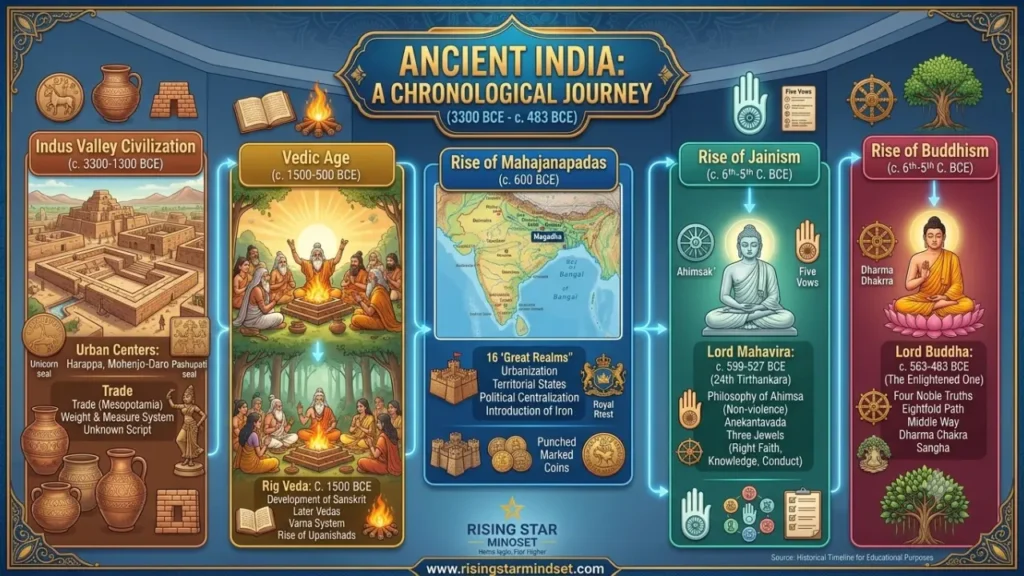
Timeline of Ancient Indian History
| Period | Time |
| Prehistoric Period | Before 3000 BCE |
| Indus Valley Civilization | 3300–1300 BCE |
| Mature Harappan Phase | 2600–1900 BCE |
| Early Vedic Period | 1500–1000 BCE |
| Later Vedic Period | 1000–600 BCE |
| Mahajanapadas | 600–300 BCE |
| Jainism & Buddhism | 6th Century BCE |
| Mauryan Empire | 321–185 BCE |
| Post Mauryan Age | 185 BCE–300 CE |
| Gupta Empire | 320–550 CE |
| Early Medieval Transition | After 550 CE |
Sources of Ancient Indian History
| Archaeological Sources | Literary Sources | Foreign Sources |
| Excavations | Vedas | Megasthenes |
| Coins | Upanishads | Fa-Hien |
| Inscriptions | Ramayana | Hiuen Tsang |
| Monuments | Mahabharata | Greek Writers |
| Seals | Puranas | Chinese Travellers |
Major Periods of Ancient India
| Period | Major Feature |
| Prehistoric Age | Stone Tools |
| Indus Valley Civilization | First Urban Civilization |
| Vedic Age | Vedas & Aryan Society |
| Mahajanapadas | Rise of Kingdoms |
| Religious Reform | Jainism & Buddhism |
| Mauryan Empire | First Pan-Indian Empire |
| Gupta Empire | Golden Age of India |
Ancient Indian History at a Glance
| Topic | Remember |
| First Urban Civilization | Indus Valley Civilization |
| Oldest Veda | Rigveda |
| Founder of Jainism | Mahavira (24th Tirthankara) |
| Founder of Buddhism | Gautama Buddha |
| First Empire | Mauryan Empire |
| Golden Age | Gupta Period |
| Famous University | Nalanda |
| Ancient Script | Brahmi |
🎯 Key Points for Quick Revision ( Ancient Indian History )
🇬🇧 English
- Ancient Indian History is one of the highest-scoring sections in BPSC.
- Chronology is the key to mastering history.
- Focus on civilizations, religions, kingdoms, and rulers.
- Revise timelines regularly.
- Practice MCQs after every topic.
- Use comparison tables for better memory retention.
- Solve PYQs before attempting mock tests.
- Create one-page revision notes for the final revision.
🇮🇳 हिन्दी ( Ancient Indian History )
- Ancient Indian History BPSC का अत्यंत महत्वपूर्ण विषय है।
- Chronology इतिहास की तैयारी की सबसे महत्वपूर्ण कुंजी है।
- सभ्यताओं, धर्मों, राज्यों और शासकों पर विशेष ध्यान दें।
- Timeline का नियमित Revision करें।
- प्रत्येक Topic के बाद MCQs अवश्य हल करें।
- Comparison Tables का उपयोग करें।
- Mock Test से पहले PYQs हल करें।
- अंतिम Revision के लिए One-Page Notes तैयार रखें।
Indus Valley Civilization (सिंधु घाटी सभ्यता)
Introduction | परिचय
🇬🇧 English
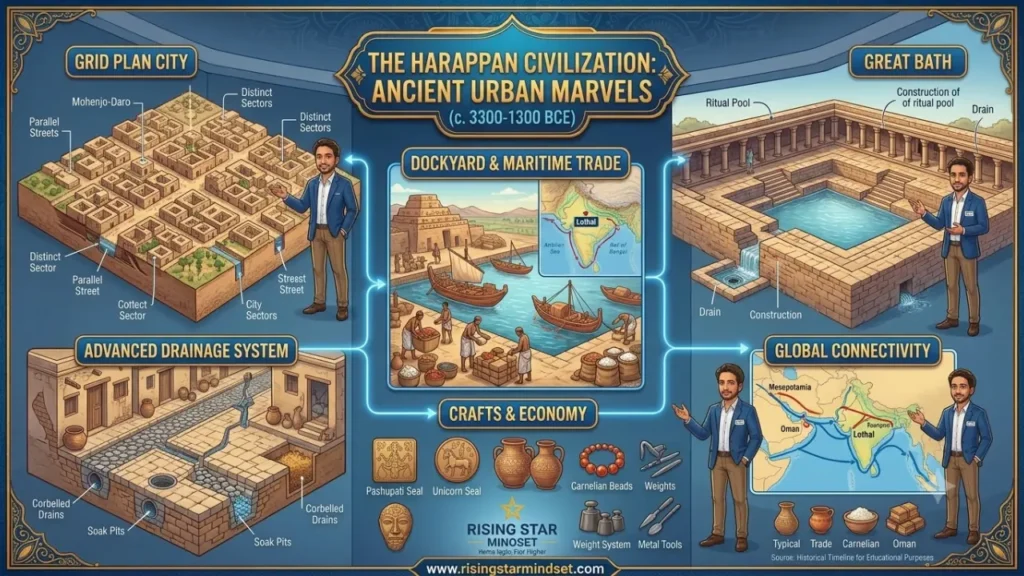
The Indus Valley Civilization (IVC) was the first urban civilization of the Indian subcontinent. It developed approximately between 3300 BCE and 1300 BCE, while its mature period lasted from 2600 BCE to 1900 BCE. Moreover, it was one of the world’s earliest urban civilizations, alongside Egypt and Mesopotamia.
Furthermore, the Harappan people were highly advanced in town planning, drainage systems, architecture, trade, agriculture, metallurgy, and craftsmanship. Therefore, the Indus Valley Civilization is regarded as one of the greatest achievements of ancient India.
🇮🇳 हिन्दी ( Ancient Indian History )
सिंधु घाटी सभ्यता भारतीय उपमहाद्वीप की प्रथम नगरीय सभ्यता थी। इसका विकास लगभग 3300 ईसा पूर्व से 1300 ईसा पूर्व तक हुआ जबकि इसका विकसित काल 2600–1900 ईसा पूर्व माना जाता है। इसके अलावा, यह मिस्र और मेसोपोटामिया की सभ्यताओं के समान विश्व की सबसे प्राचीन सभ्यताओं में से एक थी।
साथ ही, हड़प्पावासी नगर योजना, जल निकासी, कृषि, व्यापार, धातु उद्योग तथा हस्तशिल्प में अत्यंत उन्नत थे। इसलिए, इसे प्राचीन भारत की सबसे महान उपलब्धियों में गिना जाता है।
Discovery of Indus Valley Civilization
| Year | Archaeologist | Contribution |
| 1921 | Daya Ram Sahni | Harappa Excavation |
| 1922 | R.D. Banerji | Mohenjo-daro Excavation |
| 1924 | Sir John Marshall | Official Announcement |
Important Harappan Sites ( Ancient Indian History )
| Site | Present Location | Famous For |
| Harappa | Pakistan | Granary |
| Mohenjo-daro | Pakistan | Great Bath |
| Lothal | Gujarat | Dockyard |
| Dholavira | Gujarat | Water Reservoir |
| Kalibangan | Rajasthan | Fire Altars |
| Rakhigarhi | Haryana | Largest Indian Site |
| Banawali | Haryana | Agriculture |
| Surkotada | Gujarat | Horse Bones |
Major Features ( Ancient Indian History )
| Topic | Description |
| Town Planning | Grid Pattern |
| Houses | Burnt Bricks |
| Drainage | Covered Underground Drains |
| Economy | Agriculture & Trade |
| Script | Undeciphered |
| Religion | Mother Goddess, Pashupati |
| Metal | Bronze |
| Trade | Mesopotamia |
One Shot Revision ( Ancient Indian History )
| Great Bath → Mohenjo-daro |
| Dockyard → Lothal |
| Fire Altars → Kalibangan |
| Horse Bones → Surkotada |
| Water Reservoir → Dholavira |
| Largest Indian Site → Rakhigarhi |
Vedic Period (वैदिक काल) ( Ancient Indian History )
Introduction
🇬🇧 English
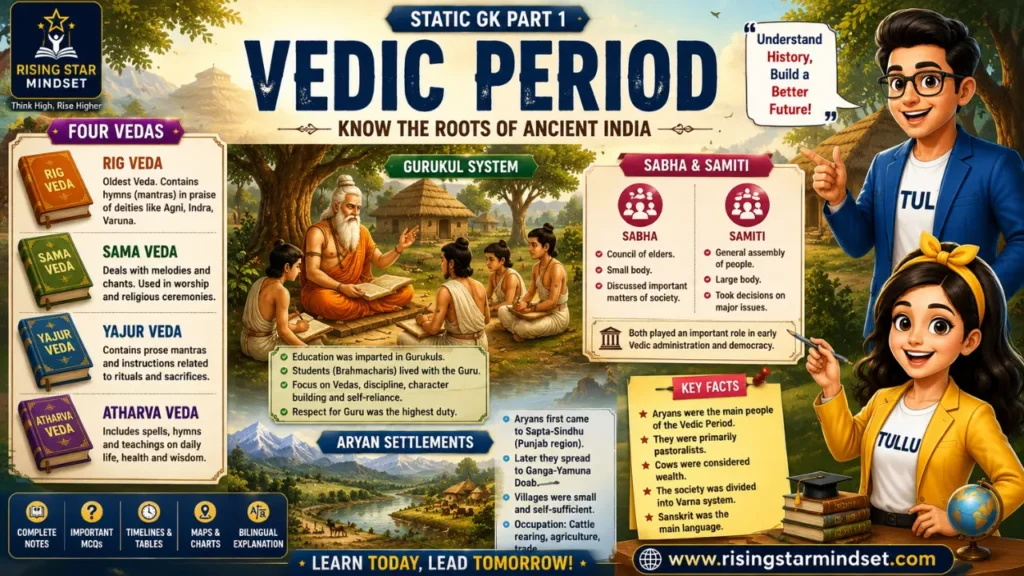
The Vedic Period began after the decline of the Indus Valley Civilization. Initially, the Aryans settled in the northwestern part of India. Gradually, they expanded towards the Gangetic plains. Moreover, the Vedas became the foundation of Indian religion, philosophy, education, and social organization.
The Vedic Age is generally divided into:
- Early Vedic Period (1500–1000 BCE)
- Later Vedic Period (1000–600 BCE)
🇮🇳 हिन्दी ( Ancient Indian History )
वैदिक काल का प्रारंभ सिंधु घाटी सभ्यता के पतन के बाद हुआ। प्रारंभ में, आर्य उत्तर-पश्चिम भारत में बसे। धीरे–धीरे, वे गंगा के मैदानों की ओर बढ़े। इसके अलावा, वेद भारतीय धर्म, दर्शन, शिक्षा तथा सामाजिक व्यवस्था की आधारशिला बने।
वैदिक काल दो भागों में विभाजित है—
- ऋग्वैदिक काल
- उत्तर वैदिक काल
Four Vedas ( Ancient Indian History )
| Veda | Subject |
| Rigveda | Hymns |
| Samaveda | Music |
| Yajurveda | Sacrifices |
| Atharvaveda | Medicine & Magic |
Comparison ( Ancient Indian History )
| Early Vedic | Later Vedic |
| Simple Society | Complex Society |
| Cattle Economy | Agriculture |
| Sabha & Samiti Powerful | King Powerful |
| Tribal Life | Kingdoms |
Social System ( Ancient Indian History )
| Varna | Work |
| Brahmin | Teaching |
| Kshatriya | Administration |
| Vaishya | Trade |
| Shudra | Service |
Economy ( Ancient Indian History )
| Main Occupation | Agriculture |
| Important Animal | Cow |
| Trade | Barter System |
One Shot ( Ancient Indian History )
Oldest Veda → Rigveda
Largest Veda → Rigveda
First Upanishad → Brihadaranyaka
National Motto → Mundaka Upanishad
Gayatri Mantra → Rigveda
Mahajanapadas (महाजनपद) ( Ancient Indian History )
🇬🇧 English
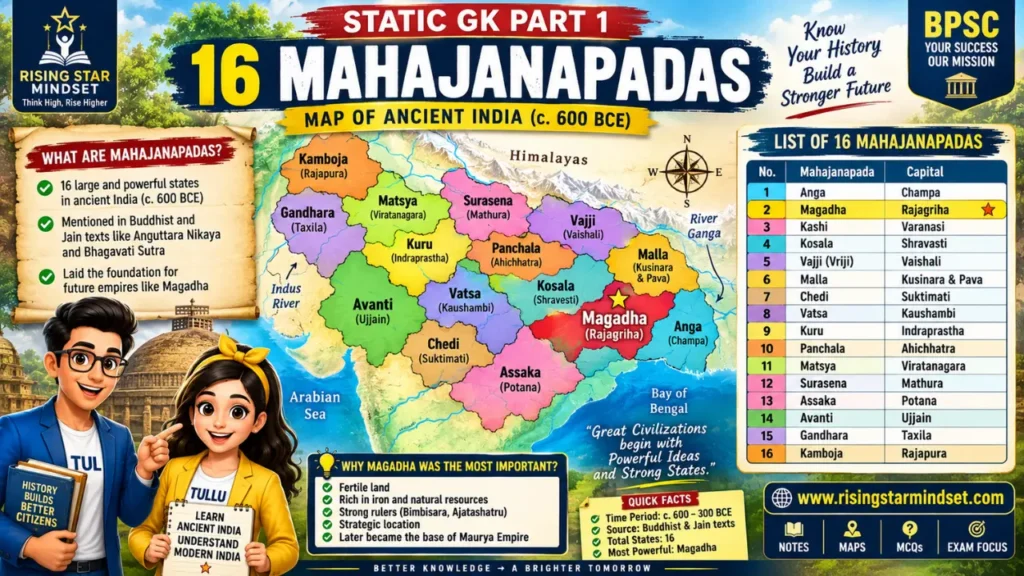
Around the 6th Century BCE, several kingdoms emerged in northern India. Among them, 16 powerful kingdoms became famous as the Mahajanapadas. Moreover, these kingdoms played a major role in the rise of Magadha, Jainism, and Buddhism.
🇮🇳 हिन्दी ( Ancient Indian History )
छठी शताब्दी ईसा पूर्व में भारत में 16 शक्तिशाली राज्यों का उदय हुआ जिन्हें महाजनपद कहा गया। इसके अलावा, इन्हीं राज्यों के समय जैन धर्म, बौद्ध धर्म तथा मगध साम्राज्य का विकास हुआ।
16 Mahajanapadas
| Mahajanapada | Capital |
| Magadha | Rajgir |
| Kosala | Shravasti |
| Avanti | Ujjain |
| Vatsa | Kaushambi |
| Anga | Champa |
| Kashi | Varanasi |
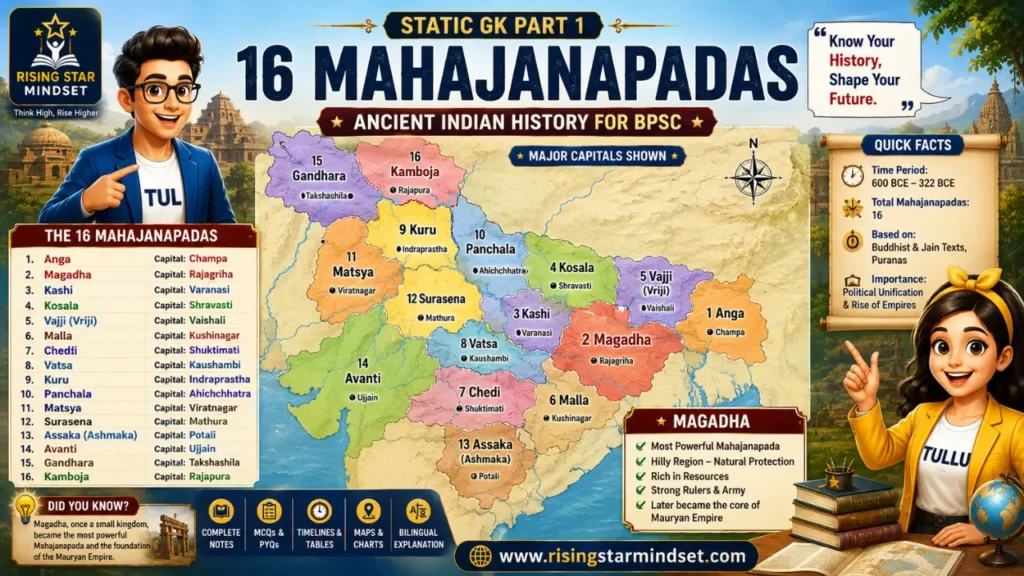
(Exam Tip: BPSC में मुख्यतः Magadha, Kosala, Avanti, Anga, Vatsa, Kashi पर प्रश्न पूछे जाते हैं।)
Why Magadha Became Powerful?
| Reason | Importance |
| Iron Ore | Better Weapons |
| Fertile Land | Agriculture |
| Rivers | Trade |
| Strong Kings | Expansion |
Jainism (जैन धर्म) ( Ancient Indian History )
Founder
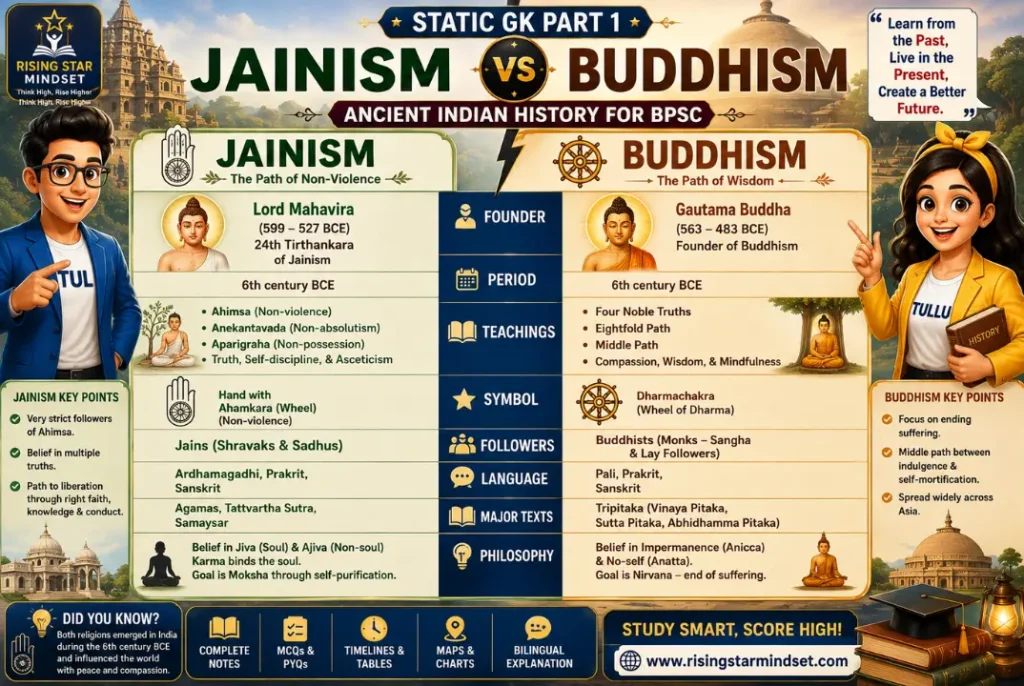
24th Tirthankara → Mahavira
Important Facts
| Topic | Answer |
| Birth | Kundagrama |
| Father | Siddhartha |
| Mother | Trishala |
| Symbol | Lion |
| Language | Prakrit |
| Nirvana | Pavapuri (Bihar) |
Five Principles
- Ahimsa
- Satya
- Asteya
- Aparigraha
- Brahmacharya
🇬🇧 English
Jainism emphasized non-violence, truth, self-control, and simplicity. Therefore, it influenced Indian philosophy and ethics deeply.
🇮🇳 हिन्दी
जैन धर्म ने अहिंसा, सत्य, संयम तथा सादगी पर विशेष बल दिया। इसलिए, इसका भारतीय दर्शन एवं नैतिक जीवन पर गहरा प्रभाव पड़ा।
Buddhism (बौद्ध धर्म) ( Ancient Indian History )
Founder
Gautama Buddha
Important Facts
| Topic | Answer |
| Birth | Lumbini |
| Enlightenment | Bodh Gaya |
| First Sermon | Sarnath |
| Mahaparinirvana | Kushinagar |
Four Noble Truths
- Life is Suffering
- Cause of Suffering
- End of Suffering
- Eightfold Path
Eightfold Path
- Right View
- Right Thought
- Right Speech
- Right Action
- Right Livelihood
- Right Effort
- Right Mindfulness
- Right Concentration
Comparison Table
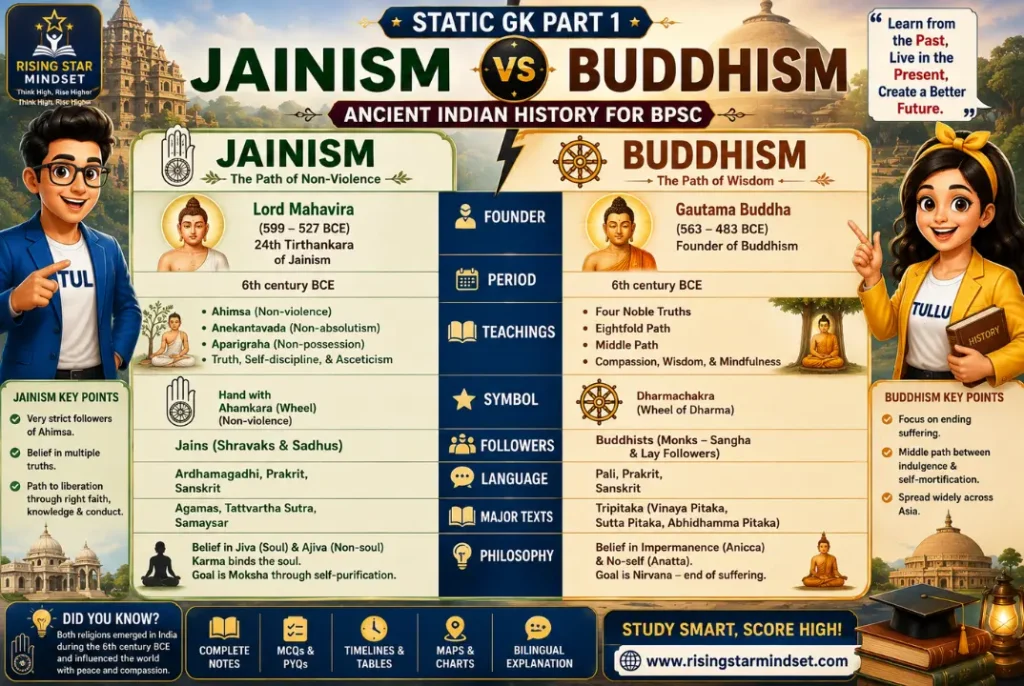
| Jainism | Buddhism |
| Mahavira | Buddha |
| Extreme Austerity | Middle Path |
| Soul Exists | No Permanent Soul |
| Prakrit | Pali |
Ancient Indian History One Shot Revision
| Topic | Remember |
| First Urban Civilization | Harappa |
| Oldest Veda | Rigveda |
| Number of Mahajanapadas | 16 |
| Founder of Jainism | Mahavira |
| Founder of Buddhism | Gautama Buddha |
| Enlightenment | Bodh Gaya |
| First Sermon | Sarnath |
| Nirvana | Kushinagar |
| Dockyard | Lothal |
| Great Bath | Mohenjo-daro |
MCQs (1–25) with Answers & Explanations
(English + हिन्दी | BPSC | UPSC | SSC | Railway | Bihar SI)
1. Which is considered the first urban civilization of India?
A. Vedic Civilization
B. Gupta Civilization
C. Indus Valley Civilization
D. Mauryan Civilization
✅ Answer: C. Indus Valley Civilization
Explanation (English): The Indus Valley Civilization was the first planned urban civilization in the Indian subcontinent.
व्याख्या (हिन्दी): सिंधु घाटी सभ्यता भारत की पहली विकसित नगरीय सभ्यता थी।
2. Harappa is situated in which present-day country?
A. India
B. Nepal
C. Pakistan
D. Bangladesh
✅ Answer: C
3. The Great Bath was discovered at:
A. Harappa
B. Mohenjo-daro
C. Lothal
D. Kalibangan
✅ Answer: B
4. Which Harappan site is famous for its Dockyard?
A. Harappa
B. Mohenjo-daro
C. Lothal
D. Dholavira
✅ Answer: C
5. Fire Altars have been found at:
A. Banawali
B. Kalibangan
C. Harappa
D. Rakhigarhi
✅ Answer: B
6. Which Harappan site is known for excellent water management?
A. Harappa
B. Mohenjo-daro
C. Dholavira
D. Lothal
✅ Answer: C
7. Horse bones were found at:
A. Kalibangan
B. Surkotada
C. Lothal
D. Harappa
✅ Answer: B
8. The Harappan script is:
A. Completely Deciphered
B. Partially Deciphered
C. Still Undeciphered
D. Sanskrit Script
✅ Answer: C
9. Which crop was first cultivated by the Harappans?
A. Rice
B. Wheat
C. Cotton
D. Tea
✅ Answer: C
10. The Indus Valley Civilization belongs to:
A. Stone Age
B. Bronze Age
C. Iron Age
D. Modern Age
✅ Answer: B
11. The oldest Veda is:
A. Samaveda
B. Yajurveda
C. Rigveda
D. Atharvaveda
✅ Answer: C
12. Which Veda is known as the Book of Hymns?
A. Rigveda
B. Yajurveda
C. Samaveda
D. Atharvaveda
✅ Answer: A
13. The Gayatri Mantra is found in:
A. Atharvaveda
B. Rigveda
C. Samaveda
D. Yajurveda
✅ Answer: B
14. How many Vedas are there?
A. 2
B. 3
C. 4
D. 5
✅ Answer: C
15. The main occupation during the Later Vedic Period was:
A. Hunting
B. Fishing
C. Agriculture
D. Mining
✅ Answer: C
16. Which Mahajanapada became the most powerful?
A. Kosala
B. Avanti
C. Magadha
D. Vatsa
✅ Answer: C
17. The capital of Magadha was:
A. Champa
B. Rajgir
C. Ujjain
D. Kaushambi
✅ Answer: B
18. How many Mahajanapadas were there?
A. 12
B. 14
C. 16
D. 18
✅ Answer: C
19. Mahavira was the ______ Tirthankara.
A. 22nd
B. 23rd
C. 24th
D. 25th
✅ Answer: C
20. Mahavira attained Nirvana at:
A. Rajgir
B. Pavapuri
C. Vaishali
D. Nalanda
✅ Answer: B
21. Gautama Buddha was born at:
A. Bodh Gaya
B. Sarnath
C. Lumbini
D. Kushinagar
✅ Answer: C
22. Buddha attained Enlightenment at:
A. Kushinagar
B. Sarnath
C. Lumbini
D. Bodh Gaya
✅ Answer: D
23. The First Sermon of Buddha was delivered at:
A. Bodh Gaya
B. Sarnath
C. Rajgir
D. Vaishali
✅ Answer: B
24. Buddha attained Mahaparinirvana at:
A. Bodh Gaya
B. Kushinagar
C. Lumbini
D. Rajgir
✅ Answer: B
25. Buddhism mainly teaches:
A. Violence
B. Luxury
C. Middle Path
D. Animal Sacrifice
✅ Answer: C
Explanation (English): Gautama Buddha taught the Middle Path (Madhyam Marg), avoiding both extreme luxury and extreme austerity.
व्याख्या (हिन्दी): भगवान बुद्ध ने मध्यम मार्ग का उपदेश दिया, जिसमें अत्यधिक भोग और अत्यधिक तपस्या दोनों से बचने की शिक्षा दी गई।
📝 MCQs (26–50) ( Ancient Indian History )
26. Which Veda is known as the oldest Veda?
A. Samaveda
B. Atharvaveda
C. Rigveda
D. Yajurveda
✅ Answer: C. Rigveda
27. Which Veda is called the Book of Hymns?
A. Rigveda
B. Yajurveda
C. Samaveda
D. Atharvaveda
✅ Answer: A
28. The capital of Magadha was:
A. Kaushambi
B. Rajgir
C. Ujjain
D. Taxila
✅ Answer: B
29. Gautama Buddha attained enlightenment at:
A. Sarnath
B. Lumbini
C. Bodh Gaya
D. Kushinagar
✅ Answer: C
30. Mahavira was the ______ Tirthankara.
A. 20th
B. 22nd
C. 23rd
D. 24th
✅ Answer: D
31. Which Mahajanapada became the strongest?
A. Kosala
B. Avanti
C. Magadha
D. Kashi
✅ Answer: C
32. The Great Bath is located at:
A. Harappa
B. Mohenjo-daro
C. Lothal
D. Dholavira
✅ Answer: B
33. Which Harappan site is famous for its Dockyard?
A. Harappa
B. Kalibangan
C. Lothal
D. Banawali
✅ Answer: C
34. Fire Altars have been discovered at:
A. Kalibangan
B. Harappa
C. Mohenjo-daro
D. Rakhigarhi
✅ Answer: A
35. Which civilization had the best underground drainage system?
A. Mauryan
B. Gupta
C. Indus Valley
D. Vedic
✅ Answer: C
36. The first sermon of Buddha was delivered at:
A. Bodh Gaya
B. Lumbini
C. Sarnath
D. Rajgir
✅ Answer: C
37. Mahavira attained Nirvana at:
A. Rajgir
B. Vaishali
C. Pavapuri
D. Sarnath
✅ Answer: C
38. Which language was mainly used for Buddhist teachings?
A. Sanskrit
B. Pali
C. Persian
D. Tamil
✅ Answer: B
39. Which language was mainly associated with Jainism?
A. Prakrit
B. Arabic
C. Greek
D. Latin
✅ Answer: A
40. Which was the first urban civilization in India?
A. Vedic Civilization
B. Gupta Civilization
C. Indus Valley Civilization
D. Mauryan Civilization
✅ Answer: C
41. Rigveda mainly contains:
A. Medical Science
B. Hymns
C. Drama
D. Astronomy
✅ Answer: B
42. The national motto “Satyameva Jayate” is taken from:
A. Rigveda
B. Mundaka Upanishad
C. Mahabharata
D. Ramayana
✅ Answer: B
43. Buddha belonged to which clan?
A. Maurya
B. Shakya
C. Gupta
D. Nanda
✅ Answer: B
44. Which city is known for excellent water management?
A. Harappa
B. Mohenjo-daro
C. Dholavira
D. Banawali
✅ Answer: C
45. Which Harappan site is located in Haryana?
A. Lothal
B. Banawali
C. Kalibangan
D. Dholavira
✅ Answer: B
46. Which king made Magadha the most powerful Mahajanapada?
A. Bimbisara
B. Chandragupta
C. Harsha
D. Samudragupta
✅ Answer: A
47. Buddhism mainly teaches:
A. Extreme Luxury
B. Middle Path
C. Violence
D. Ritual Sacrifice
✅ Answer: B
48. Jainism mainly emphasizes:
A. Violence
B. Luxury
C. Non-violence
D. Animal Sacrifice
✅ Answer: C
49. Which civilization first cultivated cotton?
A. Vedic
B. Gupta
C. Harappan
D. Mauryan
✅ Answer: C
50. Which chapter is considered the foundation of Ancient Indian History?
A. Medieval India
B. Modern India
C. Indus Valley Civilization
D. Mughal India
✅ Answer: C
🔥 HOTS Questions ( Ancient Indian History )
Q1.
Why is the Indus Valley Civilization called the first urban civilization of India?
Q2.
Compare the social life of the Harappan and Vedic people.
Q3.
Explain why Magadha became the most powerful Mahajanapada.
Q4.
Differentiate between Jainism and Buddhism with suitable examples.
Q5.
Why are the Vedas considered the foundation of Indian civilization?
📚 Previous Year Questions (PYQs)
BPSC
Q. Which Harappan site is famous for the Dockyard?
✅ Lothal
UPSC
Q. Great Bath belongs to which civilization?
✅ Indus Valley Civilization
SSC
Q. Who was the 24th Tirthankara?
✅ Mahavira
Railway
Q. Buddha attained enlightenment at?
✅ Bodh Gaya
Bihar SI
Q. Which Mahajanapada became the strongest?
✅ Magadha
🎯 Expected Questions (BPSC 2026–27)
- Explain the major features of the Indus Valley Civilization.
- Compare Early Vedic and Later Vedic societies.
- Discuss the importance of the Mahajanapadas.
- Explain the causes behind the rise of Magadha.
- Describe the teachings of Mahavira.
- Explain the Four Noble Truths of Buddhism.
- Differentiate between Jainism and Buddhism.
- Explain Harappan town planning.
- Why is Dholavira unique?
- Why is Ancient Indian History important for BPSC?
❓ Frequently Asked Questions (FAQs)
Q1. Which topic is most important in Ancient Indian History for BPSC?
English: Indus Valley Civilization, Vedic Period, Mahajanapadas, Jainism, and Buddhism are among the most frequently asked topics.
हिन्दी: सिंधु घाटी सभ्यता, वैदिक काल, महाजनपद, जैन धर्म तथा बौद्ध धर्म BPSC में सबसे अधिक पूछे जाने वाले विषय हैं।
Q2. Is Ancient Indian History scoring?
English: Yes. With proper revision, timelines, and MCQ practice, it is one of the highest-scoring sections.
हिन्दी: हाँ। नियमित Revision, Timeline तथा MCQs के अभ्यास से यह सबसे अधिक अंक दिलाने वाले विषयों में से एक है।
Q3. Which books are best for Ancient Indian History?
English: NCERT, R.S. Sharma, and BPSC-oriented notes are highly recommended.
हिन्दी: NCERT, आर.एस. शर्मा तथा BPSC आधारित नोट्स सर्वोत्तम माने जाते हैं।
🌟 Conclusion | निष्कर्ष
🇬🇧 English
Ancient Indian History forms the foundation of India’s civilization and is one of the most important subjects for BPSC and other competitive examinations. Moreover, understanding the chronological sequence of events makes the subject easier and more interesting. Furthermore, topics such as the Indus Valley Civilization, the Vedic Age, the Mahajanapadas, Jainism, and Buddhism are repeatedly asked in examinations. Therefore, regular revision, solving MCQs, analyzing previous year questions, and practicing expected questions will significantly improve your preparation. Finally, if you study consistently and revise strategically, Ancient Indian History can become one of your strongest scoring areas.
🇮🇳 हिन्दी ( Ancient Indian History )
प्राचीन भारतीय इतिहास भारतीय सभ्यता की आधारशिला है तथा BPSC एवं अन्य प्रतियोगी परीक्षाओं के लिए अत्यंत महत्वपूर्ण विषय है। इसके अलावा, यदि घटनाओं को कालक्रम (Chronology) के अनुसार समझा जाए, तो यह विषय सरल और रोचक बन जाता है। साथ ही, सिंधु घाटी सभ्यता, वैदिक काल, महाजनपद, जैन धर्म तथा बौद्ध धर्म से प्रत्येक वर्ष प्रश्न पूछे जाते हैं। इसलिए, नियमित Revision, MCQs का अभ्यास, PYQs का विश्लेषण तथा Expected Questions की तैयारी आपकी सफलता की संभावना को कई गुना बढ़ा देती है। अंततः, निरंतर अध्ययन, अनुशासित अभ्यास और स्मार्ट Revision के माध्यम से आप Ancient Indian History में उत्कृष्ट अंक प्राप्त कर सकते हैं।
🌟 Keep Learning with Rising Star Mindset
📘 Spoken English Course
🏛️ BPSC Preparation
🎓 School Notes
💡 Daily Motivation
🌐 Website: www.risingstarmindset.com