
Introduction (Class 7 Sets)
Have you ever collected different types of pens, video games, or books? In mathematics, when we group similar things together, we call it a Set. Welcome to the amazing world of Sets, where we learn how to organize data mathematically! (Class 7)
क्या आपने कभी अलग-अलग तरह के पेन, वीडियो गेम या किताबों को इकट्ठा किया है? गणित में, जब हम एक जैसी चीज़ों को एक साथ एक समूह में रखते हैं, तो उसे समुच्चय (Set) कहा जाता है। Sets की इस अद्भुत दुनिया में आपका स्वागत है, जहाँ हम डेटा को गणितीय रूप से व्यवस्थित करना सीखते हैं! (Class 7)
What is a Set? (समुच्चय क्या है?) (Class 7)
English: A Set is a well-defined collection of distinct objects. “Well-defined” means there should be no confusion about whether an object belongs to the set or not. The objects in a set are called its elements or members.
Hindi: वस्तुओं के सुपरिभाषित (Well-defined) संग्रह को समुच्चय (Set) कहते हैं। “सुपरिभाषित” का अर्थ है कि इस बात में कोई भ्रम नहीं होना चाहिए कि कोई वस्तु उस समूह का हिस्सा है या नहीं। समुच्चय की वस्तुओं को उसके अवयव (Elements या Members) कहा जाता है।
Examples (उदाहरण):
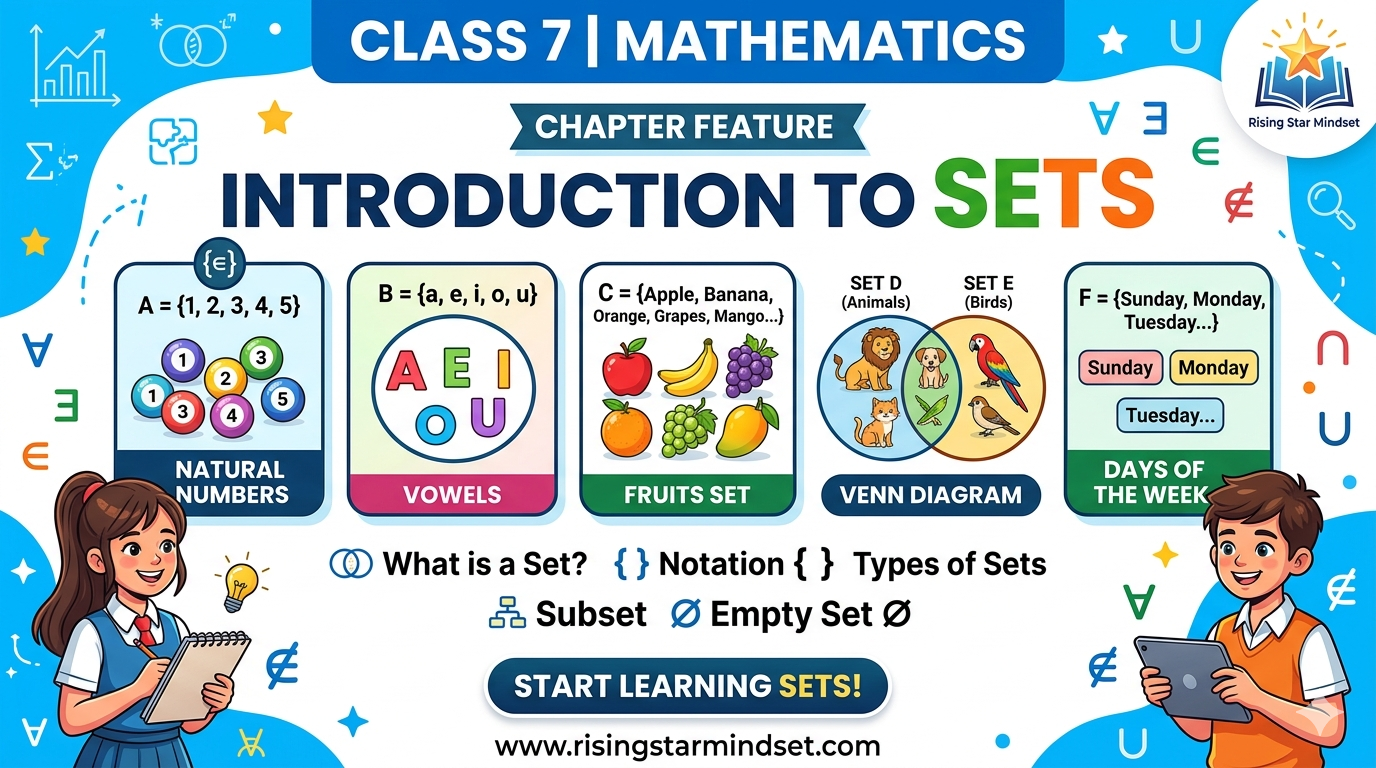
- A Set: Collection of all vowels in the English alphabet .A = {1, 2, 3}, तो 2 ∈ A. This is well-defined because everyone agrees on these 5 letters.
- NOT a Set: Collection of the 3 best cricketers in India. This is NOT a set because “best” depends on personal opinion (not well-defined).
- समुच्चय है: अंग्रेजी वर्णमाला के सभी स्वरों (Vowels) का संग्रह A = {1, 2, 3}, तो 2 ∈ A। यह सुपरिभाषित है क्योंकि सभी का उत्तर यही होगा।
- समुच्चय नहीं है: भारत के 3 सबसे अच्छे क्रिकेटरों का संग्रह। यह समुच्चय नहीं है क्योंकि “सबसे अच्छा” हर व्यक्ति की पसंद के हिसाब से बदल सकता है।
Important Symbols in Sets (महत्वपूर्ण प्रतीक) (Class 7)
| Symbol (प्रतीक) | Meaning (अर्थ) | Example (उदाहरण) |
| ∈ | Belongs to (का सदस्य है) | यदि A = {1, 2, 3}, तो 2 ∈ A |
| ∉ | Does not belong to (का सदस्य नहीं है) | यदि A = {1, 2, 3}, तो 5 ∉ A |
| ξ या U | Universal Set (सार्वत्रिक समुच्चय) | Contains all elements under consideration |
| Φ या { } | Empty Set / Null Set (रिक्त समुच्चय) | A set with zero elements |
Methods of Representing a Set (समुच्चय को दर्शाने की विधियाँ) (Class 7)
There are two main methods to represent a set in Class 7 Maths:
कक्षा 7 गणित में समुच्चय को दर्शाने की दो मुख्य विधियाँ हैं:
1. Roster or Tabular Form (रोस्टर या सारणीकरण रूप)
- English: In this form, all the elements of a set are listed, separated by commas, and enclosed within curly brackets $\{\}$.
- Hindi: इस रूप में, समुच्चय के सभी अवयवों को कॉमा (,) लगाकर एक सूची के रूप में घुमावदार कोष्ठक $\{\}$ के अंदर लिखा जाता है।
- Example: Set of first five natural numbers: $N = \{1, 2, 3, 4, 5\}$
2. Set-Builder Form (समुच्चय निर्माण रूप)
- English: In this form, we describe the common property of the elements instead of listing them.
- Hindi: इस रूप में, अवयवों की सूची बनाने के बजाय, हम उनके सामान्य गुण या विशेषता को लिखते हैं।
- Example: $N = \{x : x \text{ is a natural number and } x \leq 5\}$ (इसे पढ़ते हैं: $x$ जहाँ $x$ एक प्राकृत संख्या है जो 5 या 5 से छोटी है)।
Types of Sets (समुच्चय के प्रकार) (Class 7)
Understanding types of sets is crucial for solving Class 7 exams:
परीक्षा के प्रश्नों को हल करने के लिए समुच्चय के प्रकारों को समझना बेहद ज़रूरी है:
- Finite Set (परिमित समुच्चय): A set containing a countable number of elements. Example: Days of a week. (जिसमें अवयवों की संख्या सीमित/गिनी जा सकने वाली हो। जैसे: सप्ताह के दिन)।
- Infinite Set (अपरिमित समुच्चय): A set with uncountable elements. Example: Set of all stars in the sky. (जिसमें अवयवों की संख्या असीमित हो। जैसे: आकाश में तारों का समूह)।
- Empty / Null Set (रिक्त समुच्चय): A set which has no elements. It is denoted by { }. Example: A month having 40 days. (ऐसा समूह जिसमें एक भी अवयव न हो। जैसे: 40 दिनों का महीना)।
- Equal Sets (समान समुच्चय): Two sets having exactly the same elements. If A = {1, 2} and B = {2, 1}, then A = B. (दो ऐसे समुच्चय जिनके सभी अवयव बिल्कुल एक जैसे हों, जैसे यदि A = {1, 2} और B = {2, 1}, तो A = B)।
Cardinal Number of a Set (समुच्चय की कार्डिनल संख्या)
English: The total number of distinct elements present in a finite set is called its Cardinal Number. It is represented by n(A).
Hindi: किसी परिमित समुच्चय में उपस्थित अलग-अलग अवयवों की कुल संख्या को उसकी कार्डिनल संख्या कहा जाता है। इसे n(A) द्वारा दर्शाया जाता है।
Example (उदाहरण): If A = {a, b, c, d, e}, then the cardinal number is n(A) = 5. (यदि A = {a, b, c, d, e} है, तो इसकी कार्डिनल संख्या n(A) = 5 होगी)।
Solved Examples for Practice (हल किए गए उदाहरण)
Question 1: Write the set of letters in the word “SCHOOL” in Roster Form.
- Solution: While writing in roster form, elements are never repeated and are written inside curly brackets. So, the answer is: S = {S, C, H, O, L}.
प्रश्न 1: “SCHOOL” शब्द के अक्षरों को रोस्टर रूप में लिखिए।
- हल: रोस्टर रूप में लिखते समय अक्षरों को दोबारा नहीं दोहराया जाता है और उन्हें घुमावदार कोष्ठक के अंदर लिखा जाता है। इसलिए सही उत्तर होगा: S = {S, C, H, O, L}।
Question 2: Find the cardinal number of Set B = {x : x is a prime number less than 10}.
- Solution: First, let’s write it in Roster form. Prime numbers less than 10 are 2, 3, 5, and 7. So, B = {2, 3, 5, 7}. Therefore, Cardinal Number n(B) = 4.
प्रश्न 2: समुच्चय B = {x : x, 10 से छोटी एक अभाज्य संख्या है} की कार्डिनल संख्या ज्ञात कीजिए।
- हल: सबसे पहले इसे रोस्टर रूप में लिखते हैं। 10 से छोटी अभाज्य संख्याएँ 2, 3, 5, और 7 हैं। इसलिए रोस्टर रूप होगा: B = {2, 3, 5, 7}। अतः इसकी कार्डिनल संख्या n(B) = 4 होगी।
Class 7 Maths Set Chapter Test (स्वयं जांचें)
Try to solve these questions for your exam preparation:
अपनी परीक्षा की तैयारी के लिए इन प्रश्नों को खुद हल करने का प्रयास करें:
- Identify if the collection of “all intelligent students in your class” is a set or not. (क्या आपकी कक्षा के “बुद्धिमान छात्रों का संग्रह” एक समुच्चय है?)
- Write A = {2, 4, 6, 8, 10} in Set-Builder form. (A = {2, 4, 6, 8, 10} को समुच्चय निर्माण रूप में बदलें।)
- What is the cardinal number of an Empty Set? (एक रिक्त समुच्चय की कार्डिनल संख्या क्या होती है?)
We hope these Class 7 Maths Notes on Introduction to Sets made your concepts crystal clear! Stay tuned for more educational chapters.
Think High, Rise Higher!
Maths class =7. (Divine)
1. Sets
2. Integer
3. Fraction
4. Decimal
5.Rational number
6. Exponents
7. Ratio and proportion
8. Unitary method
9. Profit loss and discount
10. Simple interest
Maths class =7. (Divine)
1. Sets
2. Integer
3. Fraction
4. Decimal
5.Rational number
6. Exponents
7. Ratio and proportion
8. Unitary method
9. Percentage
10. Profit loss and discount
11. Simple interest
12. Algebraic Expression