How to Talk About Yourself in English: Easy Sentences & Examples
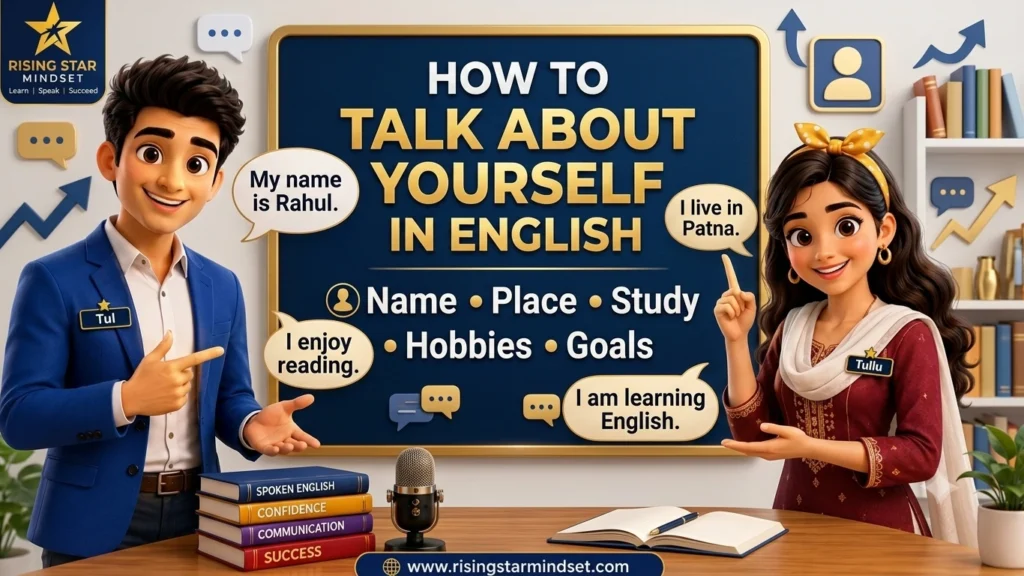
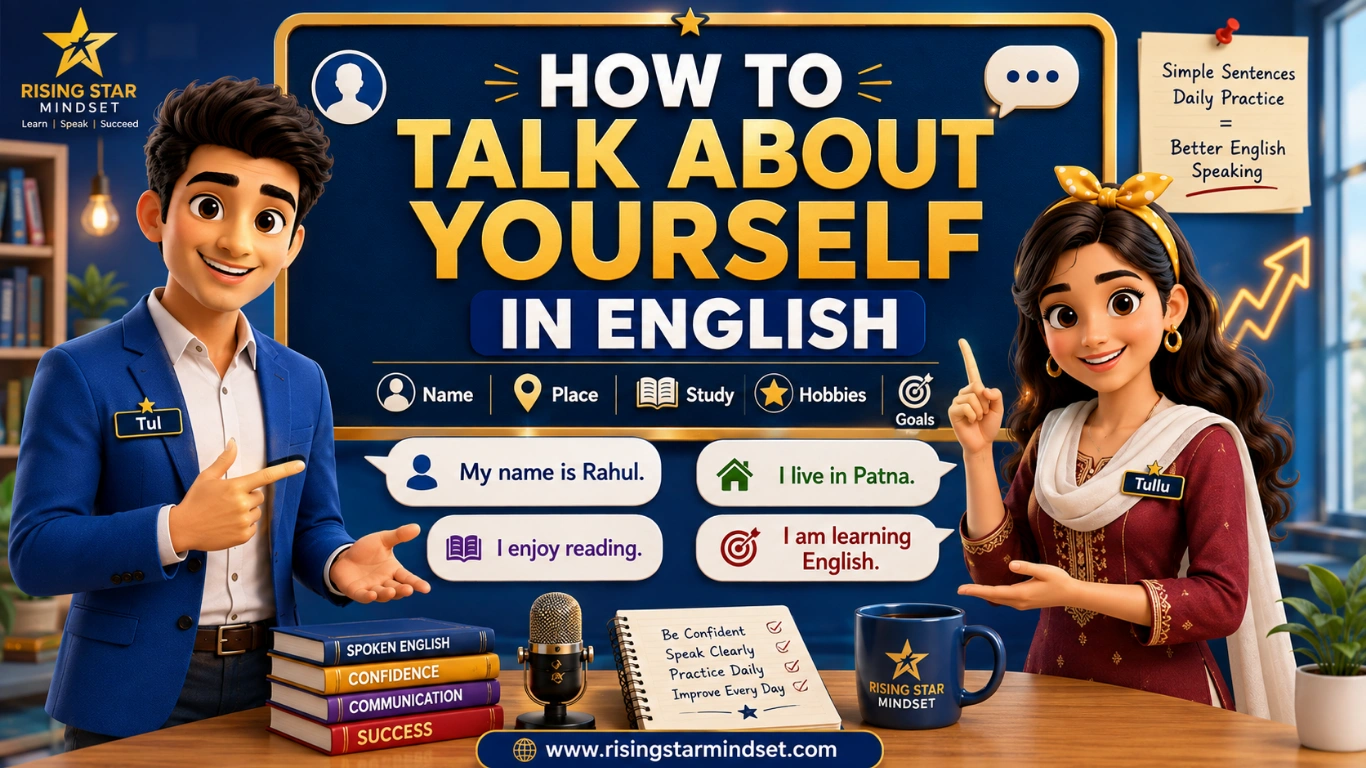
How to Talk About Yourself in English is one of the most useful skills for beginners who want to speak English confidently. Whether you are meeting someone for the first time, attending a class, joining a workplace, participating in an interview, or simply having a conversation with a friend, you often need to talk about yourself.
However, many English learners know individual words but struggle to put those words together into natural sentences. Therefore, learning a few simple sentence patterns can make self-expression much easier.
For example:
My name is Rahul.
मेरा नाम राहुल है।
I live in Patna.
मैं पटना में रहता हूँ।
In my free time, I enjoy reading books.
अपने खाली समय में, मुझे किताबें पढ़ना पसंद है।
Moreover, I am learning English because I want to communicate confidently.
इसके अलावा, मैं English सीख रहा हूँ क्योंकि मैं आत्मविश्वास के साथ बातचीत करना चाहता हूँ।
Moreover, you do not need difficult vocabulary to talk about yourself. Instead, you need simple sentences, regular practice, and confidence.
So, in this complete guide, you will learn How to Talk About Yourself in English with easy English-Hindi explanations, useful sentence patterns, question-and-answer examples, MCQs, HOTS questions, speaking practice, and practical conversation examples.
📚 How to Talk About Yourself in English– Roadmap
- Talking About Yourself in English
- Why Self-Introduction Skills Matter
- Basic Information About Yourself
- Introducing Your Name
- Talking About Your Location
- Sharing Your Education or Job
- Describing Your Family
- Talking About Your Hobbies
- Expressing Likes and Dislikes
- Describing Your Daily Life
- Talking About Your Personality
- Sharing Your Goals and Dreams
- Talking About Your English Learning
- Useful English Sentence Patterns
- Creating a Short Self-Introduction
- Building a Detailed Self-Introduction
- Self-Introduction in Daily Conversation
- Common English Mistakes to Avoid
- Question and Answer Practice
- Multiple Choice Questions (MCQs)
- HOTS: Think and Speak
- 7-Day Speaking Challenge
- Useful Abbreviations
- Key Points to Remember
- Frequently Asked Questions (FAQs)
- Conclusion: Start Speaking About Yourself
- Related Post : How to Ask Questions in English: Easy Rules & Examples
1. What Does “Talk About Yourself” Mean?
Talk about yourself means giving information about your life, interests, background, personality, studies, work, family, hobbies, goals, or other things related to you.
Simple Example
My name is Amit, and I live in Delhi. In my free time, I enjoy playing cricket and reading books. Besides that, I am learning English to improve my communication skills.
Hindi Explanation
इसका अर्थ है अपने बारे में English में जानकारी देना। अपने बारे में बात करते समय आपको हर छोटी-बड़ी जानकारी बताने की आवश्यकता नहीं होती। इसके बजाय, situation के अनुसार name, place, education, hobbies, interests और goals जैसी relevant information साझा करना अधिक natural लगता है।
For example, when meeting someone casually, you can say:
Hi! My name is Amit, and I currently live in Delhi. Nice to meet you.
वहीं, an interview में आपको अपनी education, skills, experience और career goals के बारे में थोड़ी अधिक जानकारी देनी पड़ सकती है। इसलिए, situation के अनुसार अपने introduction को छोटा या detailed रखना बेहतर होता है।
2. Why Is This Skill Important?
सबसे पहले, अपने बारे में बोलना सीखना English speaking की foundation मजबूत करता है।
इसके अलावा, यह skill आपको कई situations में मदद करती है:
- Meeting new people
- Classroom conversations
- Job interviews
- College introductions
- Social conversations
- Online meetings
- English speaking practice
- Group discussions
Moreover, जब आप अपने बारे में confidently बोलना सीख जाते हैं, तो दूसरे topics पर बोलना भी comparatively आसान हो जाता है।
Remember:
Self-talk → Confidence → Conversation → Better Fluency
3. Basic Information About Yourself ( How to Talk About Yourself in English )
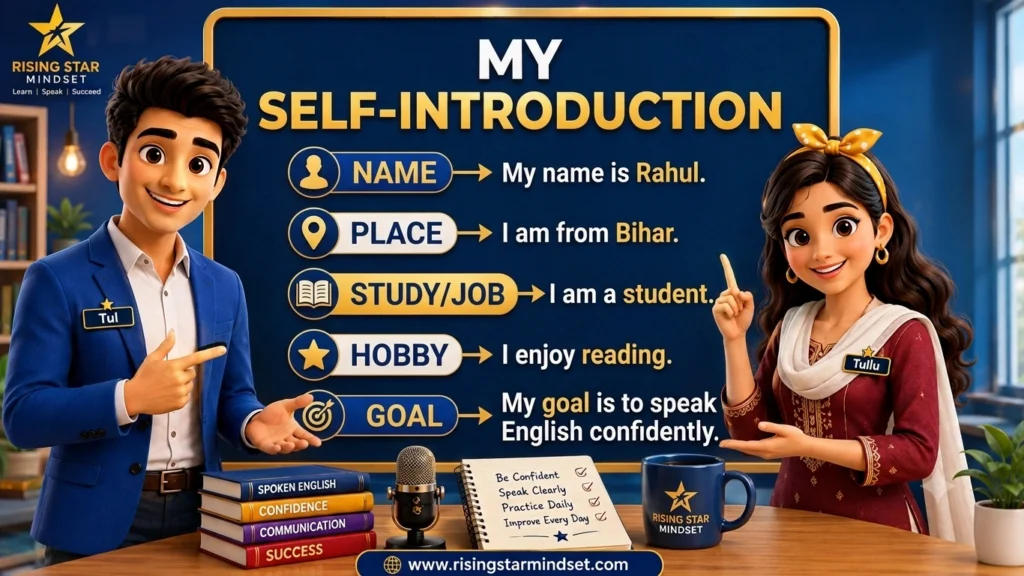
अपने बारे में बात करते समय आप basic information से शुरुआत कर सकते हैं।
Useful Topics
| Topic | Example |
| Name | My name is Rahul. |
| Place | I live in Patna. |
| Education | I am a student. |
| Job | I work as a teacher. |
| Family | I have a small family. |
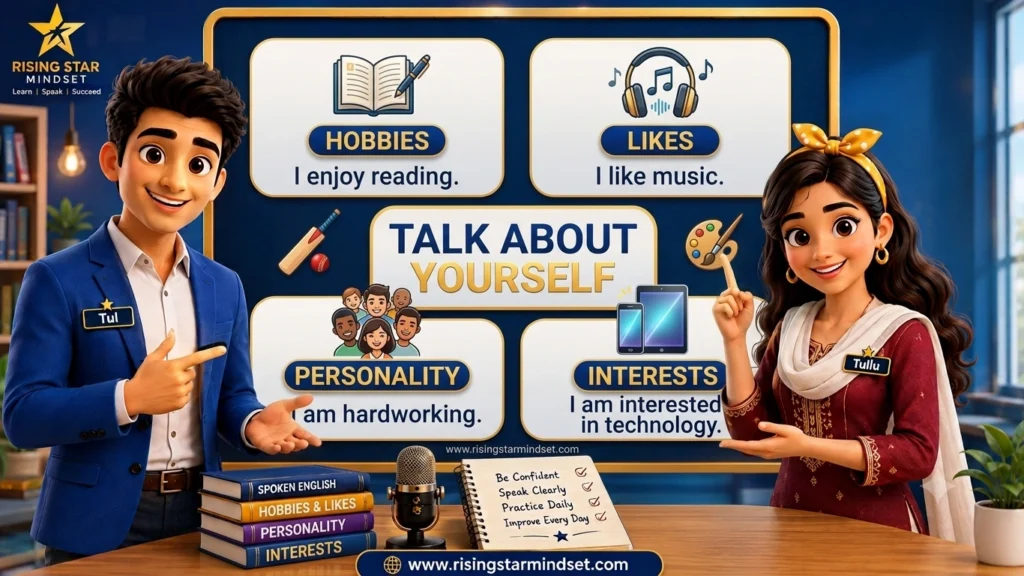
| Hobby | I enjoy reading. |
| Likes | I like music. |
| Goal | I want to become a teacher. |
| English | I am learning English. |
इस प्रकार, इन छोटे topics को जोड़कर आप एक complete introduction तैयार कर सकते हैं।
4. How to Talk About Your Name
अपने नाम के बारे में बताना सबसे आसान starting point है।
Useful Sentences
My name is Rahul.
मेरा नाम राहुल है।
I am Rahul.
मैं राहुल हूँ।
You can call me Rahul.
आप मुझे राहुल कह सकते हैं।
My full name is Rahul Kumar.
मेरा पूरा नाम राहुल कुमार है।
Conversation
A: What is your name?
B: My name is Rahul. You can call me Rahul.
A: Nice to meet you, Rahul.
B: Nice to meet you too.
Useful Tip
Casual conversation में:
I’m Rahul.
बहुत natural लगता है।
5. How to Talk About Where You Live
इसके बाद आप अपने city, town या village के बारे में बता सकते हैं।
Examples
I live in Patna.
मैं पटना में रहता/रहती हूँ।
Originally, I am from Bihar.
मैं मूल रूप से बिहार से हूँ।
At present, I live with my family.
वर्तमान में, मैं अपने परिवार के साथ रहता/रहती हूँ।
I grew up in a small town.
मैं एक छोटे शहर में बड़ा/बड़ी हुआ/हुई।
These days, I live in Delhi.
आजकल मैं दिल्ली में रहता/रहती हूँ।
Question & Answer
Q: Where do you live?
A: I live in Patna.
Q: Where are you from?
A: I am from Bihar.
ध्यान रखें:
I am from… → आपका origin/place बताता है।
I live in… → जहाँ आप अभी रहते हैं, वह बताता है।
6. How to Talk About Your Studies or Job
अब अपनी education या profession के बारे में बताइए।
For Students
I am a student.
मैं एक विद्यार्थी हूँ।
I study in Class 10.
मैं कक्षा 10 में पढ़ता/पढ़ती हूँ।
I study science.
मैं science पढ़ता/पढ़ती हूँ।
I am preparing for my exams.
मैं अपनी परीक्षाओं की तैयारी कर रहा/रही हूँ।
I enjoy learning new things.
मुझे नई चीजें सीखना पसंद है।
For Working People
I am a teacher.
मैं एक शिक्षक हूँ।
I work in a school.
मैं एक school में काम करता/करती हूँ।
I work as a manager.
मैं manager के रूप में काम करता/करती हूँ।
I have been working here for three years.
मैं यहाँ तीन साल से काम कर रहा/रही हूँ।
7. How to Talk About Your Family
Family के बारे में बात करना daily conversation में बहुत common है।
Useful Sentences
There are four members in my family.
मेरे परिवार में चार सदस्य हैं।
I live with my parents.
मैं अपने माता-पिता के साथ रहता/रहती हूँ।
I have one brother and one sister.
मेरा एक भाई और एक बहन है।
My father is a teacher.
मेरे पिता शिक्षक हैं।
My mother is a homemaker.
मेरी माँ homemaker हैं।
We enjoy spending time together.
हमें साथ समय बिताना पसंद है।
Example
I have a small family. There are four members in my family. I live with my parents, my brother, and my sister. We enjoy spending time together.
8. How to Talk About Your Hobbies
इसके बाद conversation को interesting बनाने के लिए hobbies के बारे में बात करें।
Useful Sentences
I like reading books.
मुझे किताबें पढ़ना पसंद है।
I enjoy listening to music.
मुझे music सुनना पसंद है।
I love playing cricket.
मुझे cricket खेलना बहुत पसंद है।
I like watching movies in my free time.
मुझे free time में movies देखना पसंद है।
I enjoy learning new skills.
मुझे नई skills सीखना अच्छा लगता है।
More Natural Speaking
केवल:
I like reading.
कहने के बजाय:
I like reading because it helps me learn new things.
कहने से आपका answer अधिक natural और interesting लगता है।
9. How to Talk About Your Likes and Dislikes
अपने likes और dislikes बताना भी बहुत useful है।
Likes
I like coffee.
मुझे coffee पसंद है।
I love traveling.
मुझे घूमना बहुत पसंद है।
I enjoy cooking.
मुझे खाना बनाना पसंद है।
I am interested in technology.
मुझे technology में रुचि है।
Dislikes
I don’t like wasting time.
मुझे समय बर्बाद करना पसंद नहीं है।
I don’t enjoy very noisy places.
मुझे बहुत शोर वाली जगहें पसंद नहीं हैं।
I dislike being late.
मुझे देर से पहुँचना पसंद नहीं है।
Natural Example
I enjoy reading and listening to music. However, I don’t like wasting my free time.
यहाँ however sentence को naturally connect करता है।
10. How to Talk About Your Daily Life
अपने daily routine के बारे में बात करना English speaking practice के लिए बेहद effective है।
Examples
I usually wake up early.
मैं आमतौर पर जल्दी उठता/उठती हूँ।
I start my day with a cup of tea.
मैं अपने दिन की शुरुआत एक कप चाय से करता/करती हूँ।
I go to work in the morning.
मैं सुबह काम पर जाता/जाती हूँ।
I study in the evening.
मैं शाम को पढ़ाई करता/करती हूँ।
I spend some time with my family at night.
मैं रात में अपने परिवार के साथ कुछ समय बिताता/बिताती हूँ।
Short Paragraph
I usually wake up early in the morning. Then, I get ready and have breakfast. After that, I go to work. In the evening, I spend some time studying English. Finally, I have dinner and relax with my family.
इस तरह Then, After that, In the evening, Finally जैसे transition words आपके speaking को smooth बनाते हैं।
11. How to Talk About Your Personality
अब आप अपनी personality के बारे में भी बात कर सकते हैं।
Useful Adjectives
| English | Hindi |
| Friendly | मिलनसार |
| Helpful | मददगार |
| Honest | ईमानदार |
| Hard-working | मेहनती |
| Creative | रचनात्मक |
| Patient | धैर्यवान |
| Confident | आत्मविश्वासी |
| Curious | जिज्ञासु |
| Positive | सकारात्मक |
| Responsible | जिम्मेदार |
Examples
I am a friendly person.
मैं मिलनसार व्यक्ति हूँ।
I am hardworking and responsible.
मैं मेहनती और जिम्मेदार हूँ।
I enjoy helping others.
मुझे दूसरों की मदद करना पसंद है।
I always try to learn from my mistakes.
मैं हमेशा अपनी गलतियों से सीखने की कोशिश करता/करती हूँ।
12. How to Talk About Your Goals
अपने goals के बारे में बात करने से आपका introduction अधिक meaningful बन सकता है।
Present Goal
I am working on improving my English.
मैं अपनी English सुधारने पर काम कर रहा/रही हूँ।
Future Goal
I want to become a teacher.
मैं teacher बनना चाहता/चाहती हूँ।
I hope to build a successful career.
मुझे एक successful career बनाने की उम्मीद है।
My goal is to improve my communication skills.
मेरा लक्ष्य अपनी communication skills सुधारना है।
With Reason
My goal is to speak English fluently because I want to communicate confidently.
मेरा लक्ष्य fluent English बोलना है क्योंकि मैं confidently communicate करना चाहता/चाहती हूँ।
13. How to Talk About Your English Learning
क्योंकि आप Spoken English सीख रहे हैं, इसलिए अपने learning journey के बारे में बोलना भी सीखिए।
Examples
I am learning English.
मैं English सीख रहा/रही हूँ।
I practice English every day.
मैं हर दिन English की practice करता/करती हूँ।
I am working on my pronunciation.
मैं अपने pronunciation पर काम कर रहा/रही हूँ।
I want to improve my vocabulary.
मैं अपनी vocabulary improve करना चाहता/चाहती हूँ।
I am trying to speak English without hesitation.
मैं बिना hesitation के English बोलने की कोशिश कर रहा/रही हूँ।
Better Version
I am learning English because I want to communicate confidently. Therefore, I practice speaking every day. I also listen to English conversations and learn new words.
14. Useful Sentence Patterns ( How to Talk About Yourself in English )
अब कुछ simple patterns सीखते हैं जिन्हें आप अलग-अलग situations में इस्तेमाल कर सकते हैं।
Pattern 1: I am…
I am a student.
I am a teacher.
I am from Bihar.
Pattern 2: I live…
I live in Patna.
I live with my family.
Pattern 3: I like…
I like reading.
I like playing cricket.
Pattern 4: I enjoy…
I enjoy listening to music.
I enjoy learning English.
Pattern 5: I want to…
I want to improve my English.
I want to become a teacher.
Pattern 6: I am interested in…
I am interested in technology.
I am interested in learning languages.
Pattern 7: My goal is…
My goal is to speak English fluently.
My goal is to become a successful professional.
Pattern 8: I am trying to…
I am trying to improve my pronunciation.
I am trying to speak English every day.
15. Short Self-Introduction ( How to Talk About Yourself in English )
अब इन sentences को एक साथ जोड़कर एक short introduction बनाते हैं।
English
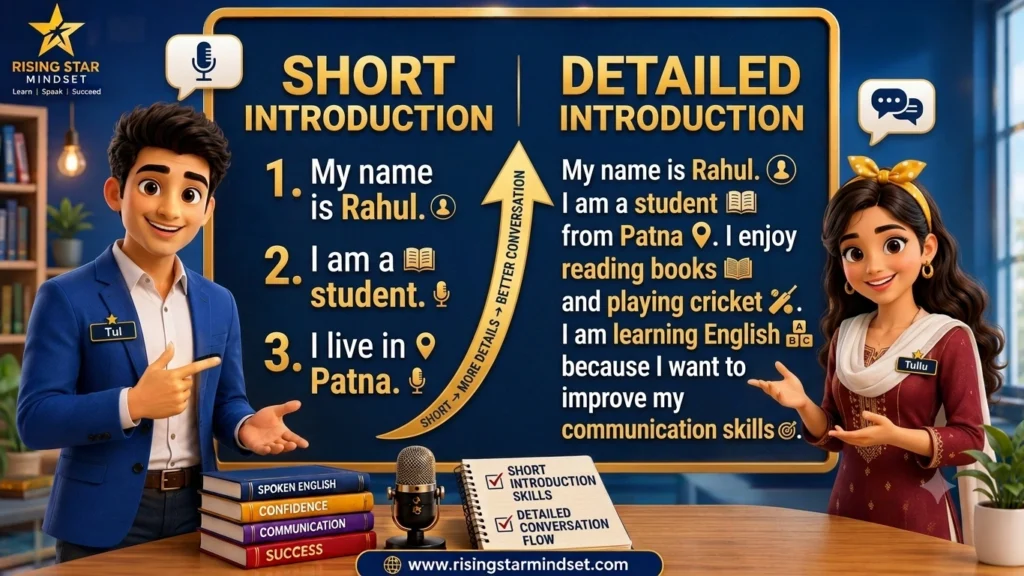
Hello! My name is Rahul. I am from Bihar, and I live in Patna. I am a student. I enjoy reading books and playing cricket. I am also learning English because I want to improve my communication skills. Nice to meet you!
Hindi Meaning
नमस्ते! मेरा नाम राहुल है। मैं बिहार से हूँ और पटना में रहता हूँ। मैं एक student हूँ। मुझे किताबें पढ़ना और cricket खेलना पसंद है। मैं English भी सीख रहा हूँ क्योंकि मैं अपनी communication skills सुधारना चाहता हूँ। आपसे मिलकर खुशी हुई!
16. Detailed Self-Introduction ( How to Talk About Yourself in English )
जब आपको थोड़ा ज्यादा समय मिले, तो आप detailed introduction दे सकते हैं।
Example
Hello everyone! My name is Rahul Kumar. I am from Bihar, and I currently live in Patna. I am a student, and I am interested in science and technology. In my free time, I enjoy reading books, listening to music, and playing cricket. I consider myself a hardworking and curious person. Moreover, I al ways try to learn something new. At the moment, I am working on improving my English speaking skills. My goal is to speak English confidently and communicate with people from different backgrounds. Thank you for listening!
Hindi Explanation
इस introduction में हमने कई अलग-अलग aspects को naturally जोड़ा है:
- Name
- Place
- Education
- Interests
- Hobbies
- Personality
- Current learning
- Future goal
इसलिए यह introduction classroom, speaking practice या formal introduction के लिए useful हो सकता है।
17. Self-Introduction in a Conversation ( How to Talk About Yourself in English )
Self-introduction हमेशा speech की तरह नहीं होना चाहिए। Daily conversation में इसे naturally use करें।
Conversation
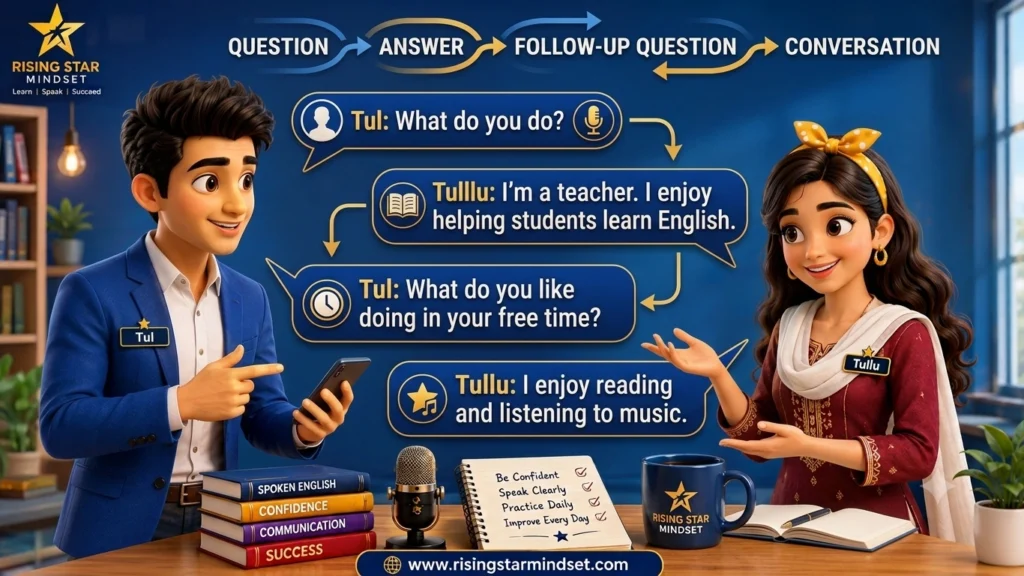
Tul: Hi! I’m Tul. What’s your name?
Tullu: Hi! I’m Tullu. Nice to meet you.
Tul: Nice to meet you too. Where are you from?
Tullu: I’m from Delhi. How about you?
Tul: I’m from Bihar. What do you do?
Tullu: I’m a teacher. I enjoy helping students learn English.
Tul: That’s great! What do you like doing in your free time?
Tullu: I enjoy reading and listening to music.
Hindi Meaning
Tul: नमस्ते! मैं Tul हूँ। आपका नाम क्या है?
Tullu: नमस्ते! मैं Tullu हूँ। आपसे मिलकर खुशी हुई।
Tul: मुझे भी खुशी हुई। आप कहाँ से हैं?
Tullu: मैं दिल्ली से हूँ। और आप?
Tul: मैं बिहार से हूँ। आप क्या करती हैं?
Tullu: मैं teacher हूँ। मुझे students को English सीखने में मदद करना अच्छा लगता है।
18. Common Mistakes ( How to Talk About Yourself in English )
अब कुछ common mistakes देखते हैं।
Mistake 1
❌ Myself Rahul.
✅ My name is Rahul.
या
✅ I’m Rahul.
Explanation: “Myself Rahul” Indian English में सुनने को मिल सकता है, लेकिन standard natural English में “I’m Rahul” या “My name is Rahul” बेहतर है।
Mistake 2
❌ I am belong to Bihar.
✅ I am from Bihar.
या
✅ I belong to Bihar.
Mistake 3
❌ I am living in Patna since five years.
अगर duration बतानी है:
✅ I have been living in Patna for five years.
Mistake 4
❌ My hobby is to reading books.
✅ My hobby is reading books.
Mistake 5
❌ I like to playing cricket.
✅ I like playing cricket.
या
✅ I like to play cricket.
19. Question and Answer Practice
अब अपने बारे में बोलने के लिए इन questions की practice करें।
Q1. What is your name?
A: My name is ________.
Q2. Where are you from?
A: I am from ________.
Q3. Where do you live?
A: I live in ________.
Q4. What do you do?
A: I am a ________.
Q5. What are your hobbies?
A: I enjoy ________ and ________.
Q6. What do you like?
A: I like ________.
Q7. What don’t you like?
A: I don’t like ________.
Q8. What are you good at?
A: I am good at ________.
Q9. Why are you learning English?
A: I am learning English because ________.
Q10. What is your goal?
A: My goal is to ________.
📝 20. MCQ Practice ( How to Talk About Yourself in English )
1. Which sentence is correct?
A. Myself Rahul.
B. I am Rahul.
C. I Rahul am.
D. Me Rahul.
Answer: B. I am Rahul.
2. Choose the correct sentence.
A. I am from Bihar.
B. I am belong Bihar.
C. I from am Bihar.
D. I belonging Bihar.
Answer: A. I am from Bihar.
3. Which sentence talks about a hobby?
A. I live in Patna.
B. I am a student.
C. I enjoy reading books.
D. I am from Bihar.
Answer: C. I enjoy reading books.
4. Complete the sentence:
My goal is _____ English fluently.
A. speak
B. speaking
C. to speak
D. spoke
Answer: C. to speak
5. Which sentence is grammatically correct?
A. I like to playing cricket.
B. I like playing cricket.
C. I liking play cricket.
D. I am like cricket.
Answer: B. I like playing cricket.
6. Which sentence describes personality?
A. I live in Delhi.
B. I am hardworking.
C. I study science.
D. I like music.
Answer: B. I am hardworking.
7. Choose the natural sentence.
A. My hobby is to reading.
B. My hobby reading is.
C. My hobby is reading.
D. My hobby is read.
Answer: C. My hobby is reading.
8. Why are you learning English?
A. I am from Bihar.
B. I live in Patna.
C. Because I want to communicate confidently.
D. I am a student.
Answer: C. Because I want to communicate confidently.
🧠 21. HOTS — Think & Speak
HOTS = Higher-Order Thinking Skills
इन questions में केवल answer याद नहीं करना है। बल्कि, अपनी सोच के अनुसार English में answer तैयार करना है।
HOTS 1
Imagine you meet a new student on the first day of class. How would you introduce yourself in 5 sentences?
Sample Answer:
Hello! My name is Rahul. I am from Bihar. I am a student. I enjoy reading and playing cricket. I am happy to meet you.
HOTS 2
Someone asks:
“Why should you learn English?”
2–3 sentences में अपना answer दीजिए।
Sample Answer:
I should learn English because it can improve my communication skills. Moreover, it can help me in my studies and future career.
HOTS 3
Imagine you have only 30 seconds to introduce yourself. What information would you choose?
Suggested order:
Name → Place → Work/Study → Hobby → Goal
HOTS 4
Which is better?
A: I am a student.
B: I am a student. I study science, and I enjoy learning new things.
Answer: B is better for conversation because it gives additional information and creates opportunities for follow-up questions.
🎯 22. Speaking Challenge ( How to Talk About Yourself in English )
अब एक छोटा 7-Day Self-Introduction Challenge शुरू करें।
Day 1
अपने नाम और place के बारे में बोलें।
Day 2
अपने studies या job के बारे में बोलें।
Day 3
अपने family के बारे में 5 sentences बोलें।
Day 4
अपने hobbies के बारे में बोलें।
Day 5
अपने likes और dislikes के बारे में बोलें।
Day 6
अपने goals के बारे में बोलें।
Day 7
इन सभी topics को जोड़कर 1–2 minute का self-introduction बोलें।
सबसे महत्वपूर्ण बात यह है कि आप इसे लिखकर केवल पढ़ें नहीं। बल्कि, आवाज़ में बोलें और अपनी recording सुनें।
📌 23. Abbreviations ( How to Talk About Yourself in English )
| Abbreviation | Full Form | Meaning |
| Q | Question | प्रश्न |
| A | Answer | उत्तर |
| H | Hobby | रुचि/शौक |
| Goal | Goal | लक्ष्य |
| Intro | Introduction | परिचय |
| V | Verb | क्रिया |
| Adj. | Adjective | विशेषण |
| e.g. | For Example | उदाहरण के लिए |
| etc. | Et Cetera | आदि |
⭐ 24. Key Points to Remember ( How to Talk About Yourself in English )
- सबसे पहले अपना name बताना सीखें।
- इसके बाद place, study/job, family, hobbies और goals के बारे में बोलें।
- छोटे sentences से शुरुआत करें।
- धीरे-धीरे answers को 2–3 sentences तक बढ़ाएँ।
- I am…, I live…, I like…, I enjoy…, I want to… जैसे patterns का practice करें।
- “Myself Rahul” की जगह “I’m Rahul” या “My name is Rahul” कहें।
- अपने answers में because, moreover, however, therefore, also, then, after that, finally जैसे transition words का natural इस्तेमाल करें।
- अपने बारे में बोलते समय कठिन vocabulary की जरूरत नहीं है।
- Regular speaking practice confidence बढ़ाती है।
- सबसे महत्वपूर्ण रूप से, English को पढ़ने के साथ-साथ बोलना भी जरूरी है।
❓ Frequently Asked Questions ( How to Talk About Yourself in English )
1. How can I talk about myself in English?
Start with your name, place, education or job, hobbies, family, interests and goals. Then connect these ideas using simple sentences.
2. How many sentences should I use for self-introduction?
For a short introduction, 4–6 sentences are enough. For a detailed introduction, you can speak for 1–2 minutes.
3. What should I say first when introducing myself?
You can start with:
“Hello! My name is…”
or
“Hi! I’m…”
4. Is “Myself Rahul” correct English?
It is better to say:
“I’m Rahul.”
or
“My name is Rahul.”
5. How can I become confident while talking about myself?
Practice your introduction aloud every day. Furthermore, record your voice and listen to it to identify pronunciation and sentence-making mistakes.
6. What should I avoid during self-introduction?
Avoid memorizing unnecessarily complicated sentences. Instead, use simple sentences that you can speak naturally and confidently.
🔄 Useful Transition Words for Better Speaking
Transition words आपके sentences को जोड़ने और ideas को naturally present करने में मदद करते हैं।
Adding Information
- Also — भी
- Moreover — इसके अलावा
- In addition — इसके अतिरिक्त
- Besides — इसके अलावा
Example:
I enjoy reading. Moreover, I like learning new languages.
Giving a Reason
- Because — क्योंकि
- Since — क्योंकि
- As — क्योंकि
Example:
I am learning English because I want to communicate confidently.
Showing Contrast
- However — हालांकि
- Although — यद्यपि
- But — लेकिन
Example:
I enjoy traveling. However, I don’t travel very often.
Showing Sequence
- First — सबसे पहले
- Then — फिर
- After that — उसके बाद
- Finally — अंत में
Example:
First, I finish my work. Then, I study English. Finally, I relax with my family.
Showing Result
- Therefore — इसलिए
- So — इसलिए
- As a result — परिणामस्वरूप
Example:
I want to speak English confidently. Therefore, I practice every day.
🏆 Conclusion
Learning How to Talk About Yourself in English is an important step toward becoming a confident English speaker. At first, you may find it difficult to form sentences quickly. However, with regular practice, these sentences will gradually become more natural.
Start small:
I’m Rahul.
I live in Patna.
I’m a student.
I enjoy reading.
I’m learning English.
Then, gradually add more information:
I’m Rahul. I live in Patna, and I’m a student. I enjoy reading books and playing cricket. Moreover, I’m learning English because I want to communicate confidently. My goal is to improve my speaking skills every day.
As a result, you will not only learn how to introduce yourself but also develop the ability to continue an English conversation.
🎯 Remember: ( How to Talk About Yourself in English )
Simple Sentences + Daily Practice + Confidence = Better English Speaking
So, don’t wait for perfect English. Start talking about yourself today.
Practice your 1-minute self-introduction aloud and try to make it better every day.
🌟 Keep Learning with Rising Star Mindset
📘 Spoken English Course
🏛️ BPSC Preparation
🎓 School Notes
💡 Daily Motivation
🌐 Website: www.risingstarmindset.com