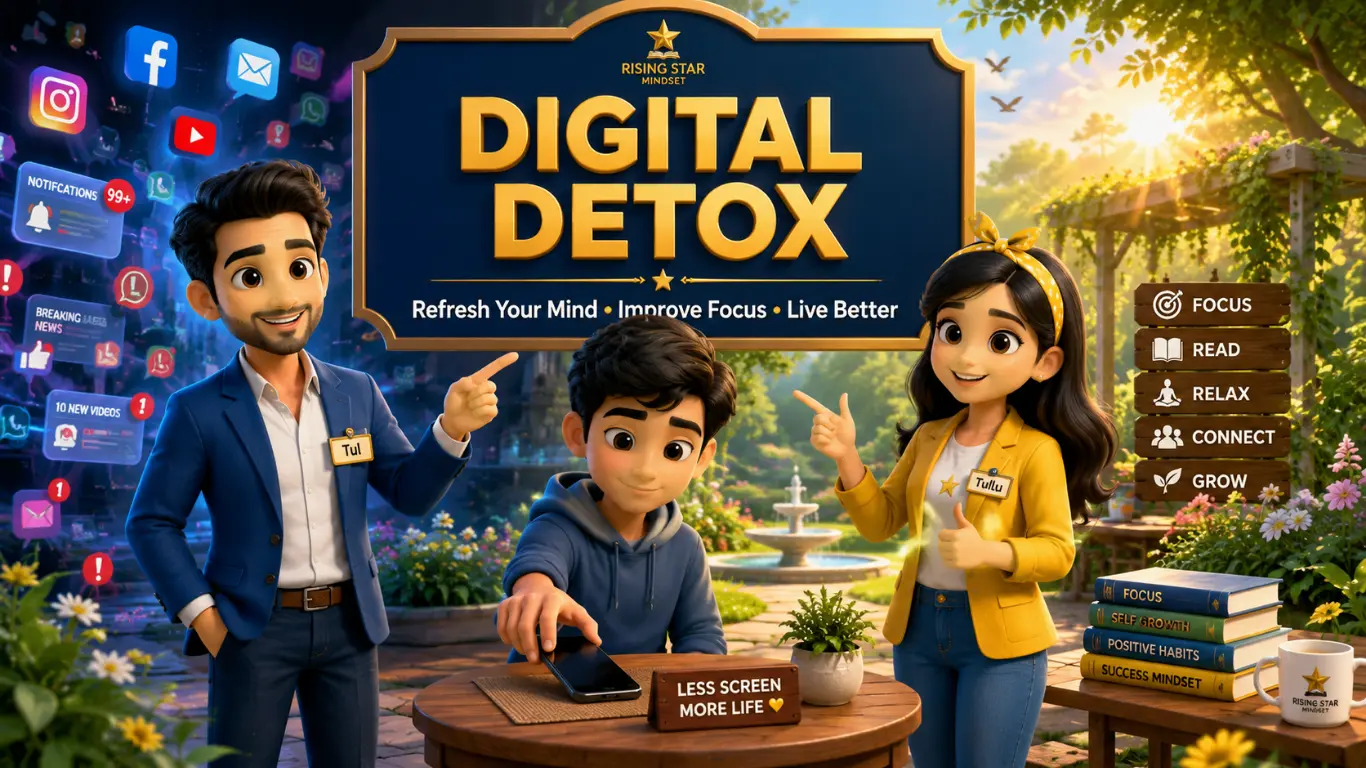
Digital Detox: Simple Ways to Refresh Your Mind and Improve Focus
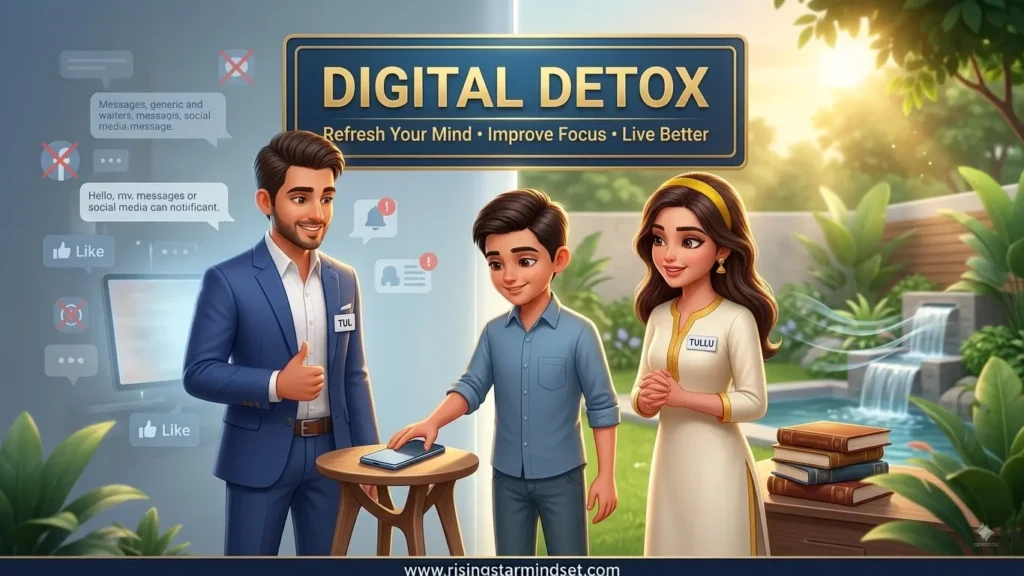
In a world of constant notifications, endless scrolling, short videos, and non-stop messages, sometimes the best way to refresh your mind is to simply disconnect for a while.
Today, smartphones and digital platforms have become an important part of our daily lives. We use them for education, communication, entertainment, work, news, banking, shopping, and even relaxation. However, when checking the phone becomes a habit rather than a conscious choice, it may become difficult to focus on the things that truly matter.This is where the idea of a digital detox becomes useful.
A digital detox does not necessarily mean throwing away your smartphone or disappearing from the internet for days. Instead, it means creating intentional periods when you reduce unnecessary digital activity and give your mind some breathing space.
Research on digital detox is still developing, and the results are not identical across all studies. Some research has found improvements in certain aspects of well-being, while other studies have reported limited or mixed effects. Therefore, digital detox should be viewed as a practical healthy-habit experiment rather than a guaranteed solution for every mental-health problem.
Related Post : How to Handle Stress: Quote of the Day & Tips
What Is Digital Detox?
Digital detox means intentionally reducing or temporarily stopping unnecessary use of digital devices, apps, or online platforms.
For example, you might decide to:
- Stop checking social media immediately after waking up.
- Keep your phone away while studying.
- Turn off unnecessary notifications.
- Avoid scrolling during meals.
- Take a short screen-free break during the day.
- Keep your phone away from your bed at night.
- Spend more time talking face-to-face with family and friends.
- Replace some scrolling time with reading, walking, exercise, hobbies, or creative activities.
The goal is not to reject technology.
The goal is to use technology consciously instead of allowing technology to control your attention.
Why Do We Need a Digital Detox?
Modern digital platforms are designed to keep users engaged. A notification appears, we check it. A short video ends, another begins. Someone sends a message, and we immediately respond.
Consequently, a few minutes of checking the phone can easily become thirty minutes of scrolling.
This can create a cycle:
Notification → Checking → Scrolling → More Content → More Checking
Over time, this habit may make it harder to protect our attention.
A digital detox can help you become more aware of this pattern.
However, it is important to remember that research does not support the idea that simply avoiding social media automatically solves stress, anxiety, or every mental-health concern. Evidence remains mixed, and the effectiveness can depend on the person, the type of digital activity, and how the reduction is carried out.
7 Signs You May Need a Digital Break
You may benefit from experimenting with a digital break if you frequently notice the following habits:
1. You Check Your Phone Without a Reason
You unlock your phone even when you do not have a notification.
At first, it may feel harmless. However, repeated checking can become an automatic habit.
2. You Find It Difficult to Study Without Checking Your Phone
You begin studying, but after a few minutes you check a message or social-media notification.
Then you return to your book.
Then you check the phone again.
This constant switching can make focused study more difficult.
3. You Scroll Longer Than You Planned
You tell yourself:
“I will use my phone for five minutes.”
Suddenly, thirty minutes have passed.
If this happens regularly, it may be worth setting intentional boundaries.
4. You Use Your Phone During Meals
Meals are an opportunity to slow down and connect with people.
Therefore, keeping your phone away during meals can create a simple screen-free routine.
5. You Check Social Media Immediately After Waking Up
Starting the day with notifications, messages, headlines, and social-media content can immediately fill your attention with external information.
Instead, try beginning the morning with water, stretching, planning, reading, or a few quiet minutes.
6. You Keep Scrolling Before Sleeping
Night-time scrolling can become particularly difficult to control.
Instead of allowing your phone to become the final activity of the day, create a short screen-free wind-down routine.
7. You Feel Uncomfortable When You Are Away From Your Phone
If every quiet moment automatically leads to phone checking, it may be useful to practise spending short periods without digital stimulation.
Digital Detox for Students: Why It Matters
For students, the smartphone can be both a learning tool and a distraction.
A phone can provide:
- Online classes
- Educational videos
- Digital dictionaries
- E-books
- Current affairs
- Study apps
- Practice tests
- Communication with teachers
Therefore, telling students to completely stop using smartphones is neither realistic nor necessary.
The better approach is purposeful digital use.
For example:
Study Mode:
Phone away or notifications off.
Learning Mode:
Use the device only for the required educational resource.
Break Mode:
Take a short screen-free break.
Entertainment Mode:
Enjoy digital content within a planned time limit.
This approach teaches an important life skill:
Use technology to reach your goals, not let it distract you from them.
The 30-Minute Digital Detox Challenge
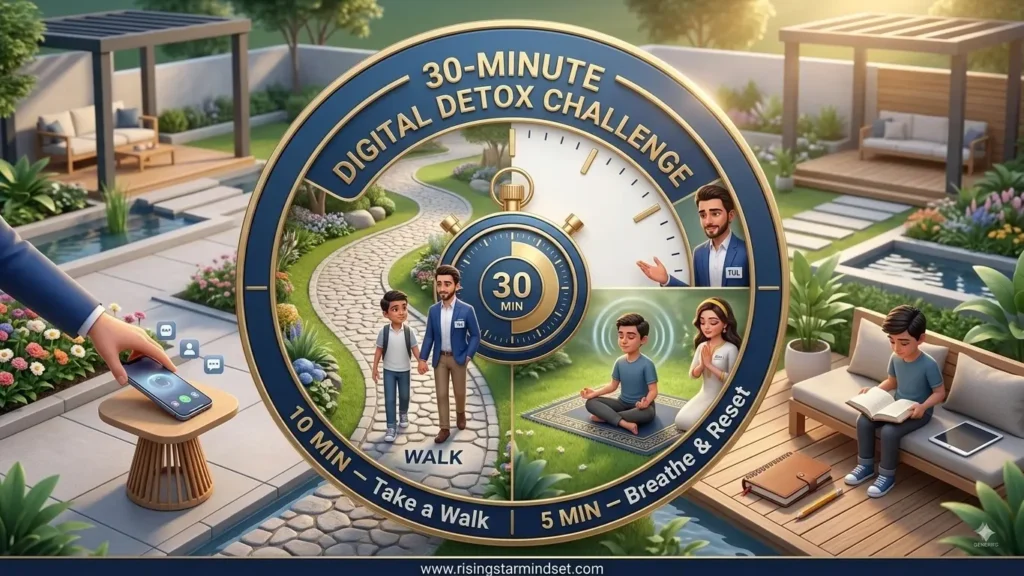
You do not need to start with a full day without technology.
Instead, try this simple 30-minute Digital Detox Challenge.
Step 1: Put Your Phone Away — 5 Minutes
Place your phone on silent and keep it away from your immediate reach.
Step 2: Take a Walk — 10 Minutes
Go outside, walk around your home, terrace, garden, or neighbourhood, if practical.
Pay attention to your surroundings instead of your screen.
Step 3: Breathe and Reset — 5 Minutes
Sit comfortably.
Take slow breaths.
Let your attention settle.
Step 4: Do Something Offline — 10 Minutes
Choose one activity:
- Read a book.
- Write in a notebook.
- Organise your study table.
- Talk to a family member.
- Draw something.
- Stretch.
- Plan tomorrow.
- Listen to music without scrolling.
After 30 minutes, ask yourself:
“Do I really need to check my phone now?”
That simple question can make you more aware of your digital habits.
8 Simple Digital Detox Habits You Can Start Today
1. Create a No-Phone Morning
Do not check social media immediately after waking up.
Instead, give yourself the first few minutes of the day.
Drink water, freshen up, stretch, pray or meditate if that is part of your routine, or simply plan your day.
2. Turn Off Unnecessary Notifications
Not every notification requires immediate attention.
Keep essential alerts and disable unnecessary ones.
As a result, you reduce the number of times your phone demands your attention.
3. Use a Study-Only Environment
When studying, keep unnecessary apps closed.
If you need your phone for learning, use it specifically for the task.
For example:
English lesson → English resource → Practice → Close the app
This creates a clear beginning and ending.
4. Keep Meals Screen-Free
Try eating without scrolling.
This small habit can help you pay more attention to your food and conversations.
Moreover, it gives your mind another opportunity to take a break from constant digital stimulation.
5. Create a Screen-Free Bedroom Routine
Instead of scrolling until you feel sleepy, try reading a few pages of a book or preparing your next day’s schedule.
The purpose is not perfection.
The purpose is to create a calmer transition toward sleep.
6. Replace Scrolling With Something Meaningful
Simply saying “I will use my phone less” may not be enough.
Replace the habit.
Instead of:
Scroll → Scroll → Scroll
try:
Walk → Read → Talk → Write → Rest
A replacement activity makes the change easier to maintain.
7. Schedule Social Media Time
Rather than checking social media every few minutes, consider setting specific times for it.
This changes social media from an automatic habit into a conscious activity.
8. Take One Screen-Free Period Every Day
It could be:
- 20 minutes
- 30 minutes
- 1 hour
Choose a realistic duration.
The important thing is consistency.
Digital Detox Does Not Mean “No Technology”
This is one of the most important points.
Digital technology is not the enemy.
Students need technology for education. Professionals need it for work. Families use it for communication. Businesses depend on it.
Therefore, the real goal is digital balance.
Think of it this way:
Technology + Purpose = Productivity
But:
Technology + Constant Distraction = Lost Attention
The same smartphone can help you learn a new language or consume hours of unnecessary content.
The difference is how intentionally you use it.
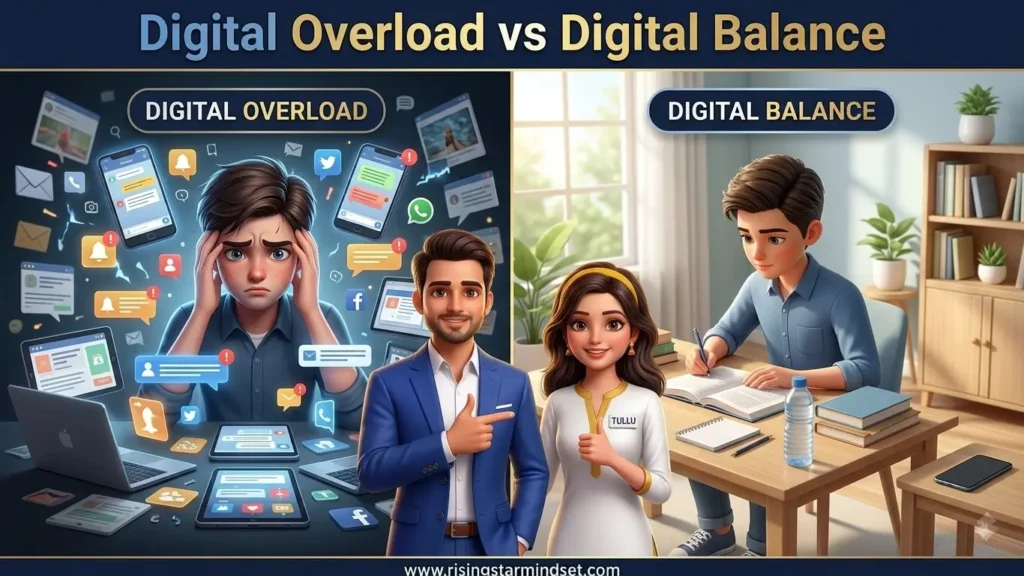
Digital Detox vs Digital Balance
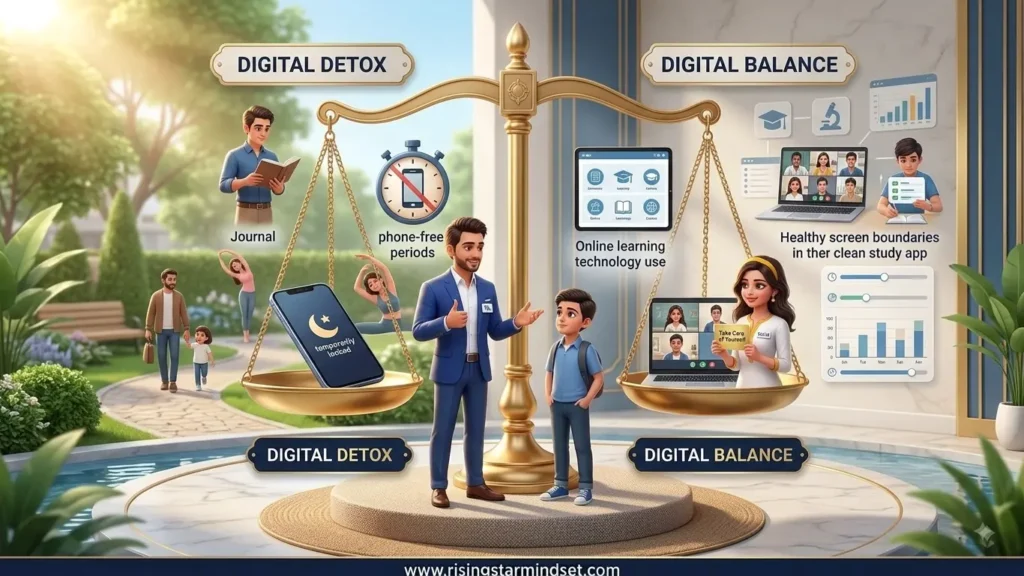
| Digital Detox | Digital Balance |
| Temporary reduction in digital use | Long-term healthy technology habits |
| May involve screen-free periods | Allows purposeful screen use |
| Useful for resetting habits | Useful for everyday life |
| Can be short-term | Designed for sustainability |
| Focuses on reducing unnecessary use | Focuses on using technology intentionally |
For most people, digital balance may be more realistic than complete digital abstinence.
Some research reviews have also suggested that reducing problematic social-media use may be more useful than insisting on complete abstinence for everyone.
A Simple Digital Balance Rule for Students
Try the following routine:
Before Study
Plan → Remove distractions → Start
During Study
Focus → Learn → Practise
During Break
Move → Breathe → Relax
After Study
Review → Complete → Disconnect
This creates a healthier relationship with technology without completely removing it from your life.
What Can You Do Instead of Scrolling?
When you feel the urge to check your phone, try one of these alternatives:
📖 Read a few pages
🚶 Take a short walk
📝 Write your thoughts
🎨 Draw or create something
🧘 Sit quietly and breathe
💬 Talk to someone
🏃 Exercise
📚 Revise your notes
🌱 Spend time outdoors
🎯 Plan your next task
At first, these activities may feel less exciting than endless scrolling.
However, with practice, your brain can become more comfortable with moments of quiet.
A 7-Day Digital Detox Mini Plan
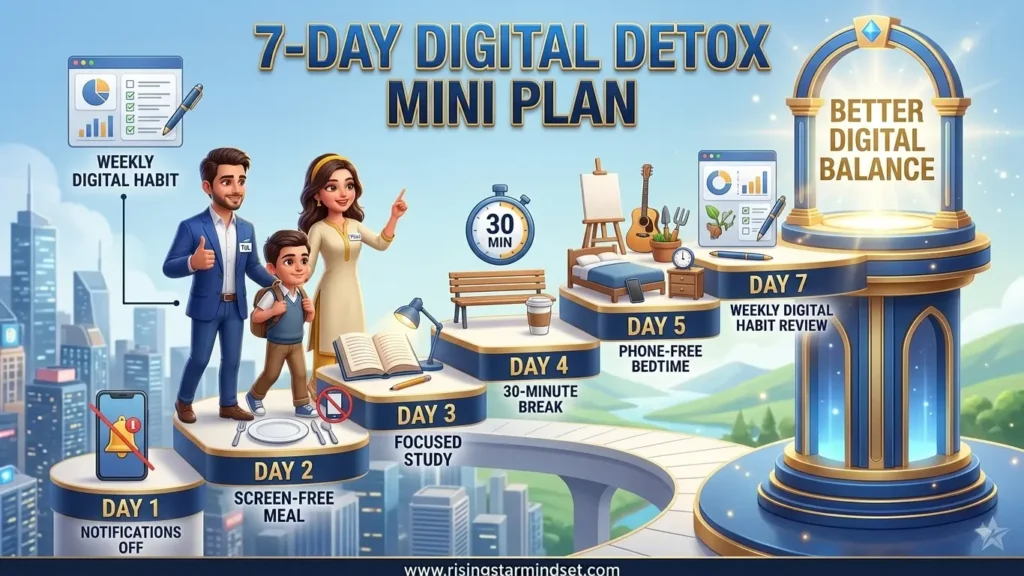
| Day | Simple Challenge |
| Day 1 | Turn off unnecessary notifications |
| Day 2 | No phone during meals |
| Day 3 | Keep the phone away during study |
| Day 4 | Take a 30-minute screen-free break |
| Day 5 | Avoid unnecessary scrolling before bed |
| Day 6 | Spend time on an offline hobby |
| Day 7 | Review your digital habits and choose what to continue |
You do not need to complete everything perfectly.
Instead, identify the habits that make the biggest difference for you.
Quick Self-Check: How Digital Is Your Day?
Ask yourself these questions:
1. Do I check my phone without a specific reason?
2. Do I lose track of time while scrolling?
3. Does my phone interrupt my study?
4. Do I use my phone while eating?
5. Do I scroll when I actually need rest?
6. Do I check notifications immediately?
7. Can I comfortably spend 30 minutes without my phone?
If you answered “Yes” to several questions, do not panic.
Instead, use your answers as a starting point.
The goal is not to become anti-technology.
The goal is to become more intentional with technology.
What Does Science Say About Digital Detox?
The evidence around digital detox is promising in some areas but far from conclusive.
A 2024 systematic review and meta-analysis found that digital-detox interventions were associated with a reduction in depressive symptoms, but it did not find statistically significant improvements across all measured outcomes such as stress, life satisfaction, and overall mental well-being.
Another 2024 meta-analysis involving 26 studies and 8,147 participants reported positive effects on subjective and psychological well-being, although the researchers also noted differences between studies and contexts.
A more recent scoping review likewise concluded that outcomes vary depending on factors such as the person’s starting level of digital use, age, coping style, environment, and the type and duration of the intervention.
So, the most sensible conclusion is:
A digital detox may help some people improve their digital habits and well-being, but it should not be presented as a universal cure for mental-health problems.
If someone is experiencing persistent emotional or psychological difficulties, reducing screen time alone should not replace appropriate professional support.
The Bigger Lesson: Protect Your Attention

Our attention is one of our most valuable resources.
Once a moment has passed, we cannot get it back.
Therefore, learning to protect our attention is not simply a technology habit. It is a life skill.
Imagine two students.
Student A
Studies for 30 minutes, checks social media for 10 minutes, returns to studying, checks messages again, watches a short video, and then struggles to regain focus.
Student B
Keeps the phone away for 30 minutes, completes the study session, and then takes a planned break.
Both students have the same phone.
Both have access to the same internet.
The difference is how they manage their attention.
A Better Question to Ask Yourself
Instead of asking:
“How many hours should I use my phone?”
try asking:
“What am I using my phone for?”
There is a huge difference between:
30 minutes of purposeful learning
and
30 minutes of mindless scrolling.
Likewise, an hour spent completing important work online is very different from an hour spent repeatedly checking notifications.
Therefore, quality and purpose matter alongside quantity.
Digital Detox: Start Small, Stay Consistent
You do not need to delete every social-media app tonight.
You do not need to switch off your phone for an entire weekend.
You do not need to follow an unrealistic challenge.
Start small.
Try:
30 minutes without unnecessary screen use.
Then try:
one screen-free meal.
Then:
one focused study session.
Then:
a calmer pre-sleep routine.
Small changes can become strong habits when repeated consistently.
Conclusion: Disconnect to Reconnect
Technology has made our lives faster, easier, and more connected.
However, constant connectivity does not always mean better living.
Sometimes, we need to disconnect from the screen so that we can reconnect with:
our thoughts,
our goals,
our family,
our surroundings,
and most importantly,
ourselves.
A digital detox is not about escaping technology.
It is about creating a healthier relationship with it.
So, today, give yourself a small break.
Put the phone aside.
Take a breath.
Look around.
Read something meaningful.
Talk to someone.
Walk outside.
And remember:
You control your attention. Your attention should not control you.
Healthy Body. Calm Mind. Balanced Life.
📌 Try This Today: 30-Minute Digital Detox
For the next 30 minutes:
- Put your phone on silent.
- Keep it away from your immediate reach.
- Avoid unnecessary notifications.
- Take a short walk or sit quietly.
- Read, write, study, or talk to someone.
- After 30 minutes, notice how you feel.
Your challenge is simple:
Less scrolling. More living.
Less distraction. More direction.
Frequently Asked Questions (FAQs)
What is a digital detox?
A digital detox is a planned reduction or temporary break from unnecessary use of smartphones, social media, and other digital technologies.
Is digital detox good for mental health?
It may help some people, but research findings are mixed. Some studies have reported improvements in certain outcomes, while others have found limited or inconsistent effects.
How long should a digital detox last?
There is no universally proven ideal duration. You can start with a manageable period such as 20–30 minutes and gradually develop healthier digital habits.
Should students stop using smartphones completely?
No. Smartphones can be useful educational tools. Students should focus on purposeful use, reduce unnecessary distractions, and create focused study periods.
Is digital detox the same as deleting social media?
Not necessarily. A digital detox can simply mean reducing unnecessary use, taking screen-free breaks, or creating specific boundaries around social media.
What is the easiest digital detox habit?
One of the easiest habits is to create a 30-minute screen-free period every day. You can also keep your phone away during meals or focused study sessions.

Final Thought
Your phone can connect you to the world, but sometimes you need to disconnect from the screen to connect with your own life.
📚 Sources & Fact Check
This article uses current research on digital detox and social-media reduction. Evidence is still developing, and the effects vary across individuals and study designs.
- Ramadhan et al. (2024), Impacts of digital social media detox for mental health: A systematic review and meta-analysis. PubMed research record
- Ansari et al. (2024), Improving Well-Being Through Digital Detoxification Among Social Media Users: A Systematic Review and Meta-Analysis. PubMed research record
- Setia et al. (2025), Digital Detox Strategies and Mental Health: A Comprehensive Scoping Review. PubMed research record
- American Academy of Pediatrics (2024), Digital Detox and Well-Being. PubMed research record
🌟 Keep Learning with Rising Star Mindset
📘 Spoken English Course
🏛️ BPSC Preparation
🎓 School Notes
💡 Daily Motivation
🌐 Website: www.risingstarmindset.com