
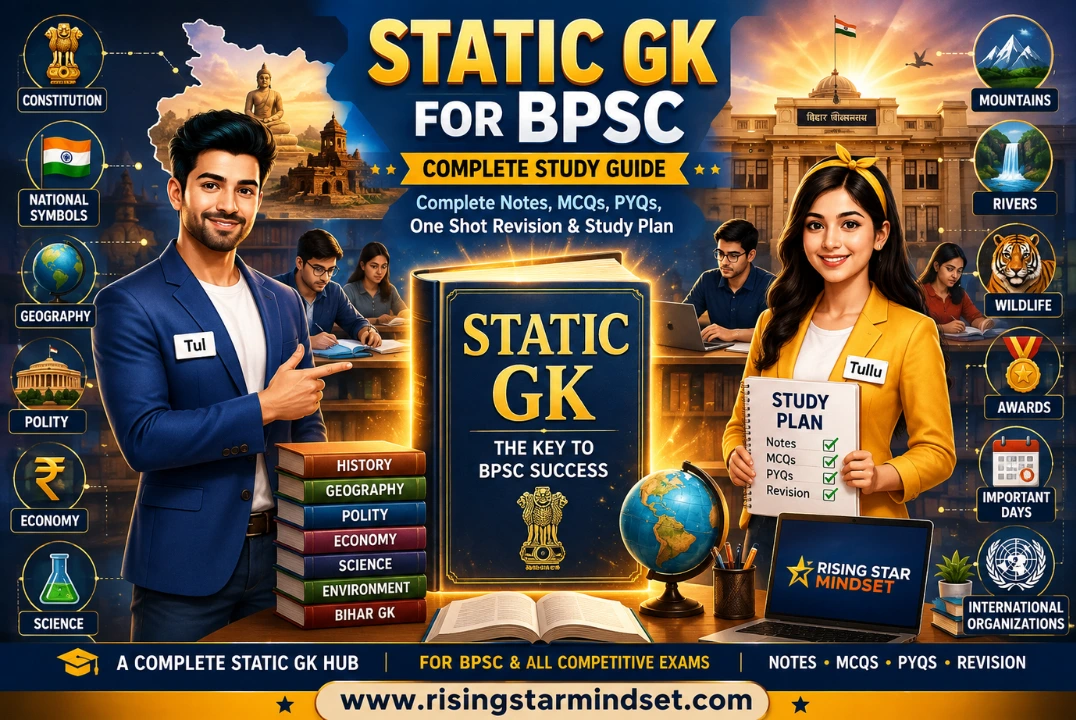
Static GK for BPSC | Complete Study Guide, Notes, MCQs & Preparation Strategy
Table of Contents
- What is Static GK?
- Why Static GK is Important?
- Exams Covered
- Complete Static GK Syllabus
- How to Study Static GK?
- Best Preparation Strategy
- Daily Study Plan
- Benefits of Static GK
- Static GK Roadmap
- Topic-wise Series
- Frequently Asked Questions
- Conclusion
- Related post : BPSC Current Affairs 2025 | Most Important Notes And MCQs
Static GK for BPSC | Complete Study Guide
🇬🇧 English ( Static GK for BPSC )
Static General Knowledge (Static GK) is one of the most important sections in competitive examinations because it contains factual information that remains unchanged for many years. Unlike Current Affairs, Static GK for BPSC focuses on permanent topics such as Indian History, Geography, Polity, Economy, Science, National Symbols, Awards, Rivers, Mountains, Important Days, International Organizations, and many other subjects.
Moreover, almost every government examination includes questions from Static GK because it tests a candidate’s fundamental knowledge. Therefore, mastering Static GK not only increases your overall score but also improves your confidence during examinations. Furthermore, when combined with Current Affairs, Static GK becomes a powerful scoring section that can significantly improve your final ranking.
This complete study guide has been specially designed for BPSC, UPSC, SSC, Railway, Banking, Bihar Police, CTET, STET, NDA, CDS, Defence, and other competitive examinations. In addition, every topic in this series will include detailed notes, bilingual explanations (English and Hindi), MCQs, PYQs, expected questions, one-shot revision, and exam-oriented practice material.
🇮🇳 हिन्दी ( Static GK for BPSC )
स्टेटिक सामान्य ज्ञान (Static GK) प्रतियोगी परीक्षाओं का सबसे महत्वपूर्ण भागों में से एक है क्योंकि इसमें ऐसे तथ्य शामिल होते हैं जो कई वर्षों तक लगभग समान रहते हैं। Current Affairs से अलग, Static GK में भारतीय इतिहास, भूगोल, भारतीय संविधान, अर्थव्यवस्था, विज्ञान, राष्ट्रीय प्रतीक, पुरस्कार, नदियाँ, पर्वत, महत्वपूर्ण दिवस, अंतरराष्ट्रीय संगठन तथा अन्य स्थायी विषय शामिल होते हैं।
इसके अलावा, लगभग सभी सरकारी प्रतियोगी परीक्षाओं में Static GK से प्रश्न पूछे जाते हैं क्योंकि यह अभ्यर्थियों के मूलभूत ज्ञान का परीक्षण करता है। इसलिए, यदि आपकी Static GK मजबूत है, तो आपका कुल स्कोर बढ़ता है और परीक्षा में आत्मविश्वास भी मजबूत होता है। साथ ही, जब Static GK को Current Affairs के साथ पढ़ा जाता है, तो यह सबसे अधिक अंक दिलाने वाला विषय बन जाता है।
यह सम्पूर्ण अध्ययन मार्गदर्शिका विशेष रूप से BPSC, UPSC, SSC, Railway, Banking, Bihar Police, CTET, STET, NDA, CDS तथा अन्य प्रतियोगी परीक्षाओं के लिए तैयार की गई है। इसके अतिरिक्त, इस पूरी श्रृंखला में प्रत्येक विषय के साथ विस्तृत नोट्स, हिन्दी एवं अंग्रेज़ी व्याख्या, MCQs, PYQs, Expected Questions, One Shot Revision तथा परीक्षा आधारित अभ्यास सामग्री दी जाएगी।
What is Static GK? ( Static GK for BPSC )
🇬🇧 English
Static GK refers to information that generally does not change with time. For example, the capital of India is New Delhi, the National Animal is the Bengal Tiger, and the Constitution came into force on 26 January 1950. These facts remain the same for a long period and are therefore called Static GK.
Furthermore, Static GK builds the foundation of General Studies. As a result, students who regularly revise Static GK perform better in competitive examinations because they are able to answer factual questions quickly and accurately.
🇮🇳 हिन्दी ( Static GK for BPSC )
Static GK ऐसे तथ्यों को कहा जाता है जो समय के साथ सामान्यतः नहीं बदलते। उदाहरण के लिए, भारत की राजधानी नई दिल्ली है, राष्ट्रीय पशु बाघ है तथा भारतीय संविधान 26 जनवरी 1950 से लागू हुआ। ये तथ्य लंबे समय तक समान रहते हैं, इसलिए इन्हें Static GK कहा जाता है।
साथ ही, Static GK सामान्य अध्ययन की मजबूत नींव तैयार करता है। परिणामस्वरूप, जो विद्यार्थी नियमित रूप से इसका अध्ययन और पुनरावृत्ति करते हैं, वे प्रतियोगी परीक्षाओं में तथ्यात्मक प्रश्नों का उत्तर अधिक तेज़ी और सही तरीके से दे पाते हैं।
Why is Static GK Important?
🇬🇧 English
Static GK is one of the highest-scoring sections in competitive examinations. Moreover, it requires regular revision instead of last-minute preparation. Furthermore, most questions are direct and fact-based, making it easier to score if your concepts are clear. Therefore, every serious aspirant should include Static GK in their daily study schedule.
Learning Static GK also improves your awareness about India and the world. In addition, it helps you during interviews, group discussions, personality tests, and descriptive examinations.
🇮🇳 हिन्दी ( Static GK for BPSC )
Static GK प्रतियोगी परीक्षाओं में सबसे अधिक अंक दिलाने वाले विषयों में से एक है। इसके अलावा, इसकी तैयारी अंतिम समय में नहीं बल्कि नियमित अभ्यास के माध्यम से करनी चाहिए। साथ ही, अधिकांश प्रश्न सीधे तथ्यों पर आधारित होते हैं, इसलिए अच्छी तैयारी होने पर इसमें अच्छे अंक प्राप्त किए जा सकते हैं। इसलिए, प्रत्येक गंभीर अभ्यर्थी को अपने दैनिक अध्ययन कार्यक्रम में Static GK को अवश्य शामिल करना चाहिए।
Static GK केवल परीक्षा के लिए ही नहीं बल्कि सामान्य ज्ञान, इंटरव्यू, समूह चर्चा तथा व्यक्तित्व विकास के लिए भी अत्यंत उपयोगी है।
Exams Covered ( Static GK for BPSC )
यह Static GK Series निम्नलिखित परीक्षाओं के लिए उपयोगी होगी—
- BPSC
- UPSC
- SSC CGL
- SSC CHSL
- Railway (RRB NTPC & Group D)
- Banking (IBPS, SBI)
- Bihar Police
- SI / Constable
- CTET
- STET
- NDA
- CDS
- CAPF
- State PSC Exams
- Other Government Exams
Complete Static GK Syllabus
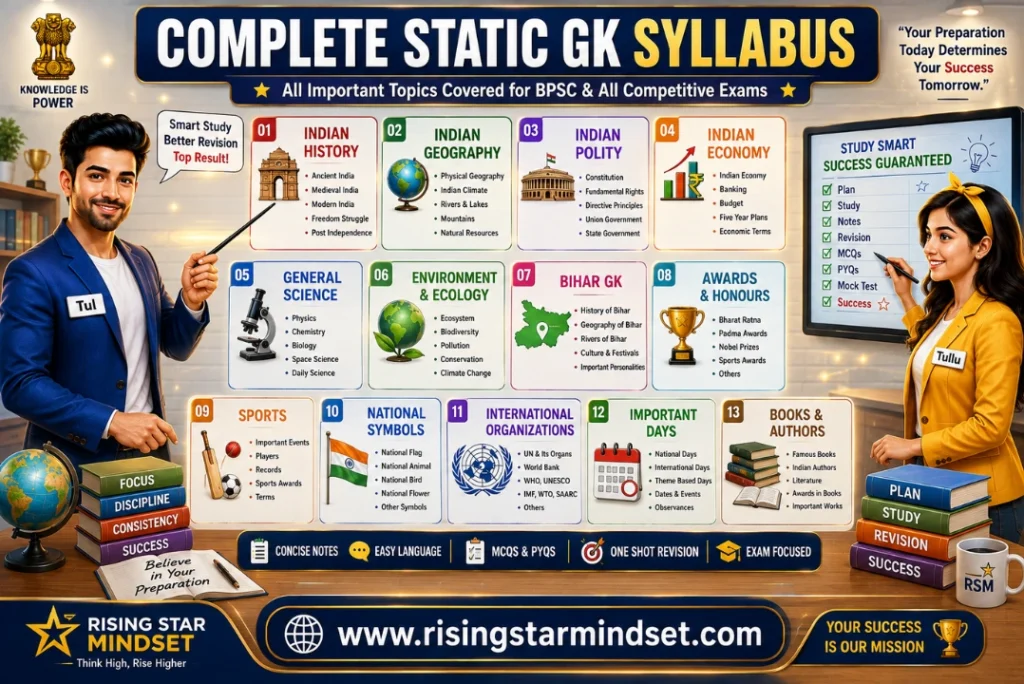
Indian History
- Ancient India
- Medieval India
- Modern India
- Freedom Movement
Geography
- India
- World Geography
- Rivers
- Mountains
- Lakes
- Climate
- Soil
- Agriculture
Indian Polity
- Constitution
- Parliament
- President
- Prime Minister
- Governor
- Judiciary
- Fundamental Rights
- Fundamental Duties
Economy
- RBI
- Budget
- Banking
- Inflation
- GDP
- Five Year Plans
- Taxation
General Science
- Physics
- Chemistry
- Biology
- Space
- Environment
Bihar GK
- History
- Geography
- Rivers
- Culture
- Festivals
- Important Personalities
Sports
- Olympic Games
- Cricket
- Hockey
- Awards
National Symbols
- National Animal
- National Bird
- National Flag
- National Song
- National Anthem
Awards
- Bharat Ratna
- Padma Awards
- Nobel Prize
- Oscar
Books & Authors
Important Days
International Organizations
- UNO
- UNESCO
- WHO
- IMF
- World Bank
- WTO
Benefits of Studying Static GK
🇬🇧 English
- Builds a strong General Knowledge foundation.
- Improves examination scores.
- Increases confidence.
- Helps in interviews.
- Enhances decision-making ability.
- Improves awareness about India and the world.
🇮🇳 हिन्दी ( Static GK for BPSC )
- सामान्य ज्ञान मजबूत होता है।
- परीक्षा में अच्छे अंक मिलते हैं।
- आत्मविश्वास बढ़ता है।
- इंटरव्यू में सहायता मिलती है।
- निर्णय क्षमता विकसित होती है।
- भारत एवं विश्व के बारे में जानकारी बढ़ती है।

Best Preparation Strategy ( Static GK for BPSC )
Step 1
Understand the complete syllabus.
Step 2
Study topic-wise.
Step 3
Prepare short notes.
Step 4
Practice MCQs daily.
Step 5
Solve Previous Year Questions.
Step 6
Revise every Sunday.
Step 7
Attempt Mock Tests.
Daily Study Plan ( Static GK for BPSC )

| Time | Activity |
| 30 Minutes | Study New Topic |
| 20 Minutes | Revise Previous Topic |
| 20 Minutes | Practice MCQs |
| 20 Minutes | Solve PYQs |
| 10 Minutes | One Shot Revision |
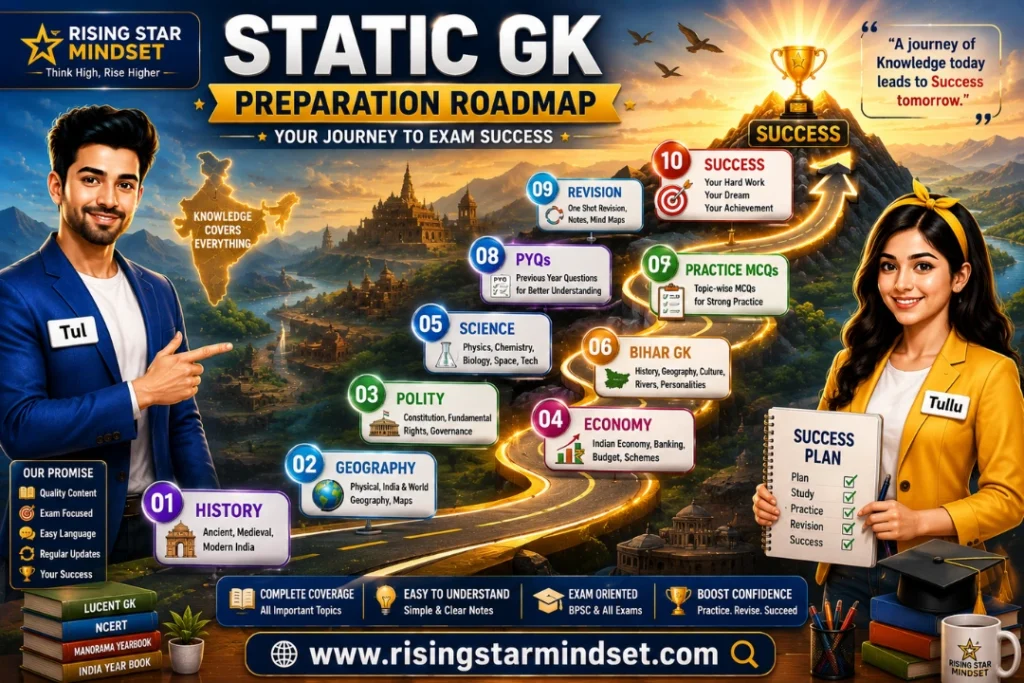
Static GK Roadmap ( Static GK for BPSC )
Basics
↓
History
↓
Geography
↓
Polity
↓
Economy
↓
Science
↓
Bihar GK
↓
Practice MCQs
↓
PYQs
↓
Revision
↓
Mock Tests
↓
Success
📌 आगे आने वाले Parts (Series)
- Part 1 – Ancient Indian History
- Part 2 – Medieval Indian History
- Part 3 – Modern Indian History
- Part 4 – Indian Geography
- Part 5 – Indian Polity
- Part 6 – Indian Economy
- Part 7 – General Science
- Part 8 – Bihar Special GK
- Part 9 – National Parks & Wildlife
- Part 10 – Rivers, Dams & Lakes
- Part 11 – Awards & Honours
- Part 12 – Books & Authors
- Part 13 – Important Days
- Part 14 – International Organizations
- Part 15 – One Shot Revision Master Guide
How to Study Static GK Effectively? | Static GK की तैयारी कैसे करें?
🇬🇧 English
Preparing Static GK is not about memorizing thousands of facts in a single day. Instead, it requires a smart strategy, regular revision, and continuous practice. Moreover, if you study topic-wise and revise consistently, you can remember facts for a much longer time. Furthermore, solving MCQs and Previous Year Questions (PYQs) helps you understand the exam pattern and improves your accuracy.
In addition, make short notes after completing each topic. These notes will help you during revision before the examination. Therefore, always focus on understanding the concepts rather than simply memorizing facts. Finally, revise every week because revision is the key to long-term retention.
🇮🇳 हिन्दी ( Static GK for BPSC )
Static GK की तैयारी एक दिन में हजारों तथ्य याद करने का नाम नहीं है। इसके बजाय, इसके लिए सही रणनीति, नियमित अभ्यास और निरंतर पुनरावृत्ति की आवश्यकता होती है। इसके अलावा, यदि आप प्रत्येक विषय को अलग-अलग पढ़ते हैं और नियमित रूप से दोहराते हैं, तो तथ्य लंबे समय तक याद रहते हैं। साथ ही, MCQs तथा Previous Year Questions (PYQs) हल करने से परीक्षा का पैटर्न समझने में मदद मिलती है और आपकी सटीकता बढ़ती है।
इसके अतिरिक्त, प्रत्येक अध्याय पूरा करने के बाद छोटे नोट्स अवश्य बनाइए। ये नोट्स परीक्षा से पहले तेज़ रिवीजन में बहुत उपयोगी होंगे। इसलिए, केवल रटने के बजाय विषय को समझने पर अधिक ध्यान दें। अंततः, हर सप्ताह Revision अवश्य करें क्योंकि सफलता की सबसे मजबूत कुंजी नियमित पुनरावृत्ति है।
Smart Preparation Strategy | स्मार्ट तैयारी की रणनीति
Step 1 – Understand the Syllabus
पहले पूरा Syllabus समझें और परीक्षा में पूछे जाने वाले विषयों की सूची तैयार करें।
Step 2 – Study Topic-wise
एक समय में केवल एक विषय पढ़ें। उदाहरण के लिए पहले History, फिर Geography।
Step 3 – Prepare Short Notes
महत्वपूर्ण तथ्यों, वर्षों, स्थानों और व्यक्तियों के छोटे नोट्स बनाएं।
Step 4 – Solve MCQs Daily
प्रतिदिन कम से कम 20–30 MCQs का अभ्यास करें।
Step 5 – Practice PYQs
पिछले वर्षों के प्रश्नपत्र हल करें ताकि प्रश्न पूछने का तरीका समझ सकें।
Step 6 – Weekly Revision
हर रविवार पूरे सप्ताह का Revision करें।
Step 7 – Mock Test
महीने में कम-से-कम 4 Full-Length Mock Tests दें।
Golden Rules for Static GK for BPSC
🇬🇧 English
- Study every day.
- Revise regularly.
- Practice MCQs.
- Solve PYQs.
- Use maps and charts.
- Make handwritten notes.
- Revise before sleeping.
- Learn from mistakes.
🇮🇳 हिन्दी ( Static GK for BPSC )
- प्रतिदिन पढ़ें।
- नियमित रिवीजन करें।
- MCQs हल करें।
- PYQs का अभ्यास करें।
- Maps और Charts का उपयोग करें।
- अपने नोट्स स्वयं बनाएं।
- सोने से पहले 10 मिनट Revision करें।
- गलतियों से सीखें।
Important Abbreviations ( Static GK for BPSC )
| Abbreviation | Full Form |
| BPSC | Bihar Public Service Commission |
| UPSC | Union Public Service Commission |
| SSC | Staff Selection Commission |
| RRB | Railway Recruitment Board |
| RBI | Reserve Bank of India |
| SEBI | Securities and Exchange Board of India |
| NABARD | National Bank for Agriculture and Rural Development |
| ISRO | Indian Space Research Organisation |
| DRDO | Defence Research and Development Organisation |
| CSIR | Council of Scientific and Industrial Research |
| UNESCO | United Nations Educational, Scientific and Cultural Organization |
| UNICEF | United Nations Children’s Fund |
| WHO | World Health Organization |
| IMF | International Monetary Fund |
| WTO | World Trade Organization |
| SAARC | South Asian Association for Regional Cooperation |
| BRICS | Brazil, Russia, India, China, South Africa |
| GDP | Gross Domestic Product |
| GST | Goods and Services Tax |
| NITI | National Institution for Transforming India |
Memory Tricks | याद रखने की आसान ट्रिक्स
🇬🇧 English
Remembering Static GK becomes easier when you use visual learning, flowcharts, mnemonics, and regular revision. Moreover, connecting facts with real-life examples helps improve memory. Therefore, avoid cramming and focus on understanding.
🇮🇳 हिन्दी ( Static GK for BPSC )
Flowchart, Map, Timeline और Mnemonics का उपयोग करने से Static GK लंबे समय तक याद रहता है। इसके अलावा, यदि आप तथ्यों को वास्तविक उदाहरणों से जोड़ते हैं, तो उन्हें याद रखना आसान हो जाता है। इसलिए, रटने के बजाय समझकर पढ़ें।
One Shot Revision Tips ( Static GK for BPSC )
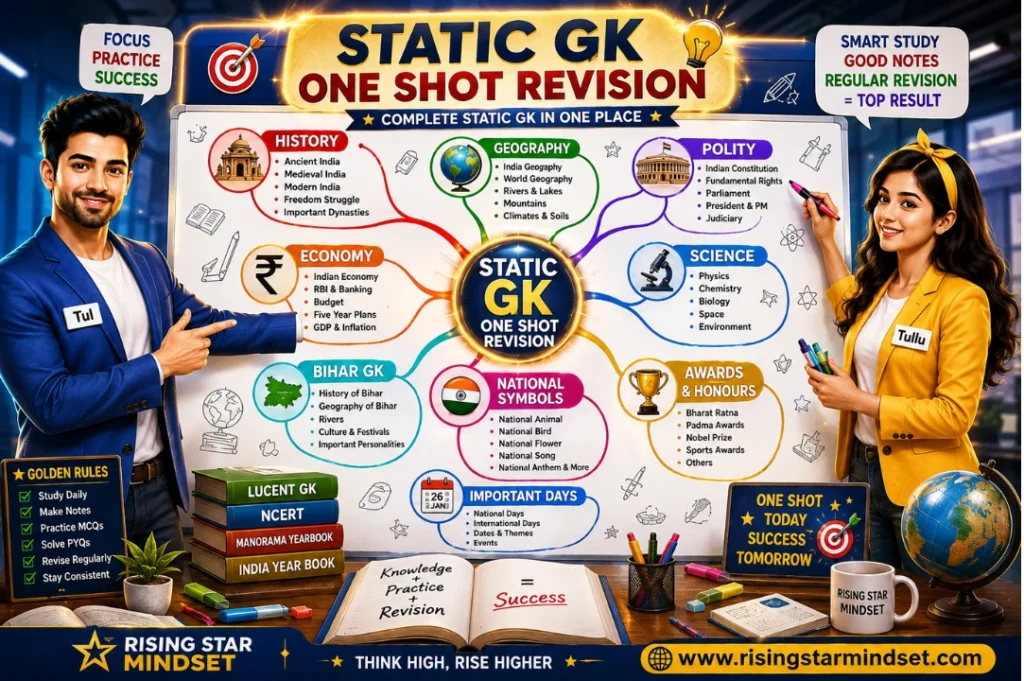
| Study one topic every day. |
| Revise yesterday’s topic before starting a new one |
| Solve at least 25 MCQs daily. |
| Read one page of short notes before sleeping |
| Revise every Sunday. |
| Solve one Mock Test every week. |
Study Resources ( Static GK for BPSC )
Recommended Books
- Lucent’s General Knowledge
- Arihant General Knowledge
- NCERT Books (Class 6–12)
- Bihar Special GK Books
- India Year Book (Selective Reading)
Online Resources
- PIB (Press Information Bureau)
- NCERT eBooks
- Government Reports
- Rising Star Mindset Static GK Series
Common Mistakes to Avoid ( Static GK for BPSC )
🇬🇧 English
- Studying without revision.
- Ignoring PYQs.
- Reading too many books at once.
- Memorizing without understanding.
- Skipping mock tests.
🇮🇳 हिन्दी
- Revision न करना।
- PYQs को नज़रअंदाज़ करना।
- एक साथ कई किताबें पढ़ना।
- समझे बिना रटना।
- Mock Tests छोड़ देना।
One Shot Static GK Checklist
| History | Sports |
| Geography | National Symbols |
| Polity | International Organizations |
| Economy | Important Days |
| Science | Books & Authors |
| Bihar GK | Practice MCQs |
| Environment | Solve PYQs |
| Awards | Weekly Revision |
Continue Your Learning Journey
इस Hub Post के बाद नीचे दिए गए Topic-wise Articles पढ़ें:
- Ancient Indian History for BPSC
- Medieval Indian History for BPSC
- Modern Indian History for BPSC
- Indian Geography for BPSC
- Indian Polity for BPSC
- Indian Economy for BPSC
- General Science for BPSC
- Bihar Special GK for BPSC
- Environment & Ecology for BPSC
- Static GK One Shot Revision
50 Important Static GK for BPSC Questions & Answers | महत्वपूर्ण प्रश्न एवं उत्तर
🇬🇧 English & 🇮🇳 हिन्दी
Q1. What is the Capital of India?
Answer: New Delhi
भारत की राजधानी क्या है?
उत्तर: नई दिल्ली
Q2. Who is known as the Father of the Indian Constitution?
Answer: Dr. B. R. Ambedkar
भारतीय संविधान के जनक कौन हैं?
उत्तर: डॉ. भीमराव अम्बेडकर
Q3. Which is the National Animal of India?
Answer: Bengal Tiger
भारत का राष्ट्रीय पशु कौन है?
उत्तर: बंगाल टाइगर
Q4. Which is the National Bird of India?
Answer: Peacock
Q5. Which river is known as the Ganga of South India?
Answer: Godavari
Q6. Largest State of India (Area)?
Answer: Rajasthan
Q7. Smallest State?
Answer: Goa
Q8. National Flower?
Answer: Lotus
Q9. National Tree?
Answer: Banyan Tree
Q10. National Anthem?
Answer: Jana Gana Mana
Q11. Which is the National Fruit of India?
Answer: Mango
भारत का राष्ट्रीय फल कौन-सा है?
उत्तर: आम (Mango)
Q12. Which is the National River of India?
Answer: Ganga
भारत की राष्ट्रीय नदी कौन-सी है?
उत्तर: गंगा
Q13. Which is the National Aquatic Animal of India?
Answer: Ganges River Dolphin
भारत का राष्ट्रीय जलीय जीव कौन-सा है?
उत्तर: गंगा डॉल्फिन
Q14. Which is the National Calendar of India?
Answer: Saka Calendar
भारत का राष्ट्रीय कैलेंडर कौन-सा है?
उत्तर: शक संवत
Q15. What is the Currency of India?
Answer: Indian Rupee (₹)
भारत की मुद्रा क्या है?
उत्तर: भारतीय रुपया (₹)
Q16. Which is the Largest State of India by Population?
Answer: Uttar Pradesh
जनसंख्या की दृष्टि से भारत का सबसे बड़ा राज्य कौन-सा है?
उत्तर: उत्तर प्रदेश
Q17. Which is the Largest Union Territory of India?
Answer: Ladakh (by area)
क्षेत्रफल की दृष्टि से सबसे बड़ा केंद्रशासित प्रदेश कौन-सा है?
उत्तर: लद्दाख
Q18. Which is the Smallest Union Territory of India?
Answer: Lakshadweep
भारत का सबसे छोटा केंद्रशासित प्रदेश कौन-सा है?
उत्तर: लक्षद्वीप
Q19. Which is the Highest Peak of India?
Answer: Kangchenjunga
भारत की सबसे ऊँची चोटी कौन-सी है?
उत्तर: कंचनजंघा
Q20. Which is the Longest River of India?
Answer: Ganga
भारत की सबसे लंबी नदी कौन-सी है?
उत्तर: गंगा
Q21. Which is the Largest Desert in India?
Answer: Thar Desert
भारत का सबसे बड़ा मरुस्थल कौन-सा है?
उत्तर: थार मरुस्थल
Q22. Which is the Largest Plateau of India?
Answer: Deccan Plateau
भारत का सबसे बड़ा पठार कौन-सा है?
उत्तर: दक्कन का पठार
Q23. Which is the Longest Dam in India?
Answer: Hirakud Dam
भारत का सबसे लंबा बाँध कौन-सा है?
उत्तर: हीराकुंड बाँध
Q24. Which is the Highest Dam in India?
Answer: Tehri Dam
भारत का सबसे ऊँचा बाँध कौन-सा है?
उत्तर: टिहरी बाँध
Q25. Which is the Largest Freshwater Lake in India?
Answer: Wular Lake
भारत की सबसे बड़ी मीठे पानी की झील कौन-सी है?
उत्तर: वुलर झील
Q26. Which is the Largest Saltwater Lake in India?
Answer: Chilika Lake
भारत की सबसे बड़ी खारे पानी की झील कौन-सी है?
उत्तर: चिल्का झील
Q27. Which is the Highest Waterfall in India?
Answer: Kunchikal Falls
भारत का सबसे ऊँचा जलप्रपात कौन-सा है?
उत्तर: कुंचिकल जलप्रपात
Q28. Which is the Longest National Highway in India?
Answer: NH-44
भारत का सबसे लंबा राष्ट्रीय राजमार्ग कौन-सा है?
उत्तर: राष्ट्रीय राजमार्ग-44
Q29. Which is the Largest Port of India?
Answer: Mumbai Port
भारत का सबसे बड़ा बंदरगाह कौन-सा है?
उत्तर: मुंबई बंदरगाह
Q30. Which is the Highest Civilian Award in India?
Answer: Bharat Ratna
भारत का सर्वोच्च नागरिक सम्मान कौन-सा है?
उत्तर: भारत रत्न
Q31. Who wrote the National Anthem of India?
Answer: Rabindranath Tagore
भारत का राष्ट्रगान किसने लिखा?
उत्तर: रवीन्द्रनाथ टैगोर
Q32. Who wrote the National Song “Vande Mataram”?
Answer: Bankim Chandra Chattopadhyay
‘वन्दे मातरम्’ किसने लिखा?
उत्तर: बंकिमचंद्र चट्टोपाध्याय
Q33. Which is the National Heritage Animal of India?
Answer: Indian Elephant
भारत का राष्ट्रीय विरासत पशु कौन-सा है?
उत्तर: भारतीय हाथी
Q34. Which is the National Reptile of India?
Answer: King Cobra
भारत का राष्ट्रीय सरीसृप कौन-सा है?
उत्तर: किंग कोबरा
Q35. Which is the National Vegetable of India?
Answer: There is no officially declared National Vegetable.
भारत की राष्ट्रीय सब्जी कौन-सी है?
उत्तर: भारत की कोई आधिकारिक राष्ट्रीय सब्जी घोषित नहीं की गई है।
Q36. Which is the National Heritage City of India?
Answer: Varanasi is one of India’s oldest heritage cities, but India has no officially declared single National Heritage City.
भारत का राष्ट्रीय विरासत शहर कौन-सा है?
उत्तर: भारत ने कोई एक आधिकारिक राष्ट्रीय विरासत शहर घोषित नहीं किया है।
Q37. Which is the Largest National Park in India?
Answer: Hemis National Park
भारत का सबसे बड़ा राष्ट्रीय उद्यान कौन-सा है?
उत्तर: हेमिस राष्ट्रीय उद्यान
Q38. Which is the Smallest National Park in India?
Answer: South Button National Park
भारत का सबसे छोटा राष्ट्रीय उद्यान कौन-सा है?
उत्तर: साउथ बटन राष्ट्रीय उद्यान
Q39. Which is the Largest Tiger Reserve in India?
Answer: Nagarjunsagar–Srisailam Tiger Reserve
भारत का सबसे बड़ा टाइगर रिजर्व कौन-सा है?
उत्तर: नागार्जुनसागर–श्रीशैलम टाइगर रिजर्व
Q40. Which is the First National Park of India?
Answer: Jim Corbett National Park
भारत का पहला राष्ट्रीय उद्यान कौन-सा है?
उत्तर: जिम कॉर्बेट राष्ट्रीय उद्यान
Q41. Which is the First Biosphere Reserve in India?
Answer: Nilgiri Biosphere Reserve
भारत का पहला बायोस्फीयर रिजर्व कौन-सा है?
उत्तर: नीलगिरि बायोस्फीयर रिजर्व
Q42. Which is the Highest Mountain Range in India?
Answer: Himalayas
भारत की सबसे ऊँची पर्वतमाला कौन-सी है?
उत्तर: हिमालय
Q43. Which is the Longest Tributary of the Ganga?
Answer: Yamuna
गंगा की सबसे लंबी सहायक नदी कौन-सी है?
उत्तर: यमुना
Q44. Which is the Longest River in South India?
Answer: Godavari
दक्षिण भारत की सबसे लंबी नदी कौन-सी है?
उत्तर: गोदावरी
Q45. Which is known as the “Silicon Valley of India”?
Answer: Bengaluru
भारत की ‘सिलिकॉन वैली’ किसे कहा जाता है?
उत्तर: बेंगलुरु
Q46. Which city is known as the Pink City?
Answer: Jaipur
पिंक सिटी किसे कहा जाता है?
उत्तर: जयपुर
Q47. Which city is known as the City of Lakes?
Answer: Udaipur
झीलों का शहर किसे कहा जाता है?
उत्तर: उदयपुर
Q48. Which city is known as the Manchester of India?
Answer: Ahmedabad
भारत का मैनचेस्टर किसे कहा जाता है?
उत्तर: अहमदाबाद
Q49. Which city is known as the Steel City of India?
Answer: Jamshedpur
भारत का इस्पात नगर किसे कहा जाता है?
उत्तर: जमशेदपुर
Q50. Which city is known as the Garden City of India?
Answer: Bengaluru
भारत का गार्डन सिटी किसे कहा जाता है?
उत्तर: बेंगलुरु
📌 अगले भाग में पढ़ें:
Static GK Part 1 – Ancient Indian History for BPSC
👉 इसी प्रकार Part 1, Part 2… में आगे आने वाले प्रत्येक Topic में 100–150 Questions दिए जाएंगे।
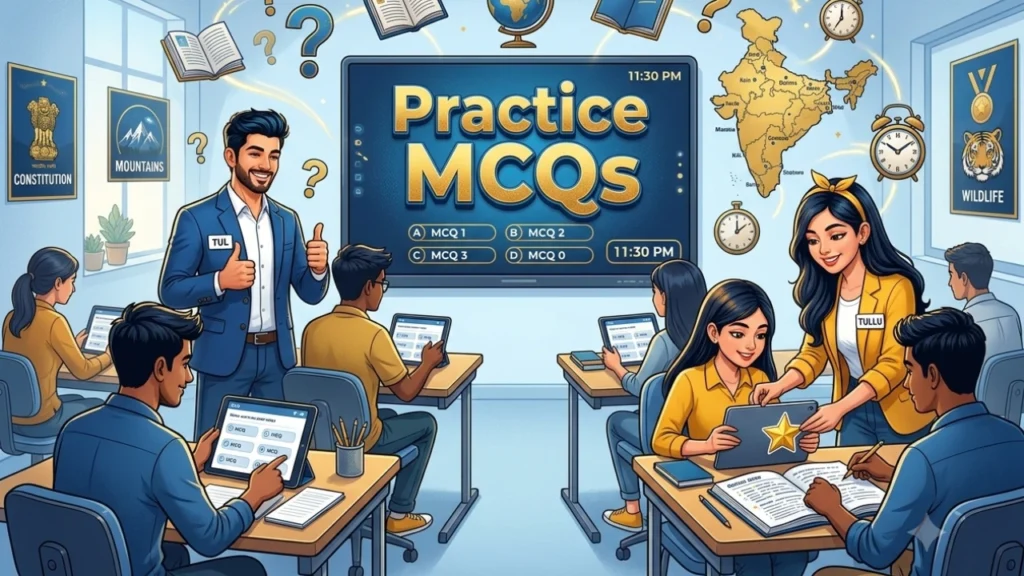
Practice MCQs ( Static GK for BPSC )
1.
Which is the National Animal of India?
A. Lion
B. Elephant
C. Bengal Tiger ✅
D. Leopard
2.
Capital of Bihar?
A. Muzaffarpur
B. Patna ✅
C. Gaya
D. Bhagalpur
3.
Indian Constitution came into force on—
A. 15 August 1947
B. 26 November 1949
C. 26 January 1950 ✅
D. 2 October 1950
4.
UNO Headquarters is situated in—
A. London
B. Geneva
C. New York ✅
D. Paris
5.
RBI was established in—
A. 1935 ✅
B. 1947
C. 1950
D. 1955
Previous Year Questions (PYQs) ( Static GK for BPSC )
BPSC PYQ
Father of Indian Constitution?
Answer:
Dr. B. R. Ambedkar
SSC PYQ
National Aquatic Animal of India?
Answer:
Ganges River Dolphin
Railway PYQ
Largest State of India?
Answer:
Rajasthan
UPSC PYQ
Capital of Bhutan?
Answer:
Thimphu
Bihar Police PYQ
National Song of India?
Answer:
Vande Mataram
Expected Questions (2026–27) ( Static GK for BPSC )
- Which Indian State has the longest coastline?
- UNESCO Headquarters?
- World Bank Headquarter?
- Highest Civilian Award?
- Largest Freshwater Lake?
- First Governor-General of Independent India?
- National Water Animal?
- Which river is called the Sorrow of Bihar?
- Longest Dam in India?
- Which State shares the longest border with Nepal?
- Which Indian State has the highest literacy rate?
- Largest Desert in India?
- First Woman Governor of India?
How This Series Will Help You? ( Static GK for BPSC )
English
This Static GK Series has been designed to help aspirants prepare systematically for competitive examinations. Moreover, every topic will include detailed notes, bilingual explanations, one-shot revision, MCQs, PYQs, expected questions, memory tricks, and practice sets. Therefore, by following this complete roadmap, you will gradually build a strong foundation in General Knowledge and improve your examination performance.
हिन्दी
यह Static GK Series प्रतियोगी परीक्षाओं की व्यवस्थित तैयारी के लिए तैयार की गई है। इसके अलावा, प्रत्येक विषय में विस्तृत नोट्स, हिन्दी एवं अंग्रेज़ी व्याख्या, One Shot Revision, MCQs, PYQs, Expected Questions, Memory Tricks तथा Practice Sets शामिल होंगे। इसलिए, यदि आप इस पूरी श्रृंखला का नियमित अध्ययन करेंगे, तो आपका सामान्य ज्ञान मजबूत होगा और परीक्षा में सफलता की संभावना बढ़ जाएगी।
Frequently Asked Questions (FAQs)
Q1. What is Static GK?
Static GK contains facts that generally remain unchanged for many years.
Static GK क्या है?
Static GK में ऐसे तथ्य शामिल होते हैं जो लंबे समय तक नहीं बदलते।
Q2. Which exams ask Static GK questions?
BPSC, UPSC, SSC, Railway, Banking, Bihar Police, CTET, STET, NDA, CDS and many other competitive exams.
Q3. Is Lucent GK sufficient?
Lucent is a very useful book; however, it should be supplemented with NCERTs, PYQs, and regular practice.
Q4. How much time should I devote daily?
30–60 minutes of focused study with revision is usually sufficient.
Q5. How often should I revise?
At least once every week, with a monthly one-shot revision.
Related Posts ( Static GK for BPSC )
Once the series is published, link the following articles here:
- Ancient Indian History for BPSC
- Medieval Indian History for BPSC
- Modern Indian History for BPSC
- Indian Geography for BPSC
- Important Indian Polity for BPSC
- Indian Economy for BPSC
- General Science for BPSC
- Bihar Special GK
- National Parks of India
- Rivers of India
- Important Days
- Awards & Honours
- Books & Authors
- International Organizations
- One Shot Static GK Revision

Conclusion | निष्कर्ष ( Static GK for BPSC )
🇬🇧 English
Static GK is one of the most reliable scoring areas in competitive examinations. Moreover, it does not require memorizing everything at once; instead, it demands consistent study, smart revision, and regular practice. Furthermore, by following a structured approach, solving MCQs, analyzing Previous Year Questions, and revising one-shot notes, you can improve both your speed and accuracy.
In addition, this complete Static GK Hub has been designed as the starting point of a comprehensive study series that will cover every important topic required for BPSC, UPSC, SSC, Railway, Banking, Bihar Police, CTET, STET, NDA, CDS, and other government examinations. Therefore, bookmark this guide, revisit it regularly, and use it as your central learning hub throughout your preparation journey. Finally, remember that consistency, revision, and disciplined practice are the real keys to success in any competitive examination.
🇮🇳 हिन्दी ( Static GK for BPSC )
Static GK प्रतियोगी परीक्षाओं का सबसे विश्वसनीय और अधिक अंक दिलाने वाला विषय है। इसके अलावा, इसमें एक साथ सब कुछ याद करने की आवश्यकता नहीं होती, बल्कि नियमित अध्ययन, सही रणनीति और निरंतर पुनरावृत्ति की आवश्यकता होती है। साथ ही, यदि आप टॉपिक-वाइज तैयारी करते हैं, MCQs का अभ्यास करते हैं, Previous Year Questions हल करते हैं और One Shot Revision करते हैं, तो आपकी गति और सटीकता दोनों में निरंतर सुधार होगा।
इसके अतिरिक्त, यह Hub Post पूरी Static GK Series का प्रारंभिक मार्गदर्शक है, जिसके माध्यम से BPSC, UPSC, SSC, Railway, Banking, Bihar Police, CTET, STET, NDA, CDS तथा अन्य सरकारी परीक्षाओं के सभी महत्वपूर्ण विषयों को विस्तार से कवर किया जाएगा। इसलिए, इस पोस्ट को अपने अध्ययन का मुख्य केंद्र बनाइए, इसे नियमित रूप से पढ़िए और प्रत्येक नए Part के साथ अपनी तैयारी को मजबूत बनाइए। अंततः, याद रखें कि निरंतर अभ्यास, सही दिशा और आत्मविश्वास ही सफलता की सबसे मजबूत नींव हैं।
📢 Call to Action ( Static GK for BPSC )
📚 Continue Your Static GK Journey with Rising Star Mindset
If you found this guide helpful, don’t stop here! Explore the complete Static GK for BPSC Series on www.risingstarmindset.com. Each upcoming article is designed with detailed notes, bilingual explanations (English & Hindi), tables, MCQs, PYQs, expected questions, one-shot revision, and exam-oriented practice to help you succeed in BPSC and other competitive examinations.
⭐ Start with: Static GK Part 1 – Ancient Indian History for BPSC
🌟 Keep Learning with Rising Star Mindset
📘 Spoken English Course
🏛️ BPSC Preparation
🎓 School Notes
💡 Daily Motivation
🌐 Website: www.risingstarmindset.com